Snapshots: Prague

We spent the week before and just after Christmas in Prague and Istanbul this year. In recent years, we’ve found that we like traveling during the cold-weather months, when the streets, museums, and restaurants are so much less crowded.

I loved the low, slightly hazy light in both cities (OK, I live near the equator the rest of the time).  And although the temperatures were between about 27°F and 40°F  (-3°C to 4°C), there was practically no wind and no rain or snow.  Maybe we were very lucky, but honestly, I’ve been colder in Amsterdam in July.

Below are some snapshots and a few travel tips for Prague.  Do not adjust your set:  with some pictures I got a bit carried away with the ‘Effects’ buttons on iPhoto.

This slideshow requires JavaScript.

(If you want to scroll through larger versions of the images, click on ‘Continue reading’ below and then on any of the thumbnails in the gallery.)

At the airport, just before you exit for the bus area, you will find a booth selling public transportation tickets.  We bought 3-day passes for about $15 each. They allowed us unlimited use of the metro (subway), bus, and tram lines.

If you like, you can take the 119 bus from the airport to the end of its line at Dejvicka (about 30 minutes) and then transfer to the green metro A  line.  (You could also buy tickets on a private bus line that will take you to any hotel in the Old City area.)

We stayed at the Courtyard Marriot (collecting points), which was not very atmospheric, but comfortable and the staff were friendly.  The hotel is in the neighborhood of Zizkov and is very convenient to the green metro line and tram lines to the Old City.

It is also near the huge and interesting Olšany Cemetery (1680 to today) — which you will find if you accidently walk in the opposite direction of the Old City, which we did first thing for about a half mile.

For some reason, we never chose the right direction in Prague, and we were lost just about every minute in the Old City and the Mala Strana.  This was not very important as those parts of the city are relatively small.  Eventually, we would stumble over the right tram line (and then take it going the wrong way).

(If the Prague tourism office is reading: “you are here” maps placed on the streets about every 5 or 6 blocks would be great.)

English is widely spoken in the parts of Prague where a visitor is likely to be, and there are signs in English everywhere.

We just wanted to wander around for two days enjoying the old architecture and the Christmas markets,* so the only museum we visited was the Prague City Museum.  My husband wanted to see the 19th century model of the city, which was remarkable — especially because they show a short 3D  movie where the camera “flies” over the town.  It’s a rather sleepy attraction, but I loved it.

The Czech food we ate was, well, filling.  Our meals consisted of a big piece of pork or duck, braised cabbage (very good), and potato and bread dumplings. Bread dumplings are really just steamed white bread.  The potato dumplings were something like gnocchi.  I can’t recommend any particular restaurants.

There were classical music concerts in churches all over the Old City.  We went two nights in a row to the 12th century St. Martin in the Wall Church to listen to, first, organ and violin and a soprano and, then, a string quartet.  The 5:00 p.m., one-hour performances were of a very high quality for about $25/ticket. Brochures** about these concerts are available all over town and at hotels.

There is a little more on the sidewalks of Prague here.

Next:  Istanbul.


* I bought small, 1″ to 2″ traditional Czech glass ornaments for about $2.50 to $3 each; they all made it home intact.

** The venue was advertised as “heated.”  I would say the translator did not fully understand the word.  We kept our coats on but were happy nonetheless.
Continue reading “Snapshots: Prague”

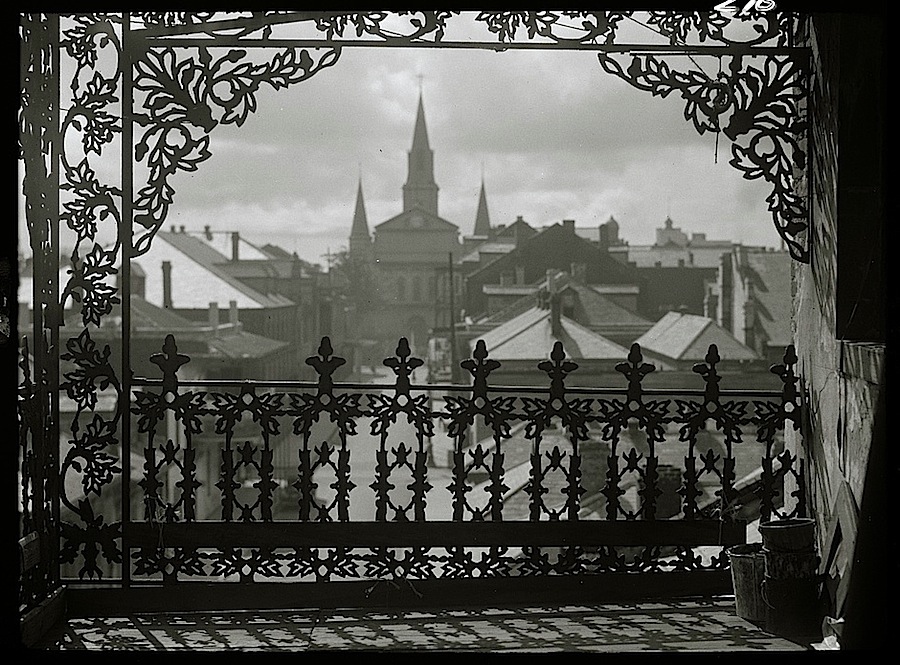
The Sunday porch: iron lace

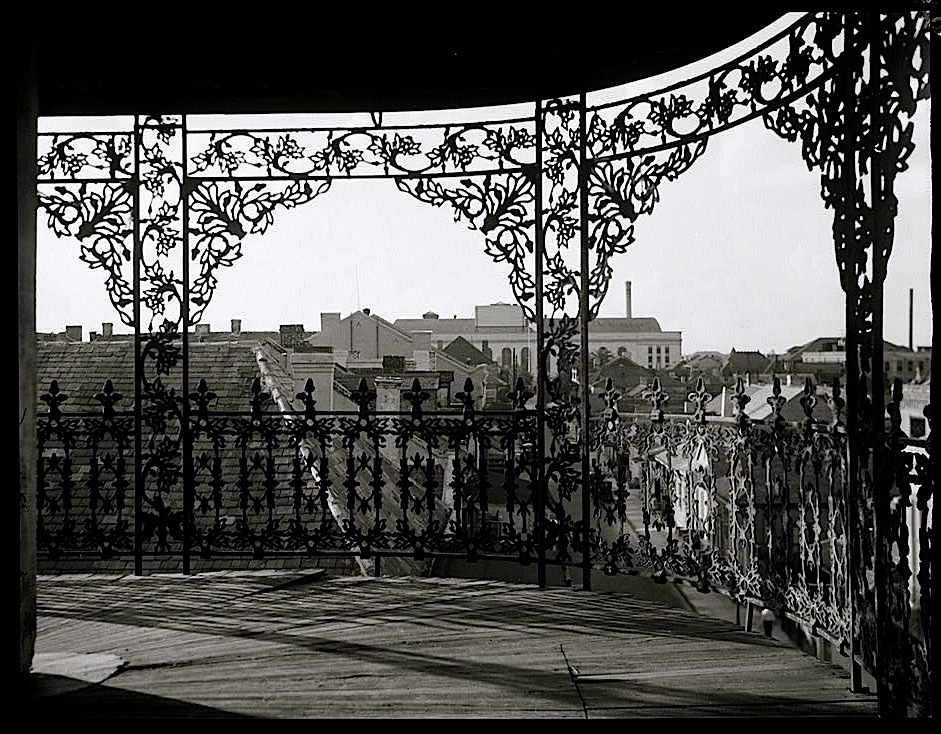
The Sunday porch/enclos*ure: iron lace in New Orleans“A vista through iron lace, New Orleans,” ca. 1920-26, by Arnold Genthe, via Library of Congress Prints and Photographs Division.

This is a covered third floor balcony, and it has a wonderful view of the back of St. Louis Cathedral in the French Quarter.

The 1836 house still stands* — wrought iron intact — at 716 Orleans Street. It is now light pink with dark green shutters and is known as the Le Pretre Mansion, for one of its first owners.

It was on the market as recently as this past April — for $2.65 million.  Here’s a 1937 photo of the entire house.

An exotic horror/ghost story goes with the mansion:

In the 19th century, a Turk, supposedly the brother of a sultan, arrived in New Orleans and rented the house. He was conspicuously wealthy, with an entourage of servants and beautiful young girls — all thought to have been stolen from the sultan.

Rumors quickly spread about the situation, even as the home became the scene of lavish high-society parties. One night screams came from inside; the next morning, neighbors entered to find the tenant and the young beauties lying dead in a pool of blood. The mystery remains unsolved. Local ghost experts say you can sometimes hear exotic music and piercing shrieks.

— “Walking Tour in New Orleans,” Frommer’s(.com)

The Sunday porch/enclos*ure: iron lace in New OrleansThe view above, from the same balcony, looking northeast on Orleans Street, was photographed in 1936, by Richard Koch for a Historic American Buildings Survey, via Library of Congress Prints and Photographs Division.

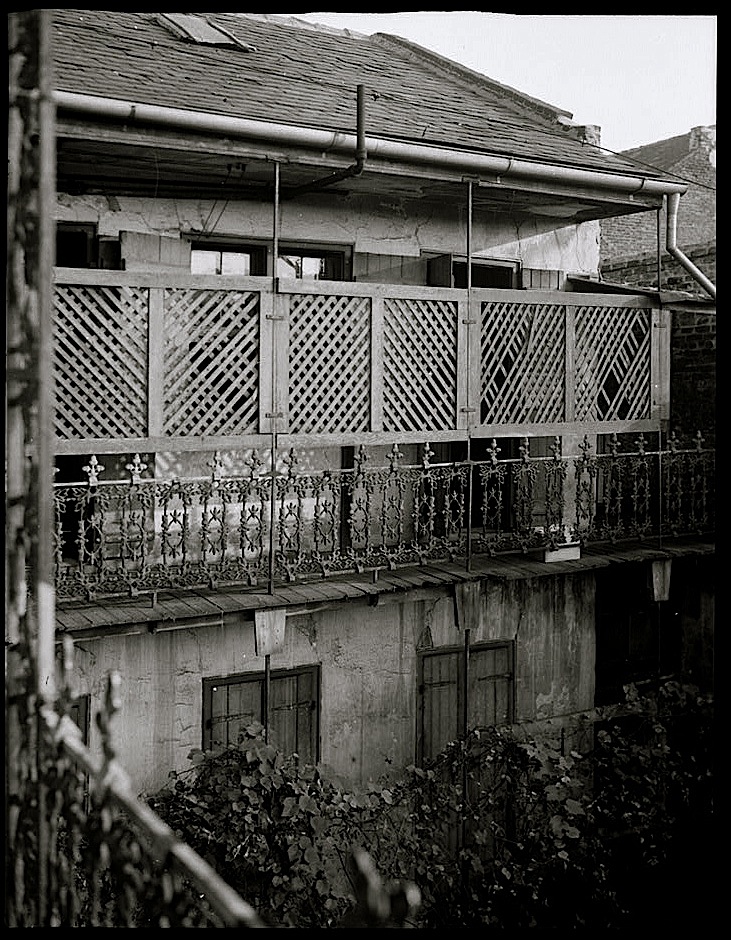
The Sunday porch/enclos*ure: iron lace in New OrleansThis privacy panel along the second floor balcony of the service wing, overlooking the courtyard, is interesting too. Photo also by Richard Koch for HABS.

A little Heaven in Kigali

I was really taken with the cover of Josh Ruxin’s recent book, A Thousand Hills to Heaven.  The illustration by Emily Robertson depicts a table set for two in an idealized garden setting among the patchwork fields of Rwanda.

A Thousand Hills to Heaven

Inside, the book is a thoughtful and engaging memoir of expat life and development work.

The actual restaurant, Heaven, which was created by Alissa Ruxin,  Josh’s wife, is one of our favorites.  Of course it’s not in the fields, but in a leafy old Kigali neighborhood, in a building completely open to the view on two sides and shaded by old ficus trees.

We had Thankgiving dinner there, and you can see pictures of that evening and read more about the book here, on The Atlantic’s website.

The Sunday porch: Georgia

While he was a professor of sociology at Atlanta University, W. E. B. Du Bois compiled 363 photographs of African American life in Georgia into several albums — which he displayed at the 1900 Paris Exposition Universelle.

The pictures* here, taken in 1899 or 1900, were part of his collection. Click on any thumbnail in the gallery to scroll through larger photos.

Du Bois’s exhibited albums particularly featured middle-class African Americans and their homes and institutions, and dozens of fine individual portraits were included.

“The photographs of affluent young African American men and women challenged the scientific ‘evidence’ and popular racist caricatures of the day that ridiculed and sought to diminish African American social and economic success,” according to the Library of Congress’s online catalogue.

In 2003, the Library of Congress published a book of 150 of the images, entitled A Small Nation of People.  You can listen to a good NPR interview with its co-author, historian Deborah Willis, here.  In it, she mentions porches being photographed for the exhibit, as places “central to family gatherings.”


*All via Library of Congress Prints and Photographs Division.

The winter garden: Illinois farmhouse

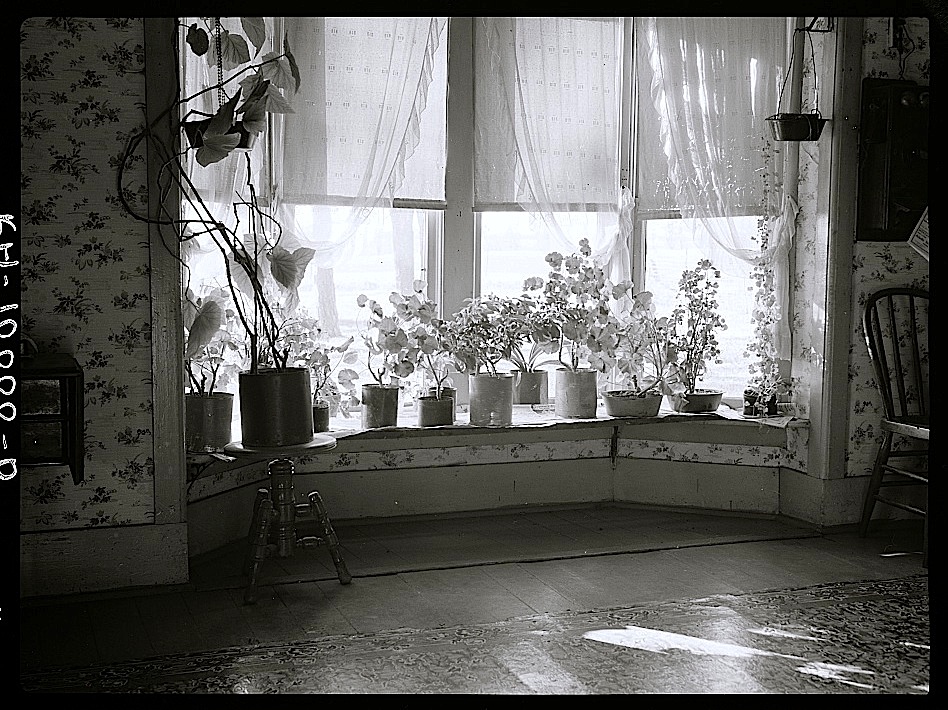
The winter garden/enclos*ure: farmhouse living room, Mercer County, Illinois, November 1936, by Russell Lee, via Library of Congress“Window of farmhouse living room. Mercer County, Illinois. Hired man lives in house on farm which was formerly residence of owner-operator,” November 1936.  Photo and caption by Russell Lee, via Library of Congress Prints and Photographs Division.

This slideshow requires JavaScript.

Another winter garden is here.

Let me go to the window,
Watch there the day-shapes of dusk
And wait and know the coming
Of a little love.

— Carl Sandburg, from “At a Window