Vintage landscape: country home

Country Home, 1904, Library of Congress“Bird’s-eye view of a new home in the country, with formal and vegetable gardens, carriage house, windmill, and farm animals,” ca. 1904, by H.M. Smyth Printing Company (Saint Paul, Minnesota), via Library of Congress Prints and Photographs Division.
Early 20th century farmhouse chic, only $$2,500.

Detail, The Country Home
Detail

I’m wondering about the white shapes in rows to the right of the house. What are they? Beehives?

Frozen in vines

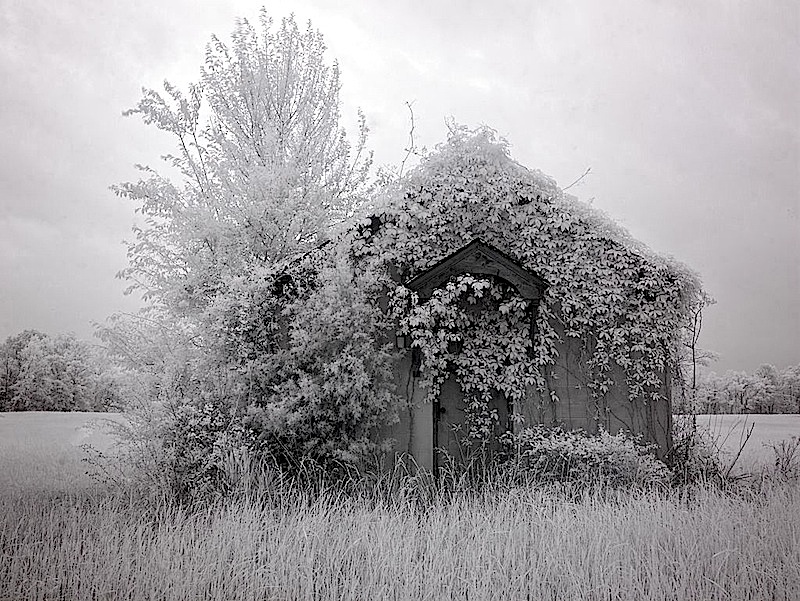
C. Highsmith cabin with vines, LoC 2Monroe County, Alabama, May 2010, by Carol M. Highsmith, via The George F. Landegger Collection of Alabama Photographs in Carol M. Highsmith’s America, Library of Congress Prints and Photographs Division.
The infrared treatment of the late spring scene gives it a wintery appearance.

Highsmith has specialized in photographing America’s architectural heritage. She has donated the rights to her work to the Library of Congress for copyright free access for all.

The winter garden: red cactus

Red Cactus, Preus Museum on flickrRød kaktus,” between late 19th c. and 1933, by Inga Breder, via Preus Museum Commons on flickr.

The small Schlumbergera genus of plants is native to the coastal mountains  of southeast Brazil.  By 1860, a number of its cultivars were being sold in England for indoor winter color.

Today, they are commonly called Christmas cactus — or Cacto de Navidad (Spanish), Cactus de Noël (French), and Weihnachtskaktus (German).

The photographer, Inga Breder, was born in Bodø, Norway, in 1855. As an adult she lived in Oslo and became an amateur photographer, competing in and judging competitions.

Merry Christmas!

Gathering the waters

This slideshow requires JavaScript.

Whenever we have visited Portland, Oregon — as we did this October –I have made a point of spending some time in the Ira Keller Fountain Park.

The fountain was designed by Angela Danadjieva and Lawrence Halprin in 1968, as part of the Portland Open Space Sequence.

“This new type of people’s park, where nature is abstracted with a geometric naturalism, was based on Halprin’s studies of the High Sierra’s spring cascades,” according to The Cultural Landscape Foundation.

At the time of the park’s opening in 1970, New York Times architecture critic Ada Louise Huxtable said it “may be one of the most important urban spaces since the Renaissance,” and she compared it to the Piazza Navona and the Trevi Fountain.

.   .   .  At the forest’s
edge, where the child sleeps, the waters gather—
as if a hand were reaching for the curtain
to drop across the glowing, lit tableau.

Eleanor Wilner, from “Reading the Bible Backward

Continue reading “Gathering the waters”

Vintage landscape: Penasco gate

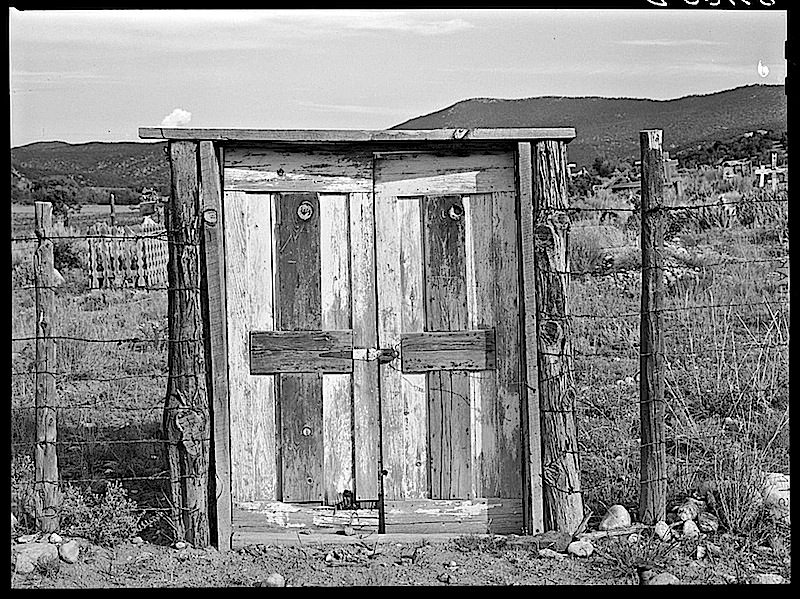
Cemetary gate, New Mexico, Library of Congress“Entrance to the cemetery at Peñasco, New Mexico (along the High Road to Taos), July 1940, by Russell Lee, via Library of Congress Prints and Photographs Division.

Lee and his wife, Jean, spent two weeks in Chamisal and Peñasco documenting the lives of the towns’ Hispanic small farmers and ranchers. The area was settled by Spanish colonists in the late 18th century.

Hark, hark! the lark at heaven’s gate sings…

— William Shakespeare, from Cymbeline