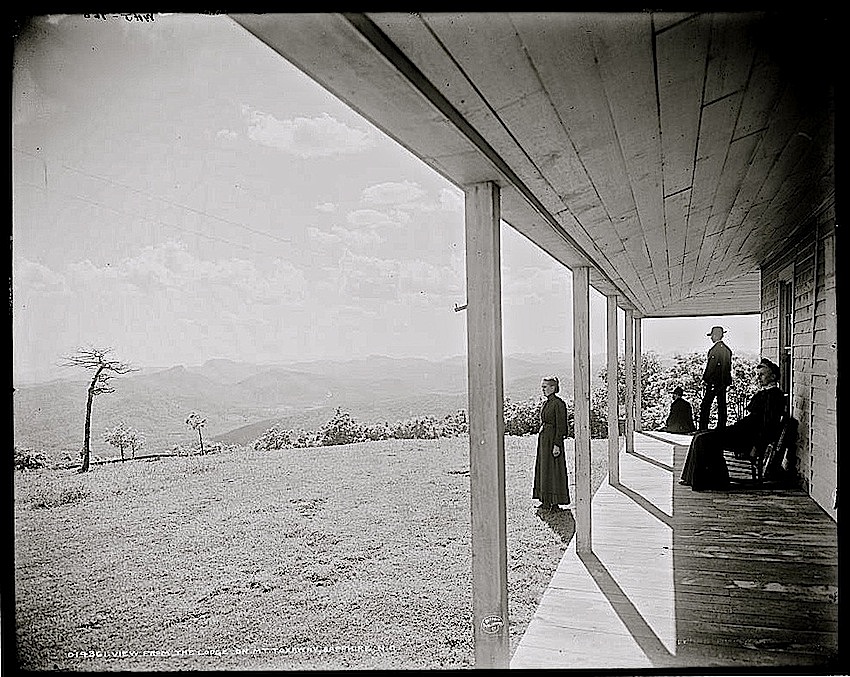
The Sunday porch: Mount Toxaway

2 The Sunday porch:enclos*ure -- Lake Toxaway, c. 1902, Library of CongressThe Lodge on Mount Toxaway, Sapphire, North Carolina, ca. 1902, by William Henry Jacksonvia Library of Congress Prints and Photographs Division (all photos here).

The Lodge was part of the Toxaway System of Hotels, created by a group of Pittsburgh entrepreneurs who began to built resorts in the Sapphire area in the 1890s.

By 1903, they had dammed the Toxaway River — creating the 640-acre artificial Lake Toxaway — and constructed the luxurious 500-guest Toxaway Inn.  After 1904, when the Southern Railroad opened a depot on the lake, the area was known as “Switzerland of America.”

1 The Sunday porch:enclos*ure -- Lake Toxaway, c. 1902, Library of Congress

The Lodge was presented in a 1905  company brochure as a “nature kindergarten” for “children of the city” to learn about trees, flowers, and birds. Farm animals and poultry were also available for study.
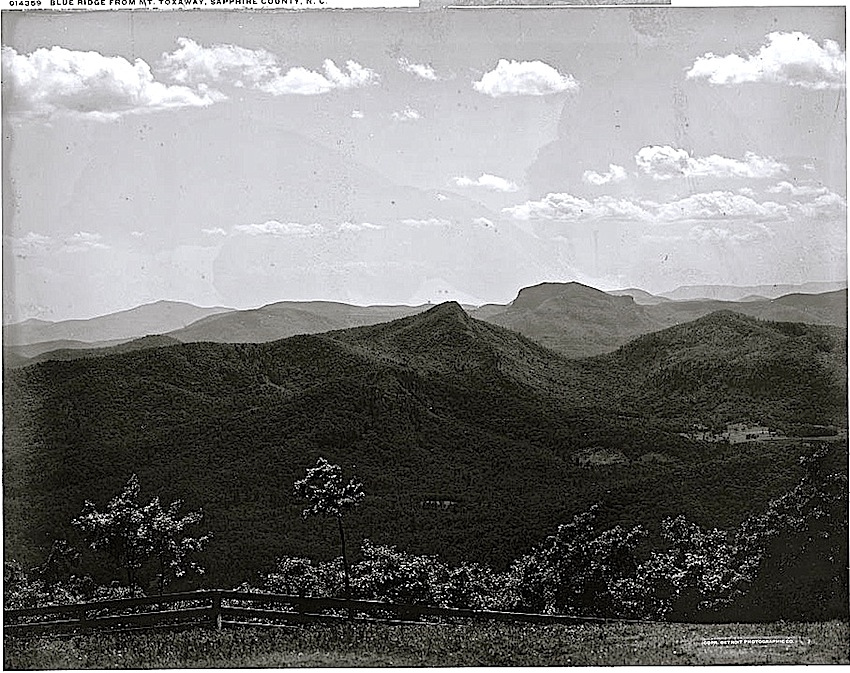
4 The Sunday porch:enclos*ure -- Lake Toxaway, c. 1902, Library of Congress

At an altitude of over 4,500 ft., the views from the wrap-around porch and the lookout tower were particularly good. Guests from the other Toxaway hotels would spend the night in the house to see the sunrise or sunset over the mountains.

It was also used as a hunting retreat for wealthy industrialists.
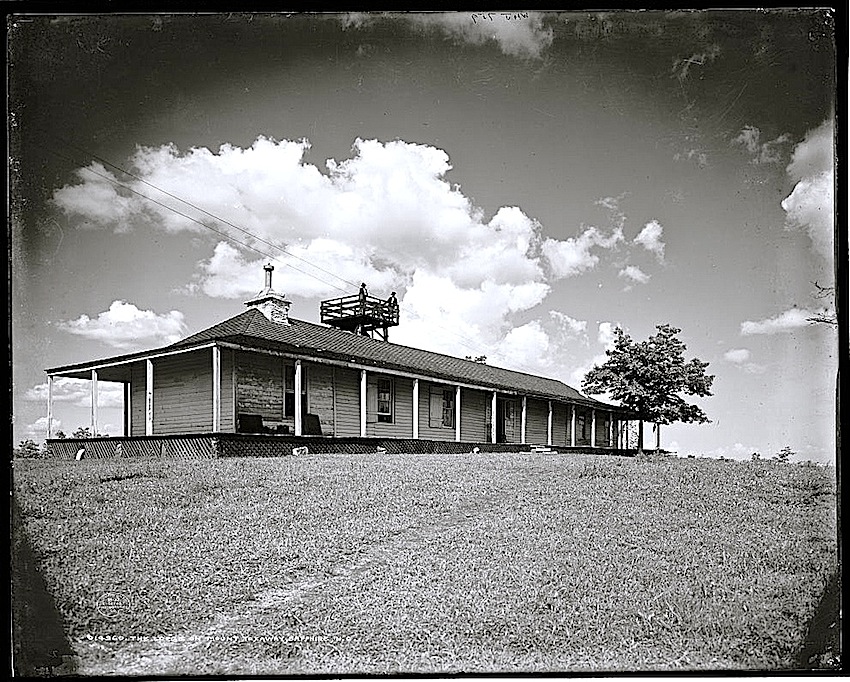
3 The Sunday porch:enclos*ure -- Lake Toxaway, c. 1902, Library of Congress

The Lodge no longer exists — although it  was still there in 1920, four years after severe flooding caused the company’s dam to burst. (Some homes were destroyed, but only a mule perished.)

Lake Toxaway disappeared, and the Toxaway Inn emptied out as well. It never re-opened after 1916 and was demolished in 1947.

In the early 1960s, another group of investors rebuilt the dam. The lake re-filled, and a golf club and hotel were opened. The property around what was once The Lodge is now  Preserve at Rock Creek, an “exclusive” real estate development.

To scroll through larger version of the photos, click on ‘Continue reading’ below and then on any thumbnail in the gallery.

My mind was once the true survey
Of all these meadows fresh and gay,
And in the greenness of the grass
Did see its hopes as in a glass. . .

— Andrew Marvell, from “The Mower’s Song

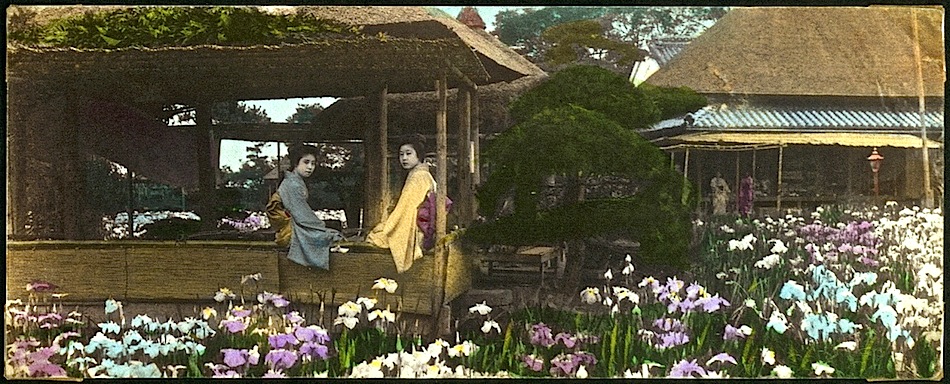
The Sunday porch: irises

Japanese Iris GardenTwo women in a pavilion overlooking irises in Japan, between 1860 and 1910.

Japanese Iris Garden, cropped 1
Detail of photo above.

This hand-colored photograph comes from the National Museum of Denmark Commons on flickr — part of a collection that belonged to journalist Holger Rosenberg.

Unfortunately, the museum does not have any additional information about it.

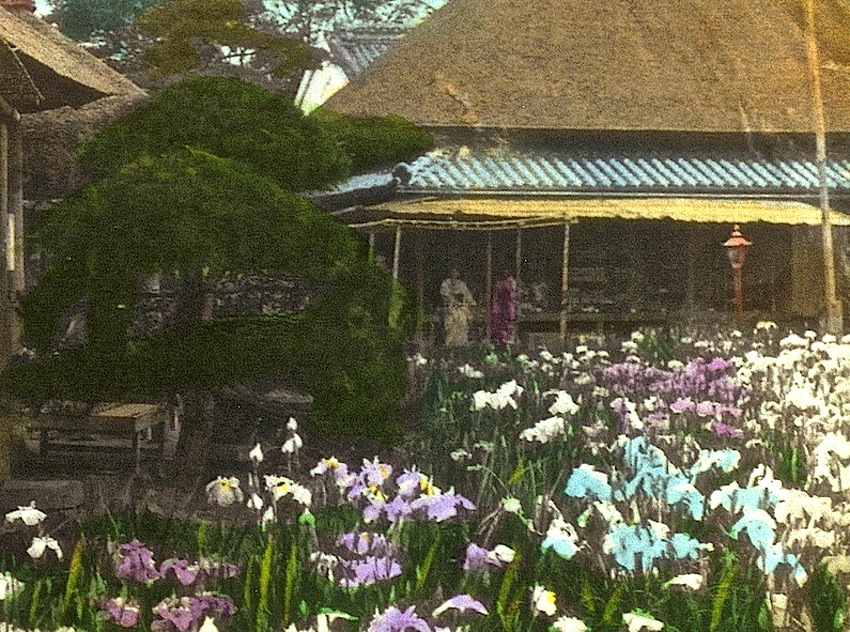
Japanese Iris Garden, cropped 2
Detail of top photo. The flowers are probably growing in slightly sunken, wet or damp ground.

In Heian Period [794 -1185] Japanese gardens, built in the Chinese model, buildings occupied as much or more space than the garden. The garden was designed to be seen from the main building and its verandas, or from small pavilions built for that purpose. In later gardens, the buildings were less visible. Rustic teahouses were hidden in their own little gardens, and small benches and open pavilions along the garden paths provided places for rest and contemplation. In later garden architecture, walls of houses and teahouses could be opened to provide carefully framed views of the garden. The garden and the house became one.

— “Japanese garden,” Wikipedia

Click here to see all the Museum’s online photos of Japanese landscapes (and some wonderful kimonos).

There’s also a 1913 Japanese iris garden in East Hampton, N.Y., here.

To scroll through larger versions of these images, click on ‘Continue reading’ below and then on any thumbnail in the gallery.

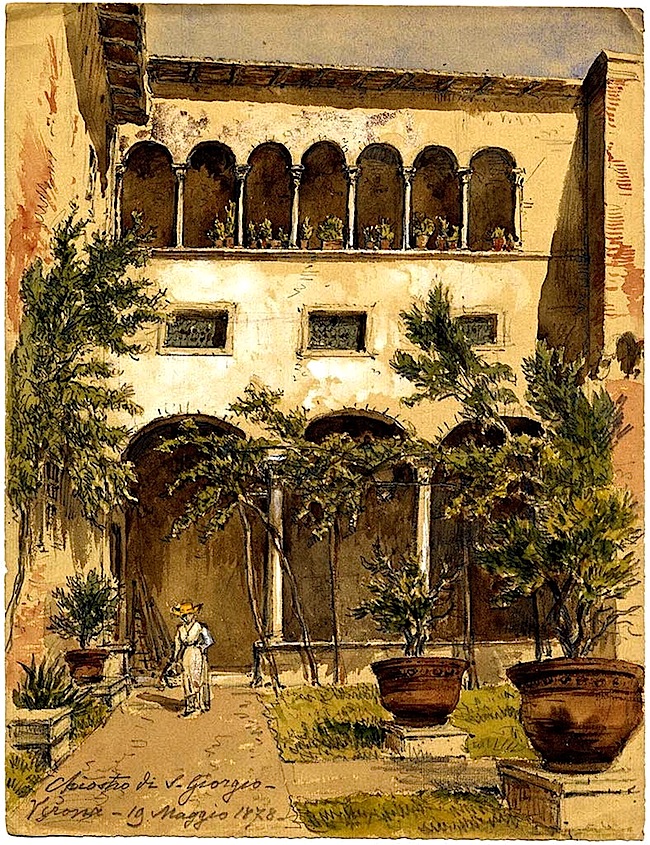
Vintage landscape: Verona, Italy

Watercolor of Italian courtyard, Natl. Archives of EstoniaSan Giorgio cloister, Verona, Italy, May 19, 1878, via National Archives of Estonia Commons on flickr.

The watercolor is one of many Italian scenes collected (perhaps painted?) by a Baroness Meyendorff in the 1870s and early 1880s.

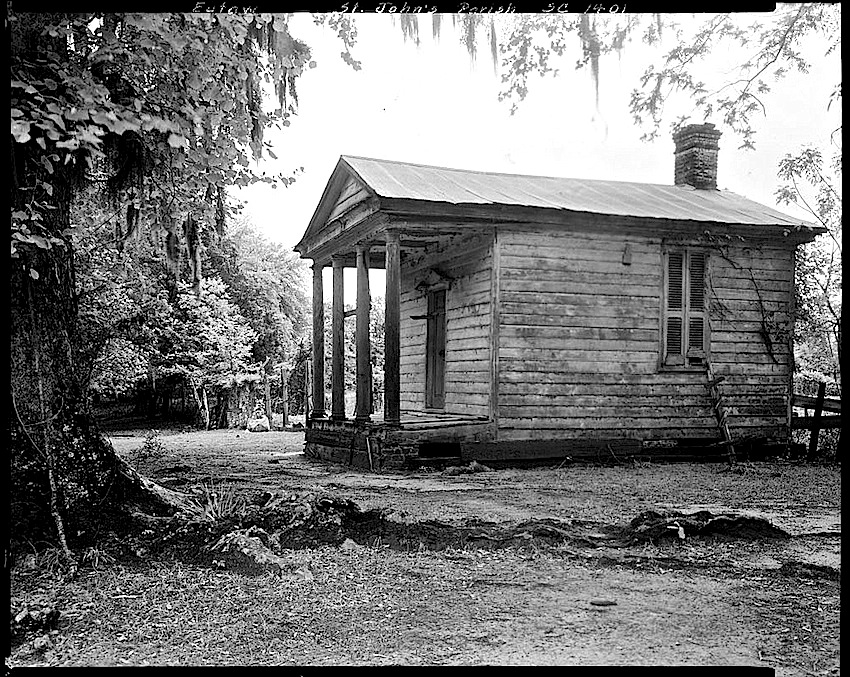
The Sunday porch: Eutaw

Eutaw, S.C., 1938, Library of Congress“The Lodge” at Eutaw Plantation, Berkeley County, South Carolina, 1938, by Frances Benjamin Johnston, via Library of Congress Prints and Photographs Division.

Eutaw Plantation, South Carolina, 1938, via Library of Congress
The plantation was established by William and Elizabeth Sinkler in the early 1800s.  Their descendants owned it until the 1940s, when the South Carolina Public Service Authority flooded the area to build the Santee Cooper hydroelectric project.  The estate now lies beneath Lake Marion.

The Lodge — built to resemble a Greek temple — was used as a medical office by a physician member of the family.

I came to explore the wreck. . . .
I came to see the damage that was done
and the treasures that prevail.

Adrienne Rich, from “Diving into the Wreck

The Sunday porch: wisteria par excellence

In honor of the wisteria now beginning to bloom in many regions, here is a Sunday porch redux from 2013:

On abandon, uncalled for but called forth. . . .*

full cropped

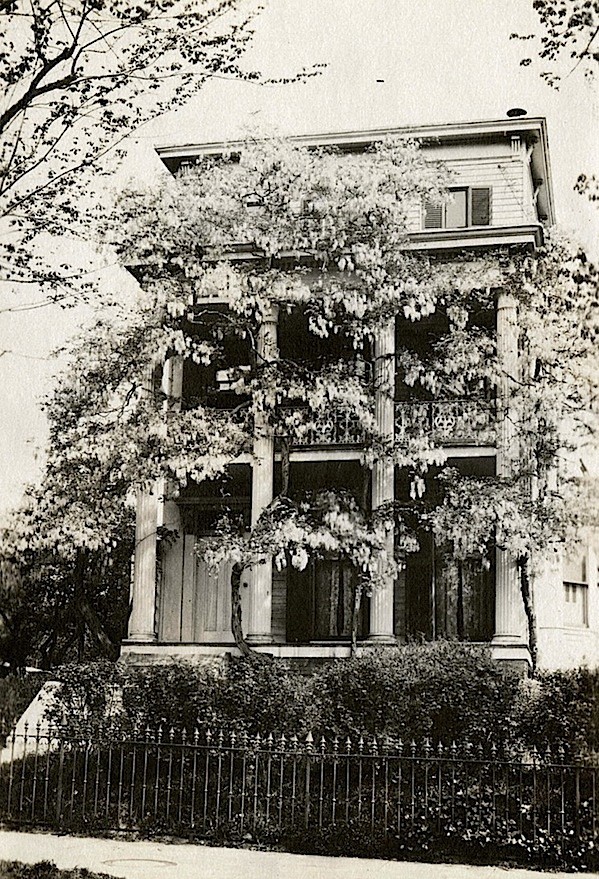
I think this is the loveliest wisteria I have ever seen.  It grew on the porch columns of “Wisteria House,” at Massachusetts Avenue and Eleventh Street, N.W., in Washington, D.C. The photo was taken in 1919, by Martin A. Gruber.**

The house was torn down in 1924 to make room for the Wisteria Mansion apartment building.

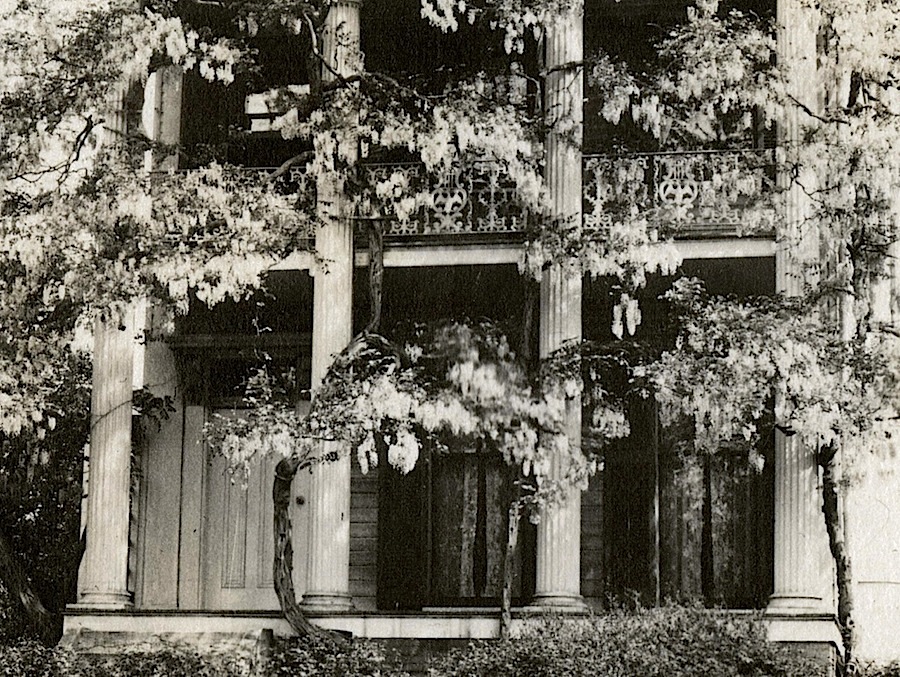
Wisteria House detail, 1919, via Smithsonian Institution Commons

A naval officer brought the vine from China and gave it to the owner of the house, probably during the 1860s, according to the blog Greater Greater Washington.

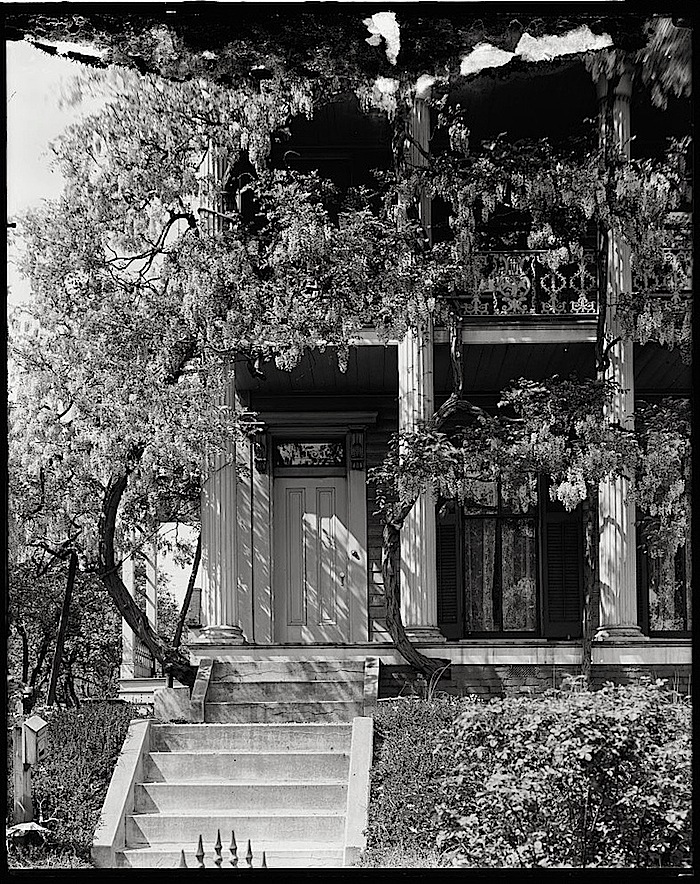
Wisteria House, Harris & Ewing photo

The Harris & Ewing** photo above, taken between 1910 and 1920, shows the trunks of the (one?) plant emerging through openings at the base of the porch.  The house was built in 1863, and the two-story portico was added in 1869 — so it looks like the wisteria was planted between those years and protected during the construction.

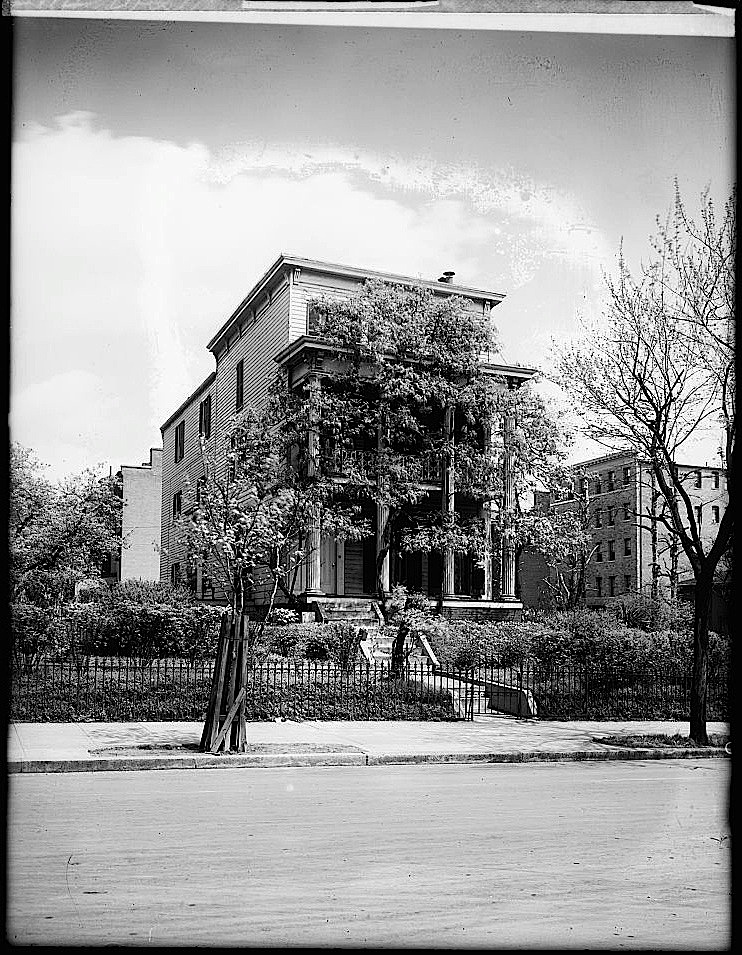
Wisteria House, LOC photo

The National Photo Company image above shows the house about 1920.

*Lucie Brock-Broido, from “Extreme Wisteria

**Top and second (a detail of the first) photos via the Smithsonian Institution Archives Commons on flickr.  Third and fourth photos via Library of Congress Prints and Photographs Division.