Bird’s eye landscape

A recent visit to the Virunga Safari Lodge in the north of Rwanda made me think of Russell Page’s book, The Education of a Gardener, and his words on handling a hilltop site with a view.

About halfway up the nearest volcano, you can see the line between cultivated fields and the park, where the mountain gorillas live protected.

The Lodge –near the Parc National des Volcans and the famous mountain gorillas — has extraordinary views. Guests can see two lakes and several volcanoes.  But Page wrote that such a location is not ideal for the gardener.

“If I were to choose a site for a garden for myself,” he wrote, “I would prefer a hollow to a hilltop.  A panorama and a garden seen together distract from each other.  One’s interest is torn between the garden pattern with its shapes and colors in the foreground and the excitement of the distant view.  Everything is there at once and one has no desire to wander to make discoveries. . . .”

If, however, one does have to have a view, he advised: “Above all avoid any garden ‘design’ or any flower color which might detract from the main theme, which in such a case must be the view. . . . If there must be flowers they should be close against the house or below a terrace wall and so only visible when you turn your back to the view.  I would arrange the gardened part of the garden — flowers and shrubs — to the sides or far enough below, so that they and the view are not seen at the same time.”
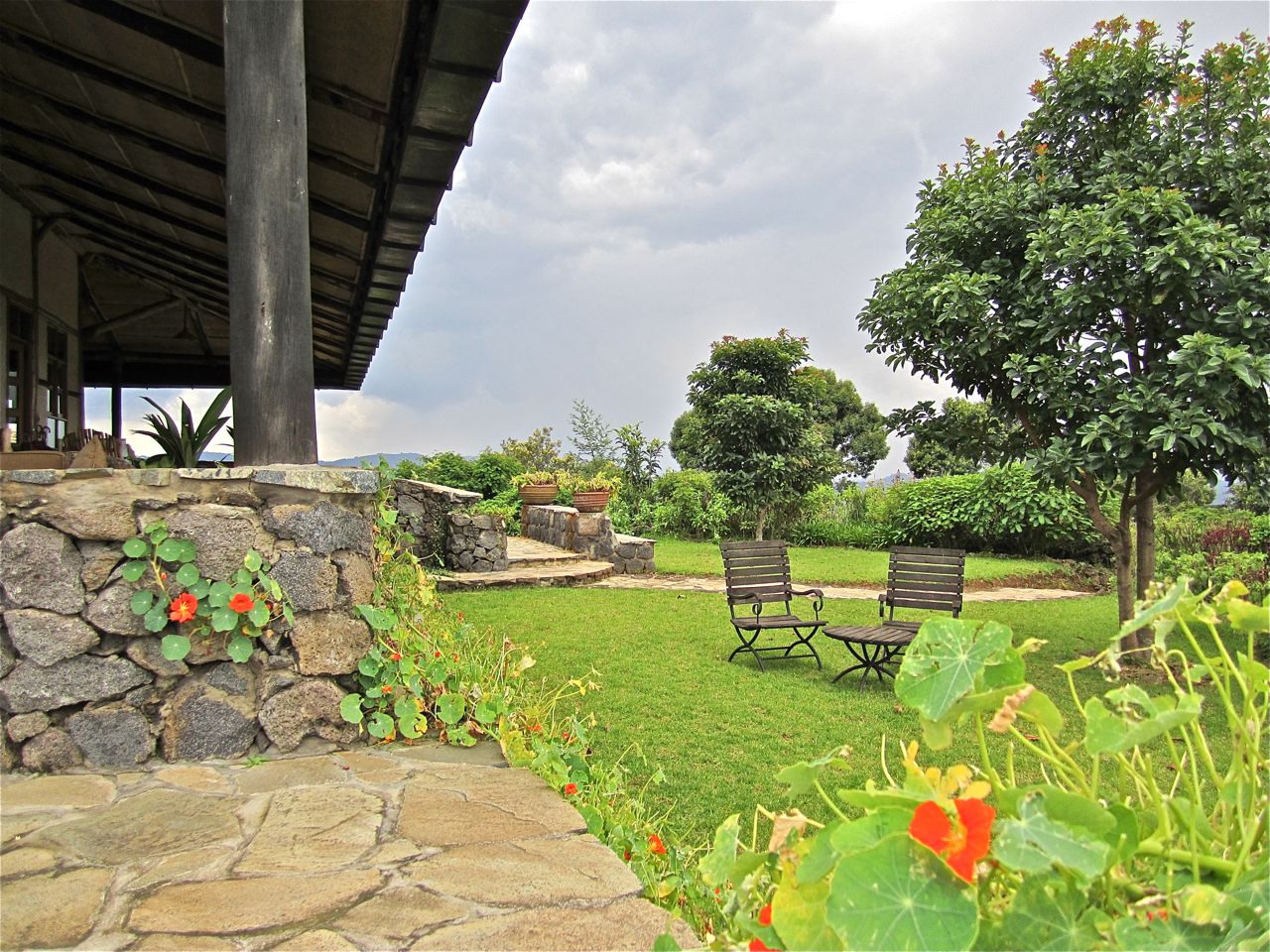
Landscaping around the dining hall and lounge is simple.

The landscape designer for Virunga Lodge seems to have worked right from the book, with beautiful results.
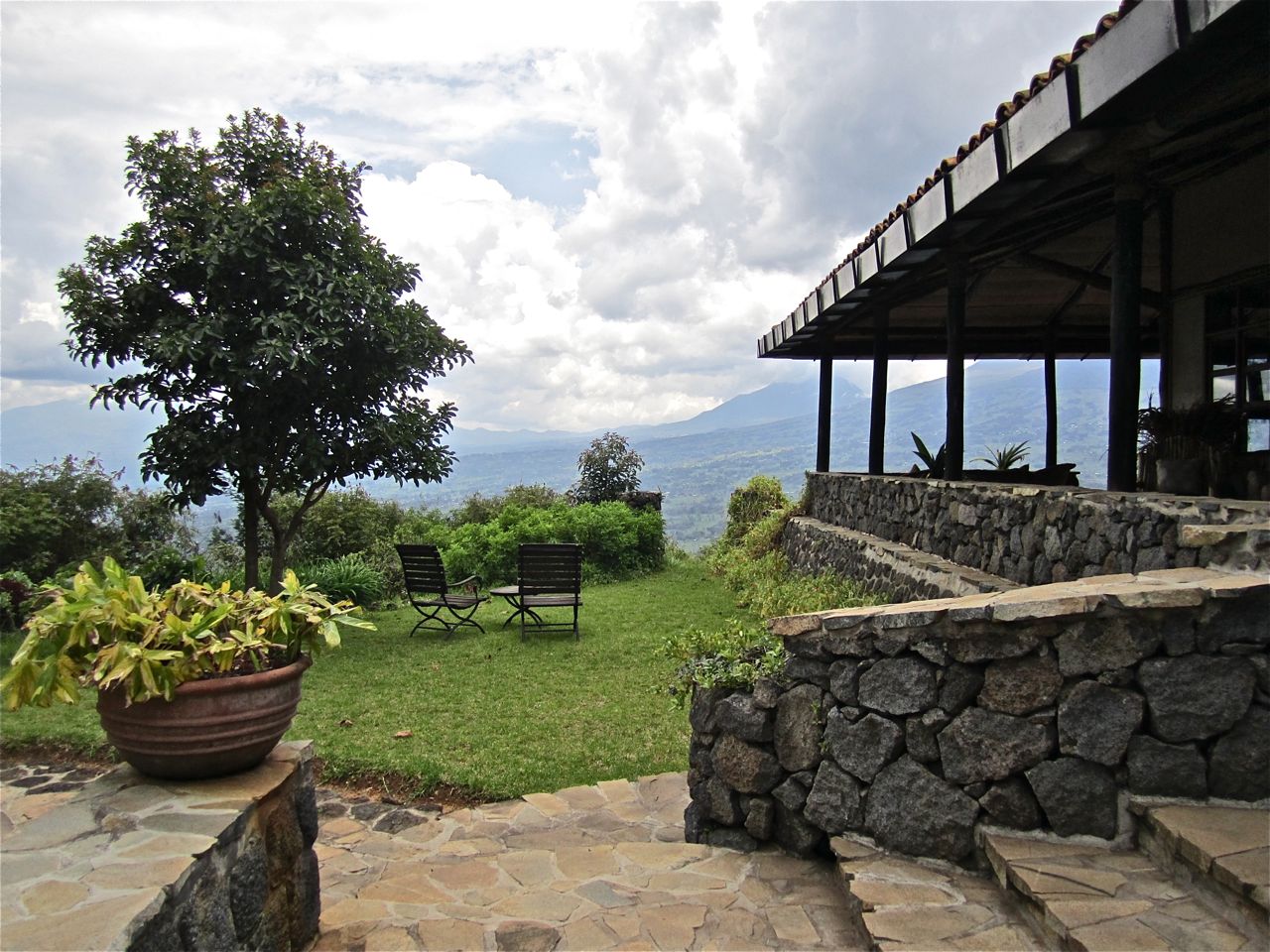
There are a few garden flowers and shrubs, but usually the existing wild brush has simply been cut back to allow for a few flat grassy areas and paved paths.
The focus is on the gorgeous view of Lake Burera.
Local volcanic rock was used in the construction of buildings and walls.
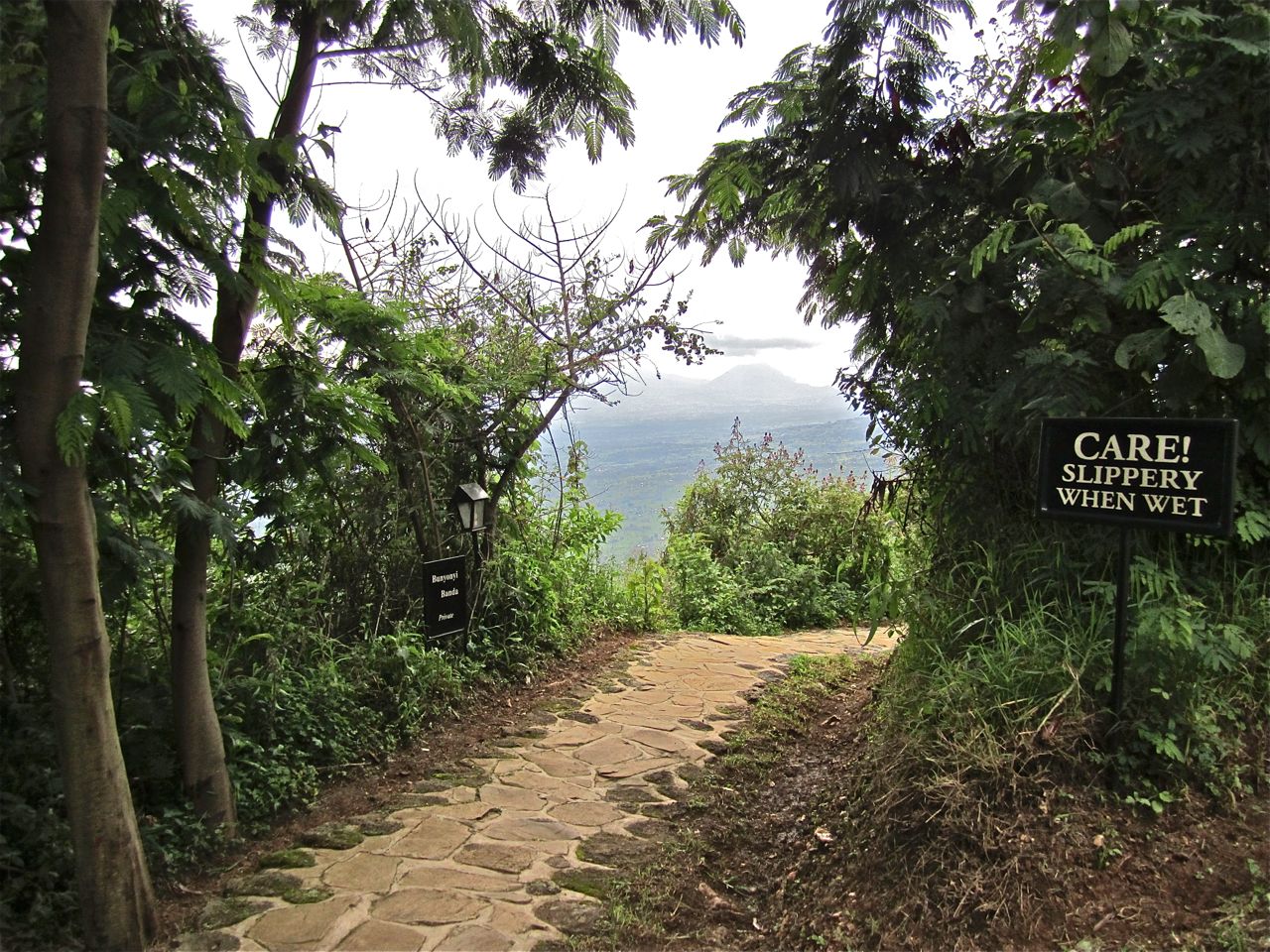
A path to a banda or individual cabin.
A trail to nearby villages. The lake is in the middle distance, topped by more hills and clouds.

About three hours drive from Kigali, the Lodge has eight “bandas” or individual cabins, which operate on solar power and use rainwater recovered from the rooftops.  It is very expensive at $600 per person per night,* although this is inclusive of all food and drink (including alcohol).  (We just stopped by for a look.)

This simple grass “room” sits along one of the main paths.
The path crosses this room, which is outlined with a low wall.
A long room with regularly spaced columns near the entrance to the Lodge.
The bandas have stone terraces.

To get a better sense of the layout and location of the Lodge (and what it’s like to arrive by helicopter), you can watch this short YouTube video.

The same morning as our stop at the Lodge, we visited two local schools and a nearby village family. Our guide was an American businessman working with faith-based development endeavors in Rwanda.  He took us to the site of a house he is building for himself. At the moment, it’s just a stone and concrete foundation set on the edge of a hill.

But again, the views were absolutely amazing.  He wisely plans to leave the land surrounding the house (which is all sloping downward) very natural, hoping to attract as many birds as possible.

Lake Burera.

Living here, one might begin to feel like a bird.


*There are reductions for Rwanda residents.

First look: Kigali, Rwanda

Muraho!  We have been in Rwanda 25 days today.

Our new home, as we expected, is beautiful. The garden is filled with wonderful plants and mature flowering shrubs that are familiar to me from previous posts in Africa and Latin America, although I have forgotten a lot of their names.  Some time on the internet should help with that.

The beautiful shrubs are filled with a variety of birds.  Unfortunately, some of them seem to live in the time zone we left behind.  We have the birds that sing at 2 a.m., those that sing at 3 a.m., 4 a.m. and so forth.  Ending with the ones who tap insistently on our bedroom window for several minutes every morning at 6. Continue reading “First look: Kigali, Rwanda”

Soon to be out of Africa

Honestly, I think I’ve had about all the luch I can take. Moving is tough.

We’re off to Rwanda at the end of this week, so enclos*ure will be on a little break — I hope not for too long.

Please check in with me from time to time. I’ll also be watching for any new comments and checking my Blotanical page.

Thanks to everyone who’s been following this blog since I started in June. I really appreciate your interest. I look forward to being back with you soon.

The new garden

Note:  There is gallery of photos at the end.  I’m still having trouble successfully inserting pictures into my posts without tears.

This spring I started my seventh garden.  As a Foreign Service spouse, that’s how it’s been: move, make a garden; move, make a garden . . . . Five in Africa, one in Chevy Chase, Md.  Now, here we go again.

We bought our 1920’s rowhouse last August.  The back garden is about 16′ x 74′.  We’re really lucky to have this much space in Glover Park, where normal is a tiny plot in front and a deck overlooking a parking pad out back.

What was already in our long narrow garden was not bad.  We have a deck, which sits about 4′ above the ground,  a 6 1/2′ tall stockade fence — nicely weathered — and a flagstone sidewalk to the back gate.

There’s a huge old holly tree (a male apparently, no berries) about two thirds of the way back.  It provides morning and mid-day shade and shields us from the view of some Wisconsin Avenue shops and restaurants (and their noise).  Unfortunately, it also drops its prickly little leaves like crazy in mid spring. Continue reading “The new garden”