Last month, we finally made a trip to southwest Rwanda, after having rescheduled twice since the spring. For me, the chief attraction of the three-day visit — which involved many hours on some very rough and curvy roads — was the drive through the 378 square mile Nyungwe National Park, one of the most species-rich mountainous rain forests in Africa.
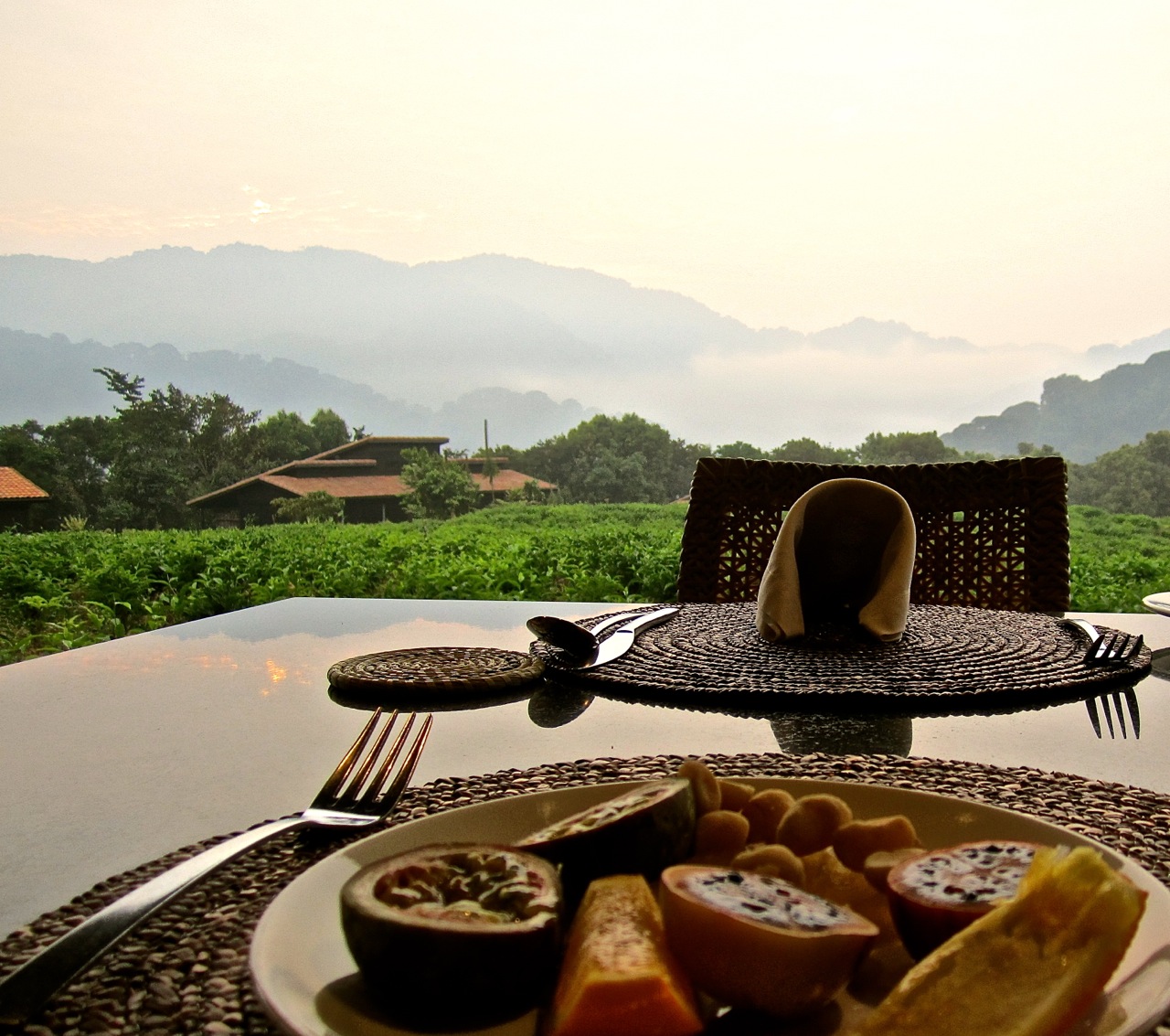
We also spent two nights at the wonderful Nyungwe Forest Lodge, possibly the best hotel in Rwanda. (Above: early morning breakfast at the Lodge.)
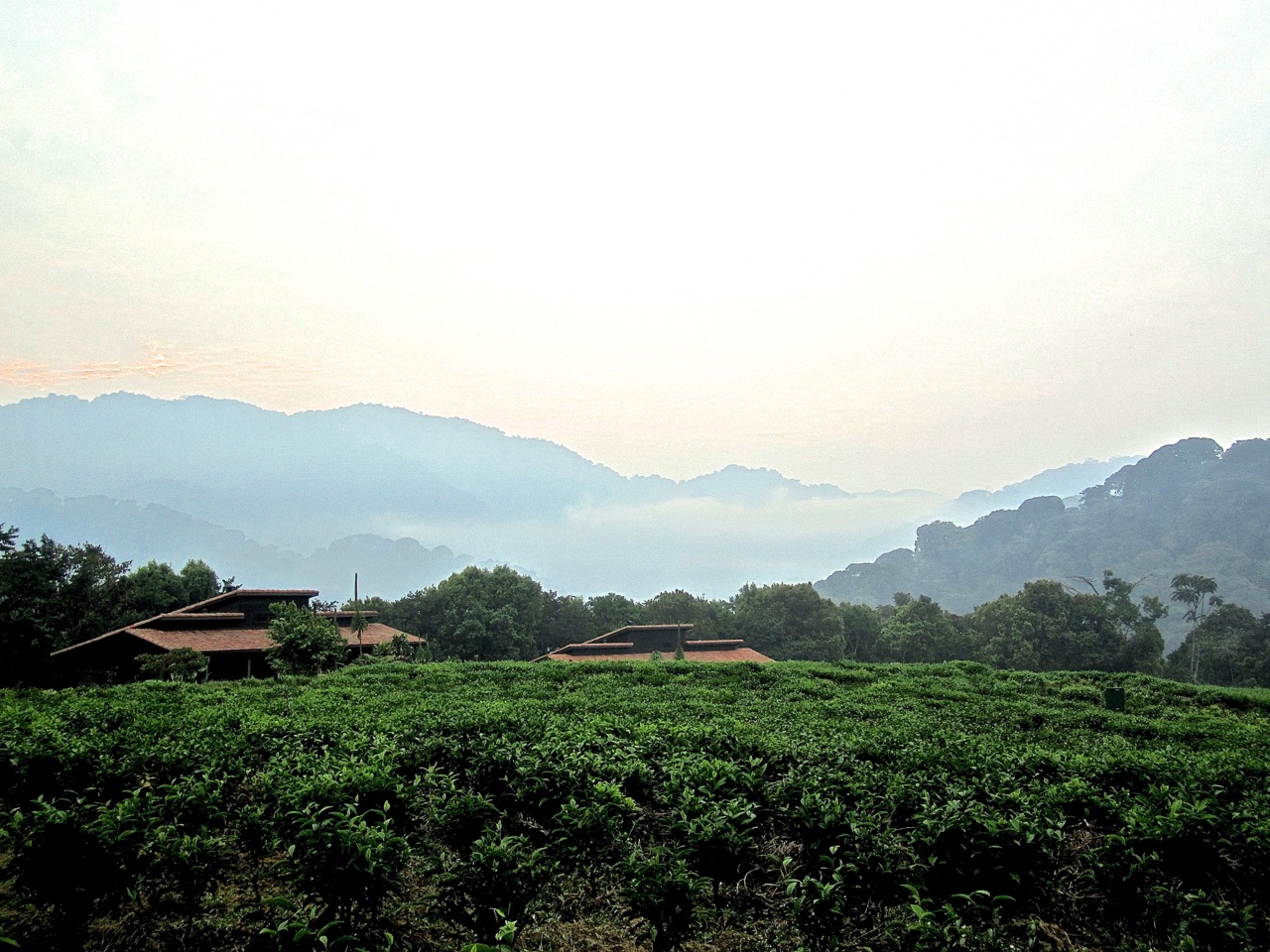
Located on the western edge of the park, the lodge offers beautiful views of two environments: the natural forest of the park and the agricultural fields of a tea plantation.
The cabins rest on the very edge of a field of tea. And their back-facing picture windows look into the forest trees (monkey sightings are common and guests are warned to close windows and doors at night).
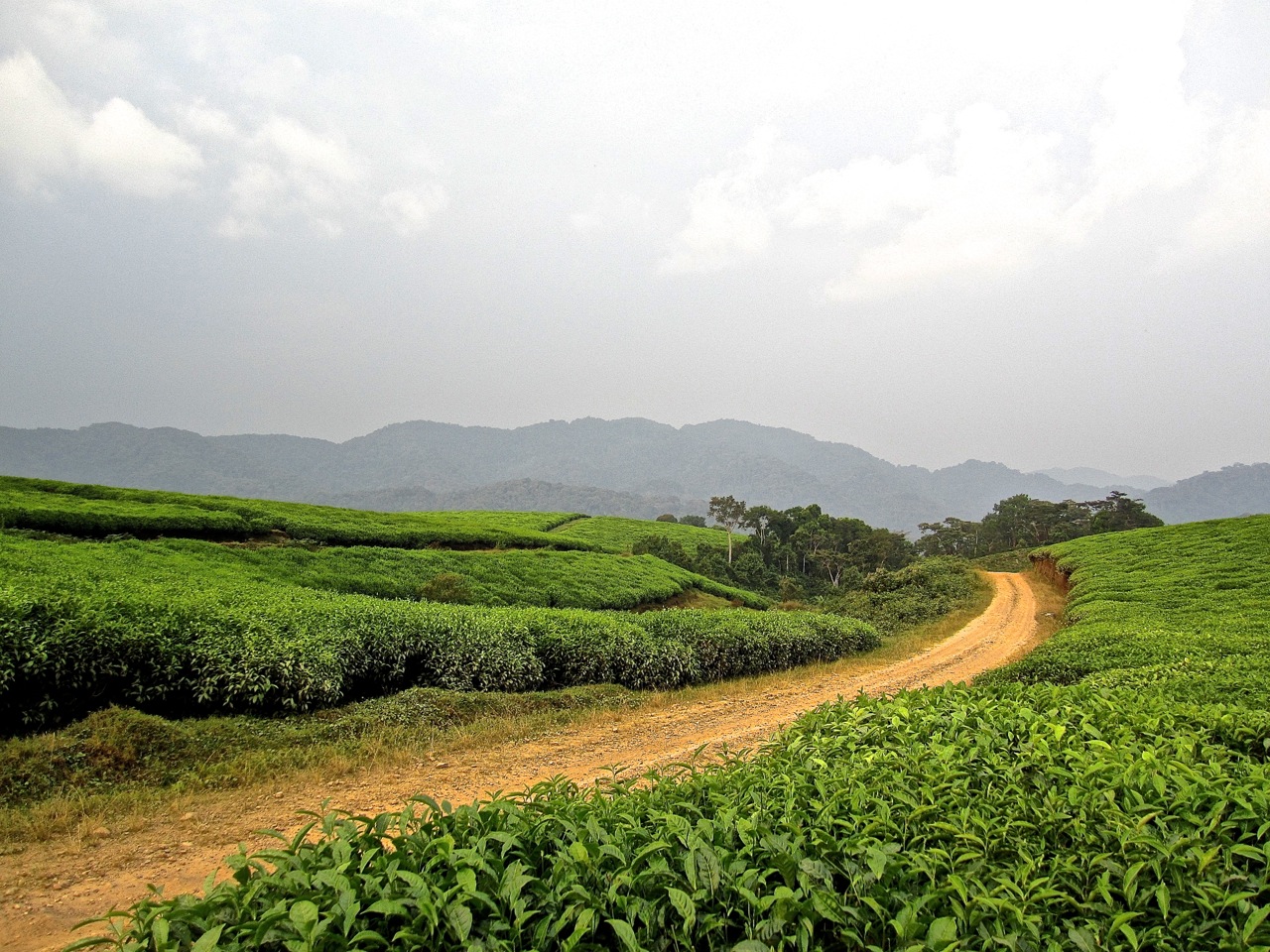
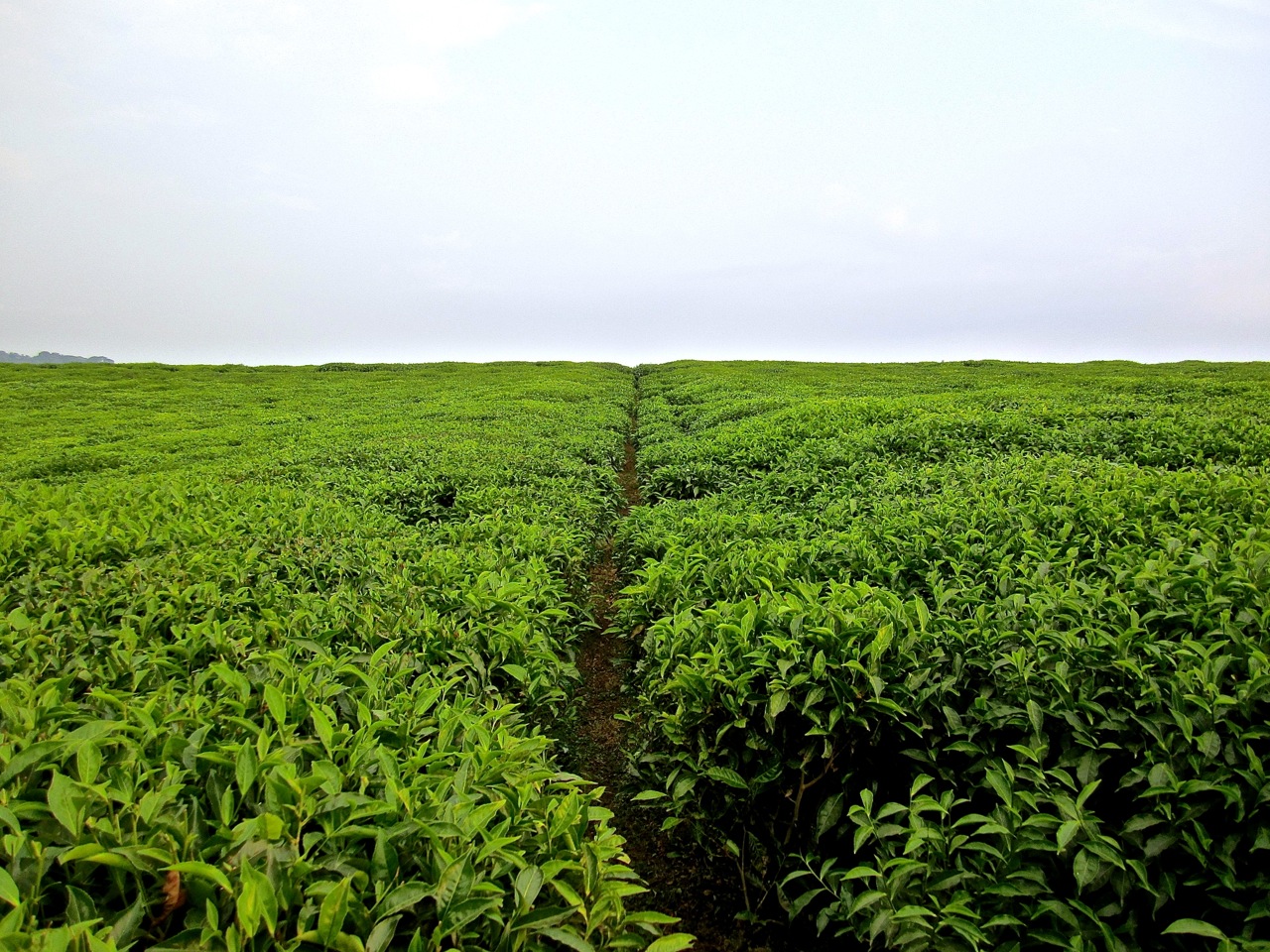
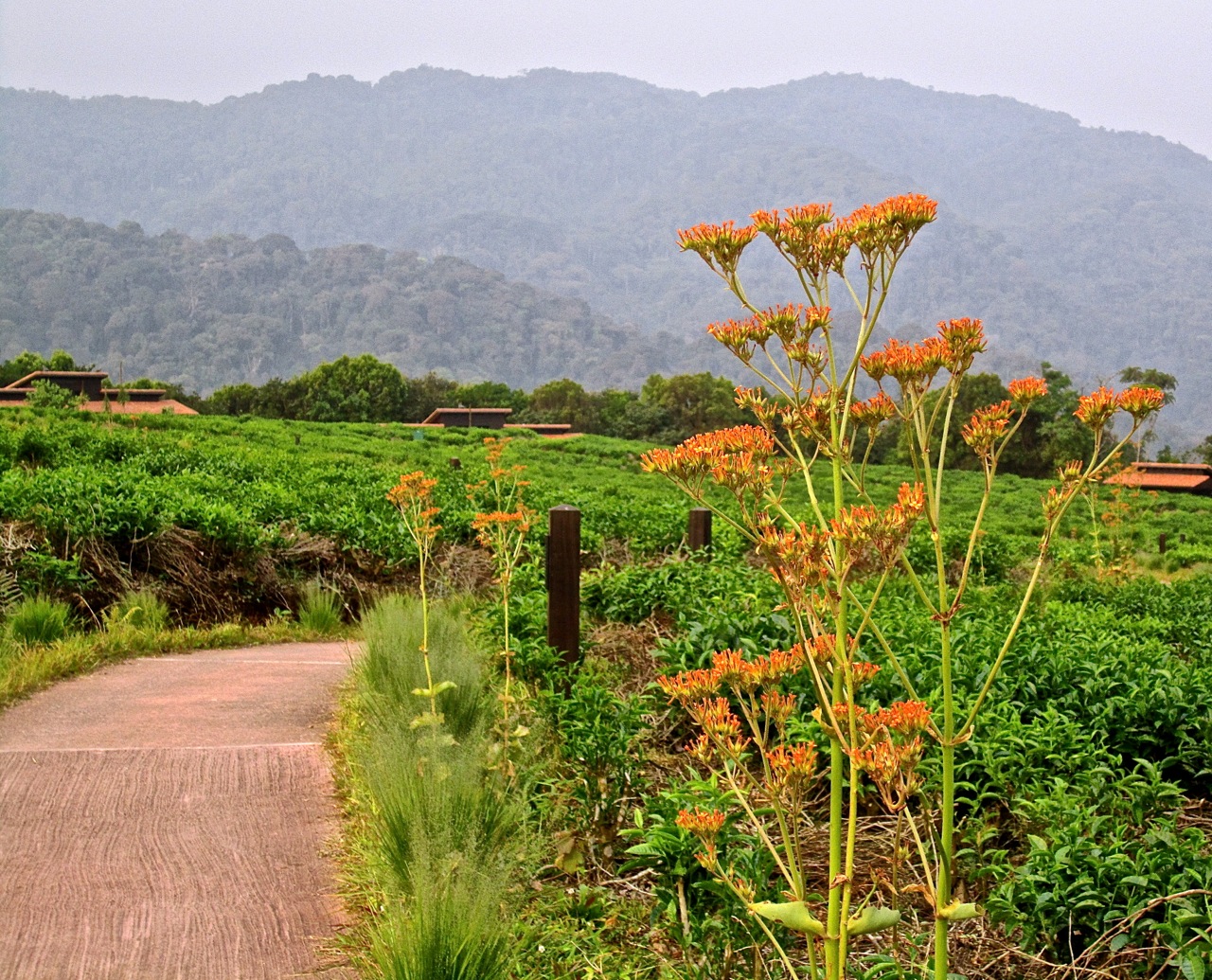
The road leading to the Lodge passes through bright green acres of tea bushes.
A local cooperative picks the tea (right up to the lodge and cabin doors) and keeps the income from its sales.
(Above: the road to the lodge and a tea collection shed.)
The (tea-side) entrances to the cabins are landscaped with plants from the forest. The Lodge was not allowed to bring any other plants onto its grounds.
The cabins are built on posts, lifting them off the ground.
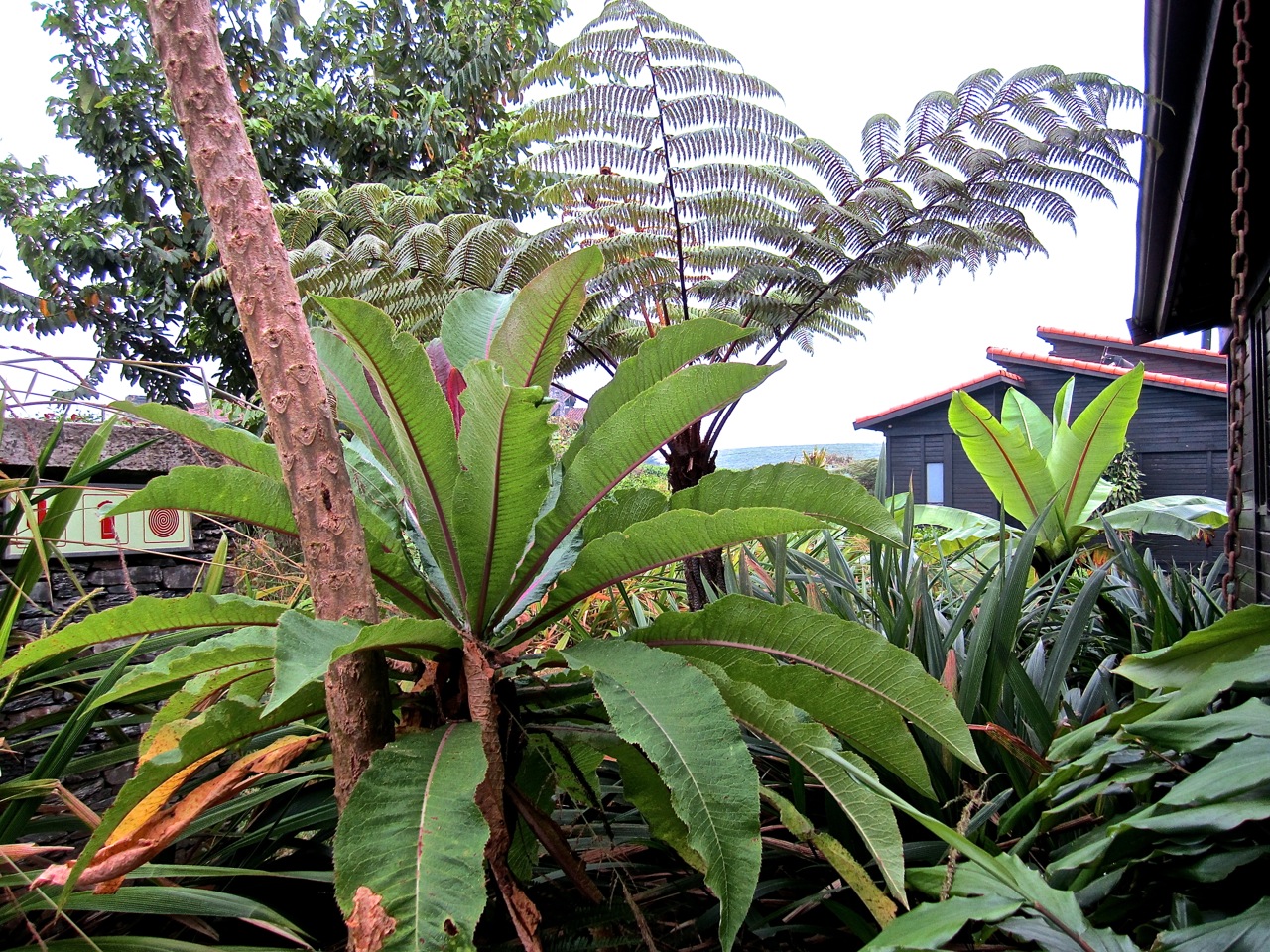
Above are some of the plants at the entrance to our cabin. I think the tree fern in the center background is a Cyathea manniana (a.k.a., Alsophila manniana). I haven’t been able to identify the plant in the foreground. Way in the back on the right is a wild banana (Musa ensete).
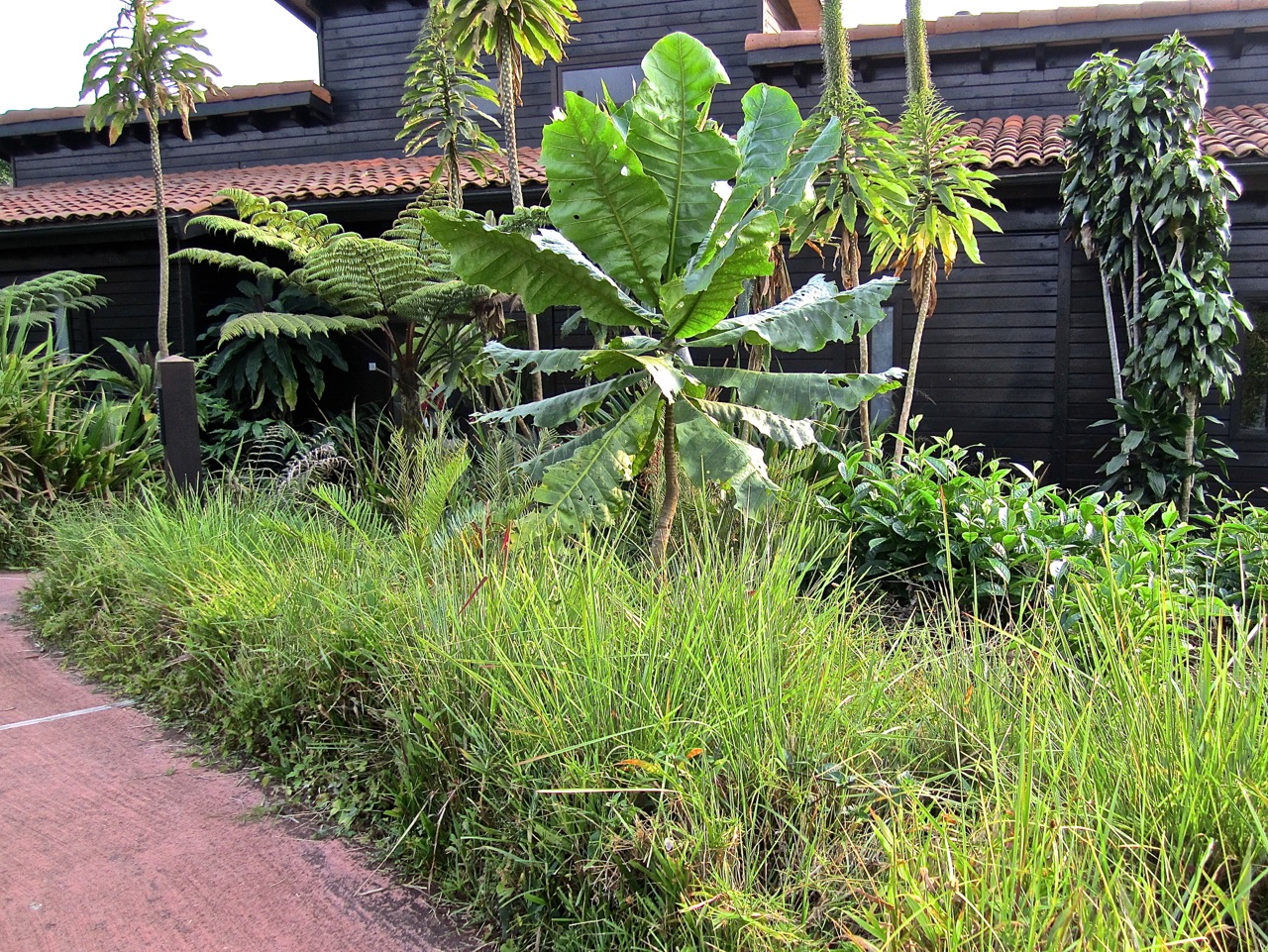
Unmown wild grass grows along the paths and among the larger plants. I believe the small tree in the center, above, is an Anthocleista grandiflora. I think the plants just to the right of it are Lobelia gibberoa.
A park trail entrance is located near the Lodge grounds. Guests are not allowed to hike, however, without paying the park fee and taking an official guide. Both can be arranged at the Lodge.
The main Lodge building (with the lounge, bar, and restaurant) rests in the center of the tea field.
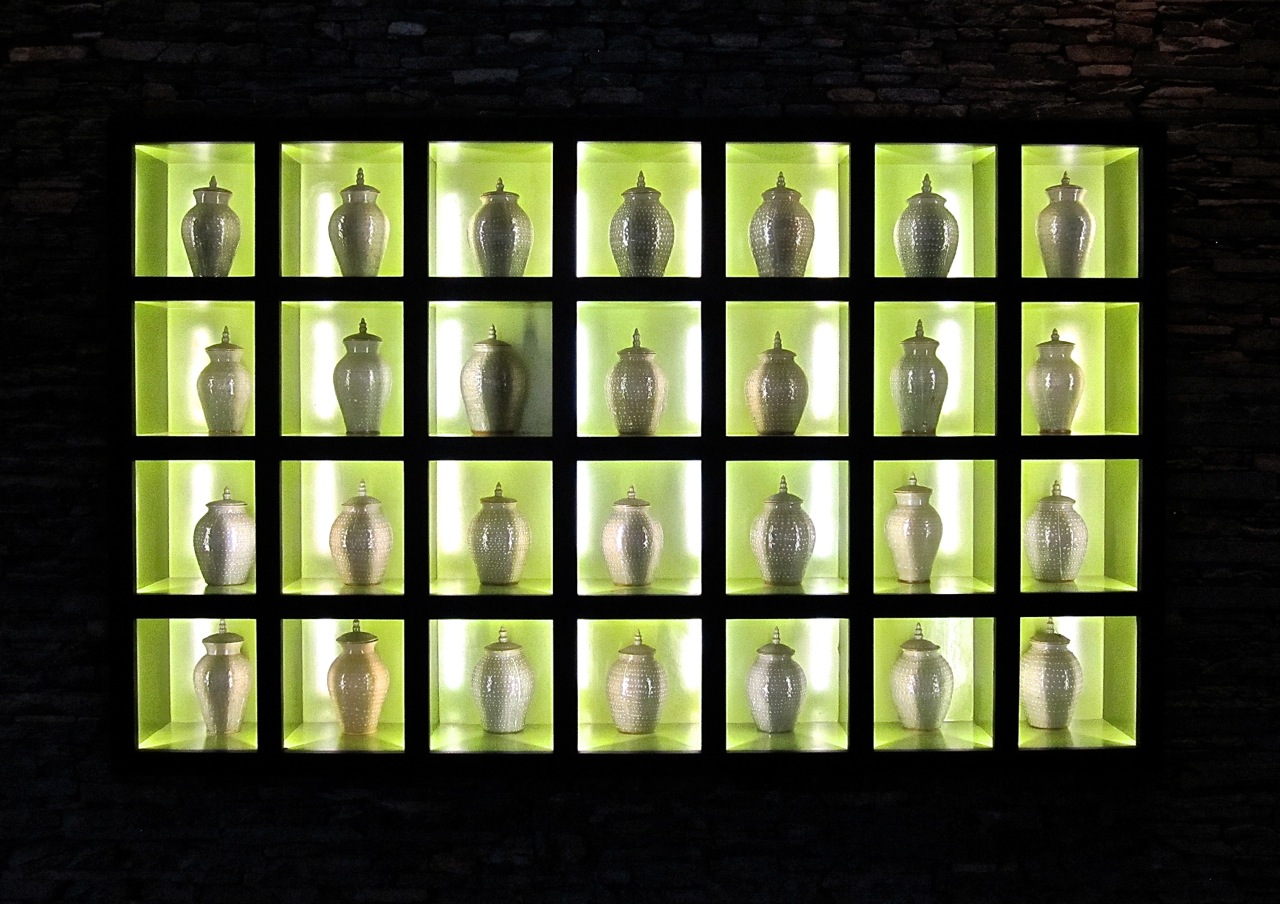
The interior is beautiful, as well. (Above: a wall of Rwandan pottery.)
The tea grows right up to the foundations of all the buildings. (Above: the main building terrace with rain chains.)
The tea bushes are mulched with the branches cut in the last pruning.
The Lodge’s main paths are earth-colored concrete and are set slightly below the level of the tea field.
The smaller paths are also partially hidden below the tea.
Orange Kalanchoe crenata plants line the paths.
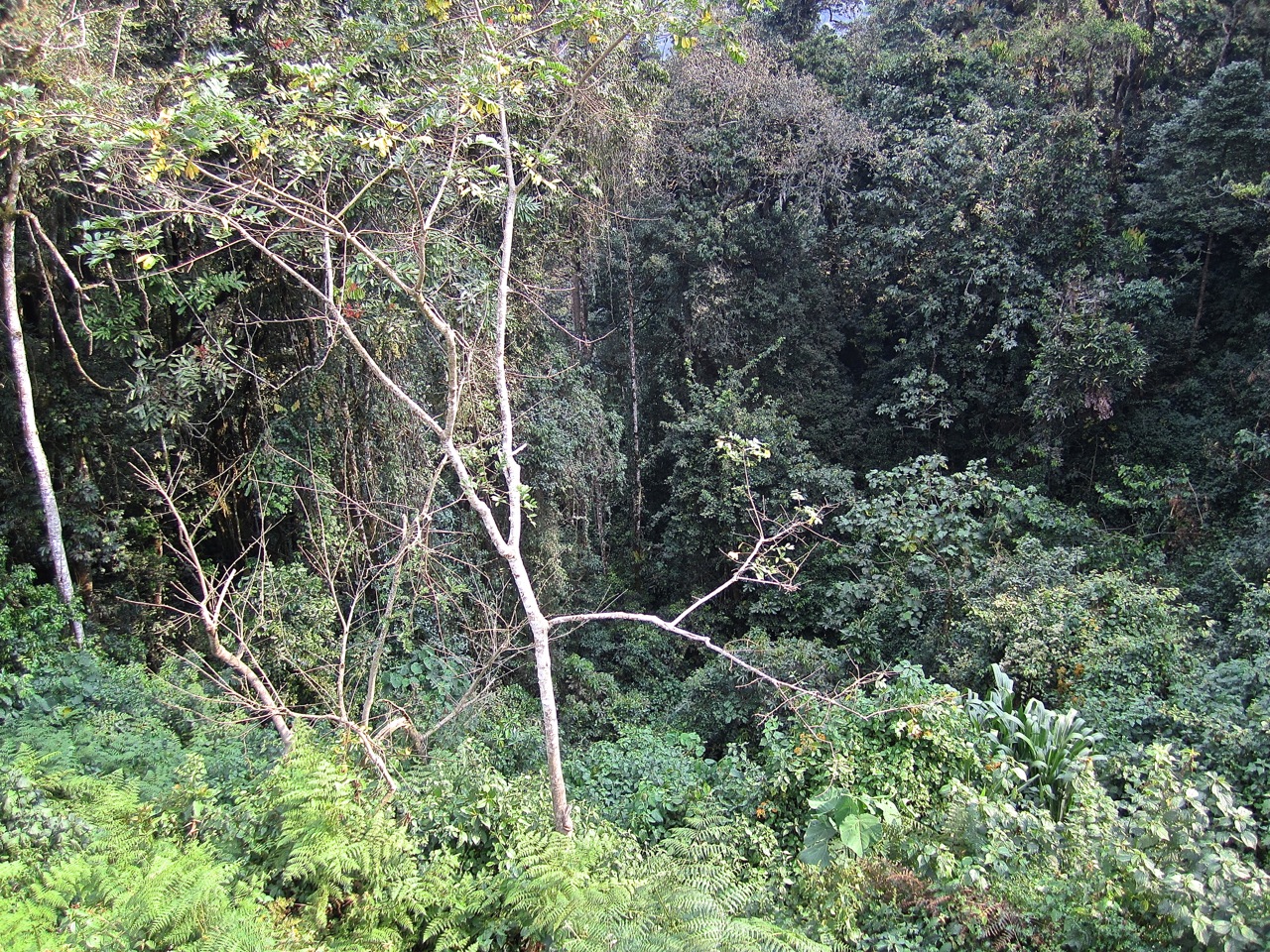
Above is the view of the forest from the pool. The trees are full of monkeys (we learned to look for shaking branches; then we saw them everywhere).
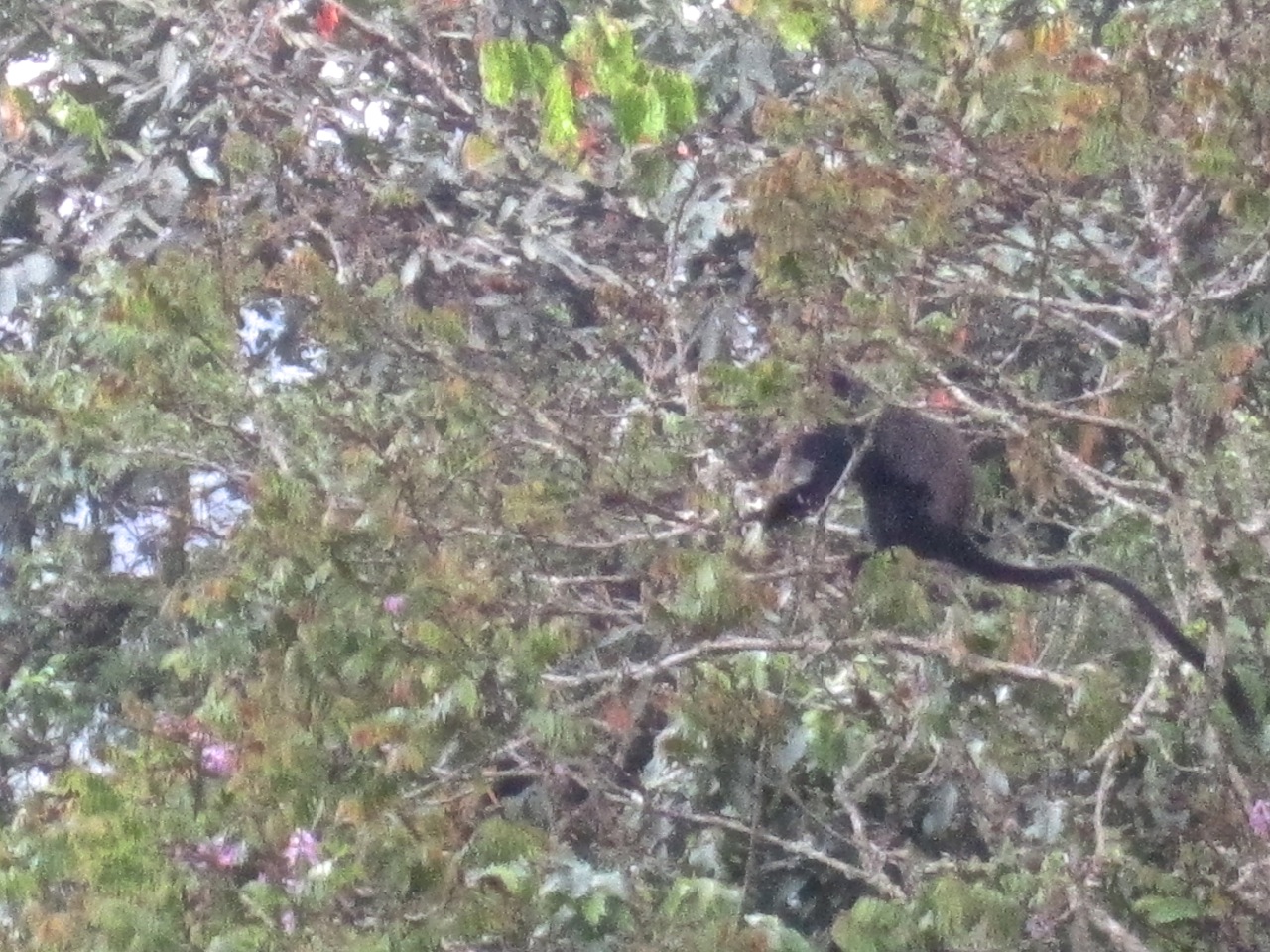
There’s one (above.)
He jumps.
And lands. (OK, my nature photography is not so good.)
Here’s a slightly better picture. It’s a L’Hoest’s monkey (Cercopithecus lhoesti).
Unfortunately, our travel schedule didn’t allow time to hike the park. But my plan is to return as soon as possible. Many people come to Rwanda to see the mountain gorillas in the north, but the Nyungwe Forest is equally remarkable, and tourists should soon begin to see it as good reason to spend more time (and money) in the country. (Tourism is Rwanda’s number one revenue producer, followed by tea and coffee exports.)
After we visited the demonstration small holding farm of Gako Organic Farming Training Centre (GOFTC), we continued down the road a short distance to its main campus.
The attractive facility includes a number of classrooms and an auditorium. A local church group was holding a service on the grounds while we were there, and we enjoyed their singing as we looked around.
The path we followed from the buildings to the fields was lined with Caliandra trees, which are regularly cut to provide good animal fodder. (Also click here for more information.)
We came to a large field of various types of garden beds, including the above terraced mound garden of carrots, onions, and parsley . . .
and the above keyhole garden of cabbages. (Click any photo to enlarge it. To scroll through all the enlarged images, click on ‘Continue reading’ below and on any thumbnail in the gallery.)
Above, cabbages were growing in sack towers, and old tires had been repurposed as containers for herbs.
Amaranthwas growing in rows. In Rwanda, it is valued more as a leaf vegetable than a grain. I was surprised to see the Cleome around it (in the photo, but a little hard to see), but I learned from Managing Director Richard Munyerango that the leaves are edible after cooking.
The center teaches animal husbandry and keeps a number of dairy cows using the “zero grazing method,” which means fodder is brought to the penned animals (they do graze twice a week).
This calf was checking out my camera.
In addition to milk, the cows contribute to the center’s power through their manure, which is processed to produce gas for cooking.
The staff were cooking bananas that day. These bananas are not sweet and when boiled and mashed taste something like potatoes.
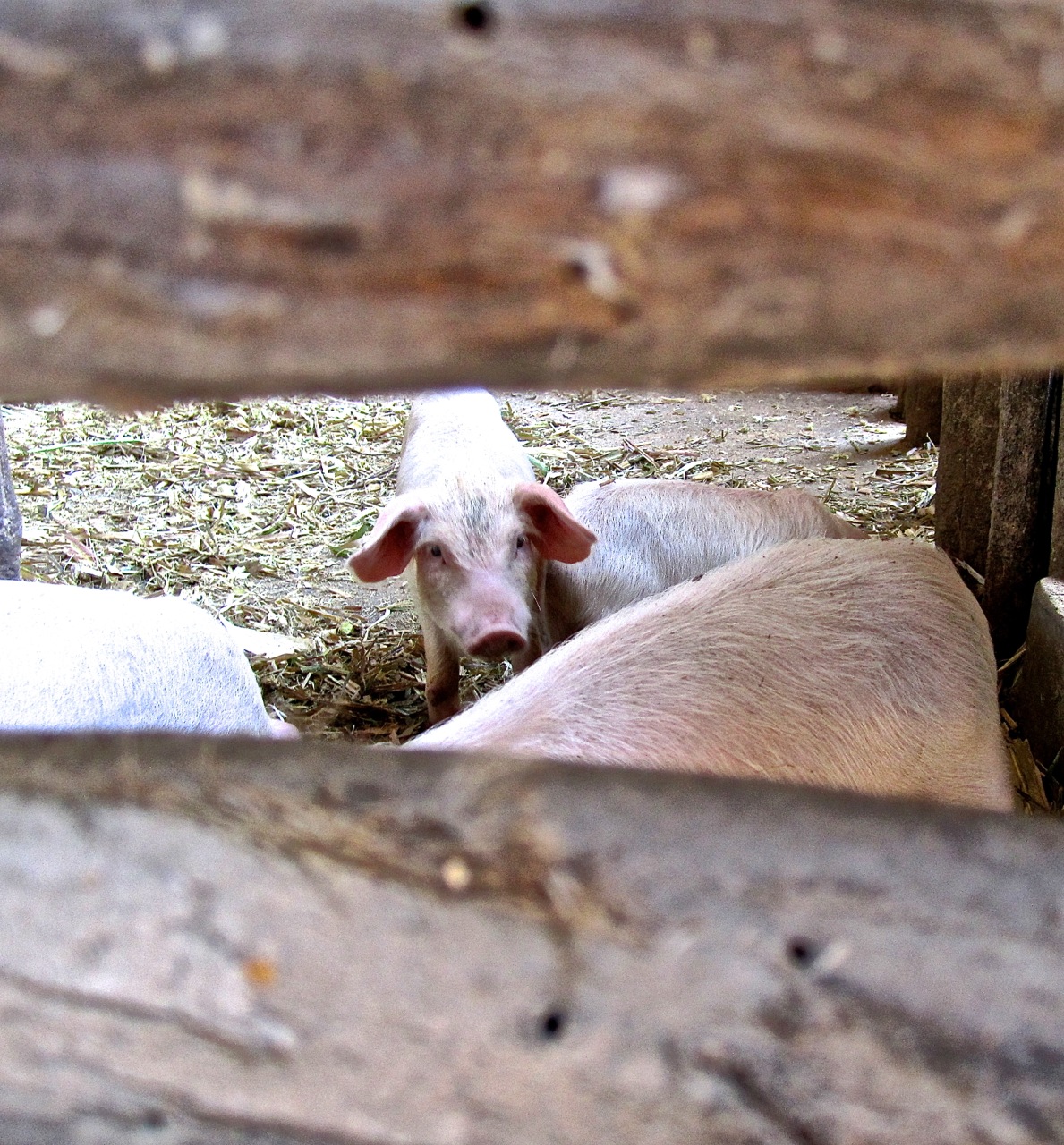
You may remember GOFTC’s pigs from my July 4 “Wordless Wednesday” post. This baby was a little more shy.
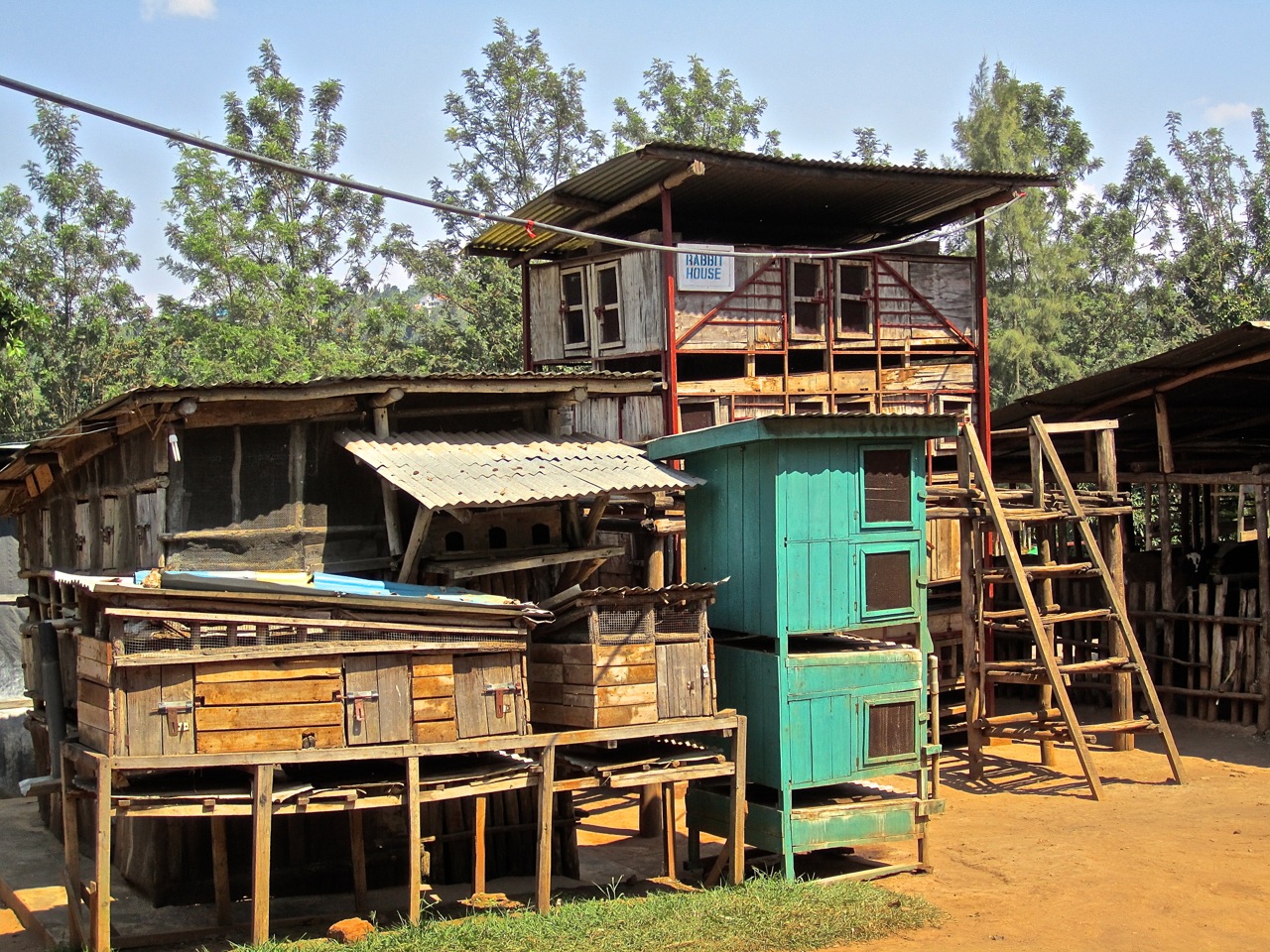
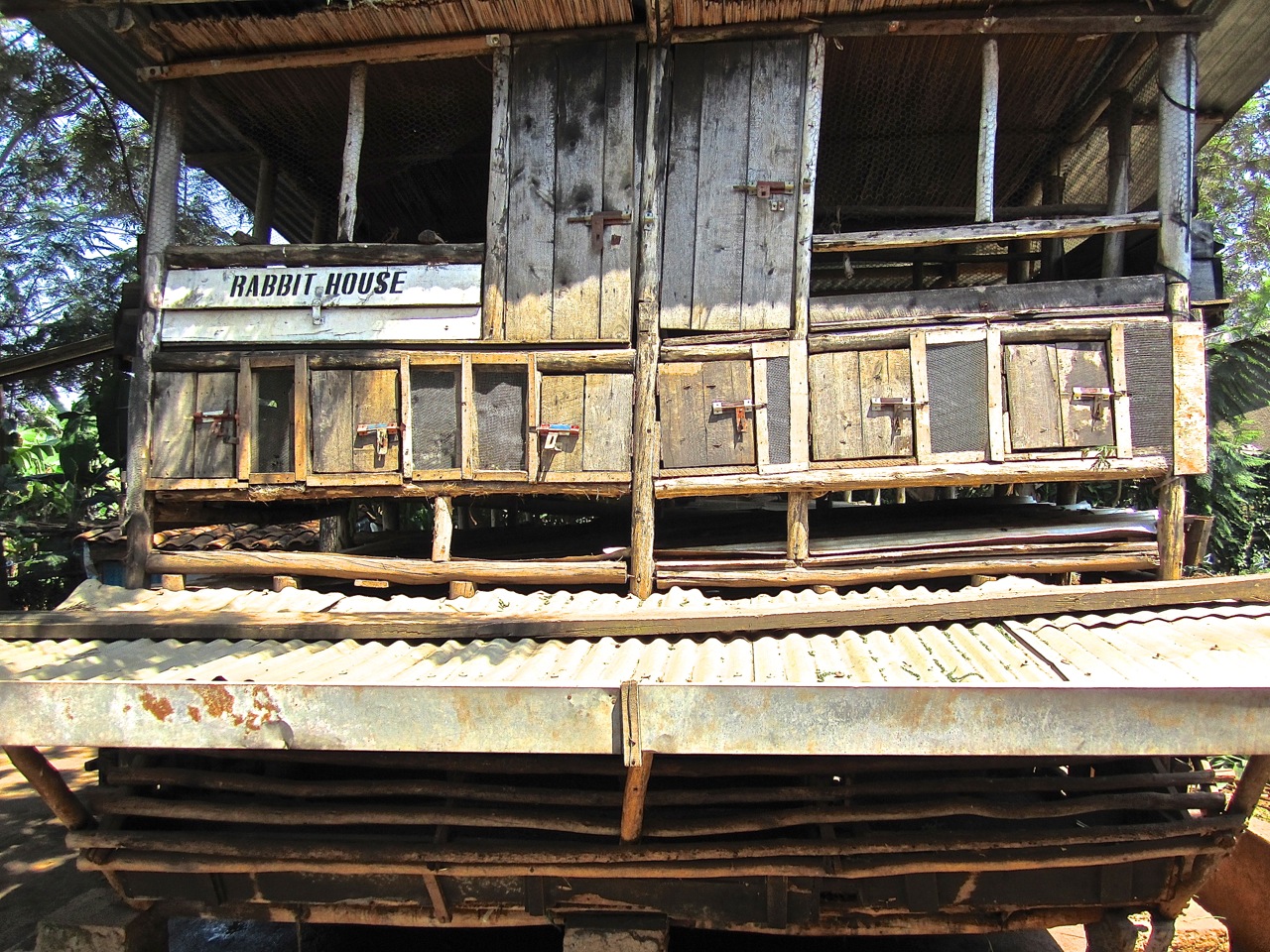
The center has an even larger rabbit hutch at the main campus.
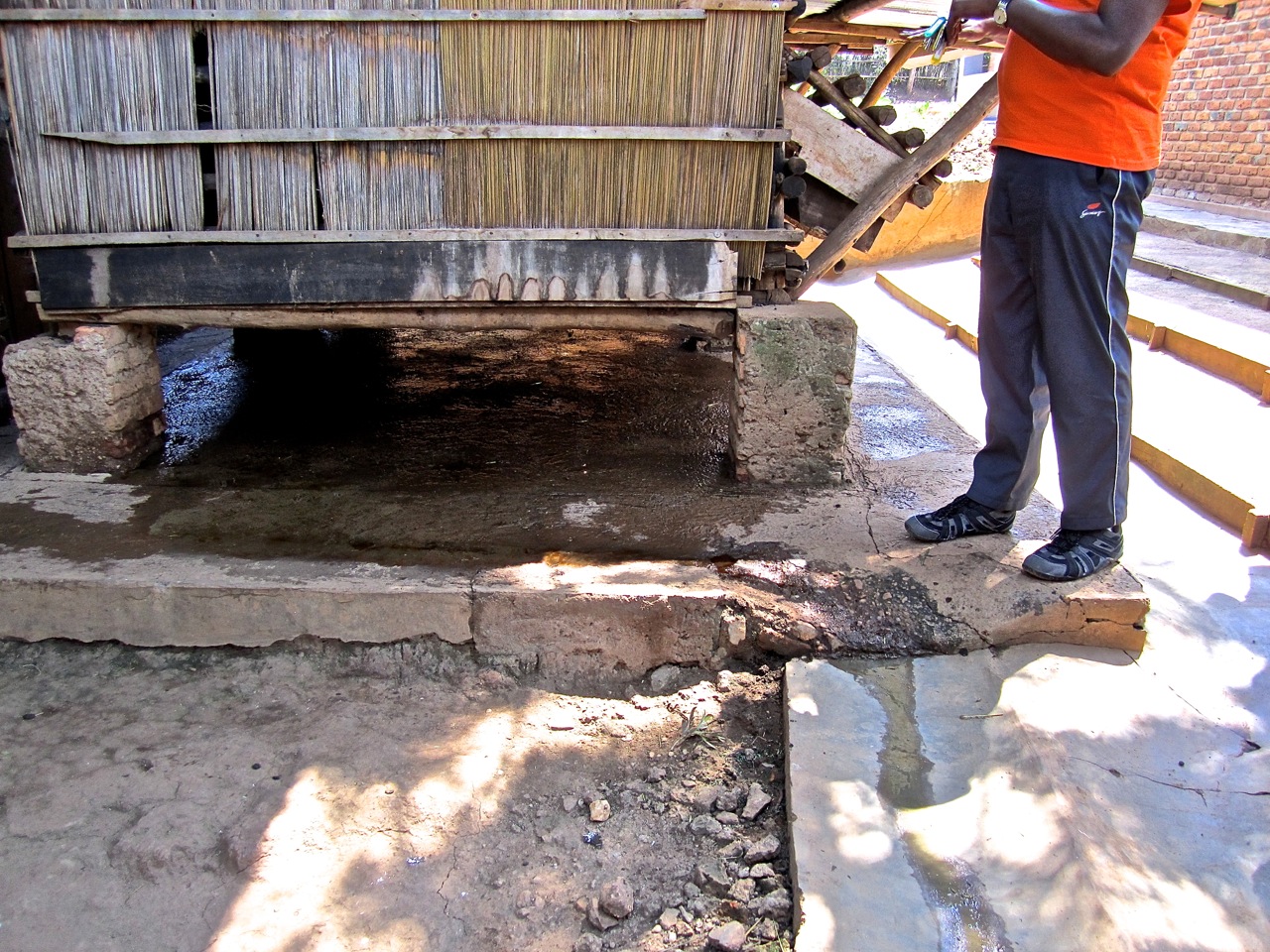
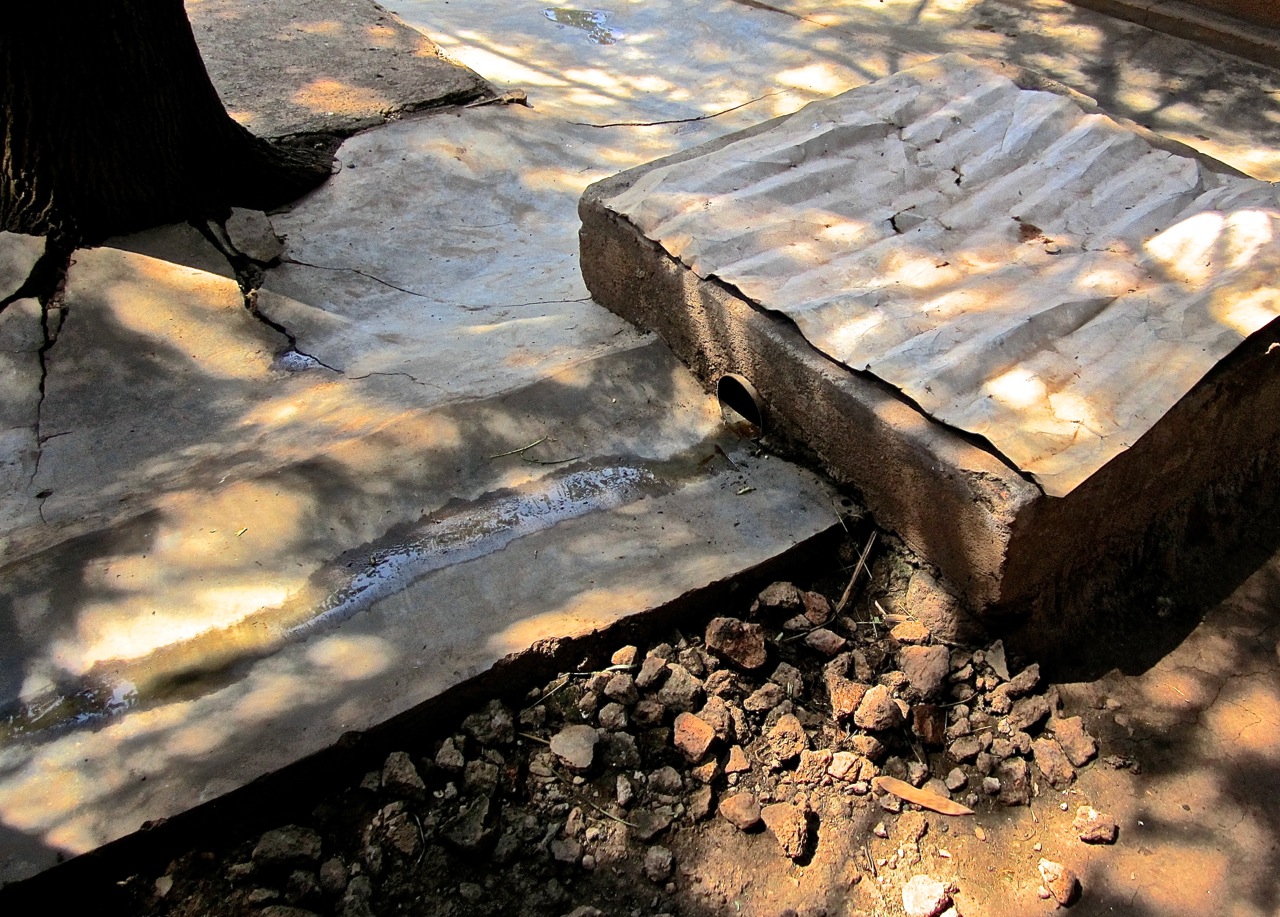
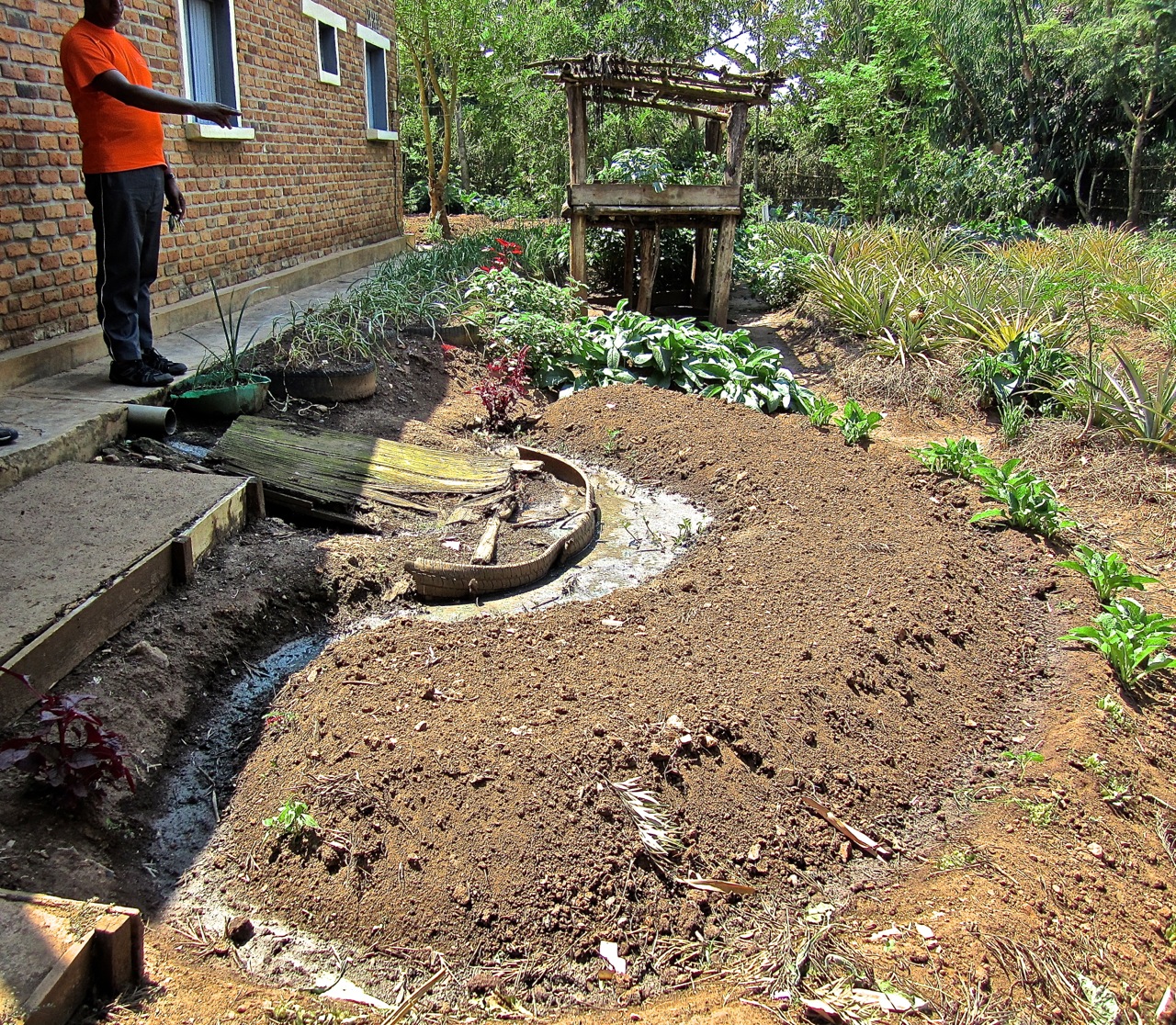
Of course, the urine is collected for the compost piles.
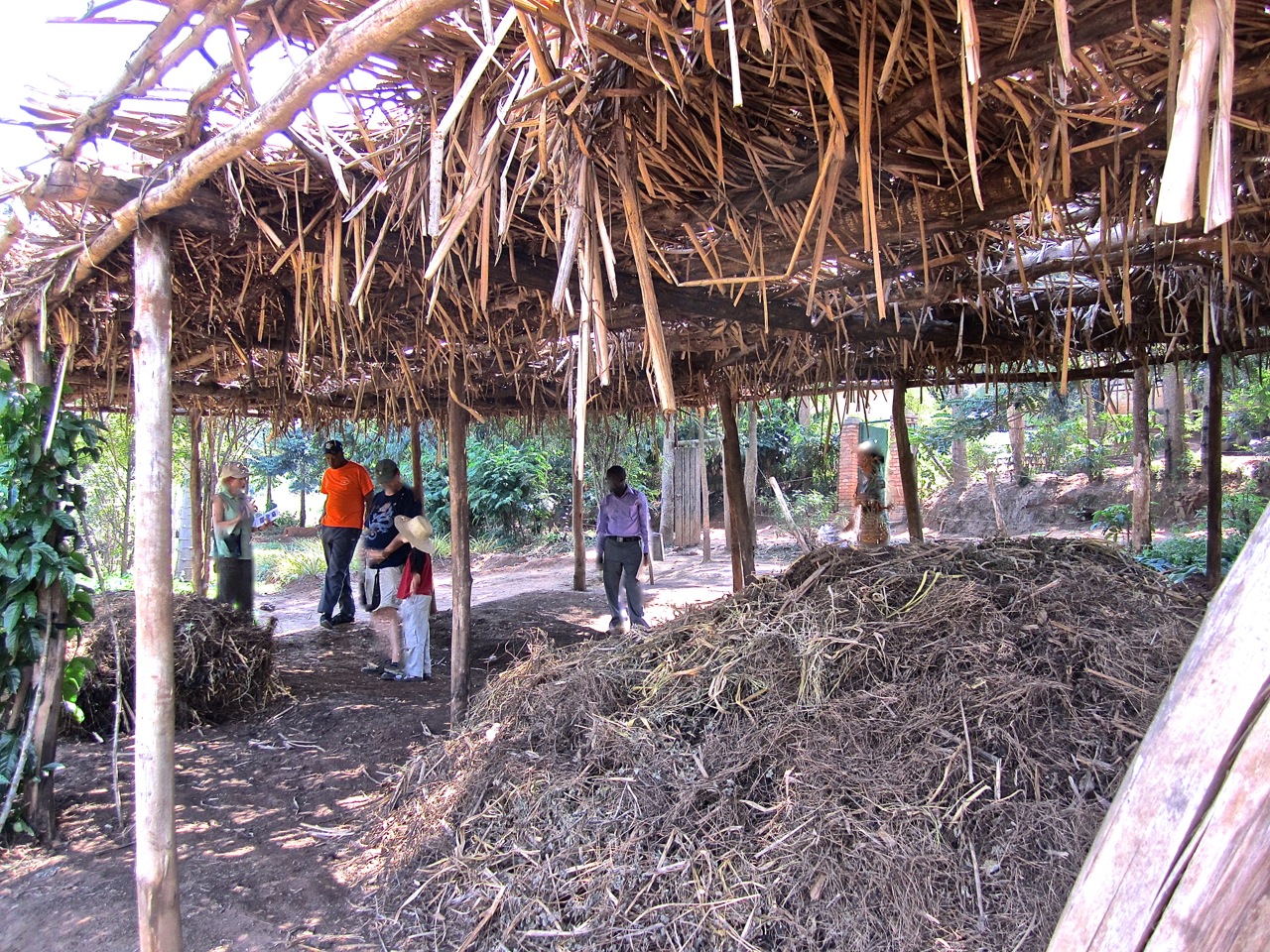
After we left the animals, we came to the compost shed. The still-cooking pile on the left was beautifully squared off. Richard told us good dimensions for a pile are 1.5 meters wide by 1.5 meters high (and 7 meters long, but this one was about 3-4 meters long).
This is clever (above). A pole is placed in the middle of the pile so that it can slide in and out. If it is pulled out warm and damp, the pile is in good shape.
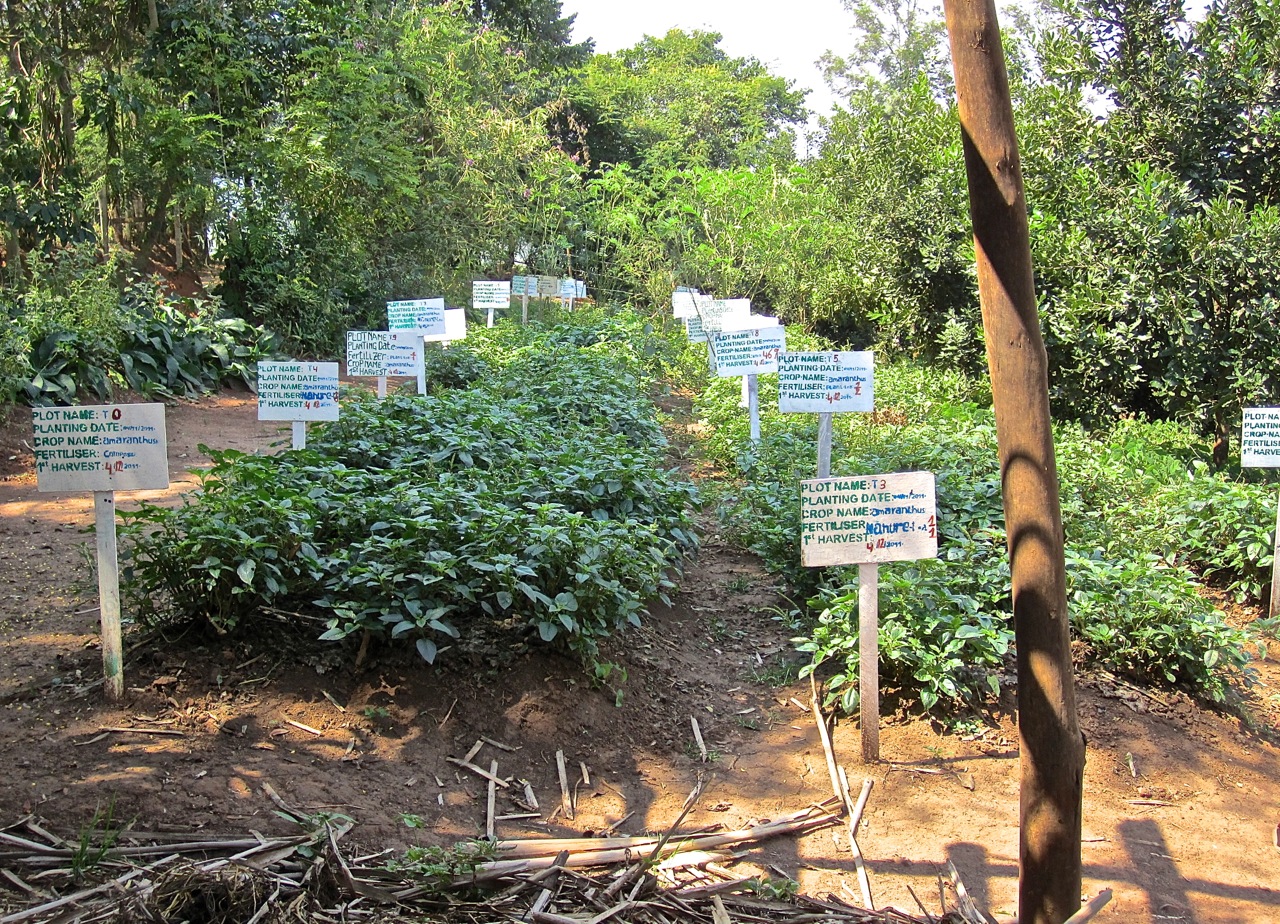
Next to the compost shed, different types of soil amendments (compost, compost tea, manure, etc.) were being tested on Amaranth.
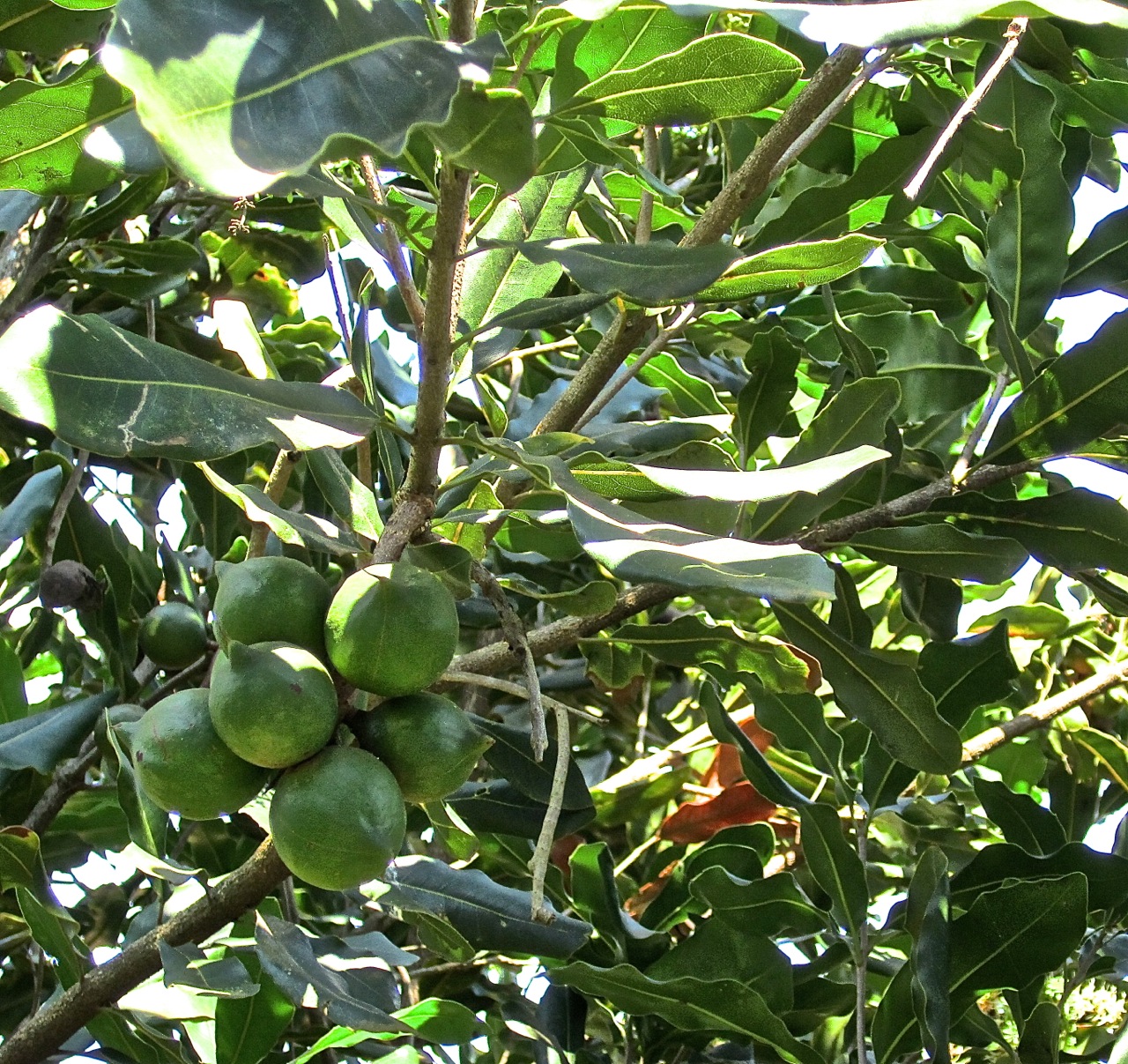
There were macadamia trees planted next to the test plot.
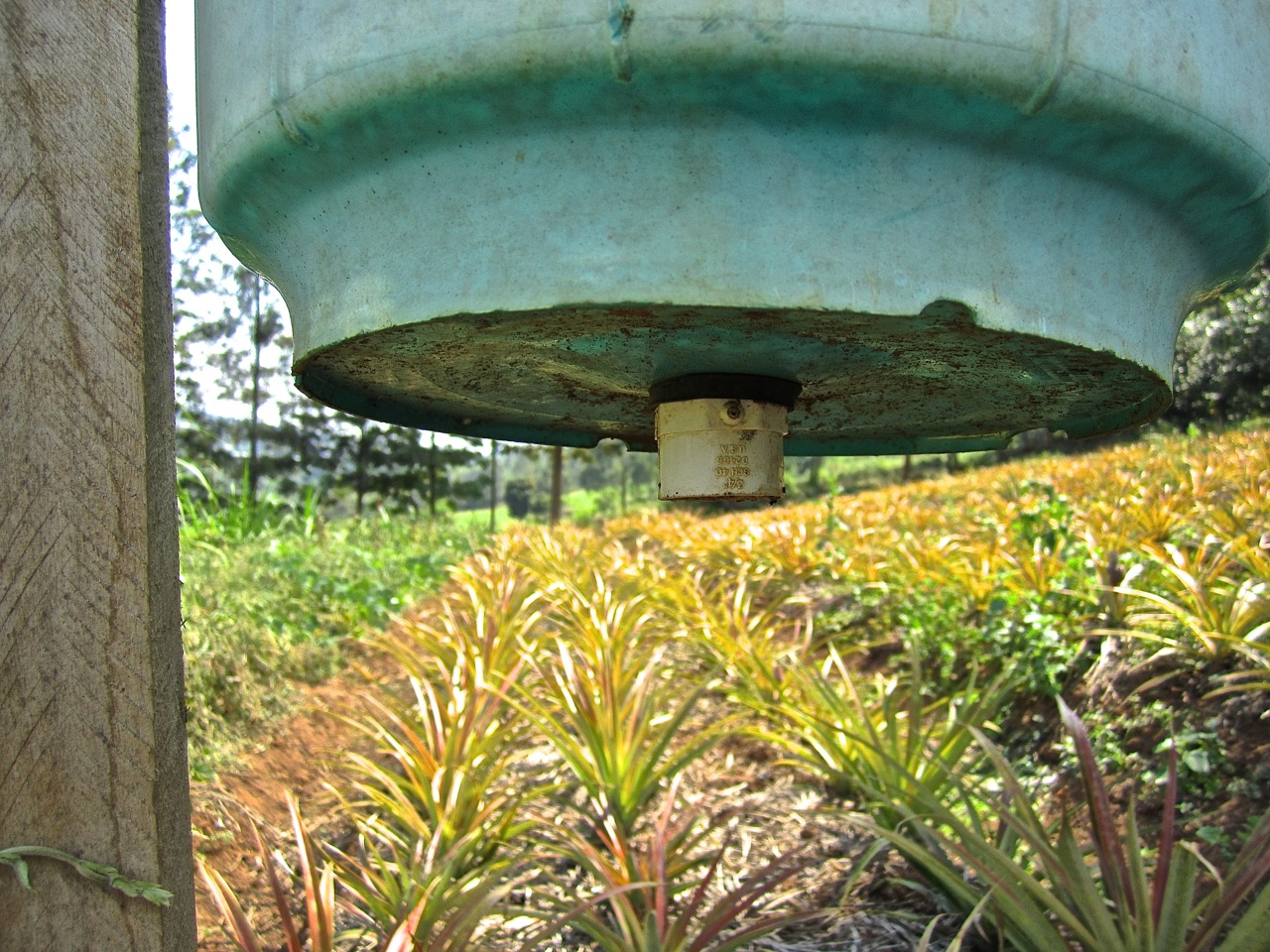
From the shed, we could also see fields of pineapples — their drip irrigation buckets still hanging at the end of the rows.
The drip lines — needed when the plants were first set out — had been removed. But when they were in use, workers had filled the buckets by hand from a well below the field. Eventually, a pump system will be installed.
The pineapples are fertilized with a solid byproduct of the “cow gas” process.
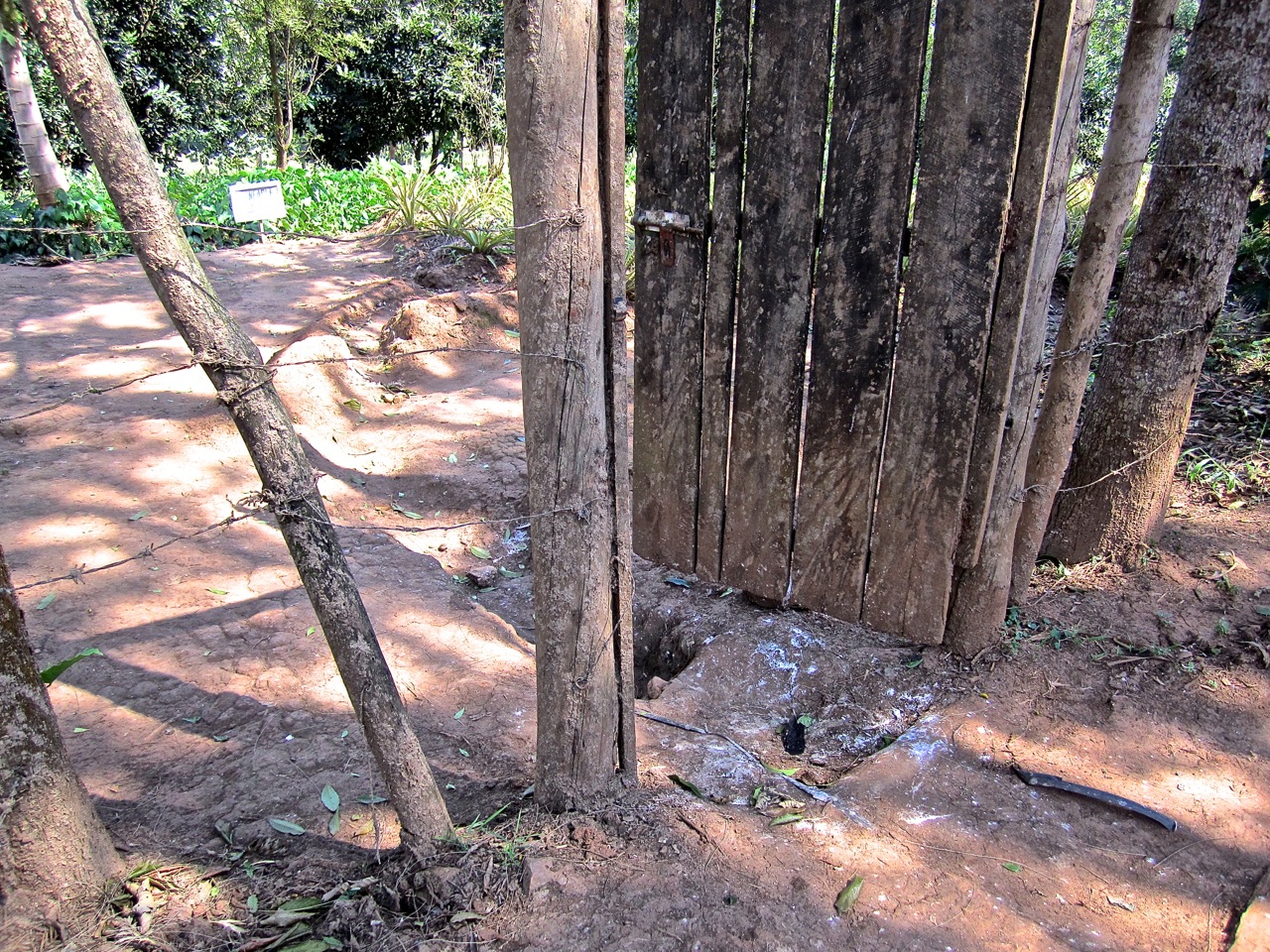
As we left the fields by this gate, I noticed again the careful capture of rainwater runoff using trenches.
I thought I would end by sharing some of the text of GOFTC’s brochure, which is rather inspiring.
“Gako Organic Farming Training Centre is a Rwandan local NGO that trains farmers in sustainable agriculture for sustained livelihood.
We are a training and demonstration enterprise. The training is in sustainable agriculture using organic farming practices, which are environmentally friendly.
We emphasis the use of limited land (small plot technique), while improving yields, which are pollution free, hence safe and healthy to eat.
We do not encourage the application of artificial fertilizers and pesticides, but try to go back to nature, by taking care of our environment so that we may depend on it for our livelihood.
We embark on planning and design, while focusing our most attention on agro-forestry and the growing of fruits and vegetables, which are natural medicines.
Since inception, GOFTC has shared this information with hundreds, if not thousands, of farmers in Rwanda and the neighboring countries who come for training. . . .
[Our mission is] to empower the farming communities to improve their living standards through appropriate, affordable and productive organic farming practices that promote environmental conservation for a healthy, progressive and united people.”
You can read more about GOFTC in a January 2011 post by Jared in the blog Rwanda on the Wing.
You can contact GOFTC by writing to P.O. Box 3047, Kigali, Rwanda, or by e-mailing to goftc2008@yahoo.com.
Soon-to-be Peace Corps volunteers before their swearing-in.
There’s a swearing-in ceremony for new Peace Corps Volunteers taking place in our garden right now, which has caused me to stop moving plants around long enough to write a new post.
A couple of weeks ago, a friend organized an outing to a wonderful place called the Gako Organic Farming Training Centre (GOFTC) — located just on the edge of the Kigali city limits. Our host and guide there was Richard Munyerango, founder and Managing Director of the center and a tremendous source of knowledge on small farming techniques.
Since 2000, GOFTC has trained over 60,000 farmers from Rwanda, Burundi, and the D.R.Congo, among them demobilized soldiers, disabled persons, women’s groups, and many participants in the Send a Cow and OXFARM programs.
Our first stop of the morning was a small house surrounded by a fenced demonstration garden of about an acre, which Richard had created to show how a small holding could feed a family.
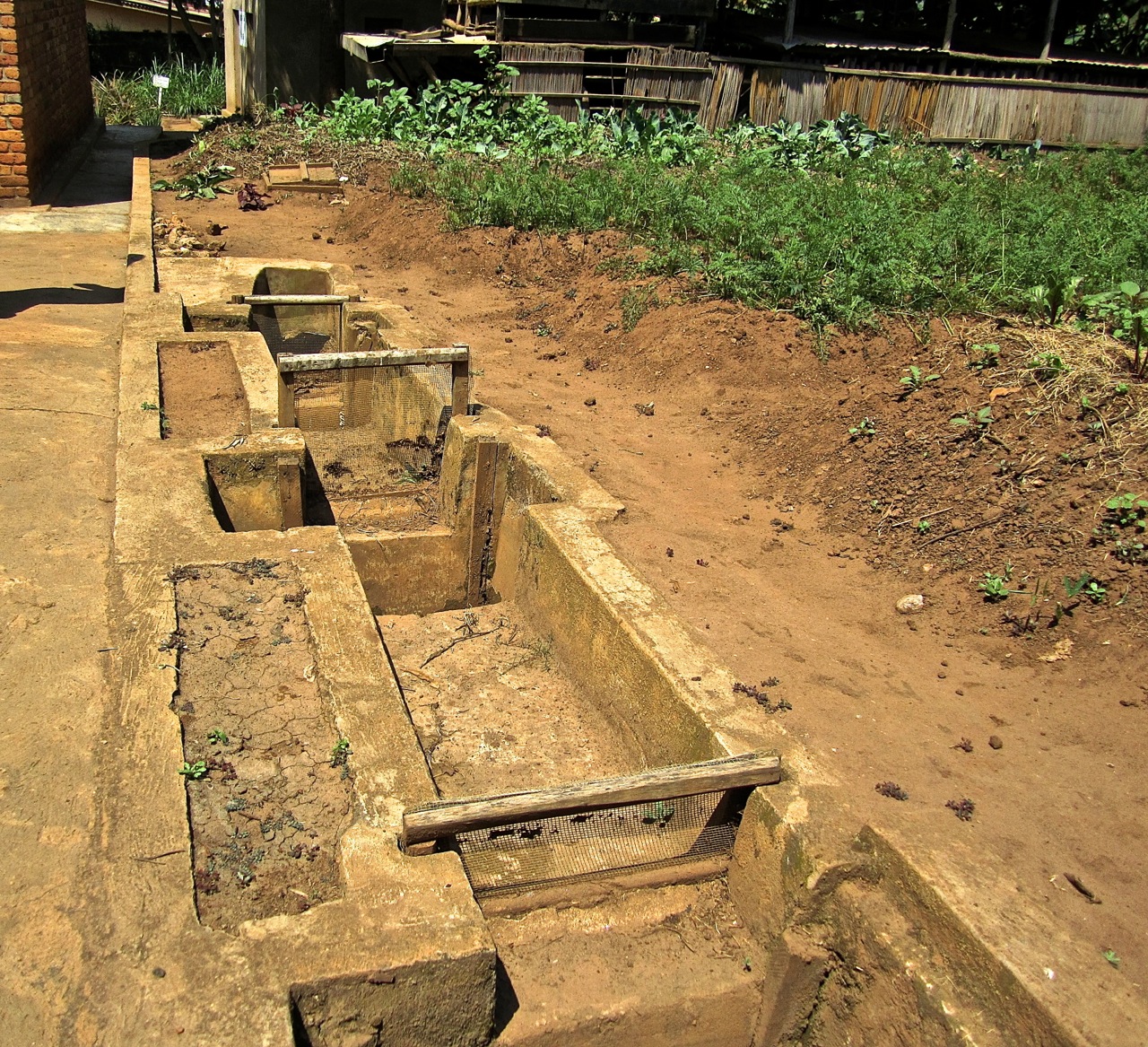
The first thing we noticed as we passed through the gate was the paved trench that directs the street’s rainwater runoff into the property.
The water passes through a series of screens (or would were this not the dry season). . .
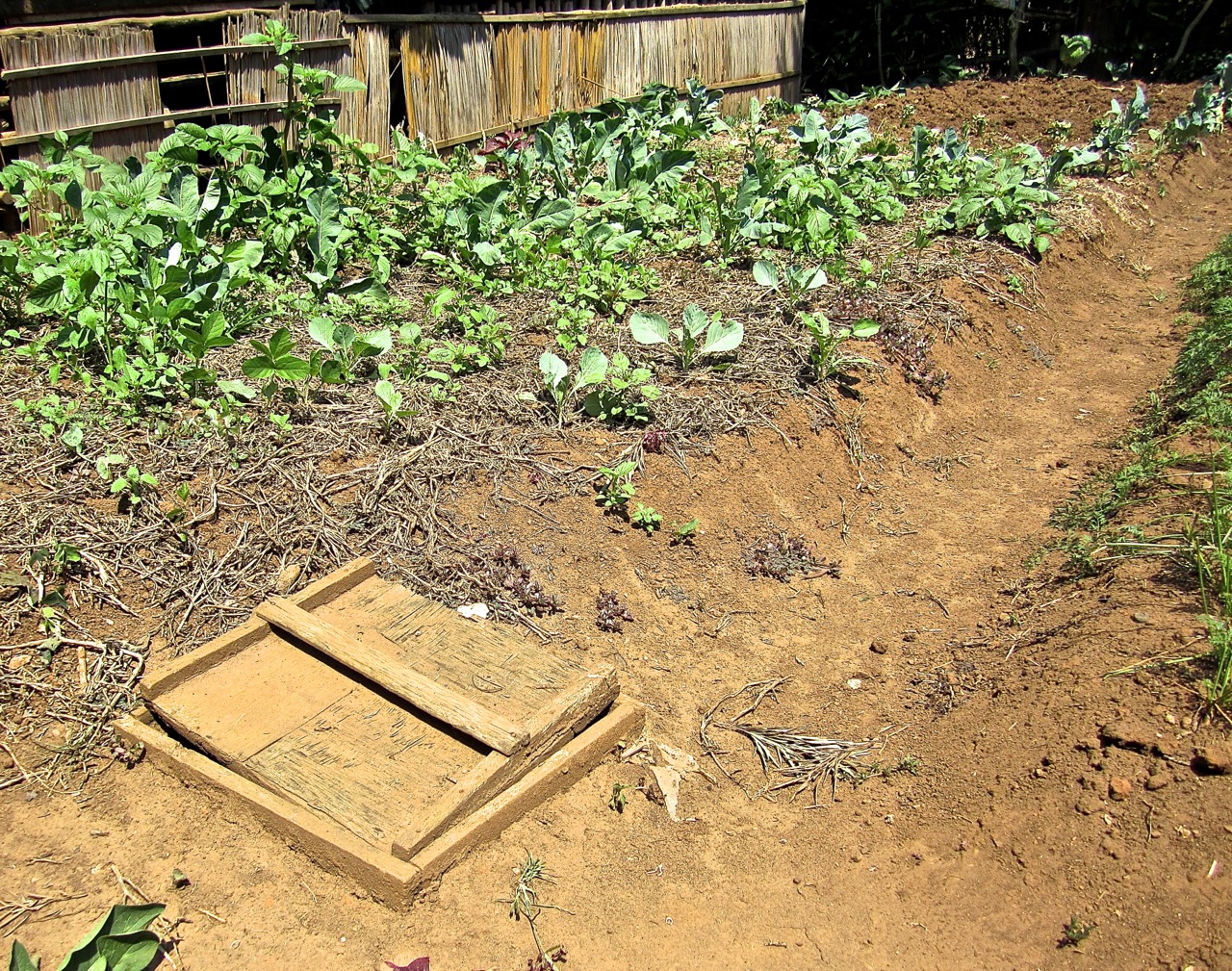
and is saved in an underground tank.
To the right of the trench and filters are mounded rows of vegetable crops. (Click any photo to enlarge it. To scroll through all the enlarged images, click on ‘Continue reading’ below and on any thumbnail in the gallery.)
Just beyond the water tank and planting beds is a raised rabbit hutch, looking a bit like a an ark.
Behind the hutch are stalls for a cows or some goats, but neither were in residence when we visited. The center raised chickens until the Avian Flu scare of several years ago. Richard hopes to re-introduce them eventually.
The rabbit cages are raised so that droppings and urine can be captured.
The urine runs into a holding tank and is added to garden’s compost piles to help them break down faster.
The composting area, just beside the hutch, is covered to help retain moisture in the pile on the left. Compost material is collected in the pit on the right.
The compound holds two mushroom houses.
Above, Richard lifts the row cover to reveal mushrooms.
Behind the house are rows of pineapples and Pennisetum grass (animal fodder), as well as a small mango tree.
Behind the kitchen, another trench system reuses grey water. The surrounding beds are planted with herbs and greens.
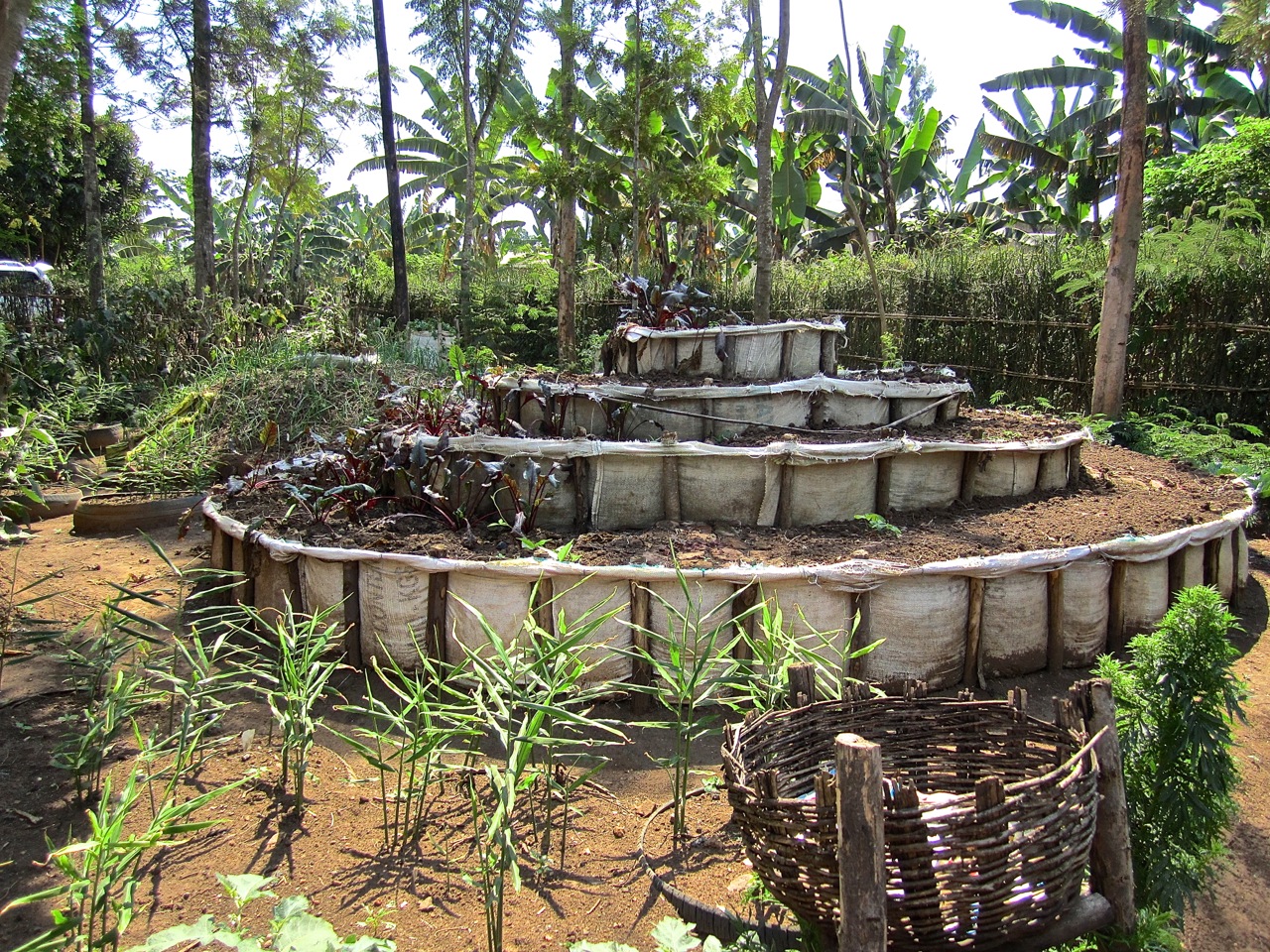
At the other side of the house are several mounded gardens. The one above is terraced, using old nylon rice sacks.
The mounded garden above is a “keyhole garden” — so called because of the opening that allows the gardener access to a center hole . . .
to which compost material is continually added.
(To watch a charming video about making a keyhole garden (by the organization Send a Cow), click here.)
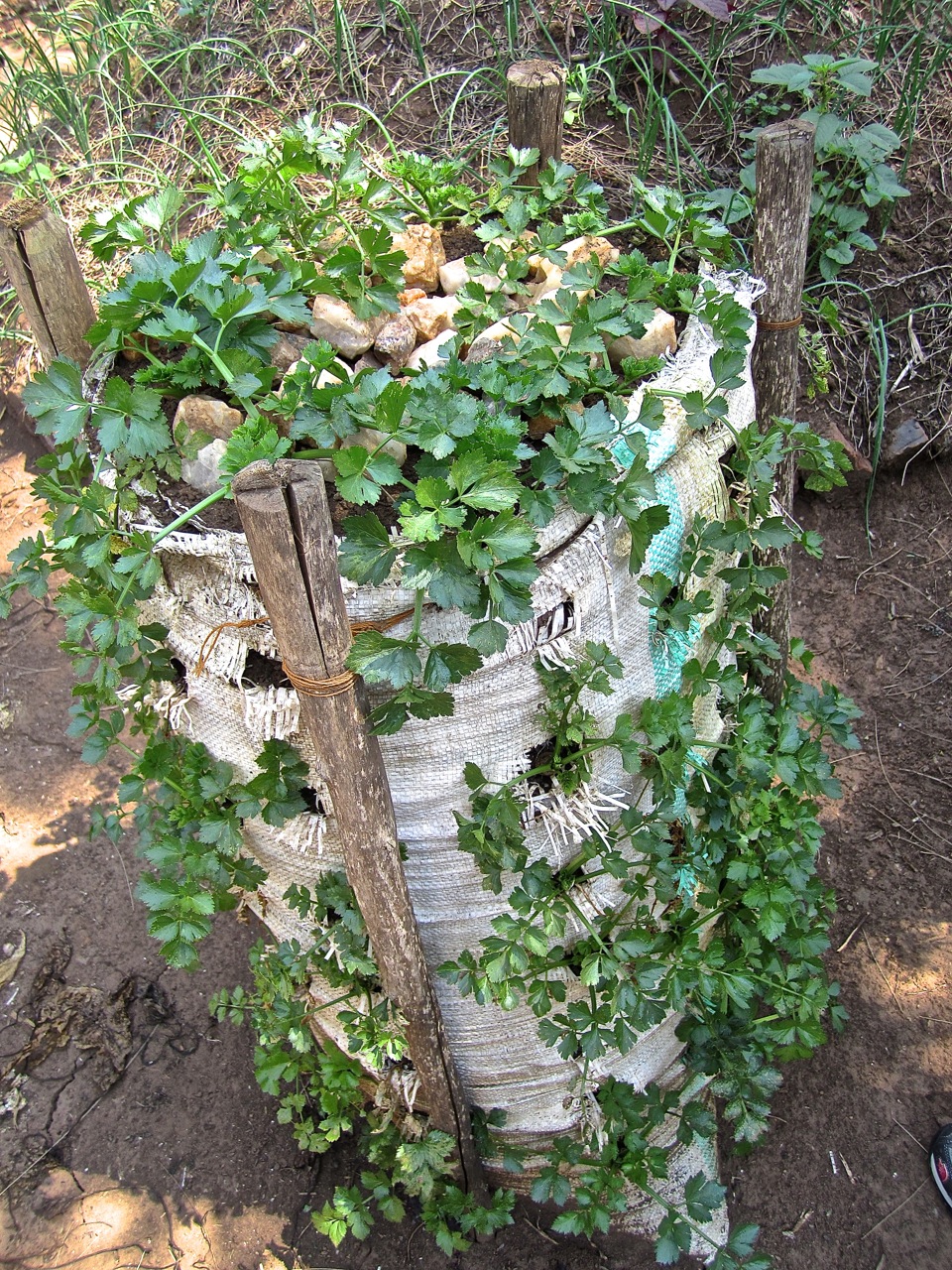
There were also several sack towers, this one planted with parsley. The rocks at the top keeps water moving straight down into the dirt.
A variety of trees surround the garden. This one is a Moringa, which provides food for both humans and animals from its leaves. (More about this highly nutritious tree here.)
In my next post, I’ll continue with our tour of the main GOFTC facility.
First, let me give you a very quick, belated GB Bloom Day. I was too wiped out to post yesterday. I spend most of the day transplanting some shrubs and a bunch of Gerbera daisies and asters. They needed dividing, and it was fiddily work pulling apart all the little roots. And there seemed to be a battalion of ants everywhere I wanted to put them.
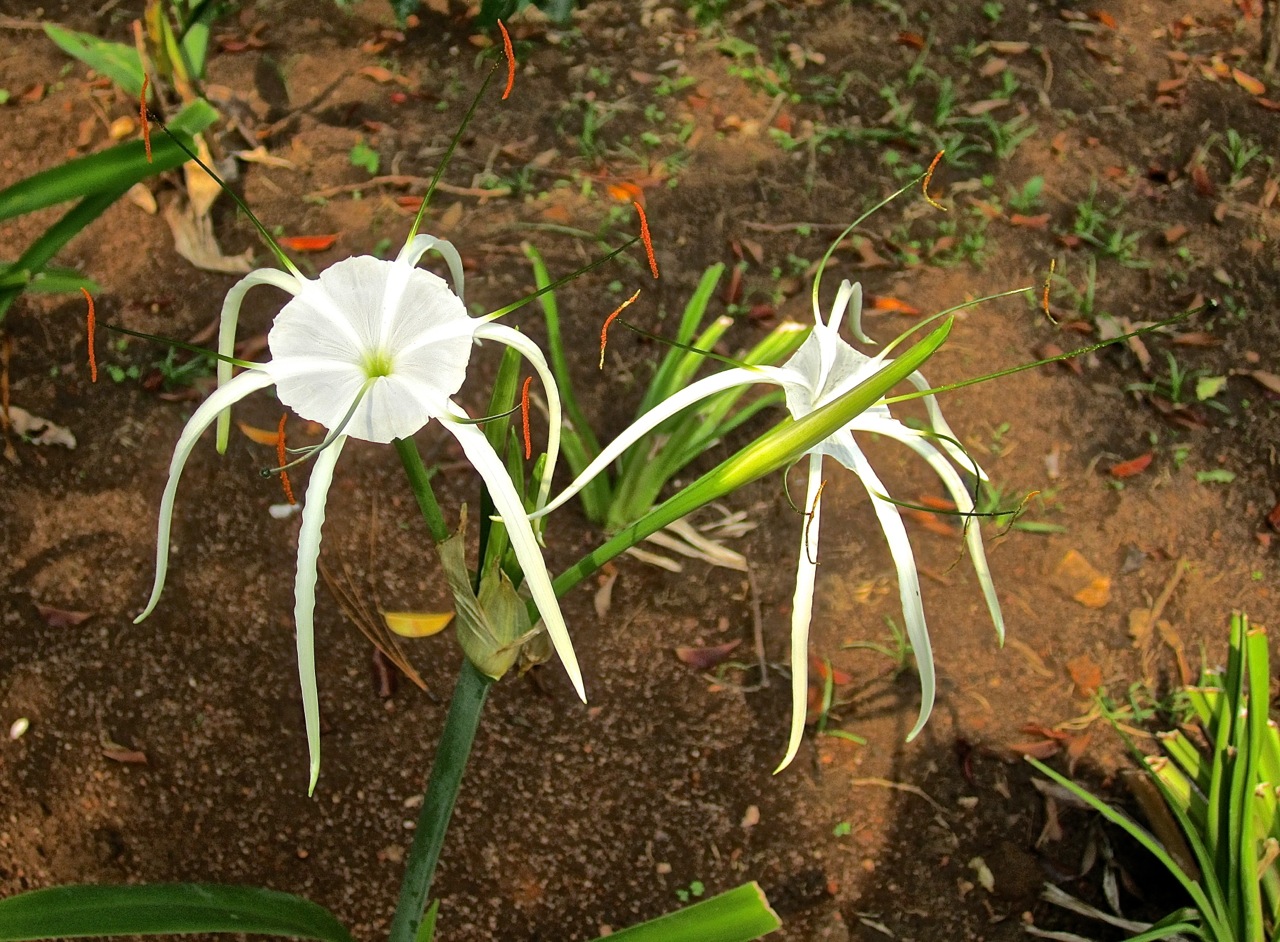
In the last month, as we’ve been renovating the garden, we’ve pulled out about 50 of these beach spiderlilies (Hymenocallis littoralis) from under old bushes and moved them to the front of the newly widened planting beds along the front lawn. They started blooming right away, although they’re a bit sad, since we cut off their leaves as we set them out.
Beach spiderlilies are native to southern Mexico, the west coast of Florida, and Central America, but somehow they made it to Rwanda, where they’re a common garden flower.
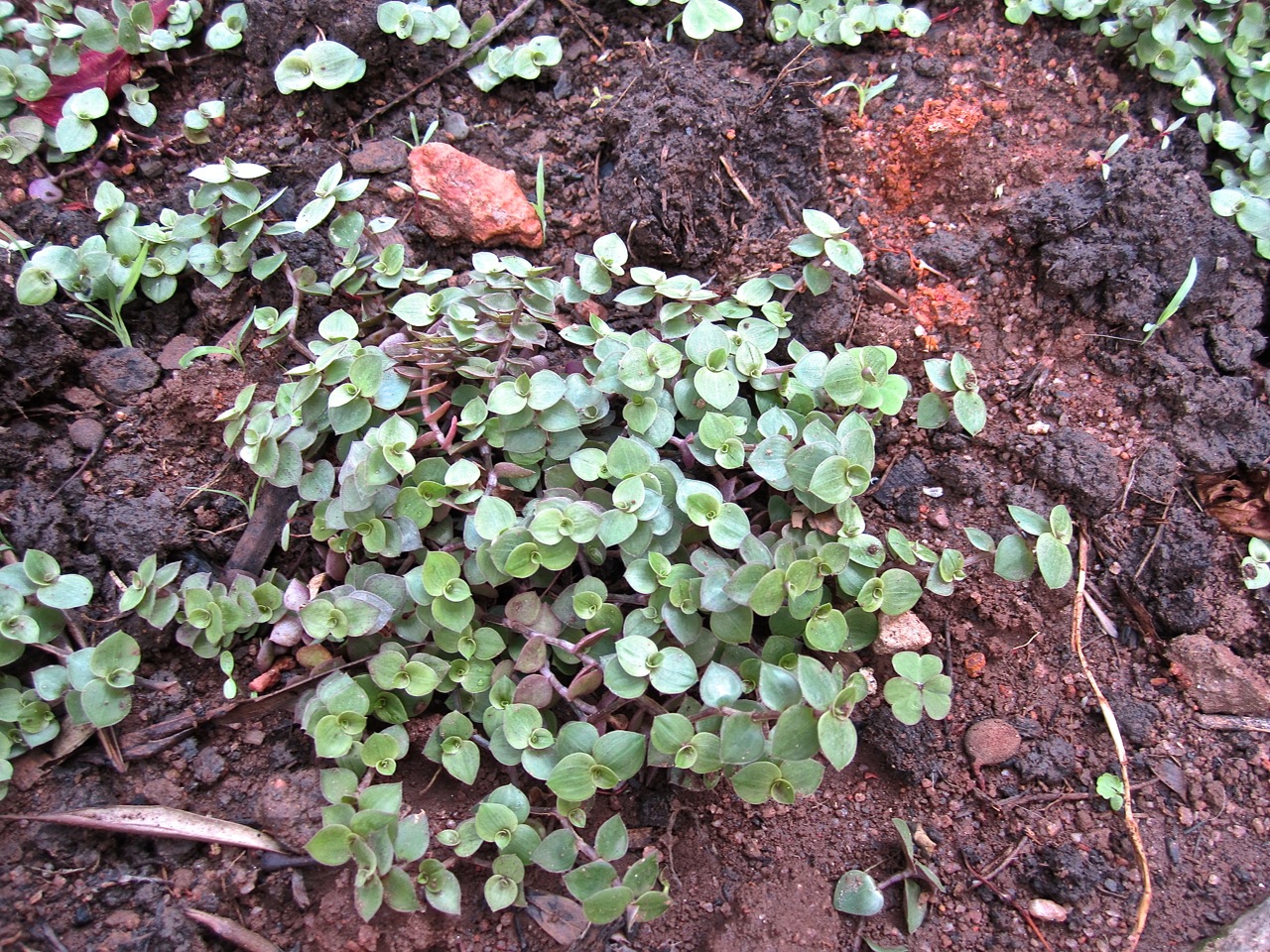
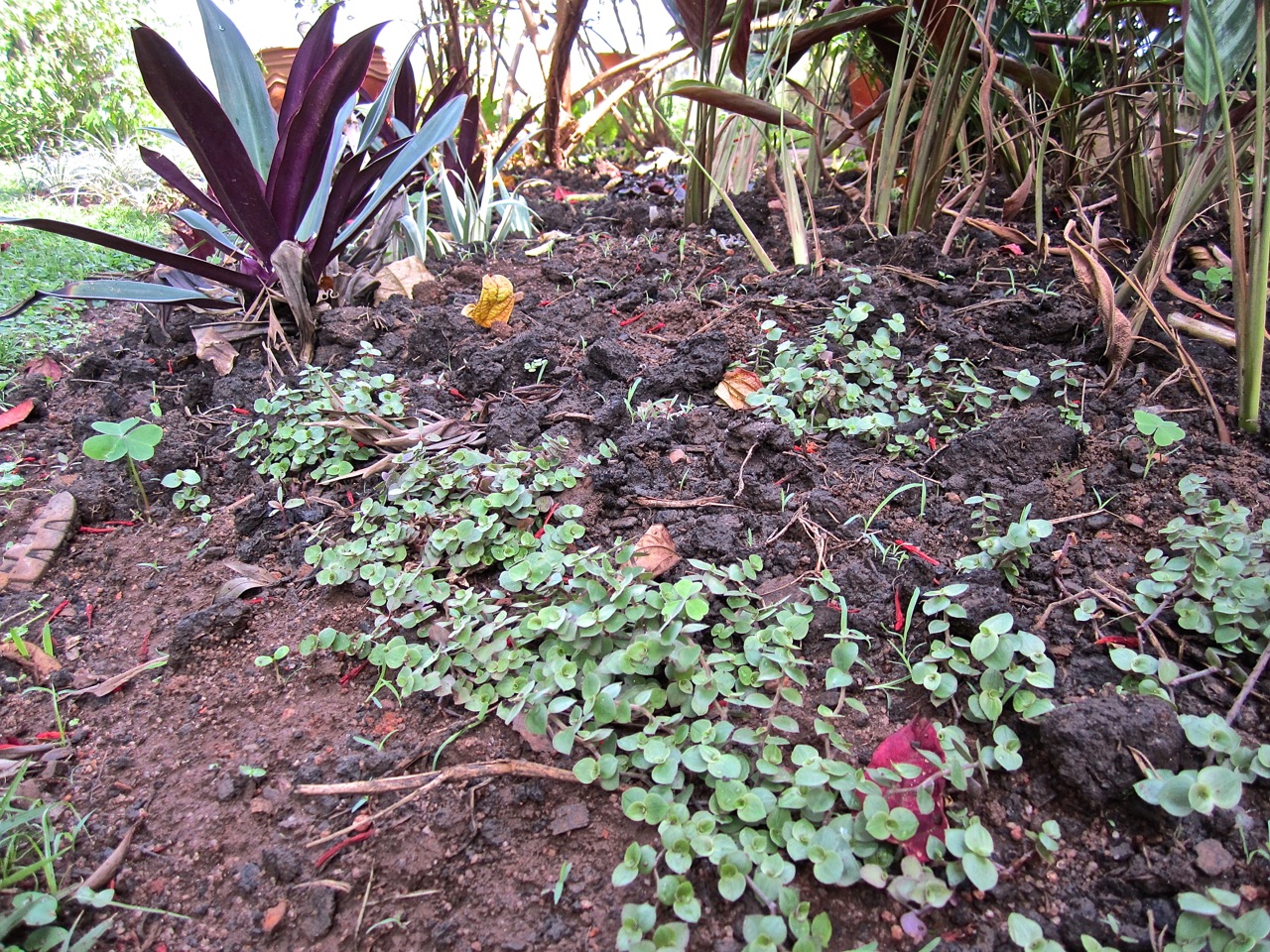
Now on to foliage: the little creeping plant below is a real lifesaver here where you can’t buy that nice bagged mulch to cover all the bare dirt in a newly planted area. I don’t know its name, but we had it in Niger as well. It may be a sedum.
It’s very shallow-rooted, so it’s easy to scoop up a handful, tease it apart a little, and then press it into loose soil under taller plants that need some time to fill out.
It’s grow-your-own mulch. It spreads quickly and can actually get out of hand, but I’ll always be tearing off the overflow for another spot. Or just tossing it — grow-your-own compost too.
In Washington, D.C., I had a spreading stonecrop sedum that served much the same purpose.
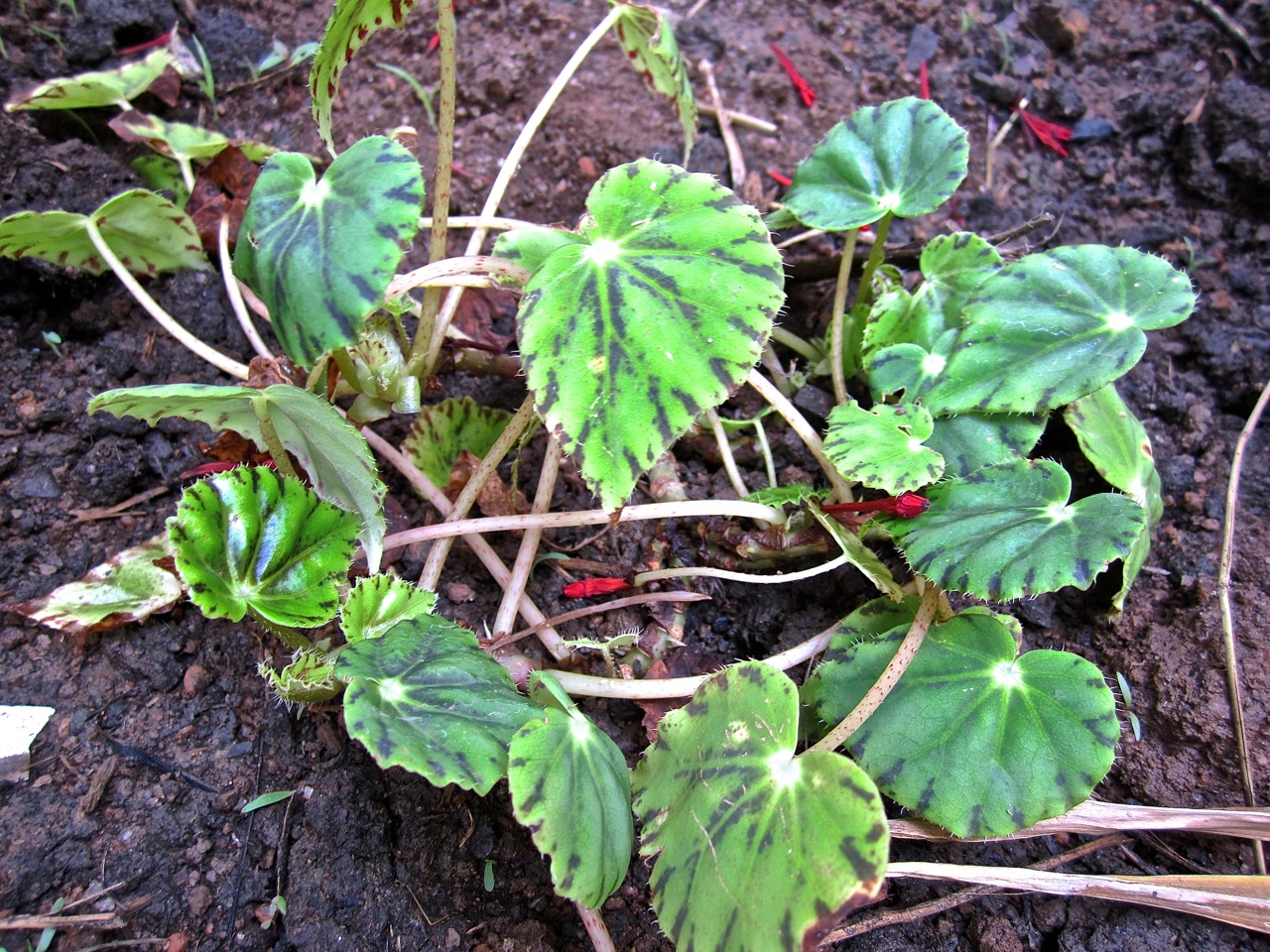
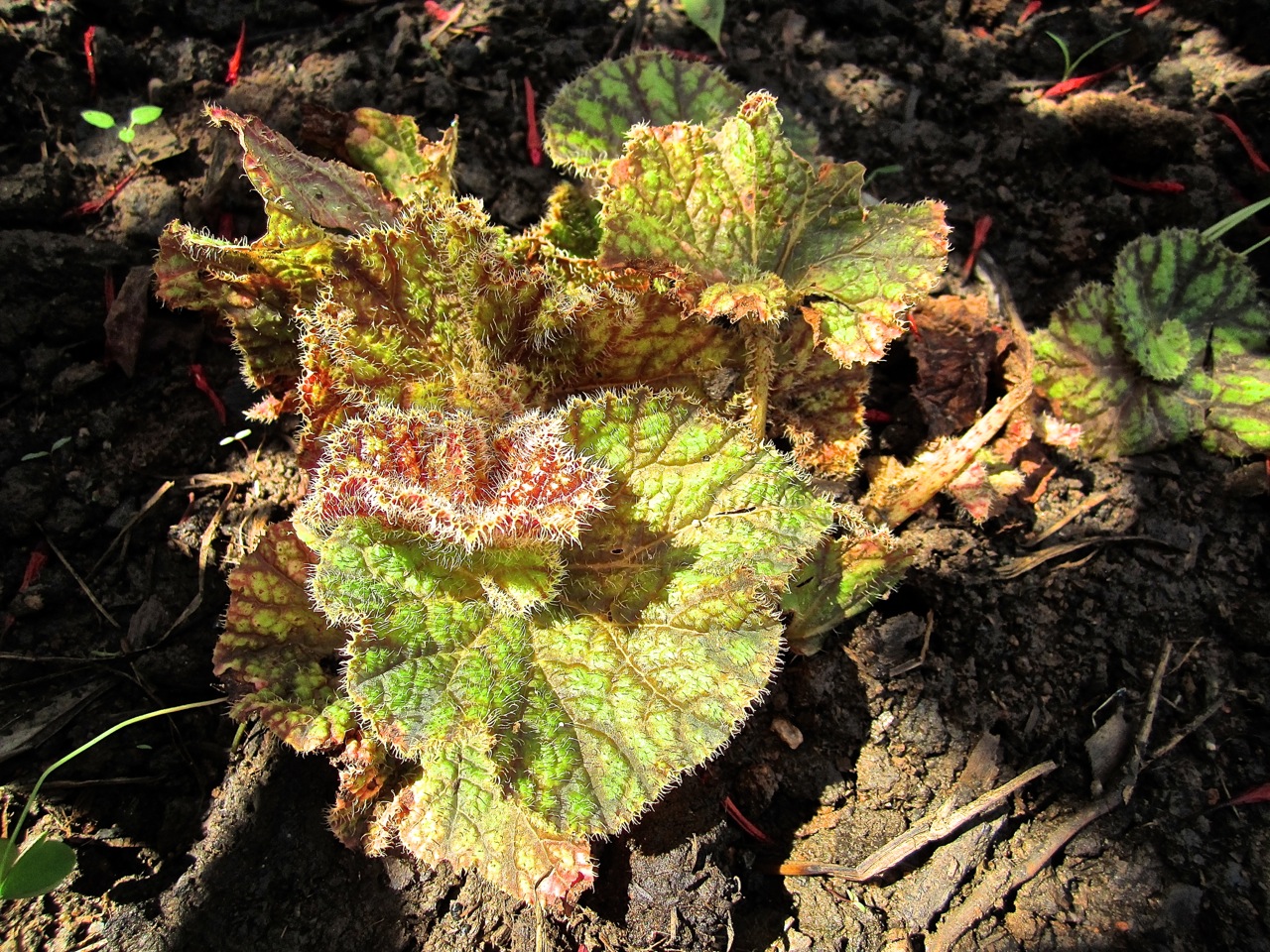
This month, I’ve also been pulling various begonias out of pots and re-planting them in semi-shade as ground cover. They won’t spread as fast as the sedum, but they should make a nice tapestry eventually.
I’m not going to try to name these varieties.
I think there as many different types of begonias as daylilies.
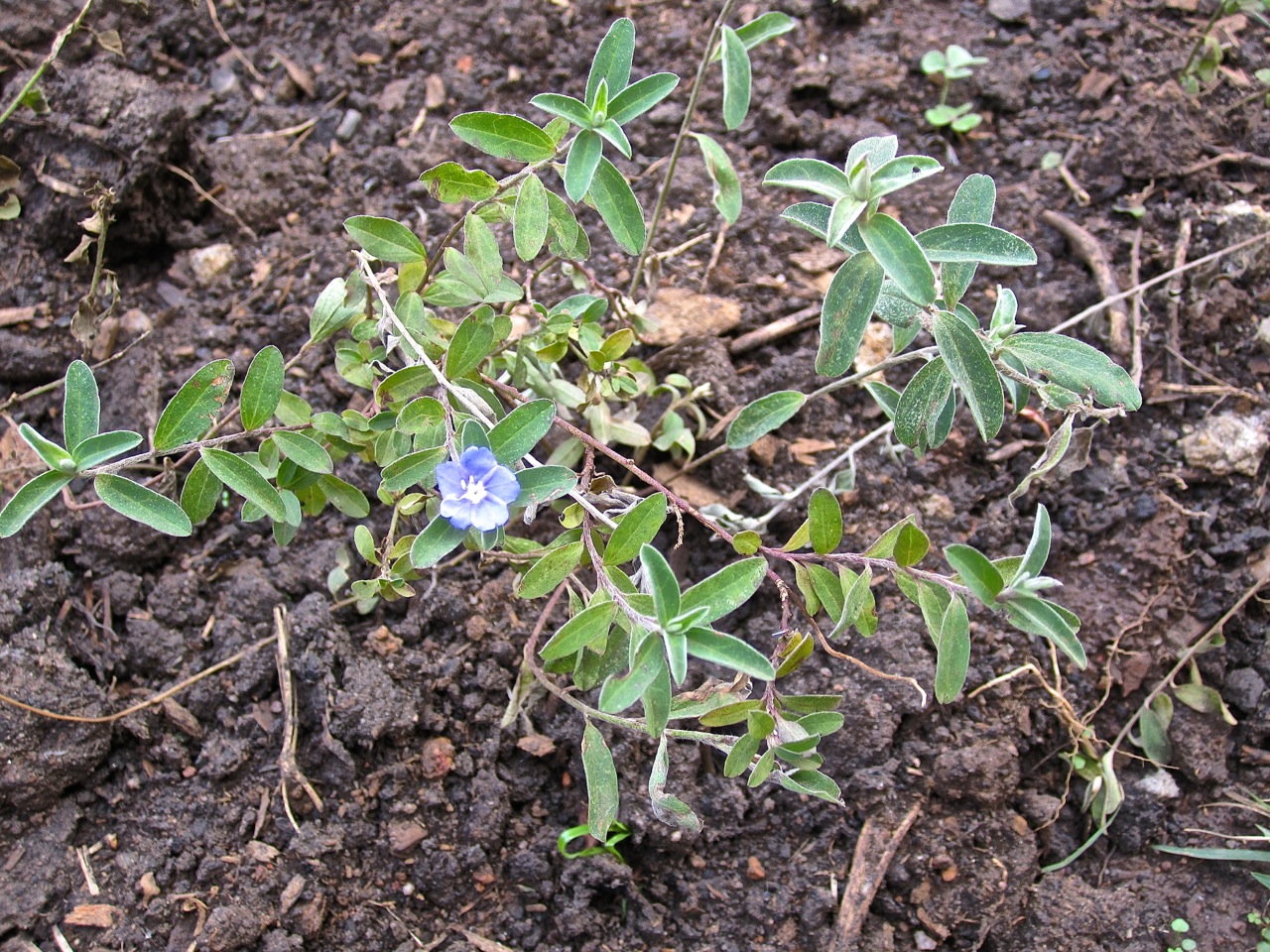
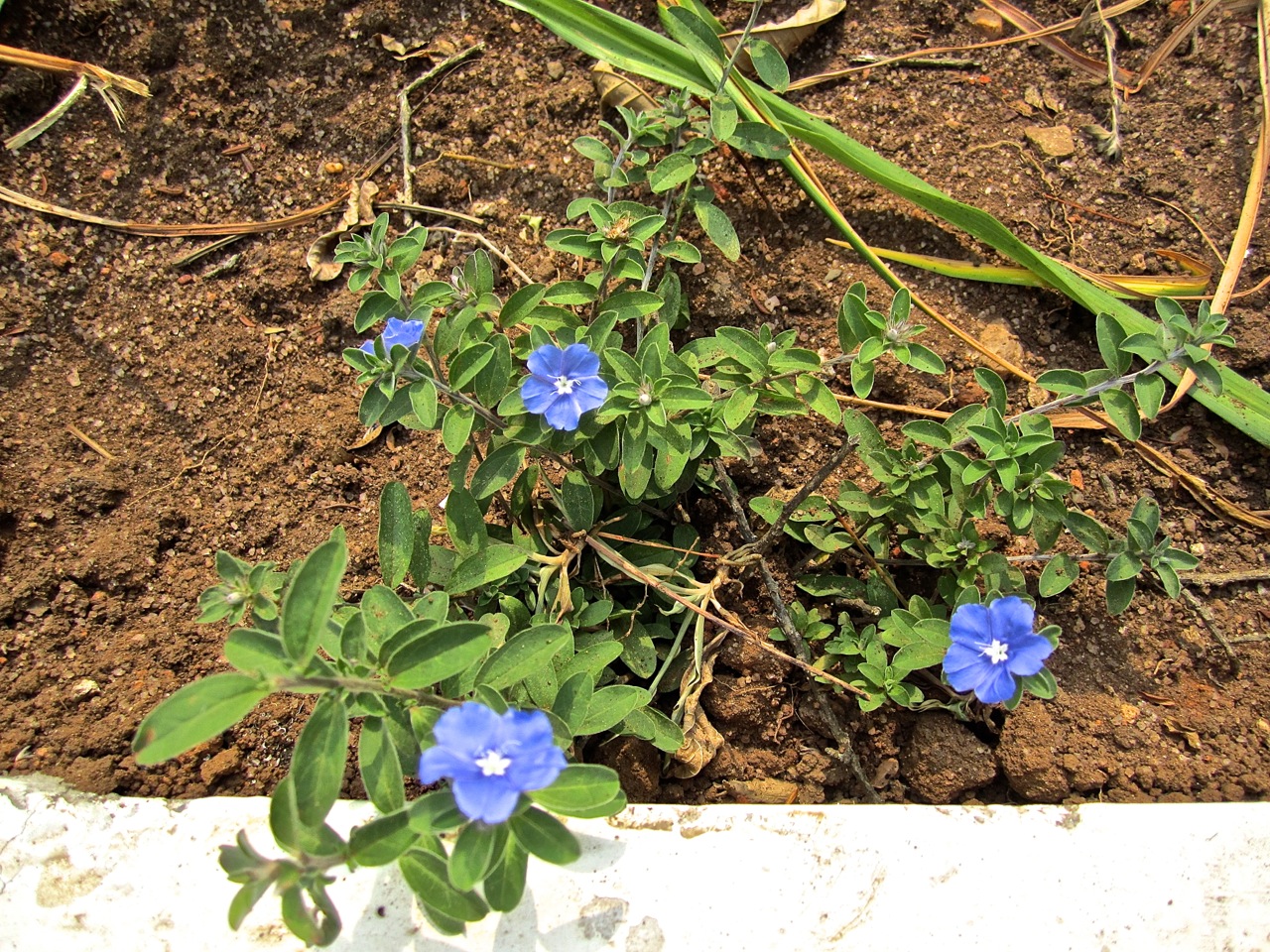
Below is great spreading plant for which I don’t yet have a name. I found it behind the back parking area, hidden by the curb. I’ve been dividing and planting it everywhere.
It has true blue flowers.
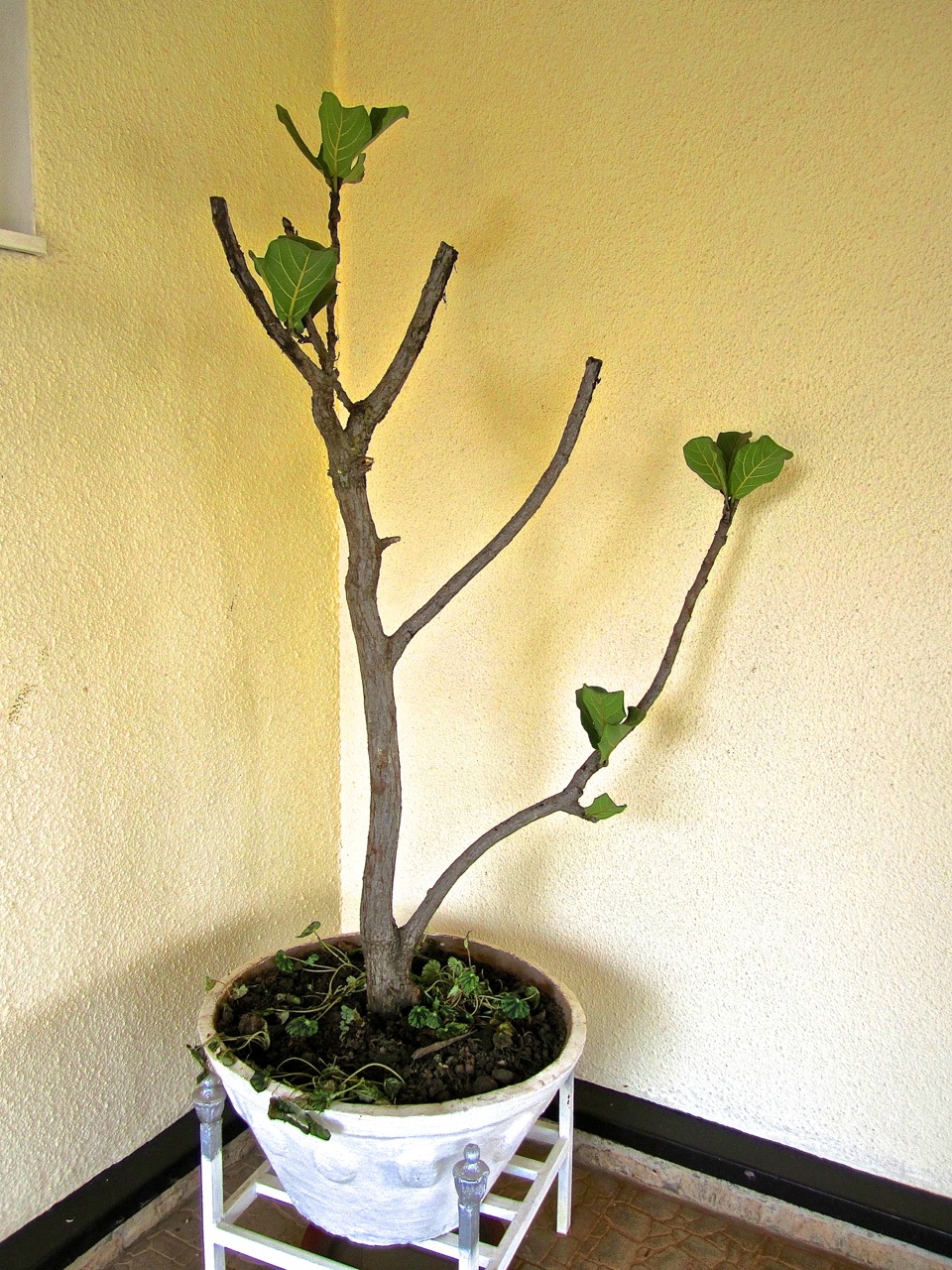
I’m not really a pots person. In the last couple of months, I’ve mostly been removing the plants from a lot of the old pots that I’ve found all around the house and putting them in the ground. However, I did recently create this rather pitiful arrangement.
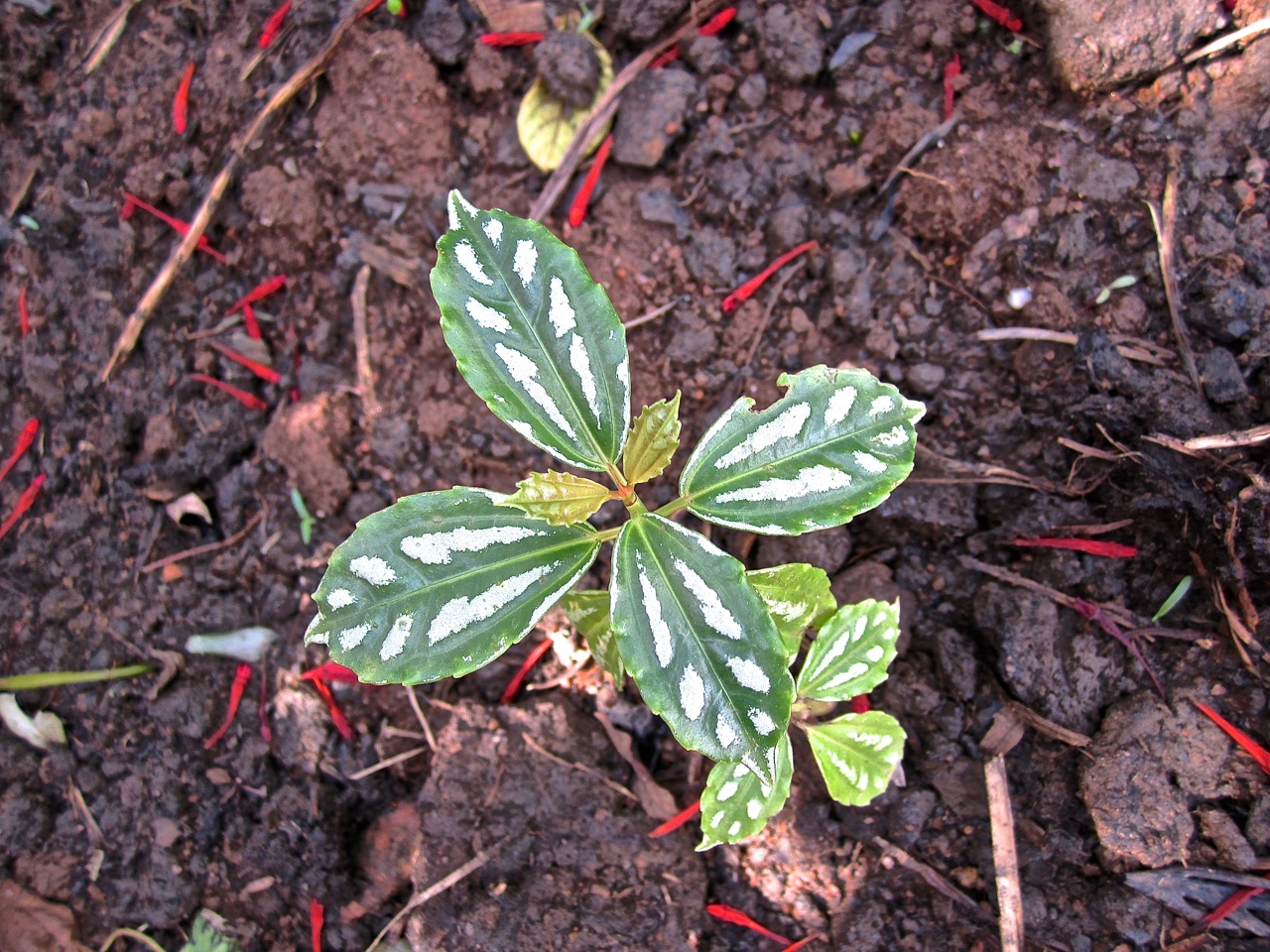
The tree — one of those big-leafed Ficus that you see in chic rooms in House Beautiful — was in another pot at the side of the house, baking in full sun. We pulled it out and pruned its roots and top. Then, we put it in this prettier pot in the bright shade of the terrace, underplanted with the little round-leafed begonia shown above.
I’ve got my fingers crossed that it will eventually put out new leaves. [UPDATE: It recovered beautifully.]
To see what’s blooming in other garden bloggers’ gardens, check out May Dreams Gardens, and thanks to Pam at Digging for hosting Garden Bloggers’ Foliage Follow Up the 16th of every month.
I’m afraid I’ve let all the work we’ve done on our Kigali garden recently move well ahead of writing posts about it.
We — the gardener, two temporary workers, and I — made some substantial changes during June. So much so that we’re now taking a week or so of relative rest before the gardener and I start phase two. (When I got up in the middle of the night about a week ago, I thought I was going to die, my muscles were so sore.)
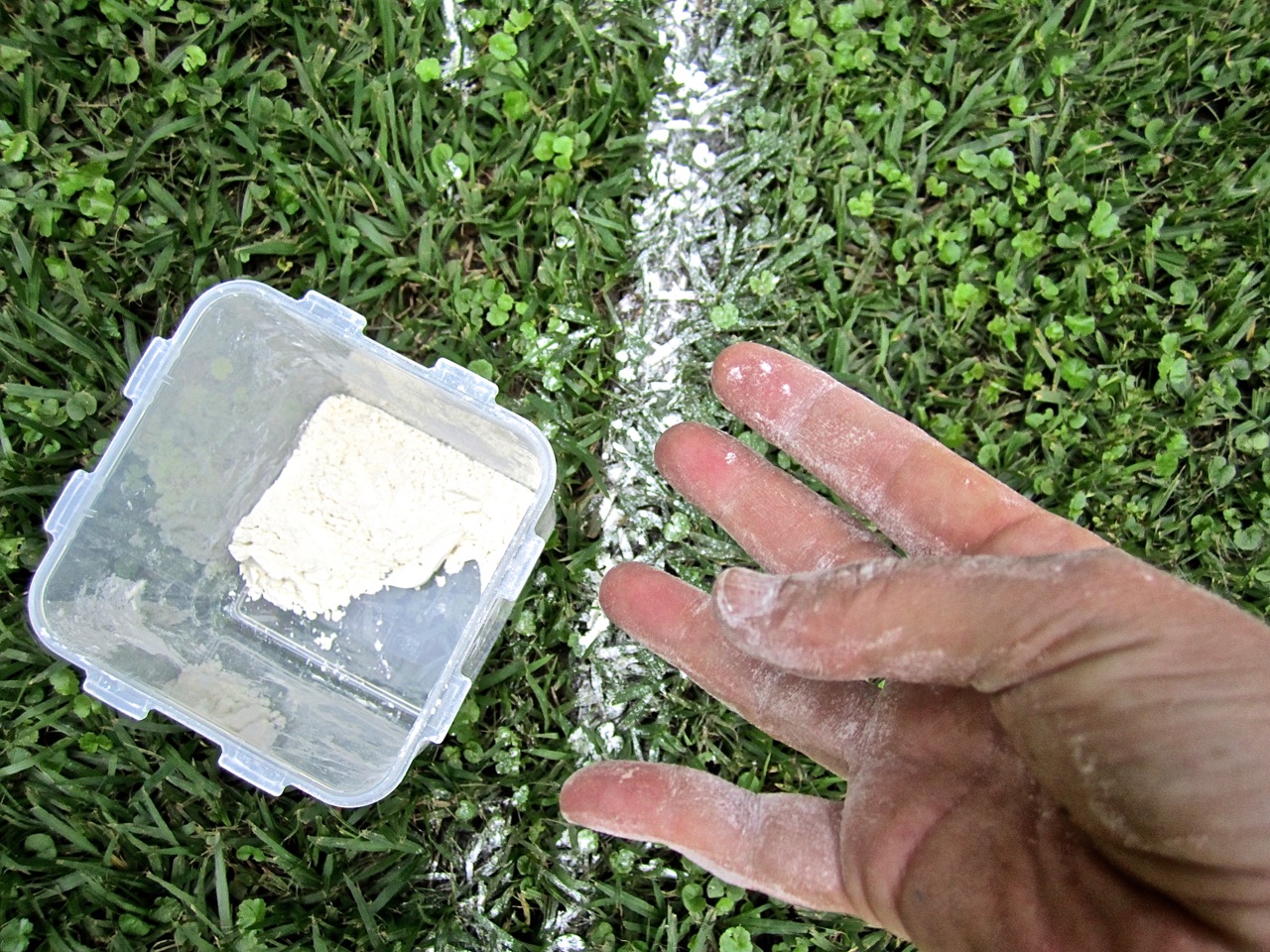
Hint: I’ve been using flour to mark the new outlines of planting beds.
So while we pause, I’ll back up and give you some “before” pictures and a little site analysis.
(I’m going to use the present tense while describing the old garden features, so as not to give away the changes we’ve made).
This is a good-sized, “working” diplomatic garden that hosts two or three receptions or ceremonies a month. It’s very pretty and lush, with mature trees and many flowering shrubs. But it also has some problem areas — places where purpose is ill-defined, opportunities for drama or charm are missed, transition points are weak, and many plants are too old or badly pruned or overcrowded.
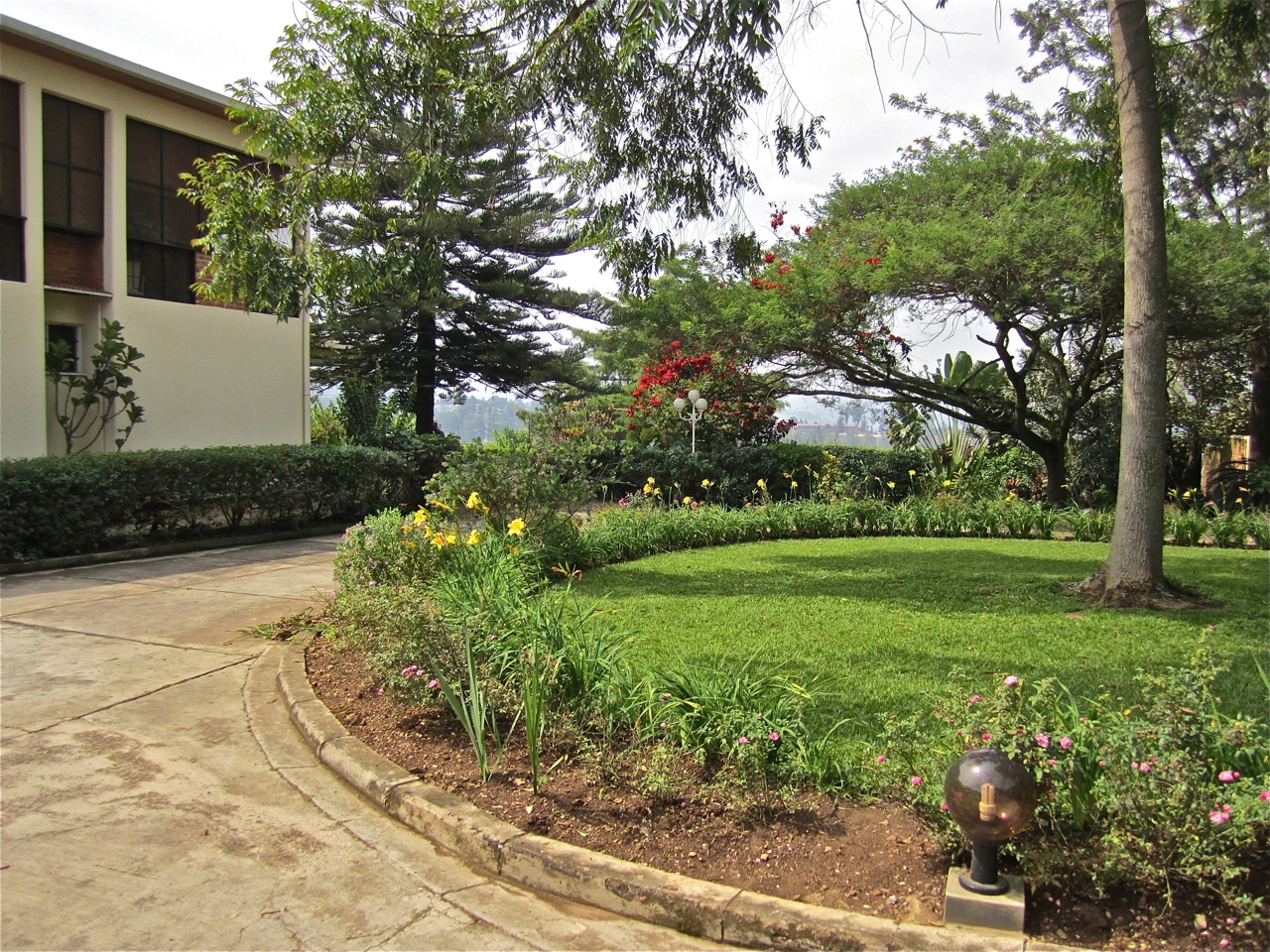
The first photo below shows the view when you enter the gate to the property: one end of the house, the circular driveway, and a semicircle of grass edged by day lilies and miniature roses. (If you look left, you see the back of the house and a parking area.)
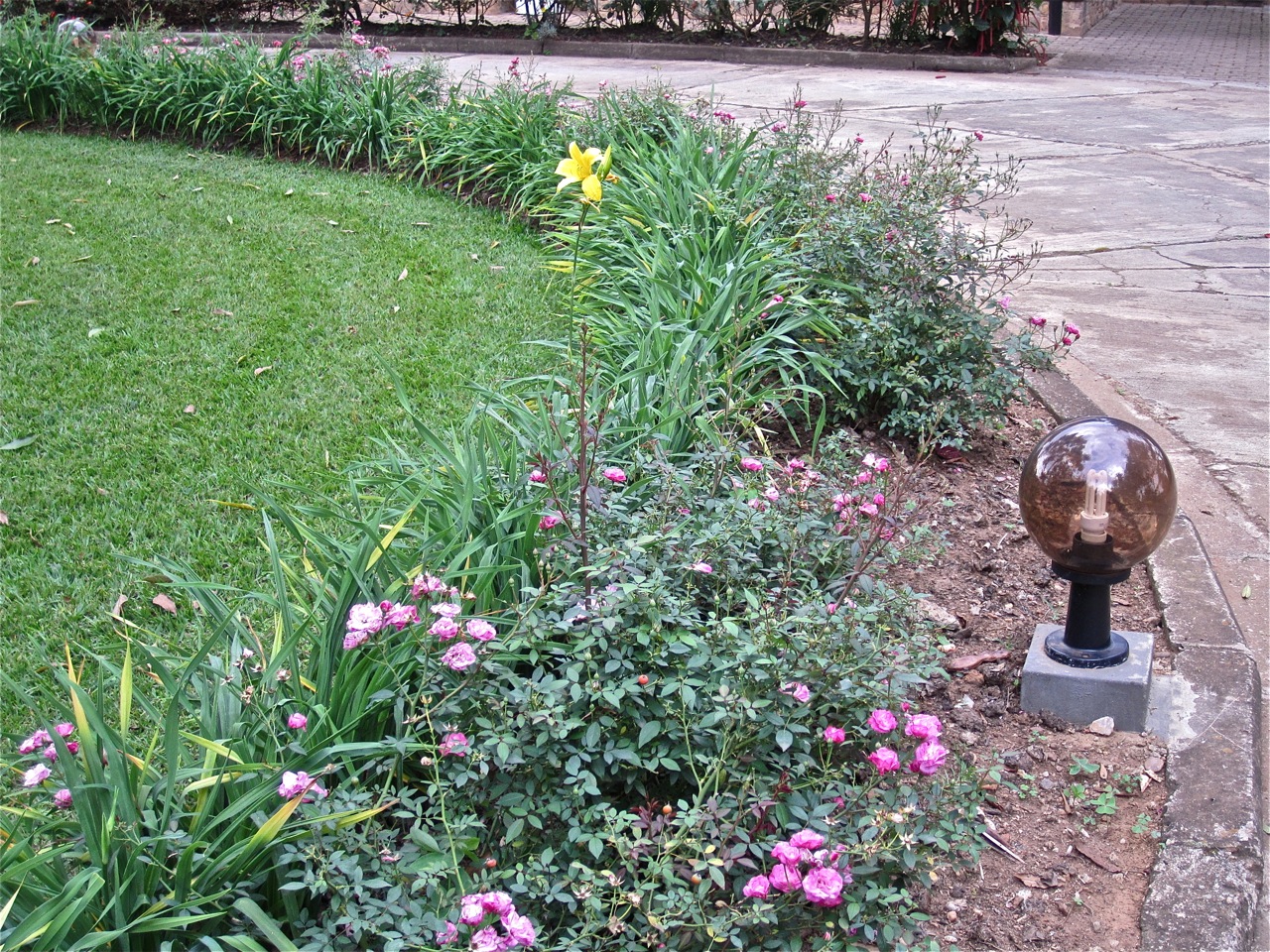
In the semi-circle, shown above and below, the miniature pink shrub roses (possibly “The Fairy” variety) are planted in a line along the curb, and the yellow day lilies are lined up right behind them. I’m not fond of the yellow/pink combination, but my main concern is that the single-file arrangement — the first thing you see when you walk or drive into the enclosure — is skimpy and makes a weak impression.
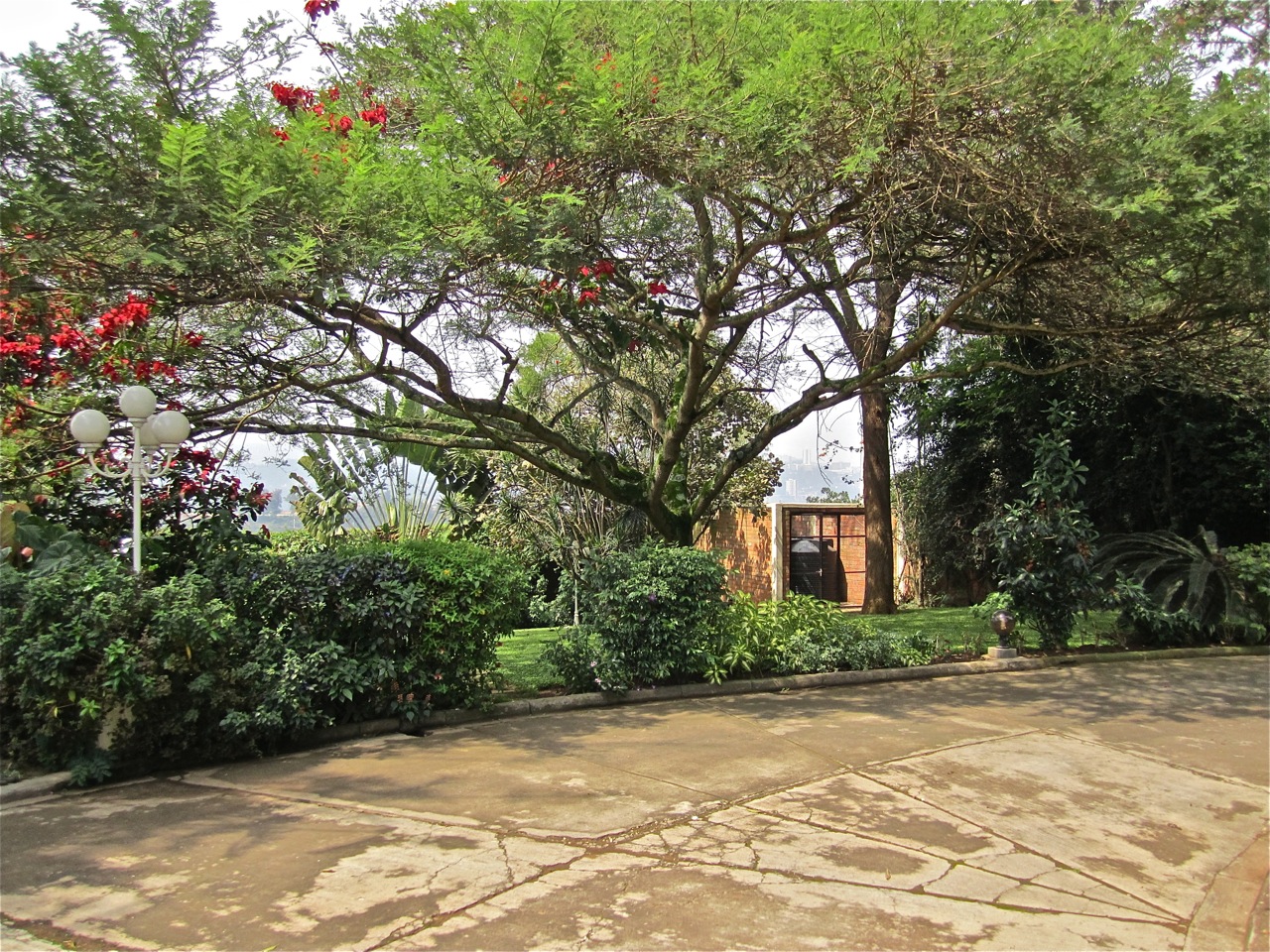
Looking right across the semi-circle, below, you see a beautiful spreading acacia tree, but its impact is obscured by the shrubs and plants growing along the edge of the drive.
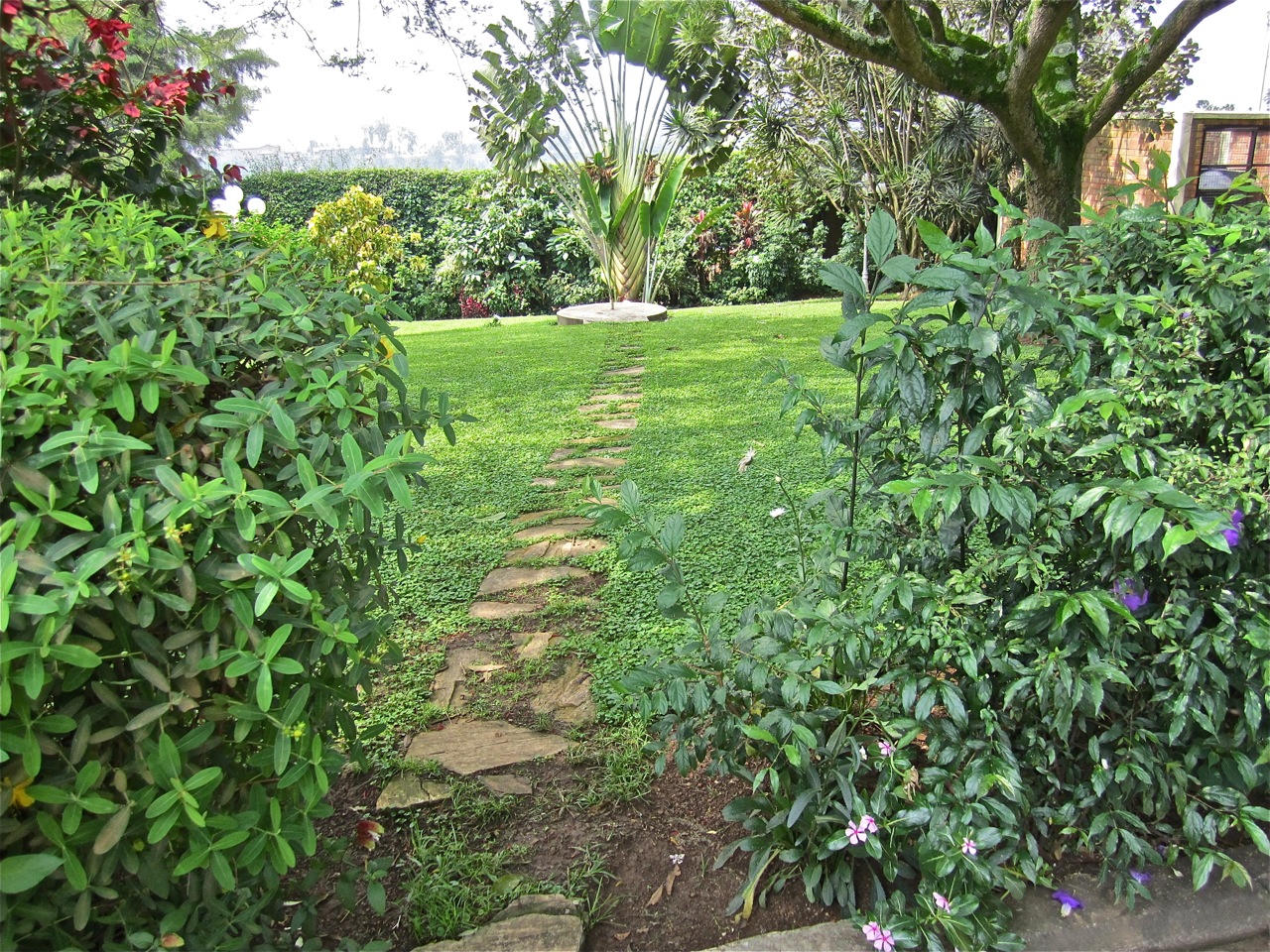
If you slip in a small space between a couple of those shrubs, as in the photo below, you find an old stone path leading to a no-longer-used concrete flagpole base. And to the left of the concrete base are steps to the long front lawn.
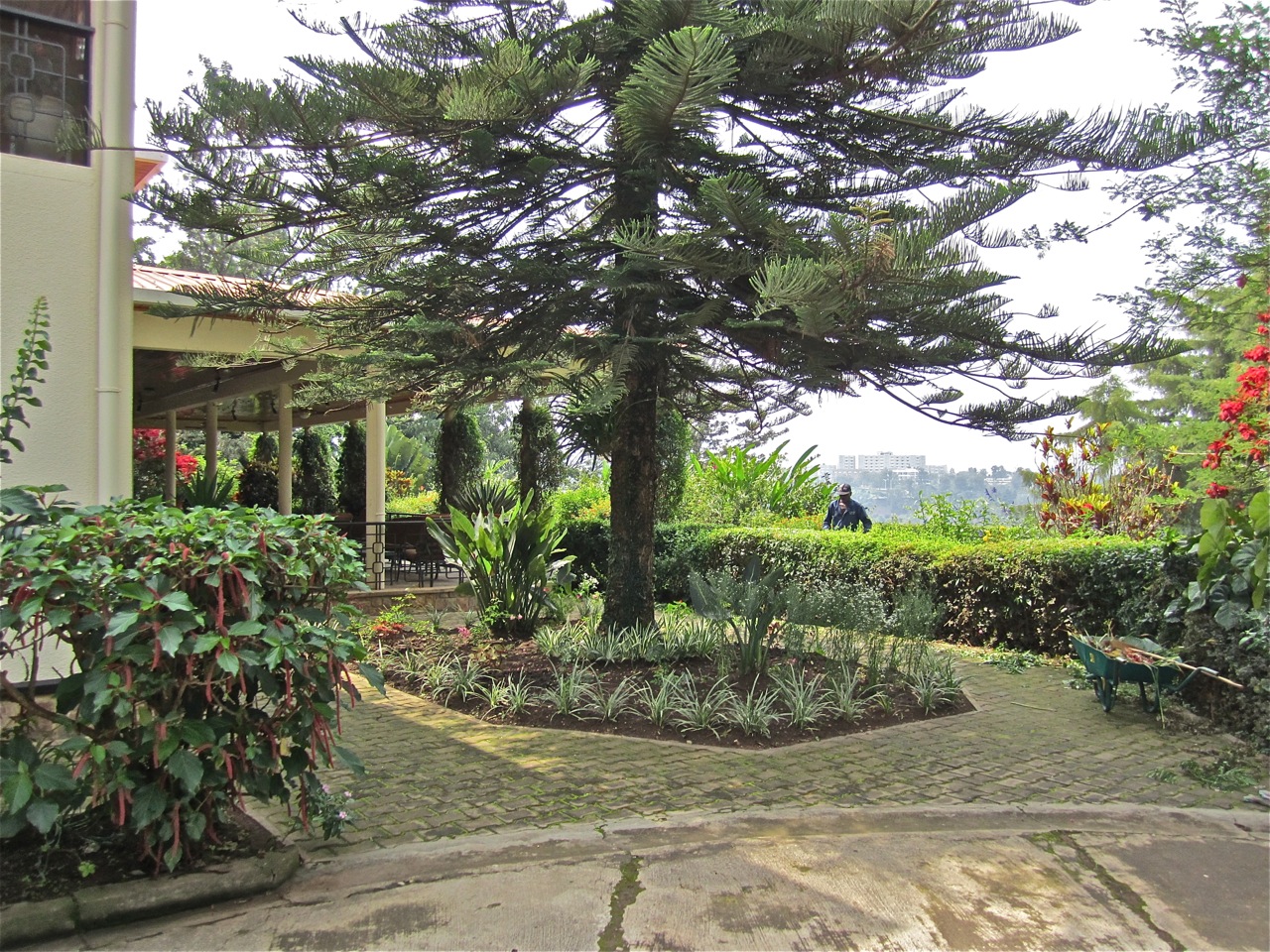
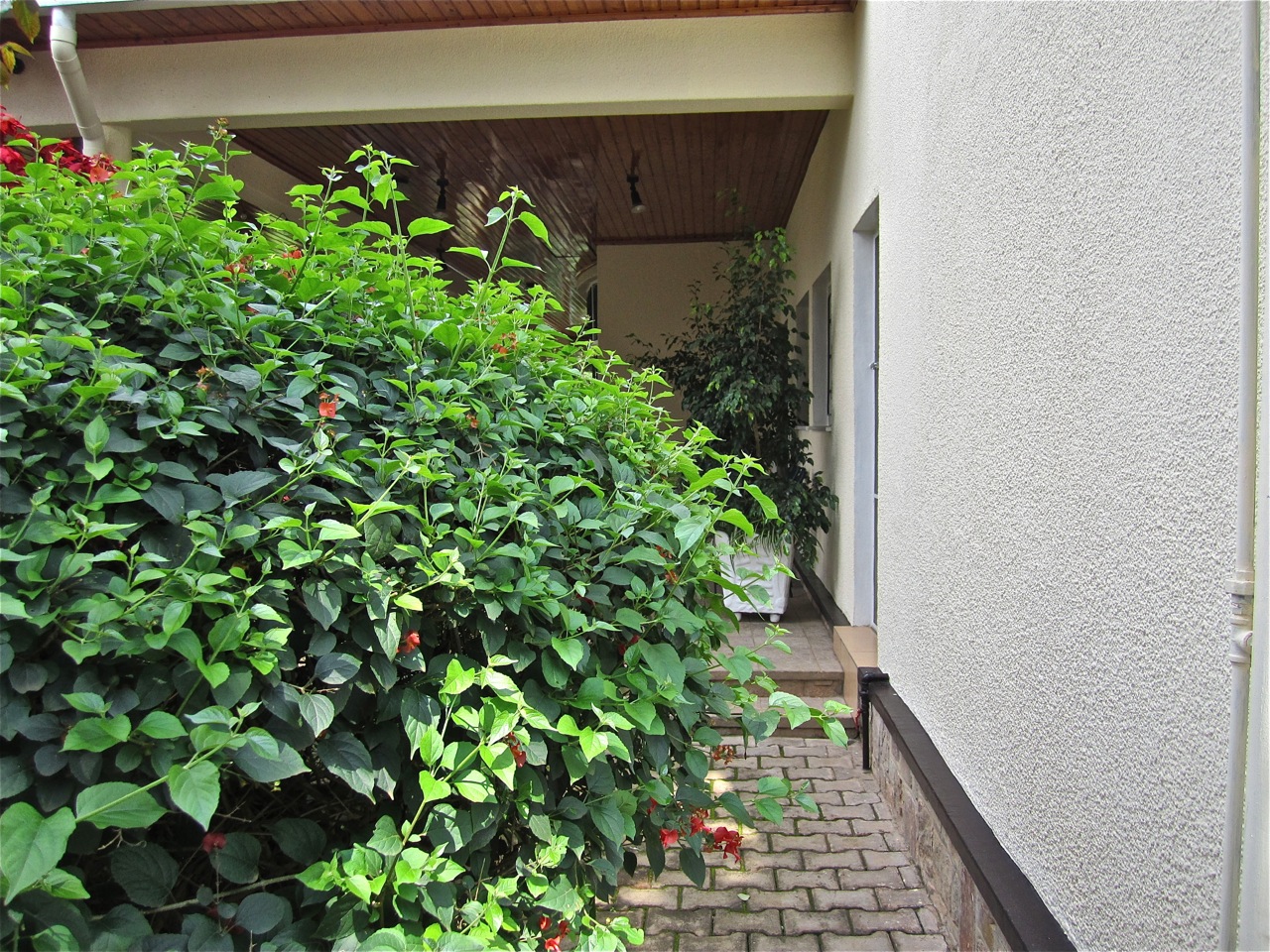
Below, the photo shows the side entrance to the front terrace. (If you back up to the starting point in the first photo above, walk down the drive along the side of the house, you reach this point.) This is where we welcome guests. Because of the planting bed in the center, and the clipped hedges at the edge, the paved walkways only comfortably allow for two people to stand side by side.
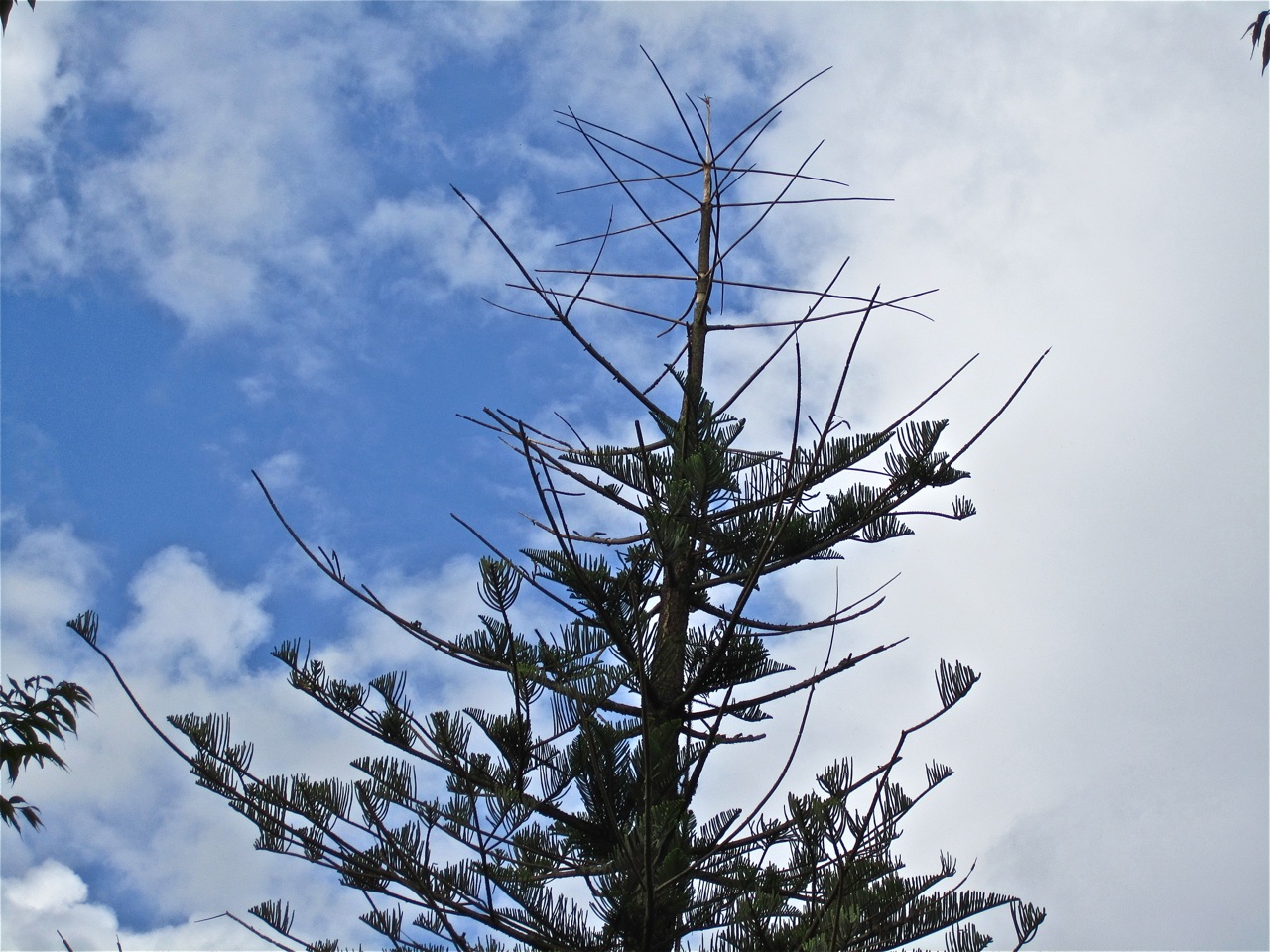
The hedge is made up of plumbago, lantana and other flowering plants, but the blooms are mostly sheared off. In center of the planting bed is a tall Norfolk pine and a rather skimpy assortment of small roses, asters (I think), lirope, coleus, and a bird of paradise.
Unfortunately, the tree is dying.
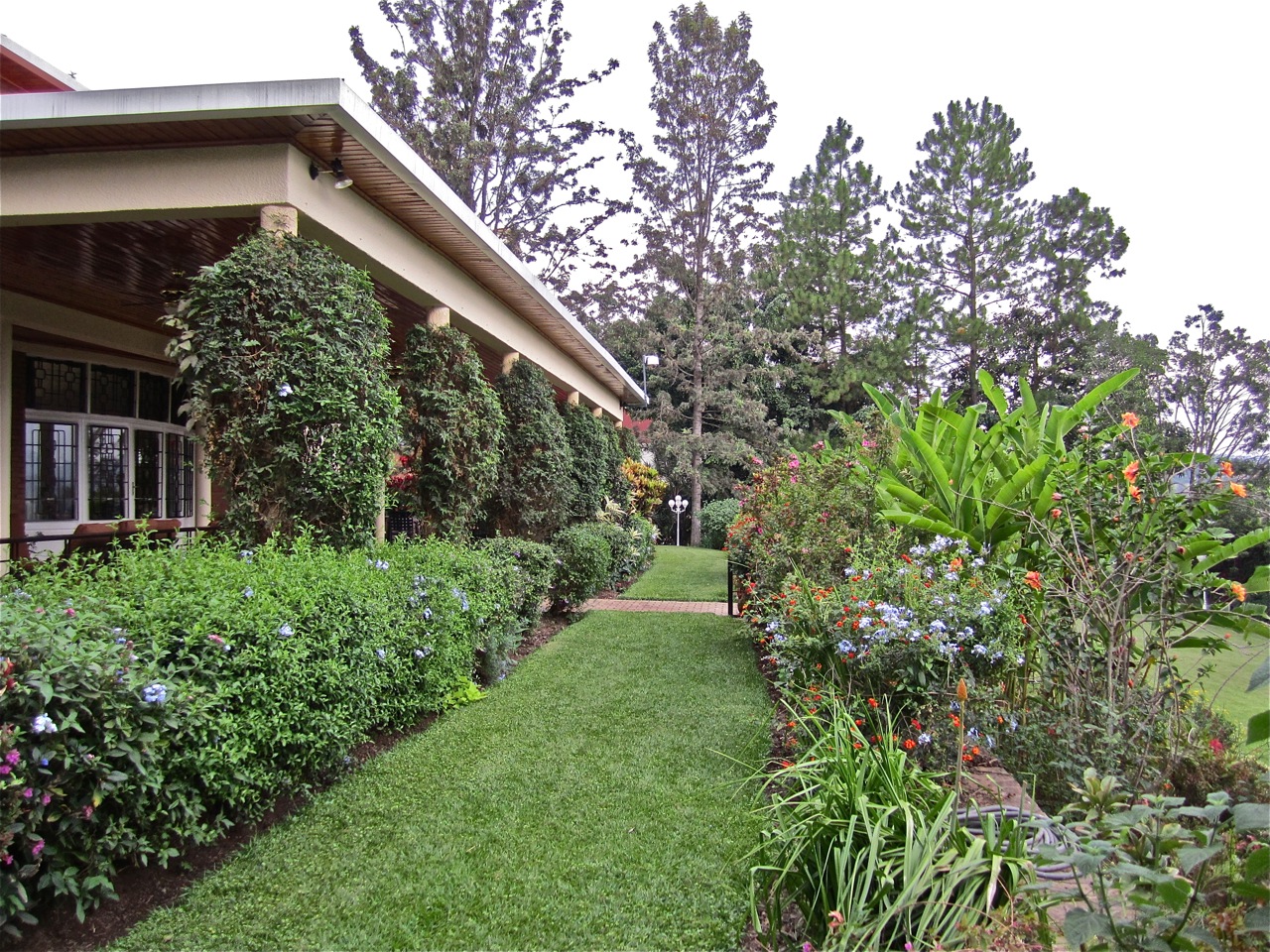
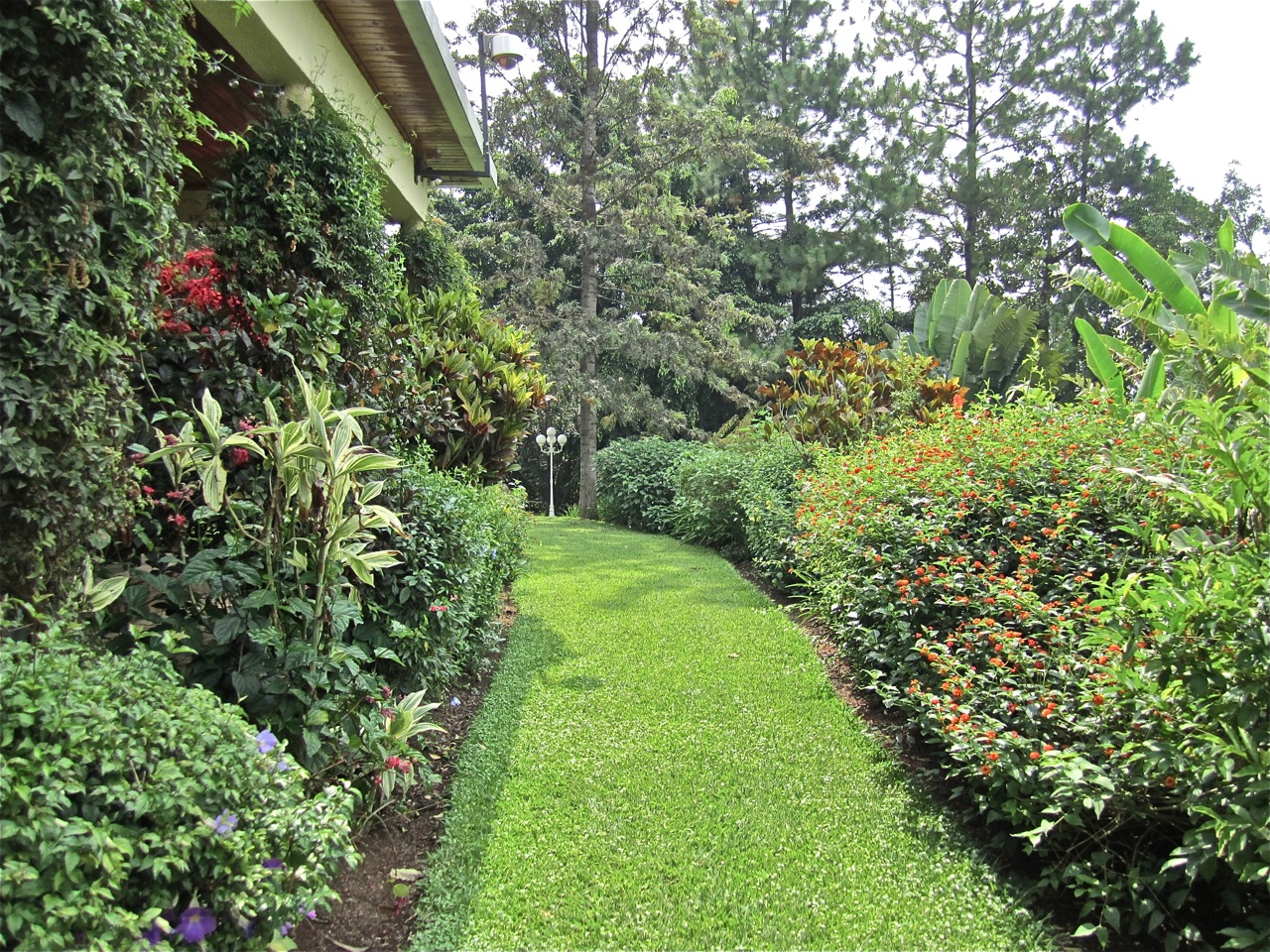
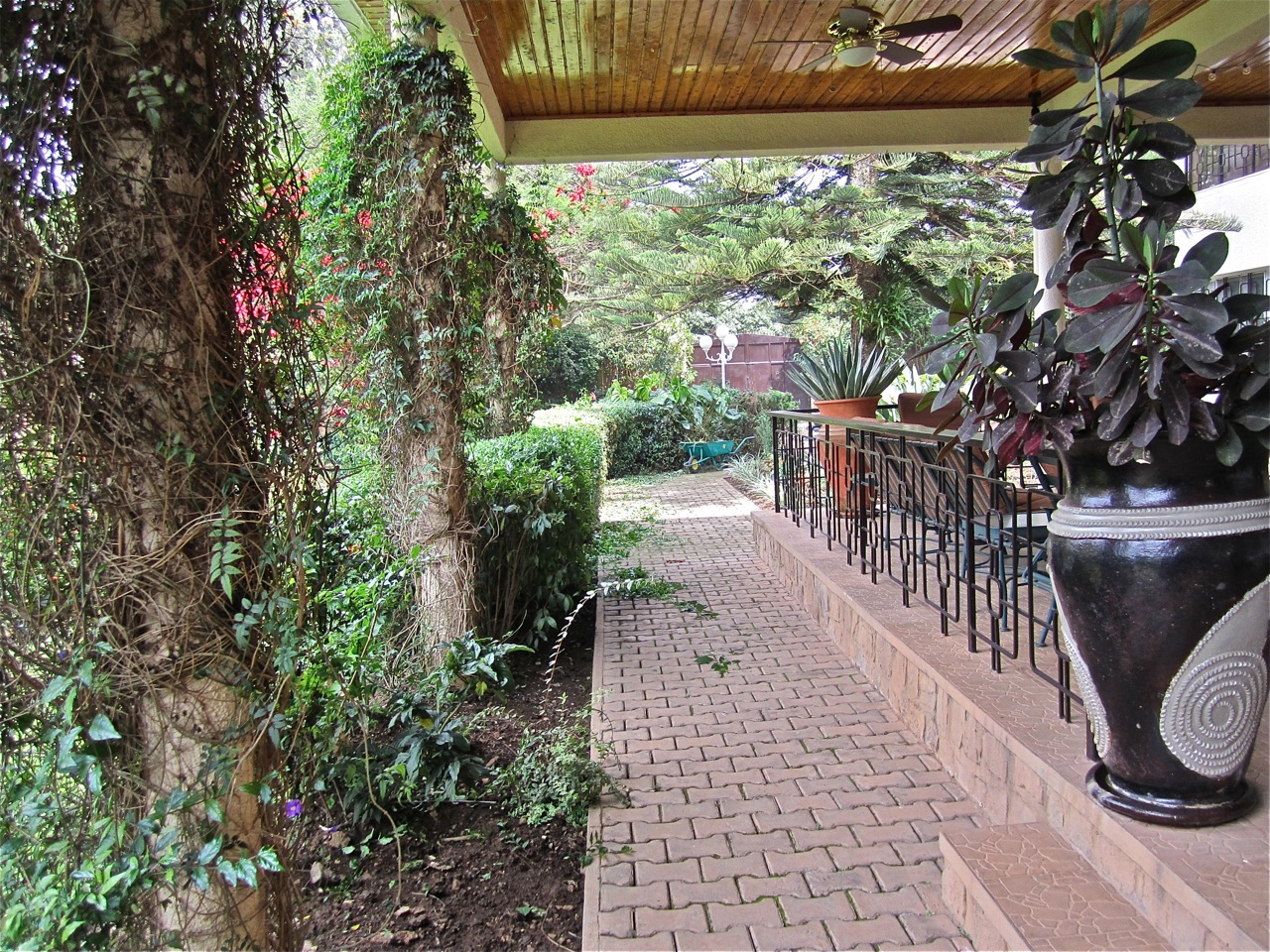
If you step through this area, you’ll be on a long terrace along the front of the house. As you can see in the photo below, in front of the terrace are two rows of (mostly) clipped shrubs and a path of grass between them. Plumbago and jasmine are growing up the house columns. The vines and shrubs attract colorful little birds right up to the terrace. However, the vines on the backsides of the columns are bare and brown from constant shearing and a lack of light.
The shrubs right along the terrace make it feel closed in, and I believe that mosquitoes hide in there in the evening.
While the arrangement is rather pretty, the grass path serves little purpose — it’s mostly blocked by the shrubs on one end, and it’s too narrow for seating. The tall plants on the right in the picture above — particularly the 6’+ lobster claws (Heliconia rostrata) — obscure the view of the hills and the city.
There are a lot of great plants in the beds on either side. And I always imagine Alice running through some part of Wonderland when I look down this side of the path (above).
Unfortunately, the terrace side of this strip (above) gives me an unpleasant crowded feeling, and the leaves of the vines die off from lack of good light.
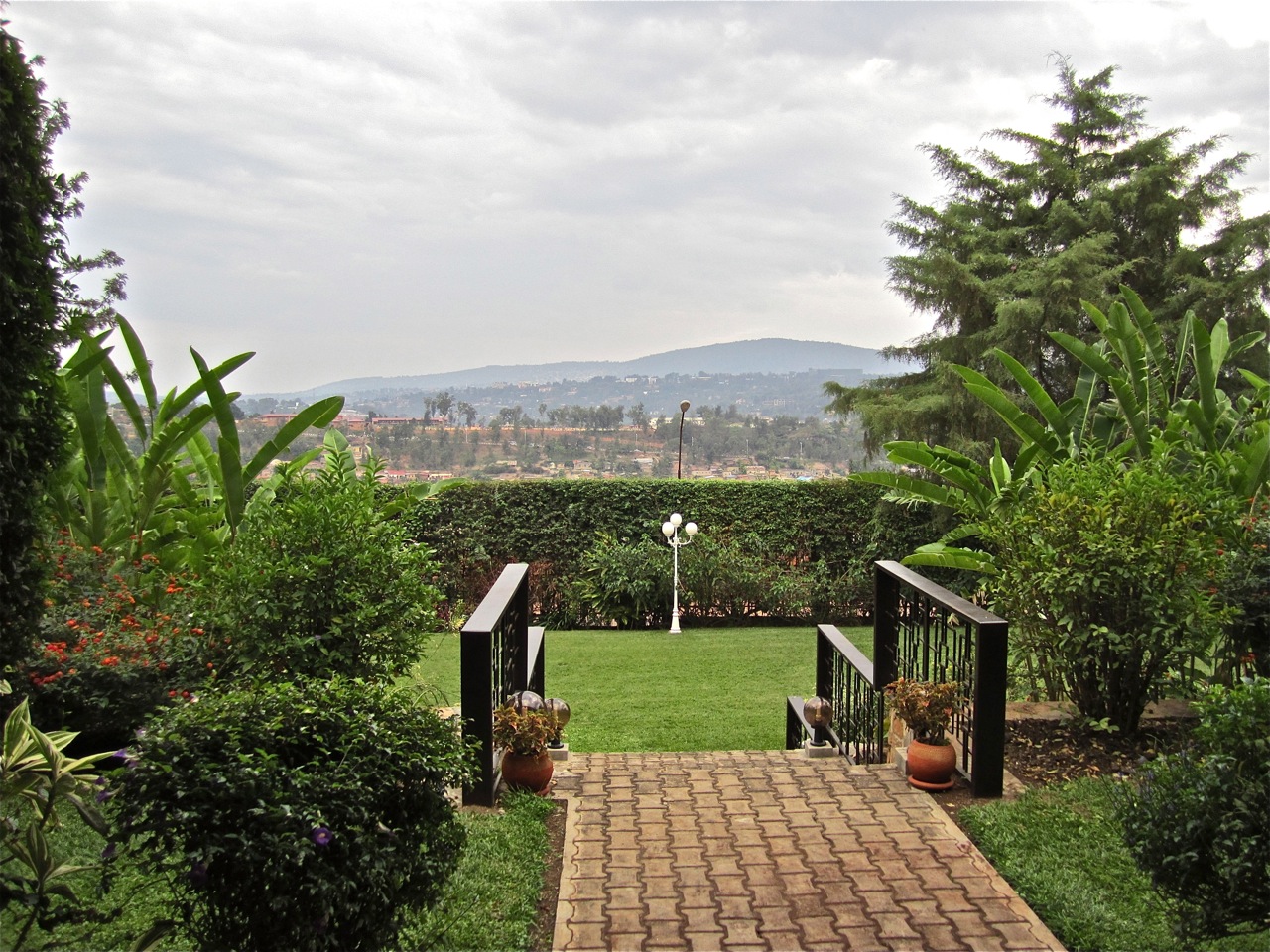
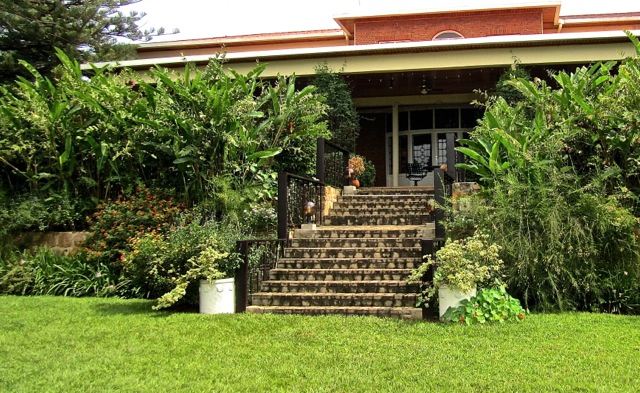
Above is the view from the center of the terrace. It’s somewhat blocked by the tall lobster claws on either side of the steps. Down those steps are two levels of stone retaining walls and then a long lawn.
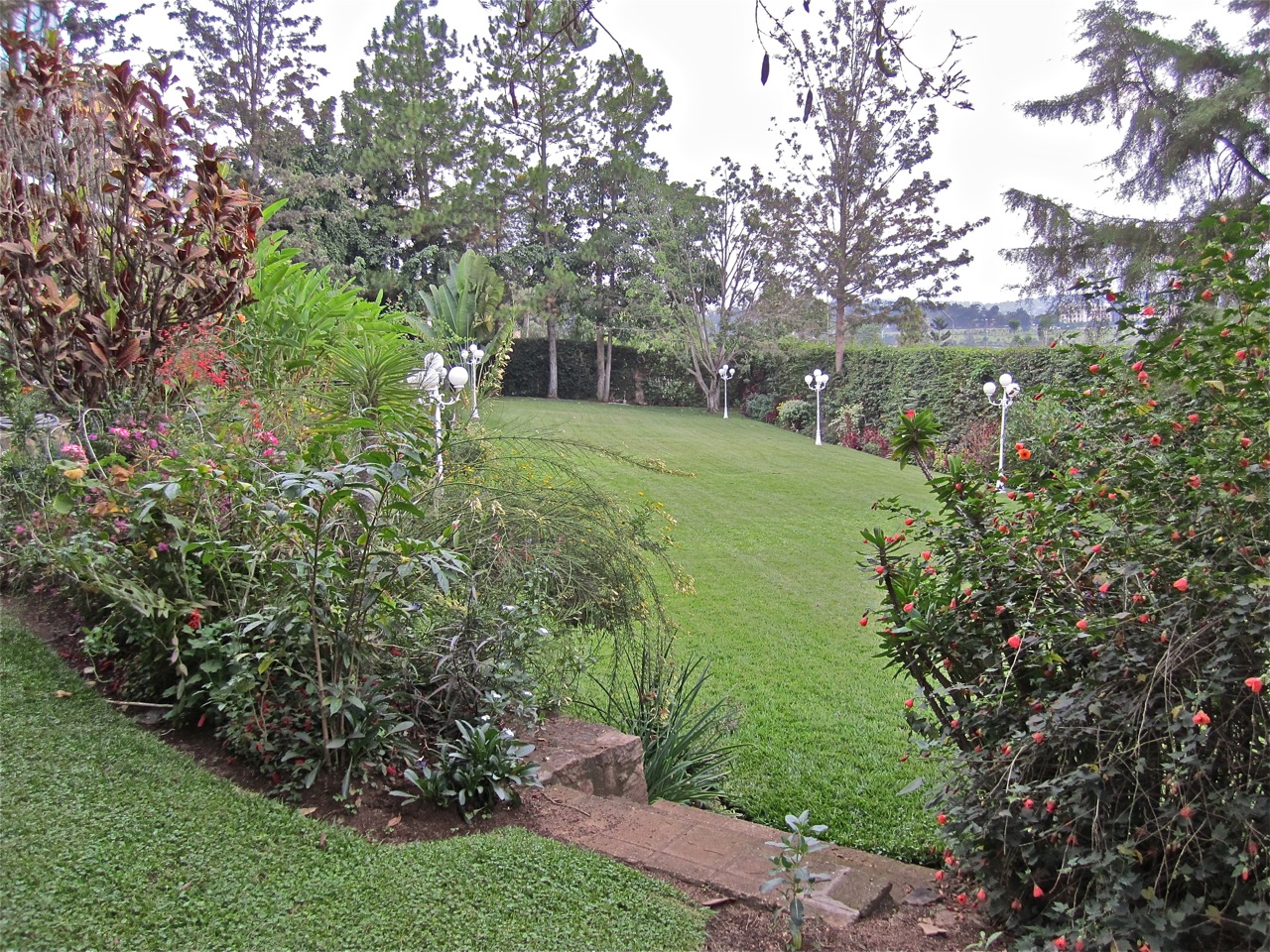
Above is a view of the lawn from one end (at the steps just to the left of the flagpole base in the earlier picture). When we entertain large groups, the embassy puts up one or two tents in the center of the lawn.
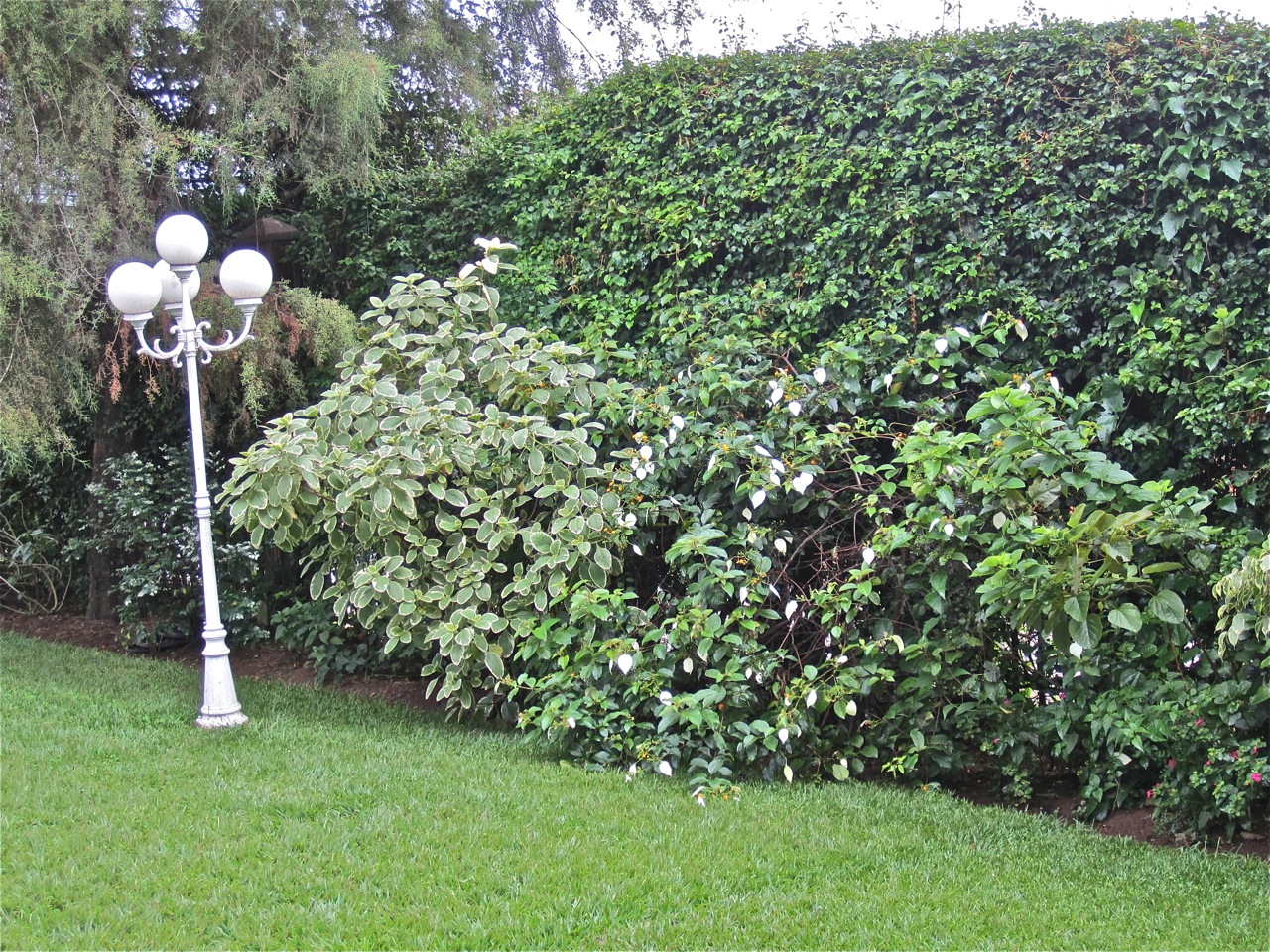
On the right side of the lawn, at the front of the property, there is a clipped bourgainvillea hedge and a variety of interesting shrubs and plants, all sharing a very narrow strip of ground. The slight dip at the edge of the lawn makes it look like the plants in front are sliding under the hedge.
In the photo above, you can see how pretty the shrubs are, but again how little room they have. Since this picture was taken, the gardener has cut these bushes along their sides to keep them from intruding onto the grass. Now you see a lot of bare stems — not very attractive.
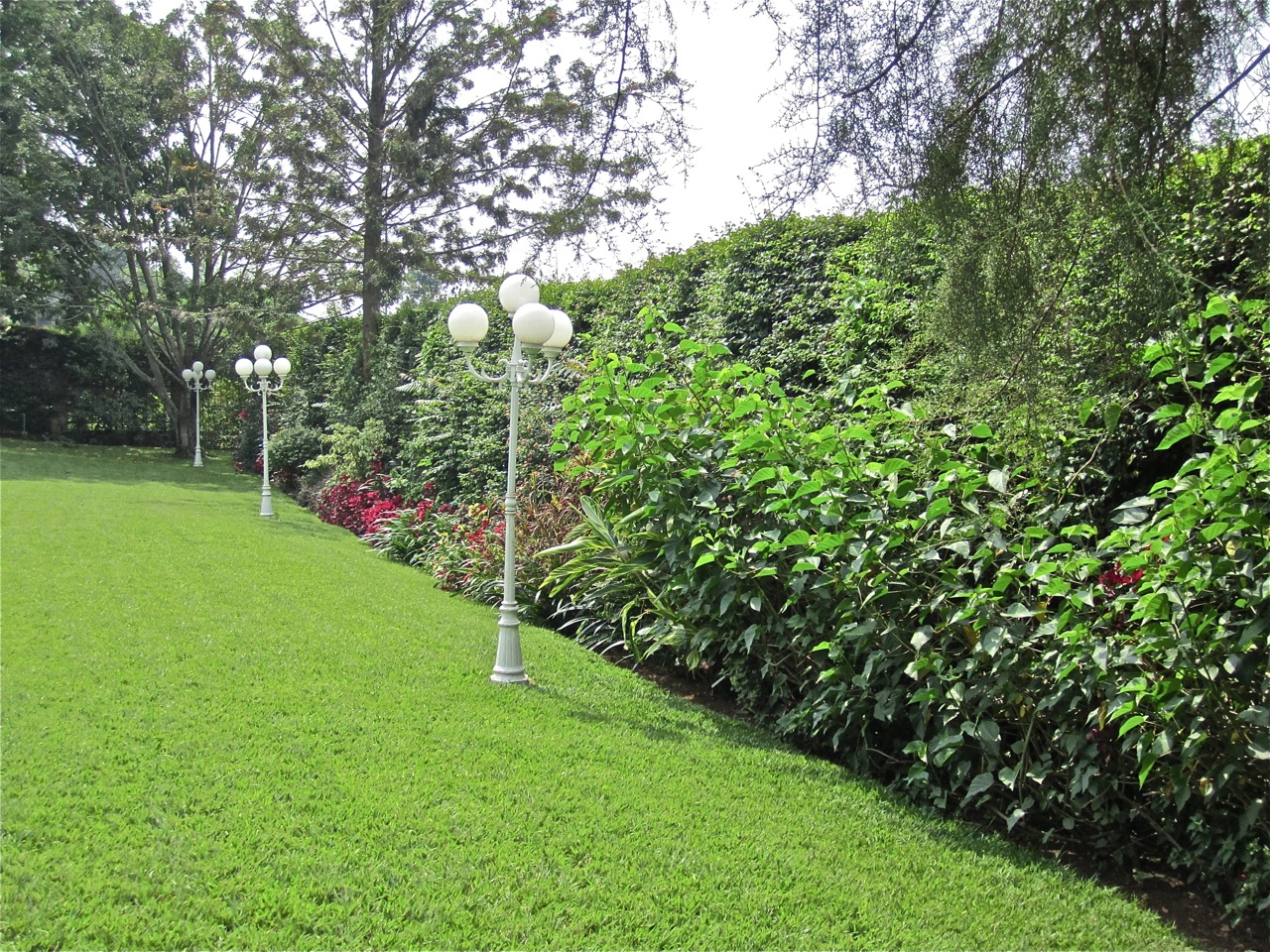
The white, curlicue, Victorian light posts in the above photos really bug me, I must admit, because, as you can see in the picture below, the lines of the house are attractively modern and simple.
Above is the view from the lawn at the bottom of the center terrace steps. You can see, to the right and left, how tall and thick the lobster claws are. (Are you getting the idea that maybe something’s going to happen to those plants?)
You can also see from this photo how the two levels of stone retaining walls that branch out from either side are an important feature of this part of the garden.
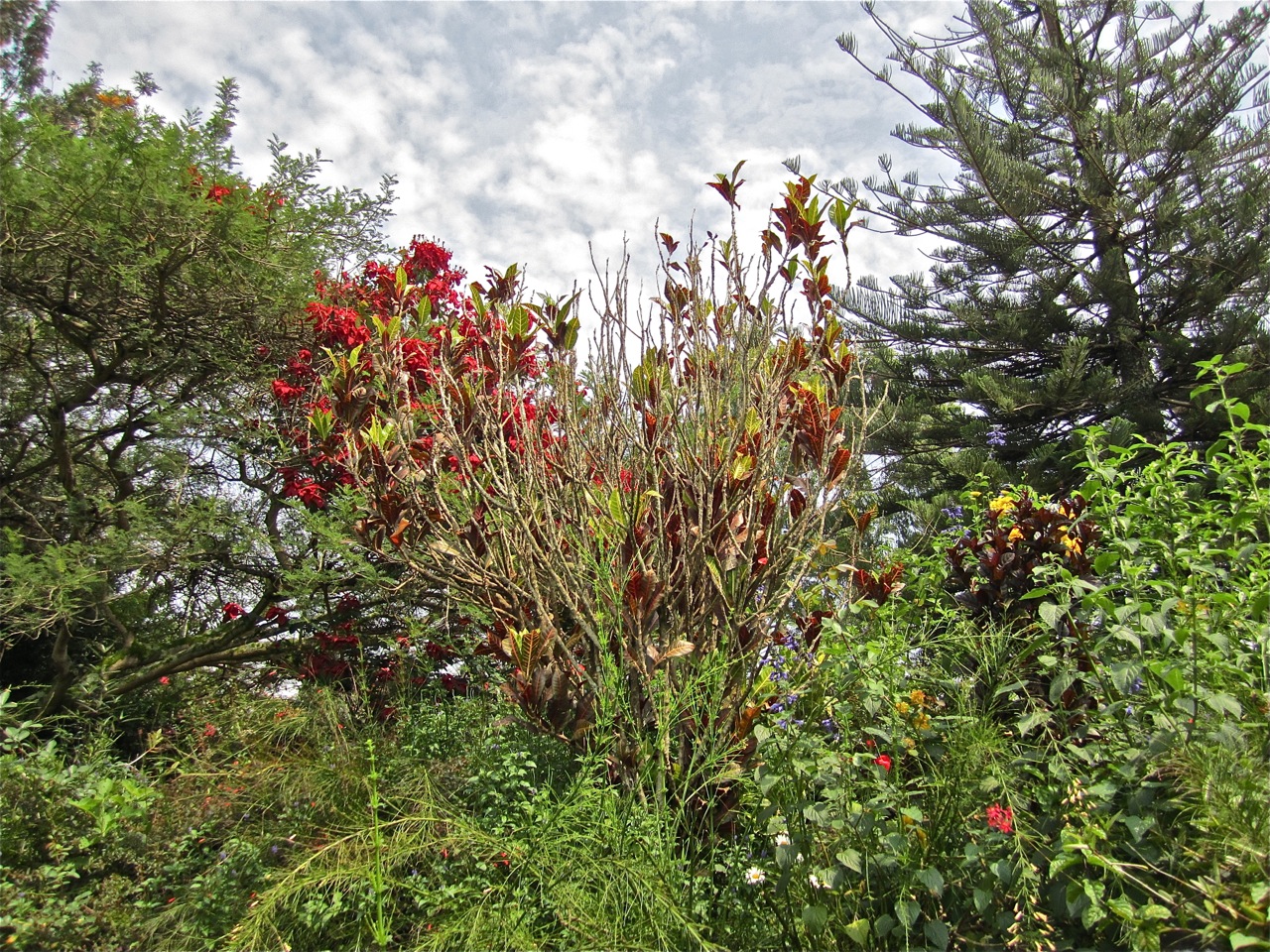
The planting beds at the top of the lower retaining walls are full of great plants, but it’s a real thicket in there. I have sometimes found three shrubs growing out of the same 8″ spot of ground. And this old croton (above) is so overgrown that it’s lost half its leaves. And at its current height, you look up onto the undersides of the remaining leaves, rather than down onto the colorful tops.
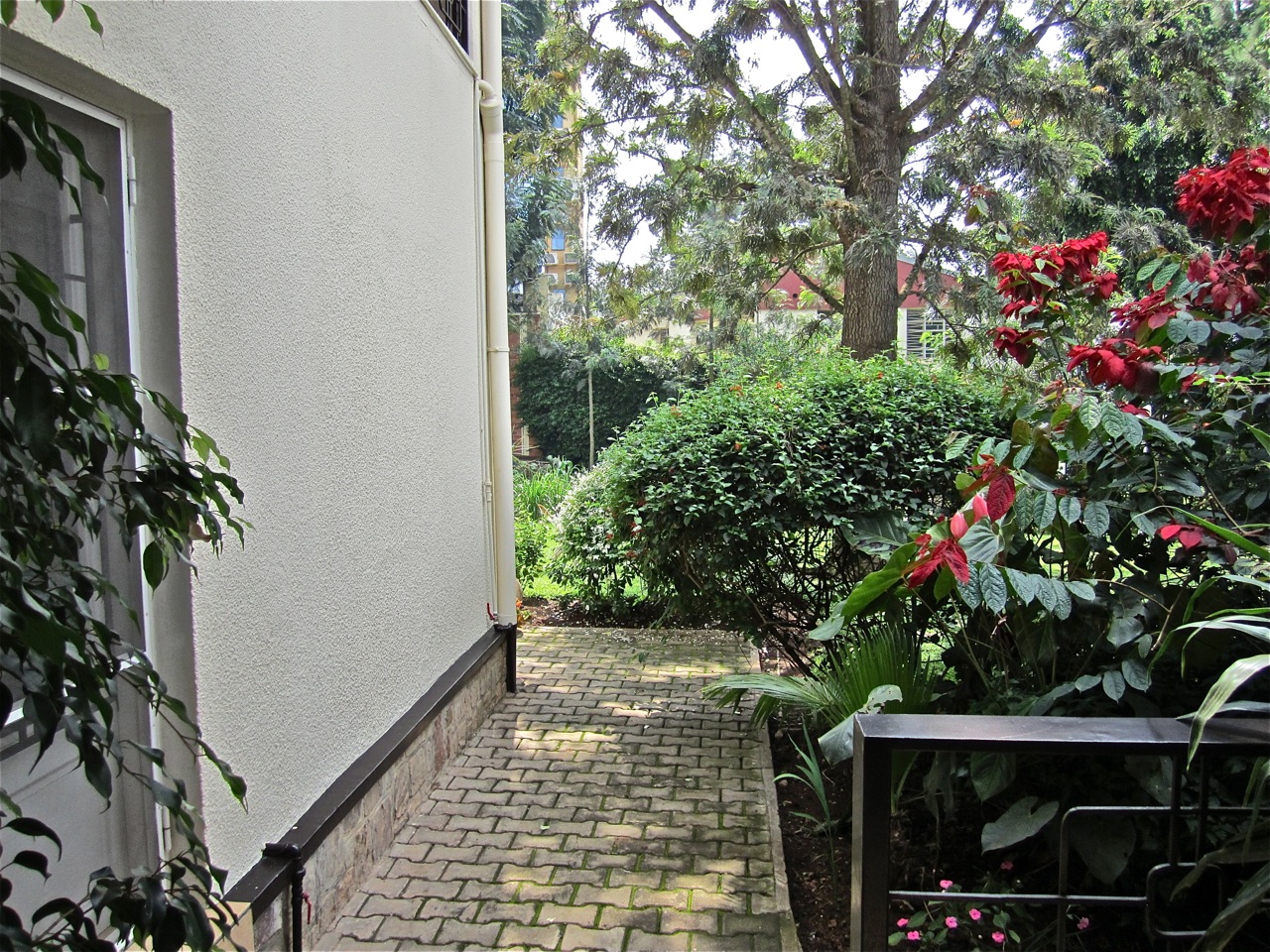
Above, going back up to the terrace and walking its length to the opposite end of the house, the path to the side yard is almost blocked by a very large, very clipped shrub (also shown below).
Squeezing past the bush, you come to the side yard and the other end of the house (below), which has a narrow planting strip along the sidewalk . . .
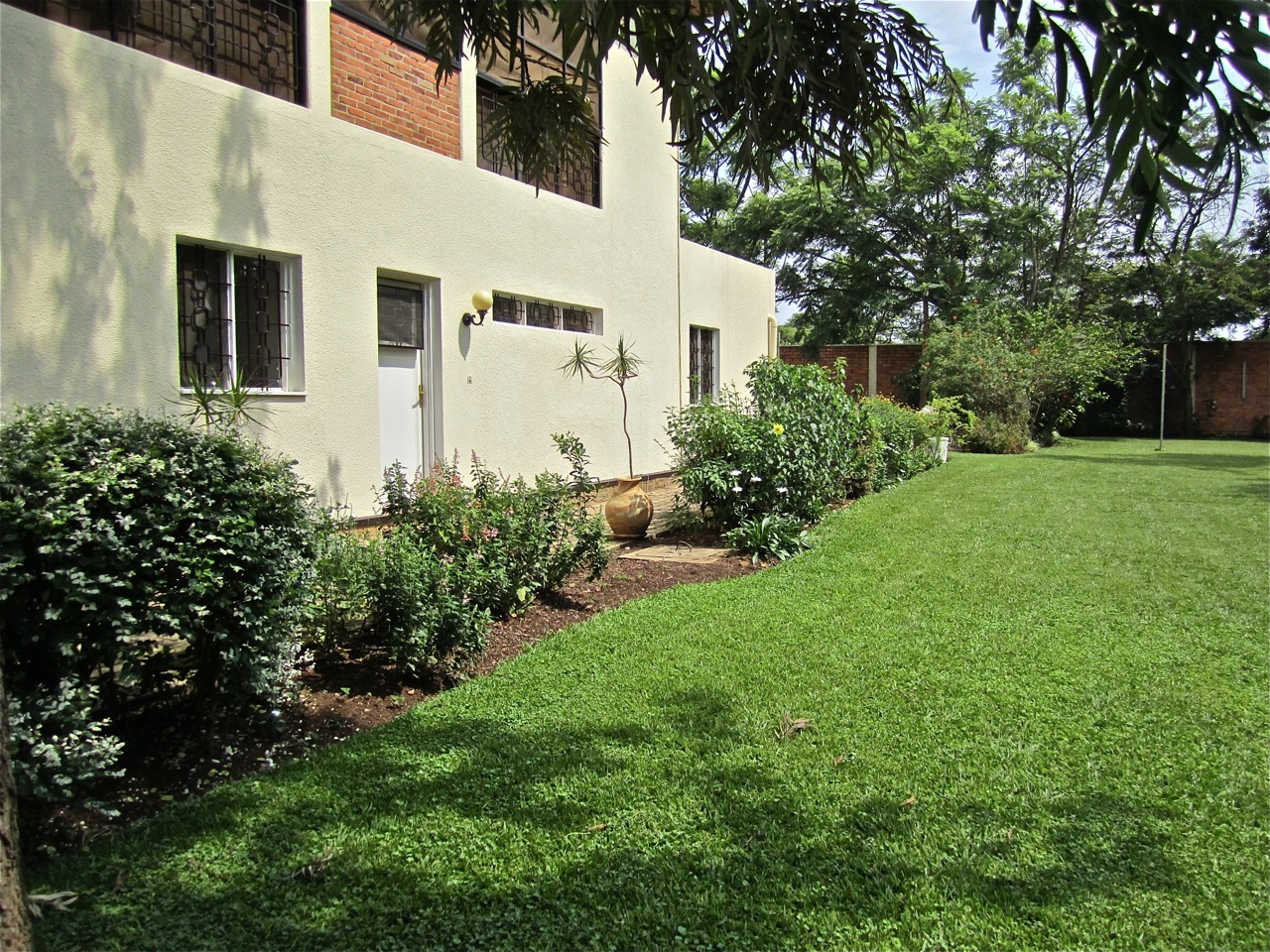
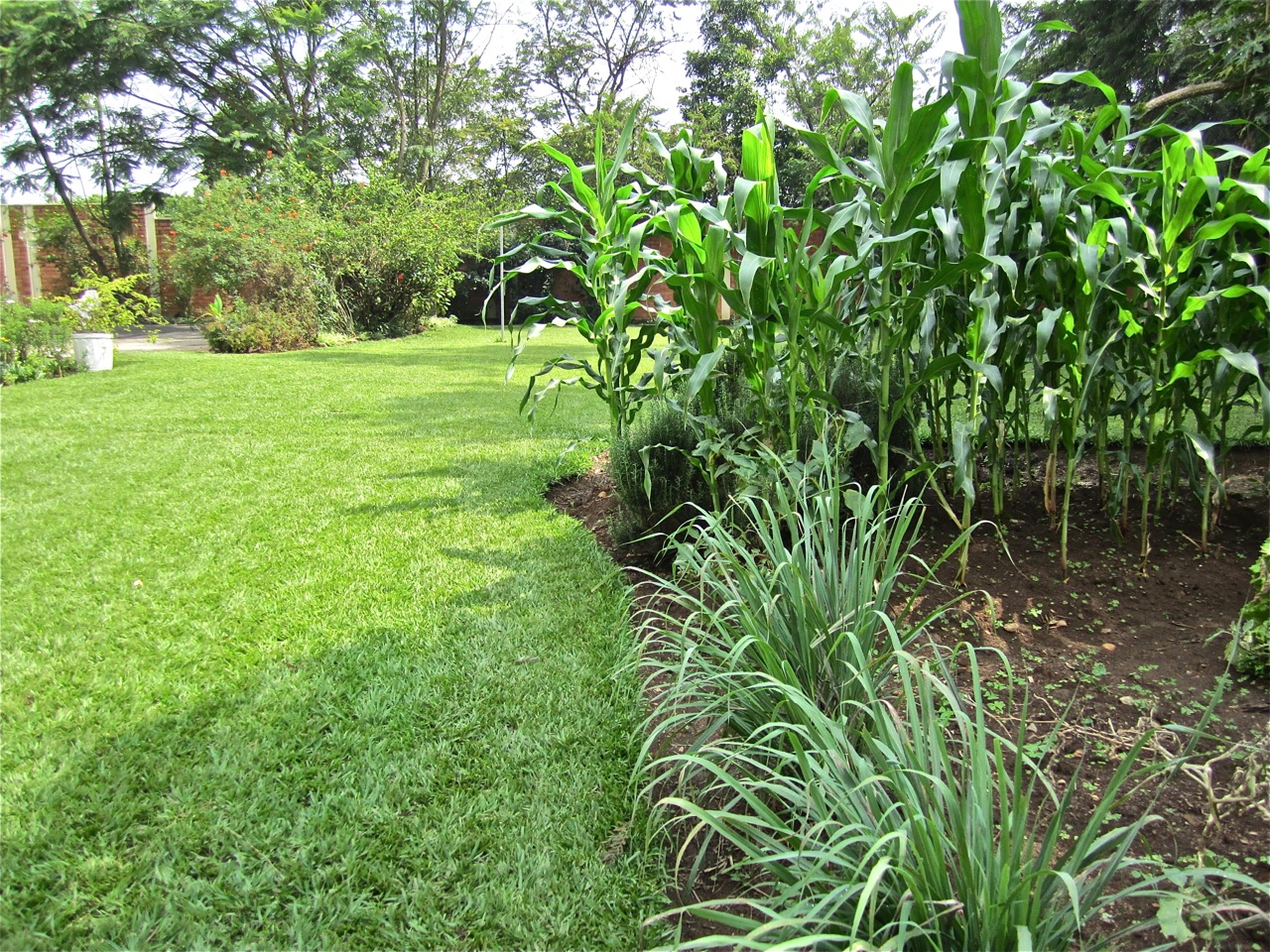
and, across from that (below), a large vegetable garden whose edges have become rather freeform over the years. There’s a lot of sunny grassy space between these two beds, which isn’t needed for entertaining.
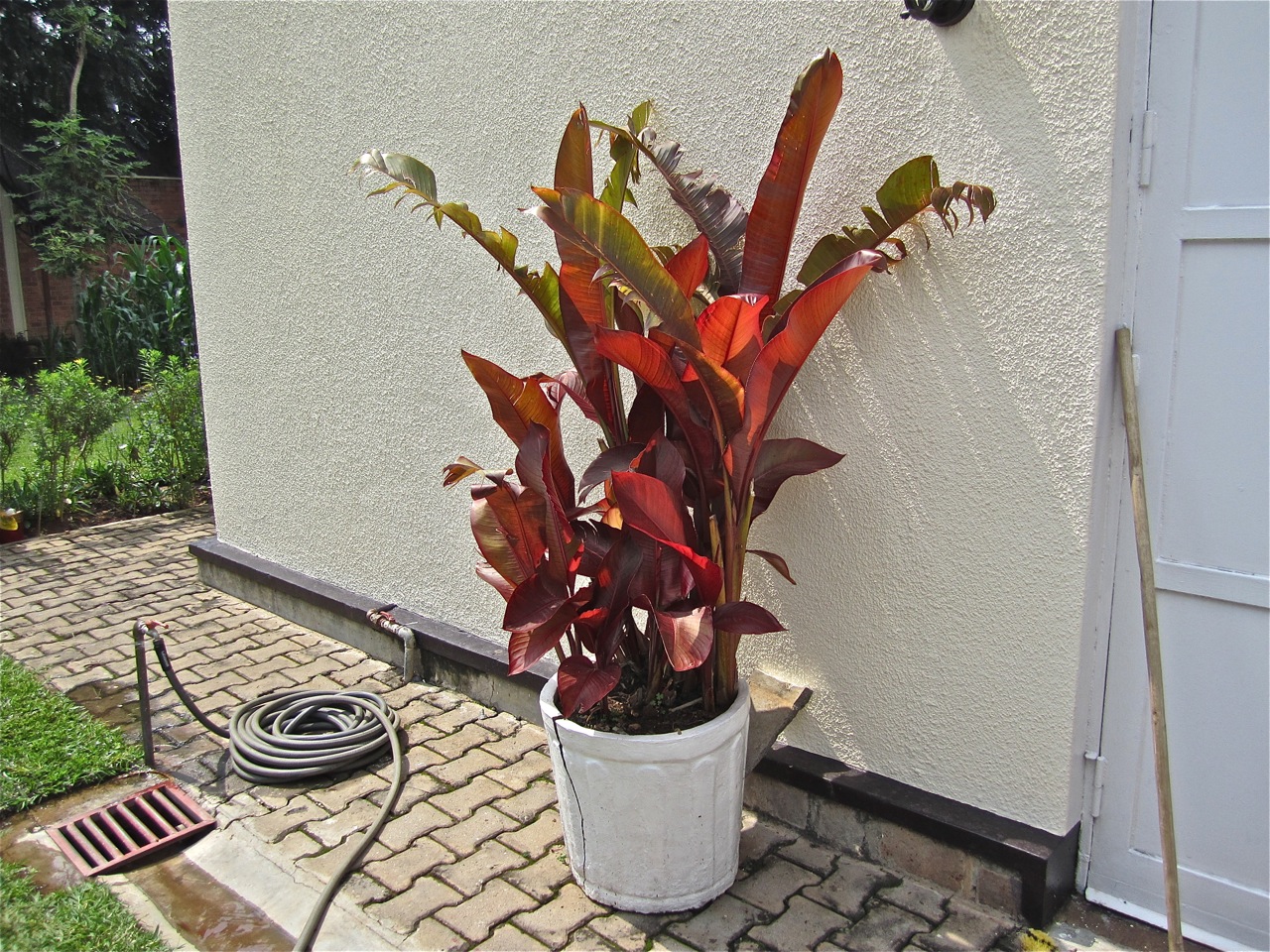
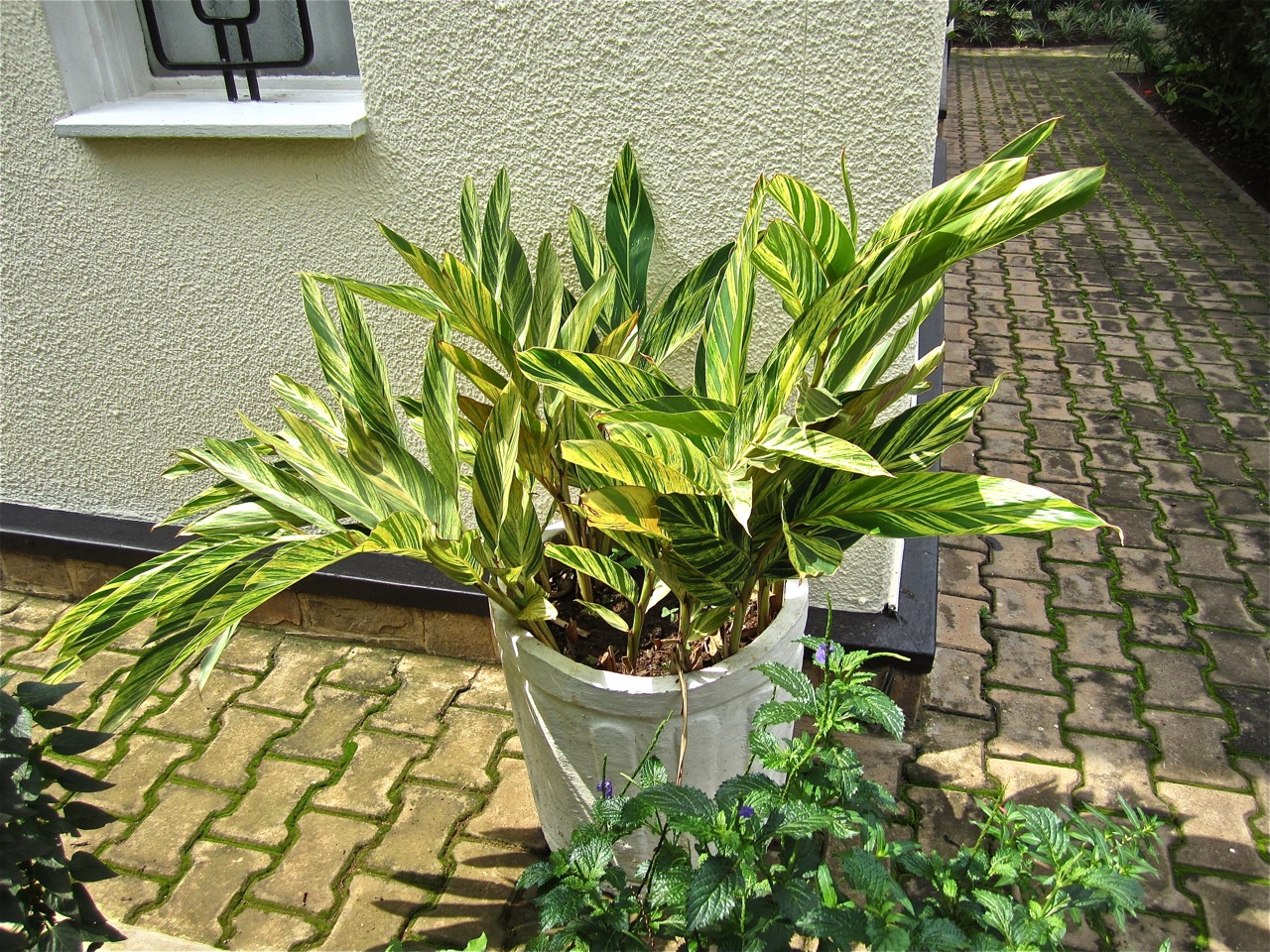
There are a number of potted plants in the garden, including these two (below), which have been left at the back of the house. They hold burgundy cannas (which are breaking their pot) and bright variegated gingers, but almost no one sees them. On the terrace, we also have variegated yuccas planted in very nice tall pots, but so deeply that only the ends of their squished up spiky leaves show (and they’re a bit dangerous at upper-body level).


 (Above: the road to the lodge and a tea collection shed.)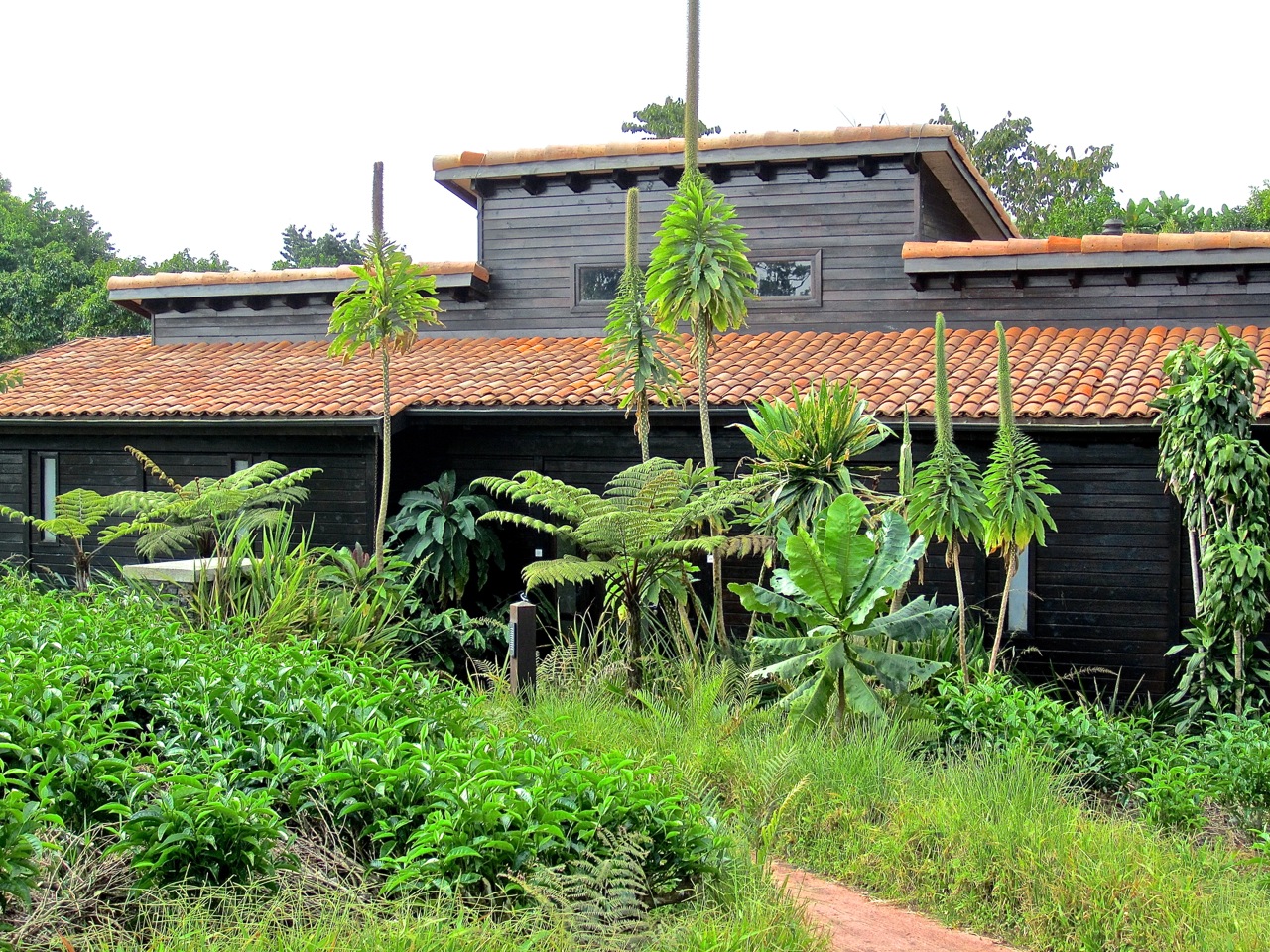






 There’s one (above.)
 He jumps.
 And lands. (OK, my nature photography is not so good.)
 Here’s a slightly better picture. It’s a L’Hoest’s monkey (Cercopithecus lhoesti).














 enclos*ure