Vintage landscape: Grey Gardens

Billboard near the High Line, NYC/enclos*ure While walking along the High Line in New York City last month, I spotted this billboard for a storage company.   It made me remember these Library of Congress hand-colored lantern slides by Frances Benjamin Johnston and Mattie Edwards Hewitt.

View of the walled garden from upstairs in the house. All photos via the Library of Congress Prints and Photographs Division.
View from an upstairs window of the house.   All photos via the Library of Congress Prints and Photographs Division.

This was Grey Gardens in 1914 — long before it was made famous by the 1975 documentary.

The walled garden section of the four-acre estate in East Hampton, N.Y., was designed by Anna Gilman Hill and landscape architect Ruth Bramley Dean.

Anna and her husband, Robert Carmer Hill, had purchased the property in 1913.  They sold it to Phelan and Edith Bouvier Beale (whose daughter was Little Edie) in 1927.

The northeast gate to the walled garden.

Hill imported the concrete walls from Spain.  She took the name for the house and garden from its environment.

It was truly a gray [sic] garden. The soft gray of the dunes, cement walls and sea mists gave us our color scheme as well as our name… nepeta, stachys, and pinks… clipped bunches of santolina, lavender and rosemary made gray mounds here and there. Only flowers in pale colors were allowed inside the walls, yet the effect was far from insipid….I close my eyes and sense again the scent of those wild roses, the caress of the hot sun on our backs as we sauntered to and fro from our bath and lazy mornings on the beach.

—Anna Gilman Hill, from Forty Years of Gardening

Beyond the property is the Atlantic Ocean.  The walled garden was 70′ x 40′.

A plan of the garden, artist unknown.

The estate (now two acres) has been owned by Ben Bradlee (formerly editor-in-chief of The Washington Post) and Sally Quinn since 1979.  They have restored both the house and garden.

Now the land between the walled garden and the ocean is filled with newer houses and gardens, and there is a very tall hedge just behind the far wall and the pergola.
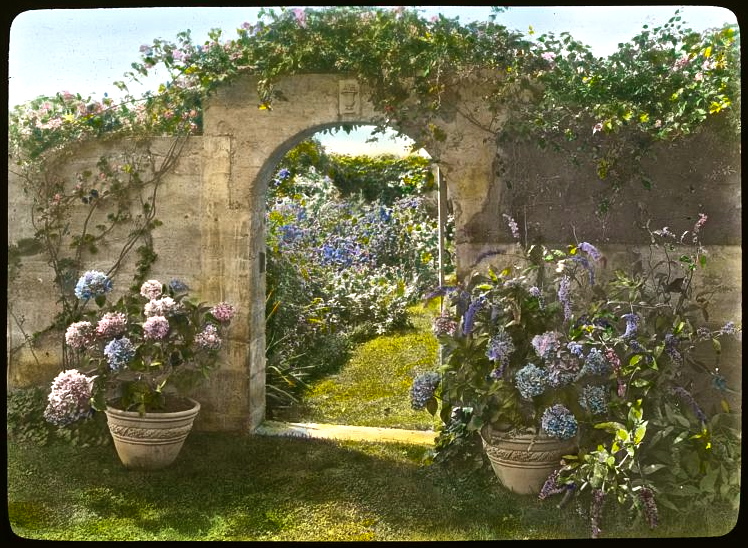
The northeast gate.
The northeast gate.
The original photograph before hand coloring.
The bench inside the northeast gate.
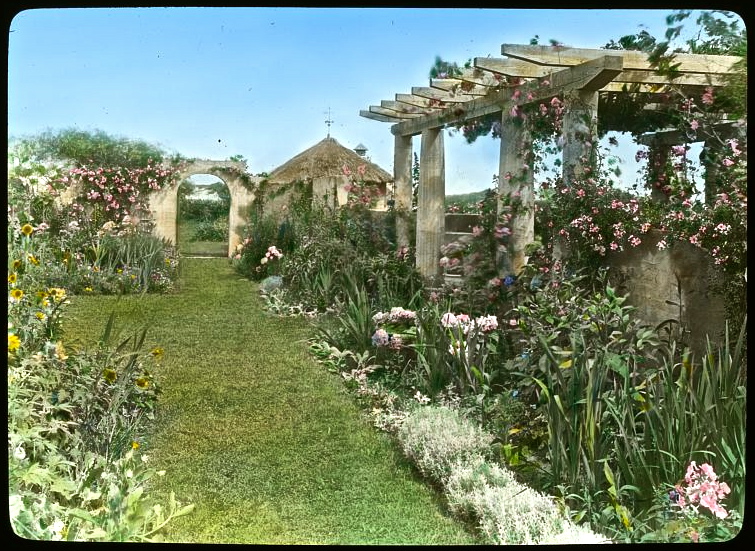
Looking west to pergola.
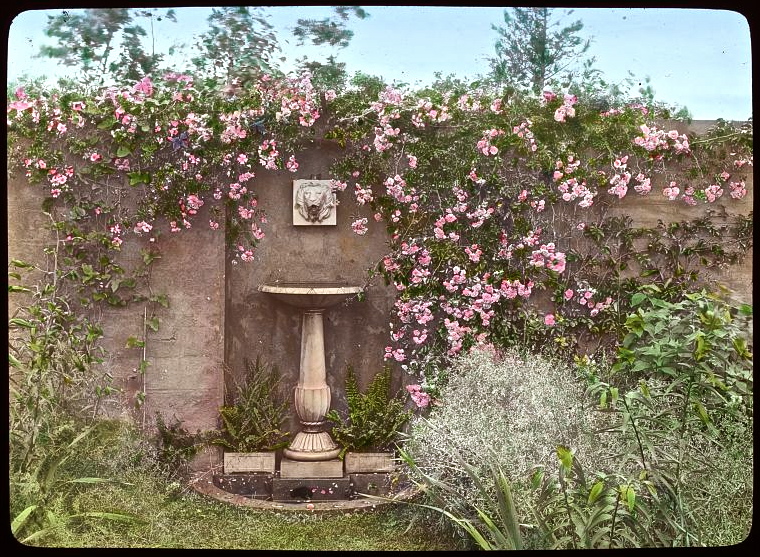
Birdbath on west wall.
Pergola and tool house gate.
East gate to the tool house.
The garden tool house.
Sunroom in the house overlooking the walled garden.

The open doorway in the photo above lined up with the pergola.  It seems that, at the time of this photo, there was an opening in the garden wall between the house and pergola.  But I can’t tell if the opening was there before or after the time of the other photographs.

Birdbath.
Birdbath.
Dovecote.
Dovecote.

Help save a masterpiece

The Dumbarton Oaks Park Conservancy is in the midst of a campaign to win $75,000 from the “Partners in Preservation” $1 million giveaway in the Washington, D.C., metro area.  The giveaway is sponsored by the National Trust for Historic Preservation and American Express.

You can vote for the DO Park HERE* every day through midnight on May 10.

(And voting enters you in a contest to win a three-night stay at a Marriott hotel.)

Dumbarton Oaks Park (not to be confused with the adjacent Dumbarton Oaks Gardens) is one of the masterworks of landscape architect Beatrix Farrand.

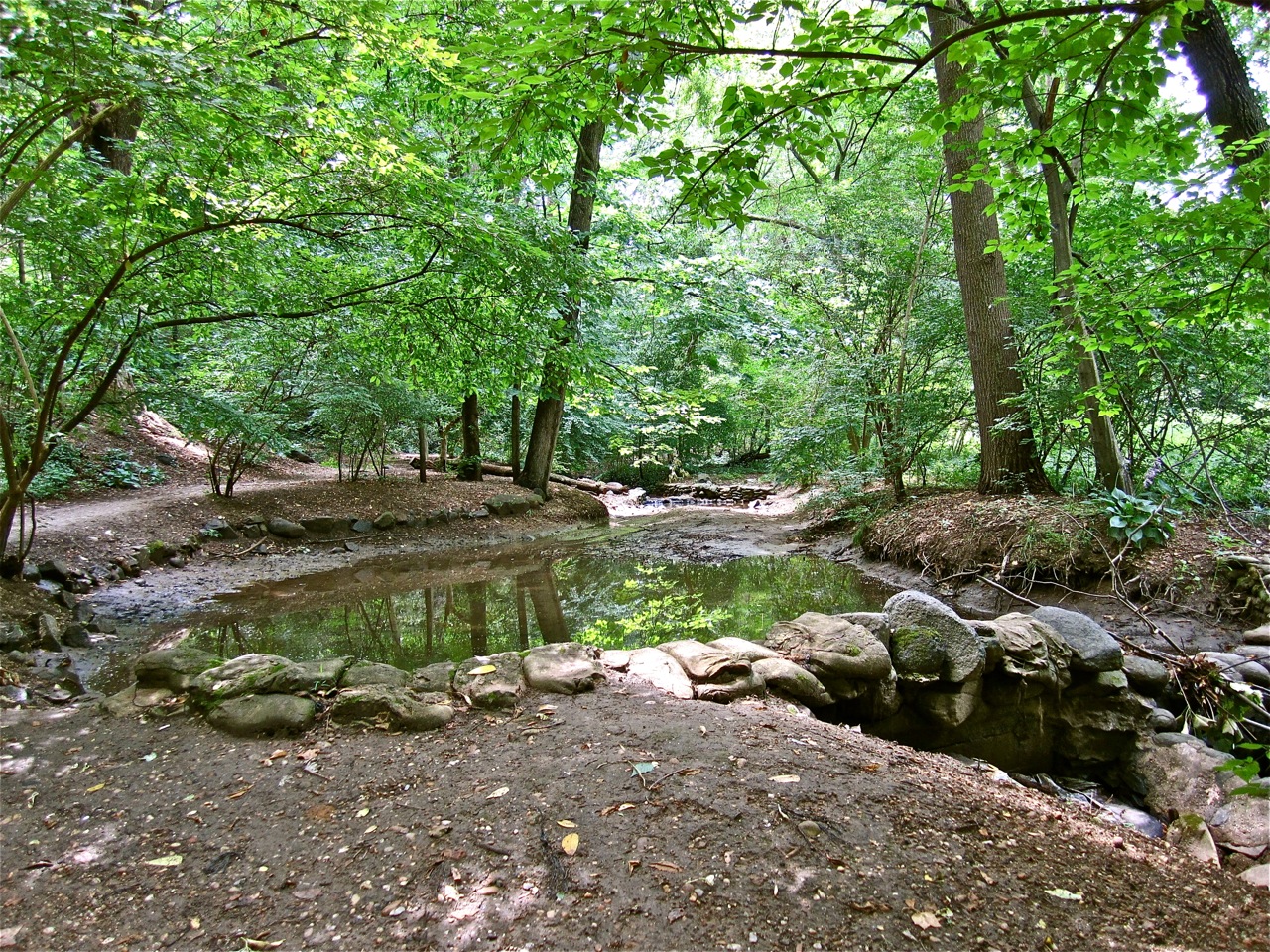
In 1928, she composed the park as a series of paths and meadows along a small tributary of Rock Creek and had them planted out with drifts of native and exotic wildflowers, bulbs, and woodland shrubs.  Eighteen waterfall dams, two arbors, and several benches and footbridges were built in the rustic Arts and Crafts style.

Even with the damage, the artistry of Farrand's arrangement of dams and bridges shine through.
Even with many years’ damage, the artistry of Farrand’s stonework shines through.

Sadly, the 27-acre park has suffered greatly from lack of sufficient resources since 1940, when it was turned over to the National Park Service.  However, in 2010, the Conservancy was formed to restore the park to its former glory by raising money and fielding teams of volunteer “weed warriors.”

Beatrix Farrand was America’s first female professional landscape architect and one of eleven founding members of the American Society of Landscape Architects.

Participants at a recent conference on her work lauded her as a “scientific-minded experimenter, an early proponent of native plants, a leader in ‘pre-ecological design,’ an expert in stormwater management, and a flexible and innovative designer who mastered numerous styles,”reported The Dirt, the blog of the American Society of Landscape Architects.

Please vote and spread the word! The $75,000 will repair the park’s stonework at the east falls dam and viewing platform.


*The first time you go to the site, don’t click ‘vote’ right away. Go to ‘log in’ and register. Then, you’ll receive an e-mail asking you to confirm your address. Then you can log in and vote. It takes a couple of minutes, but you’ll be able to vote in seconds for the next five days.  (You must be a legal resident of the U.S. to be eligible to win the free stay in  a Marriot hotel.)

Vintage landscape: open-air school

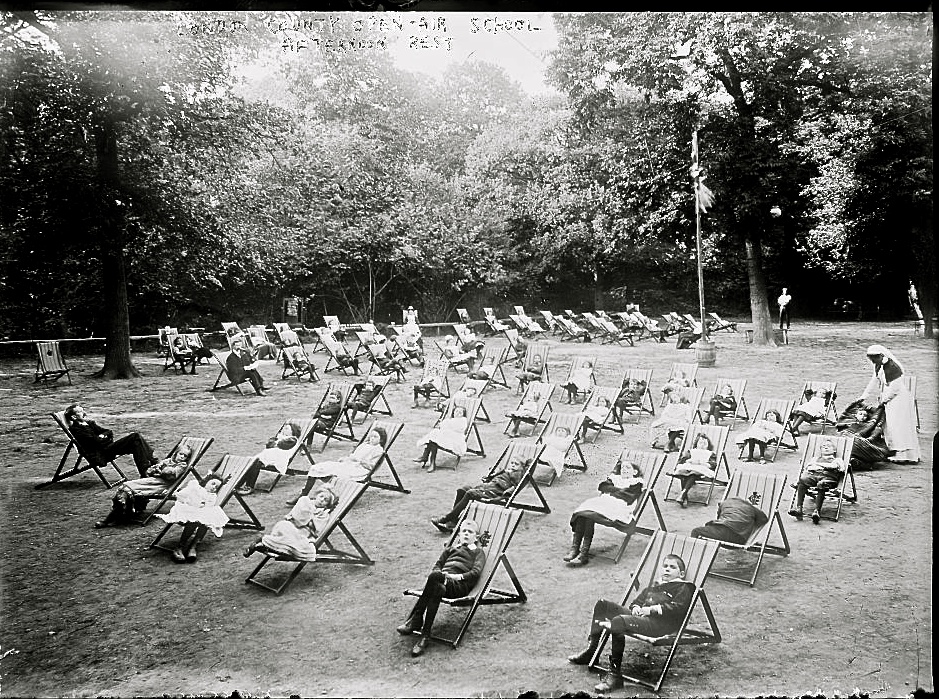
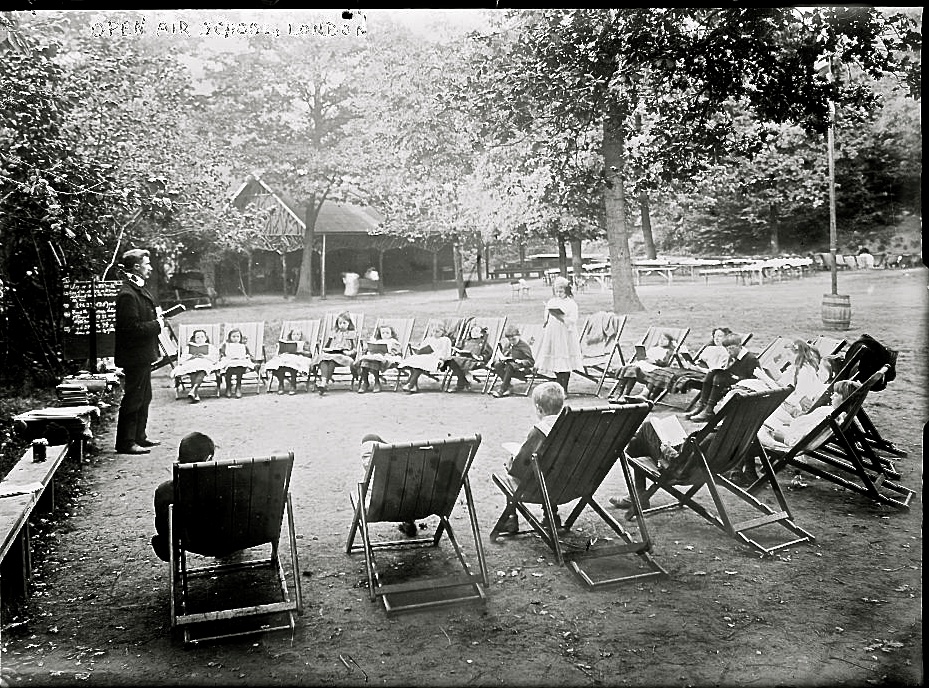
Open-air school in London, Library of Congress“Children in chairs on lawn during afternoon rest, London County Open-air School.”

Open-air school, London, Library of Congress“Class on lawn, children in chairs, London Open-air School.”

Open-air schools in Europe and the U.S. were  part of an effort in the first half of the 20th century to combat the rise of tuberculosis.  The first — a waldeschule or forest school — was built near Berlin, Germany, in 1904.

An open-air school was created in England in 1907 by the London County Council. This may be the school pictured here.  A second London school was organized in 1908. By 1937, there were 96 open-air schools in Great Britain.

Photos and captions by Bain News Service via the Library of Congress Prints and Photographs Division (no dates provided).

ADDENDUM: More on open-air schools here, on the blog Messy Nessy Chic.

Wordless Wednesday: Oxford garden

This slideshow requires JavaScript.

Chaplain’s Quadrangle garden of Magdalen College, Oxford, September 2012.

Continue reading “Wordless Wednesday: Oxford garden”