Recent finds

I knew the thing
before I knew its name. . . .*
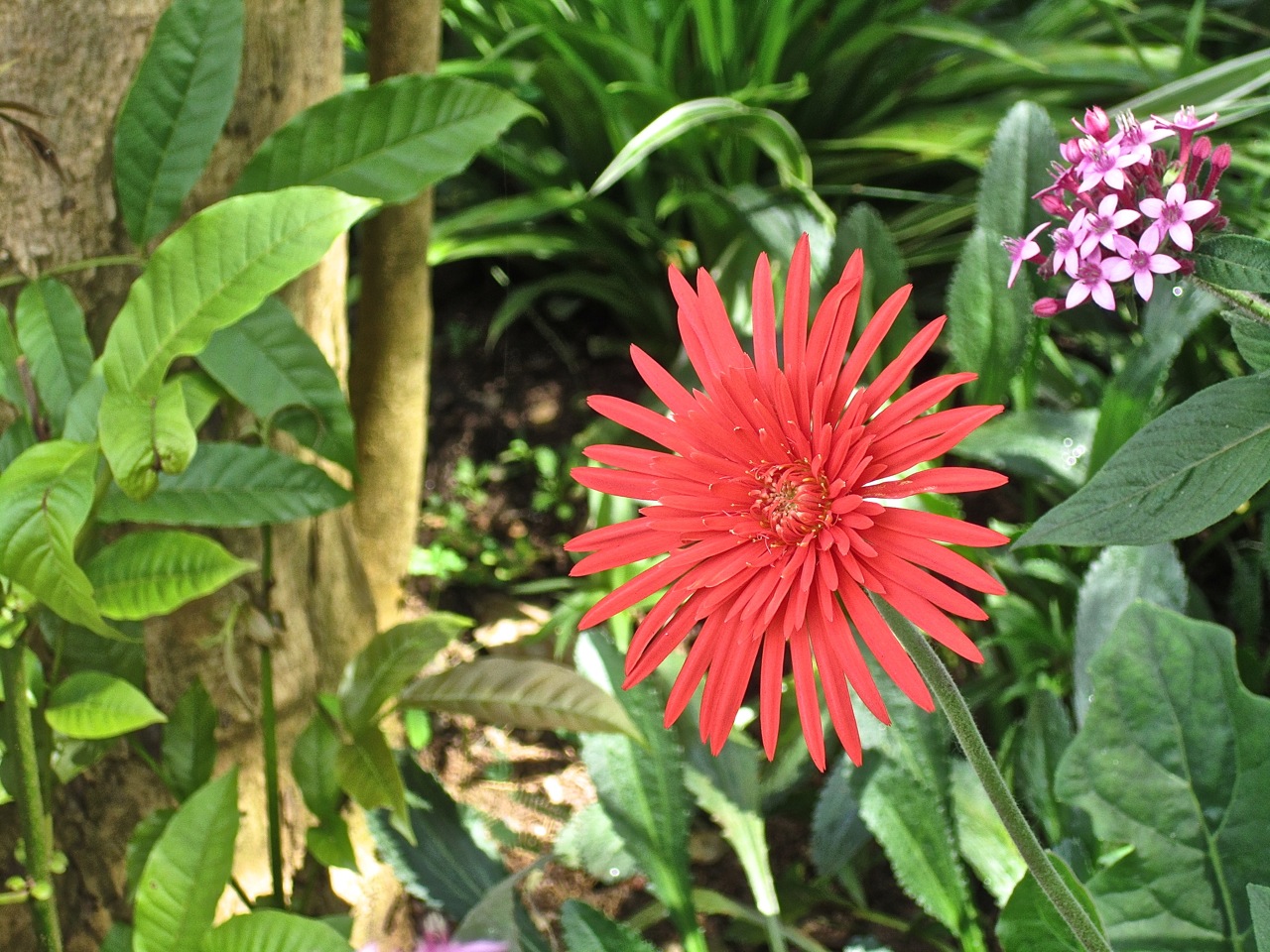
Dec 24 Gerbera

I went outside yesterday and discovered this single dark orange Gerbera daisy (probably Gerbera jamesonii or Transvaal daisy) in the back flower bed.

I was so pleased because I’ve been looking for more orange flowers to tie together two orange-flowered shrubs about 7′ apart in a mostly yellow section of the front garden (they are too large to move).  It divided into four little plants when I transplanted it.

We have a lot of coral pink Gerberas.  They bloom all the time and are a nice color for setting off flowers in red, orange and white, and violet and blue areas.
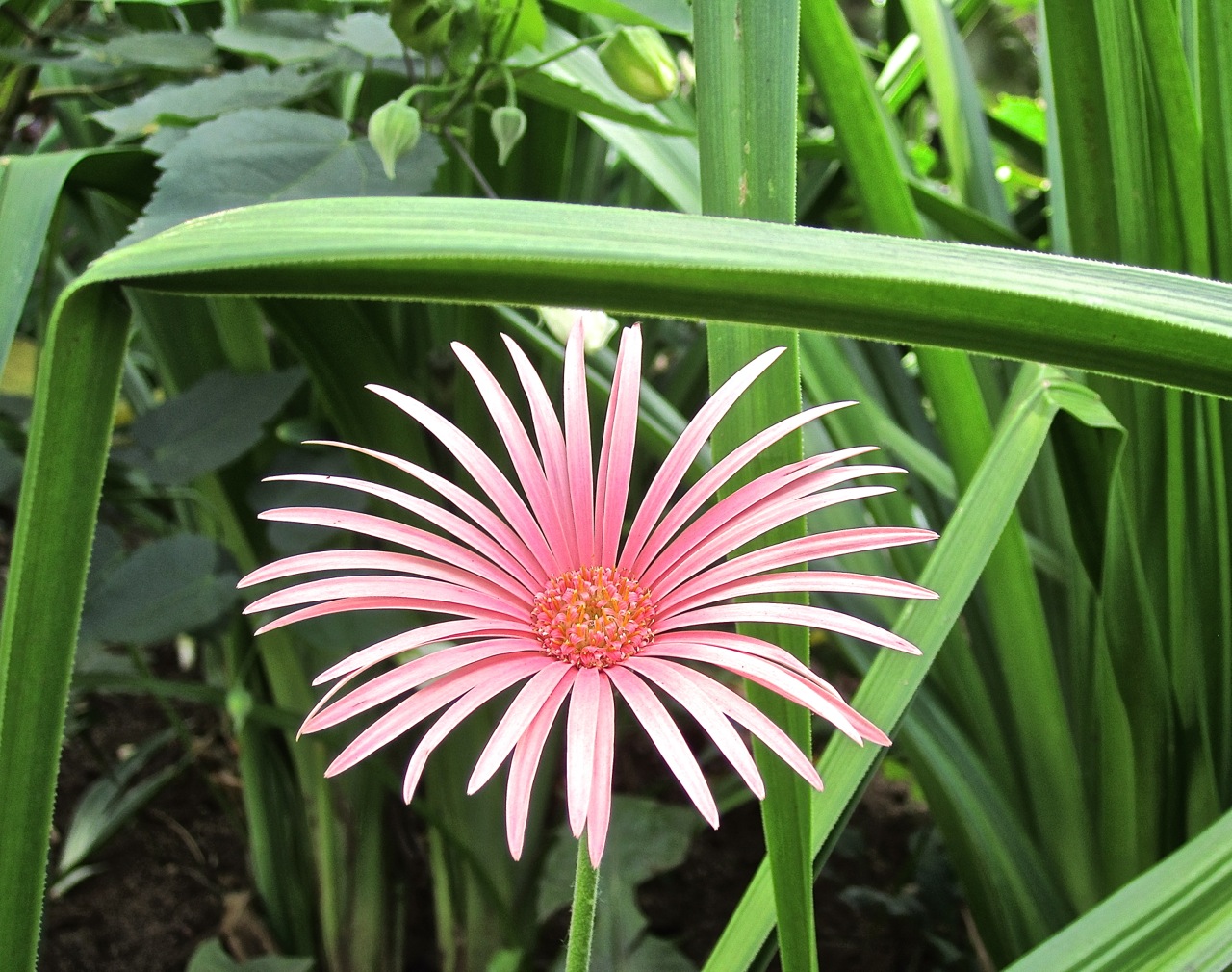
Dec 24 pink Gerbera

They are also a super-tough perennial for warm climates. Back in Washington, D.C., we mostly see them as cut flowers or potted plants sold in a grocery store. Gerberas are the fifth most-used cut flower in the world, according to Wikipedia.

A couple of weeks ago, I also found this in bloom in the back area:
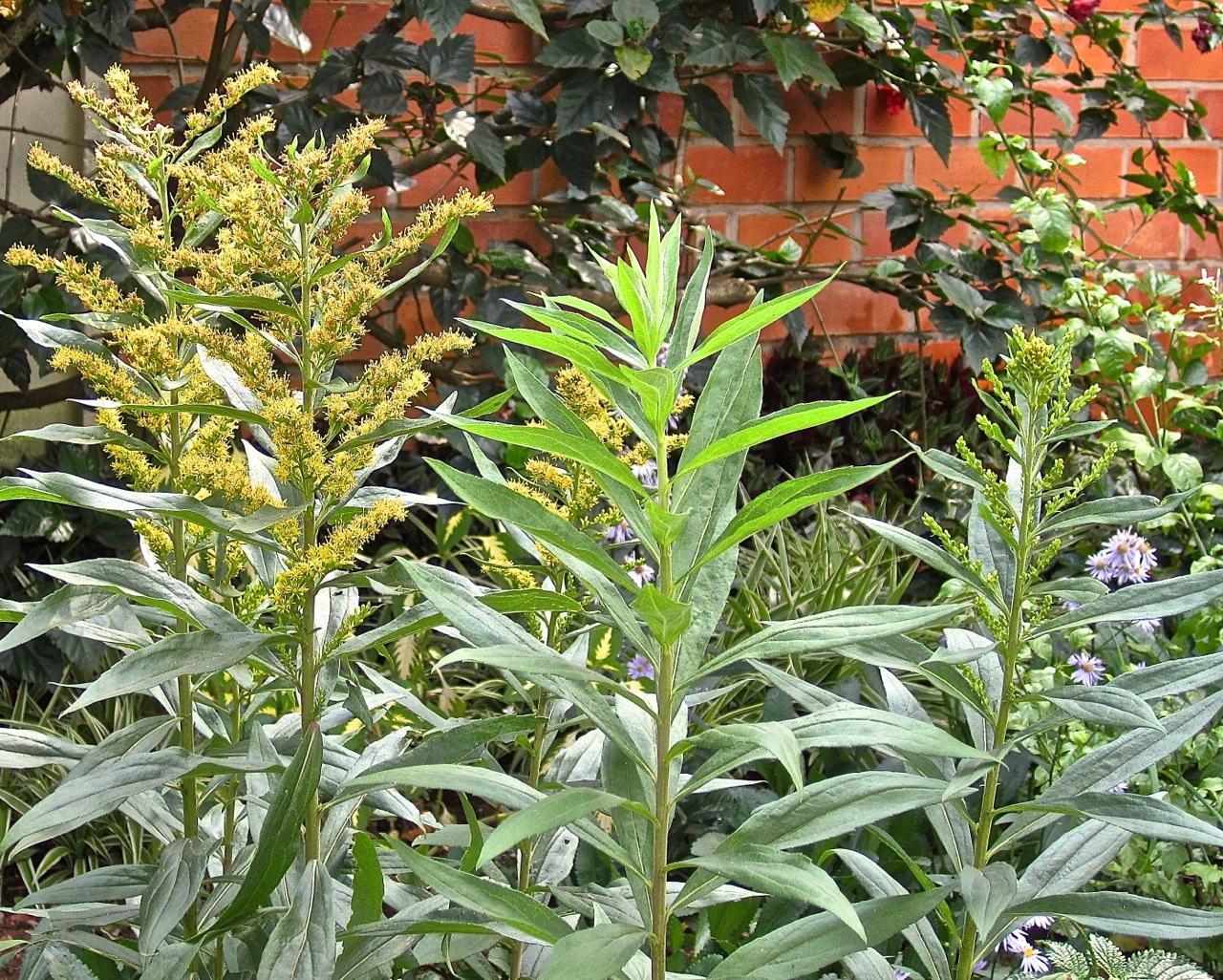
Dec 24 goldenrod

Goldenrod (Solidago) — I immediately divided it and took some pieces to the yellow border in the front.

I had been watching the plant for a couple of months, thinking it was possibly a weed, but also thinking that it looked familiar. I should have recognized it — Solidago rugosa ‘Fireworks’ is one of my favorite  perennials.

There are over 100 species in the Solidago genus (both it and Gerbera are in the Asteraceae family), so I doubt I’ll identify it more specifically than ‘goldenrod.’  The plant is native to North America, although a few species are found in South America and Eurasia.

I searched for images of Fireworks on Google and found my own picture was number three on the page.  This was sort of thrilling (I lead a very quiet life.)  Strangely, pictures of our dog Sophie, were numbers seven and eight — I guess because I had put them in the same post. (There’s a nicer picture of the plant here.)

An interesting story from Wikipedia:

Inventor Thomas Edison experimented with goldenrod to produce rubber, which it contains naturally.  Edison created a fertilization and cultivation process to maximize the rubber content in each plant. His experiments produced a 12-foot-tall (3.7 m) plant that yielded as much as 12 percent rubber. The tires on the Model T given to him by his friend Henry Ford were made from goldenrod.

Extensive process development was conducted during World War II to commercialize goldenrod as a source of rubber.  The rubber is only contained in the leaves, not the stems or blooms. Typical rubber content of the leaves is 7 percent. The resulting rubber is of low molecular weight, resulting in an excessively tacky compound with poor tensile properties.

Miscellany

David Montgomery of The Washington Post has a sad story today about the elimination of “Ye Olde Yule Log” from this year’s events on the Ellipse (in front of the White House):

For more than 50 years, it was one of the quirky miracles of holiday Washington.  Groundskeepers stoked the fire around the clock. They used a forklift to feed it giant stumps and trunks from trees that had been marked as “hazardous” and culled from national parks in the region. Tourists and residents would gather around the mesmerizing inferno, sharing stories with strangers, feeling uplifted as much by the smoky, sparky nostalgia of it all as by the sheer unlikeliness of such a scene in this locked-down, plugged-in world.

The National Park Service has a contact page here, by the way.

If your potted poinsettias are already getting on your nerves, you may want to cut the “flowers” (I know — bracts) to arrange in a vase.  Here’s an article from The Telegraph on getting them to last.


*by Ian Parks, from “Goldenrod

My Christmas trees

Whose woods are these I think I know. . . .

The Christmas Trees, enclos*ure

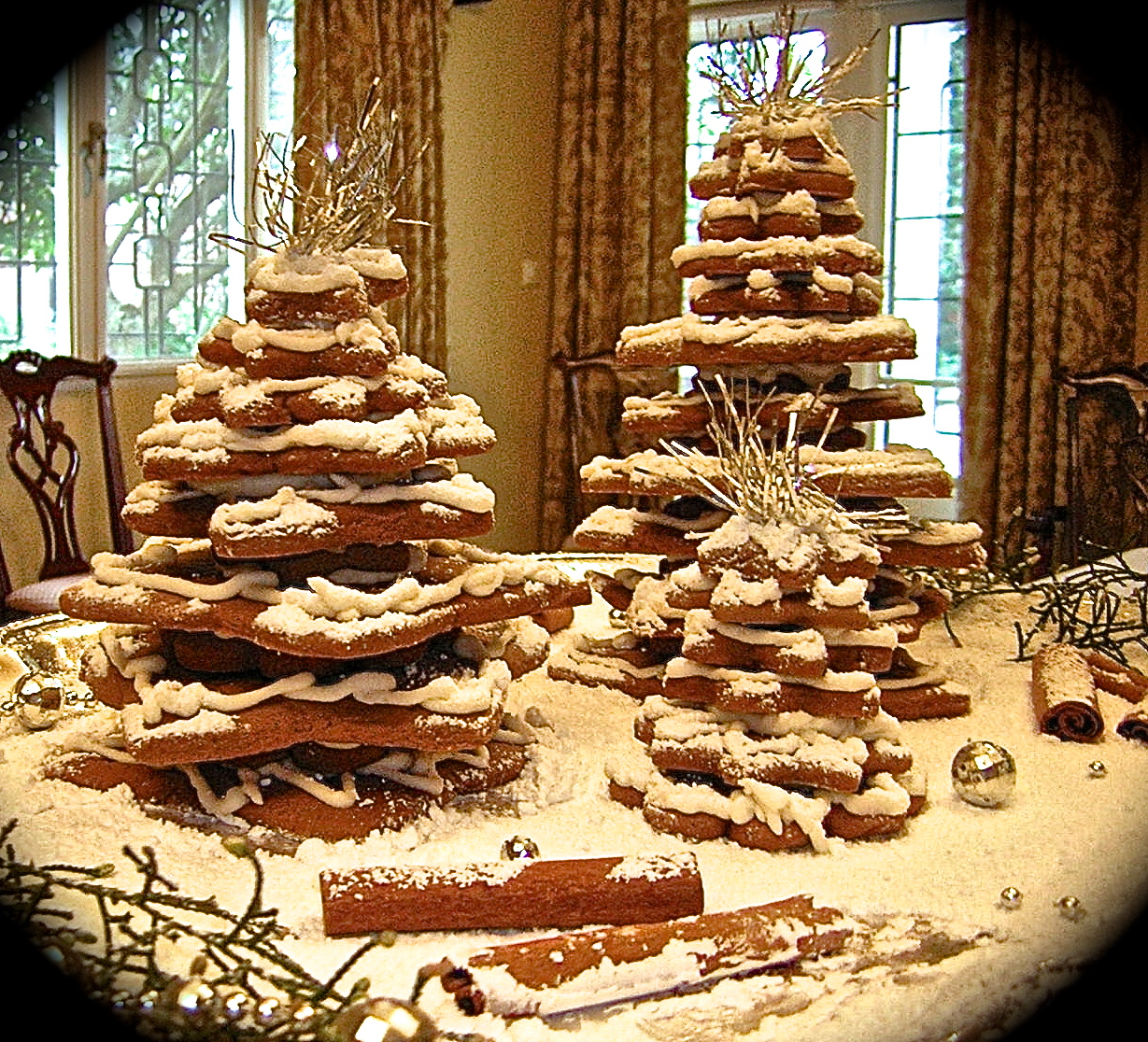
I just wanted to share this week’s planting project, a centerpiece for our holiday open house buffet table, before it crumbles — or actually turns green.

Pictures of many similar trees and links to recipes are here.

Lady Bird Johnson

Today, December 22, is the centenary of the birth of environmental advocate, businesswoman, and former First Lady Lady Bird Johnson (Claudia Alta Taylor).

Texas bluebonnet (Lupinus texensis).  Public domain hoto by Dr. Thomas G. Barnes, U.S. Fish and Wildlife Service.
Texas bluebonnet (Lupinus texensis)

While her husband was president, she created a First Lady’s Committee for a More Beautiful Capital and then expanded its efforts with successful support for the Highway Beautification Act of 1965.

In 1982, Johnson and actress Helen Hayes created an organization to protect the native plants and natural landscapes of North America.  It became the Lady Bird Johnson Wildflower Center in Austin, Texas.

Some of her words:

“Though the word ‘beautification’ makes the concept sound merely cosmetic, it involves much more: clean water, clean air, clean roadsides, safe waste disposal and preservation of valued old landmarks as well as great parks and wilderness areas. To me…beautification means our total concern for the physical and human quality we pass on to our children and the future.”

“The environment is where we all meet; where all have a mutual interest; it is the one thing all of us share. It is not only a mirror of ourselves, but a focusing lens on what we can become.”

You can listen to an interview about Lady Bird Johnson, An Oral History on “The Diane Rehm Show” at the link on the sidebar under “Today’s Quote.”  Adrian Higgins of The Washington Post wrote a tribute to her in October, here.

Public domain photo above by Dr. Thomas G. Barnes, U.S. Fish and Wildlife Service.

Vintage landscape: comfort and joy

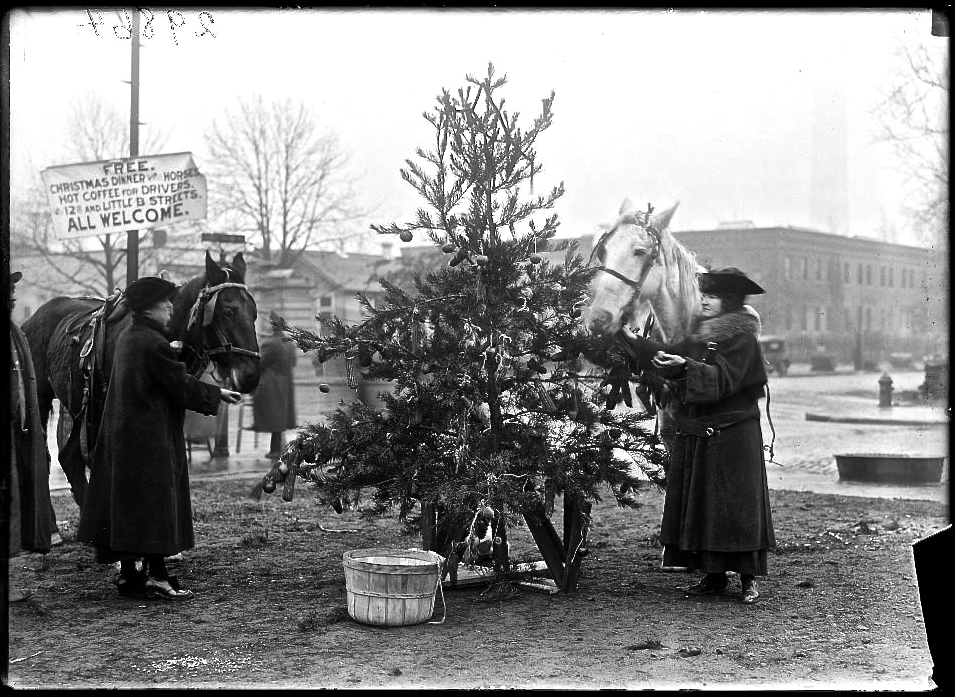
horse xmas tree 1918

In the first decades of the 20th century, horses toiled to move almost everyone and everything around the city of Washington, D.C.   But one December day a year, for several years at least, they were rewarded with Christmas trees hung with apples and corn and accompanied by troughs of grain.

“Christmas Tree for Horses” was sponsored by the Washington Animal Rescue League.  The 1918 gathering, shown in the photo above, took place at 12th and Little B Streets — the current site of the IRS offices at 12th St. and Constitution Ave., N.W.,  just south of the Old Post Office.  A 1909 map of the area shows a “Horse Fountain” at 11th and Little B Streets.

These holiday horse dinners also took place in other American cities in the early 20th century.

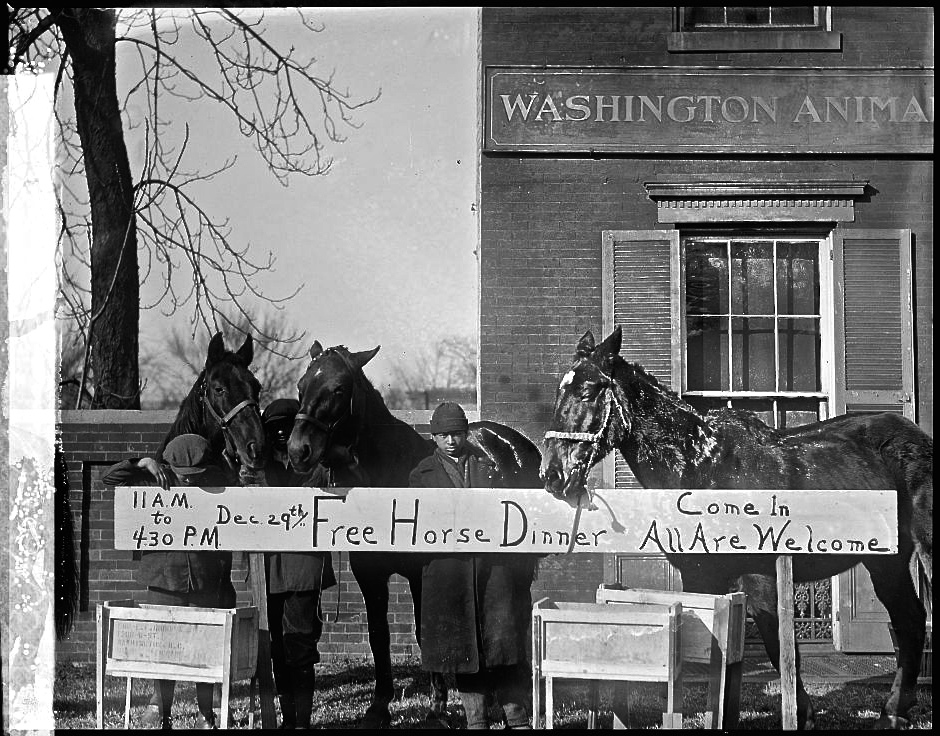
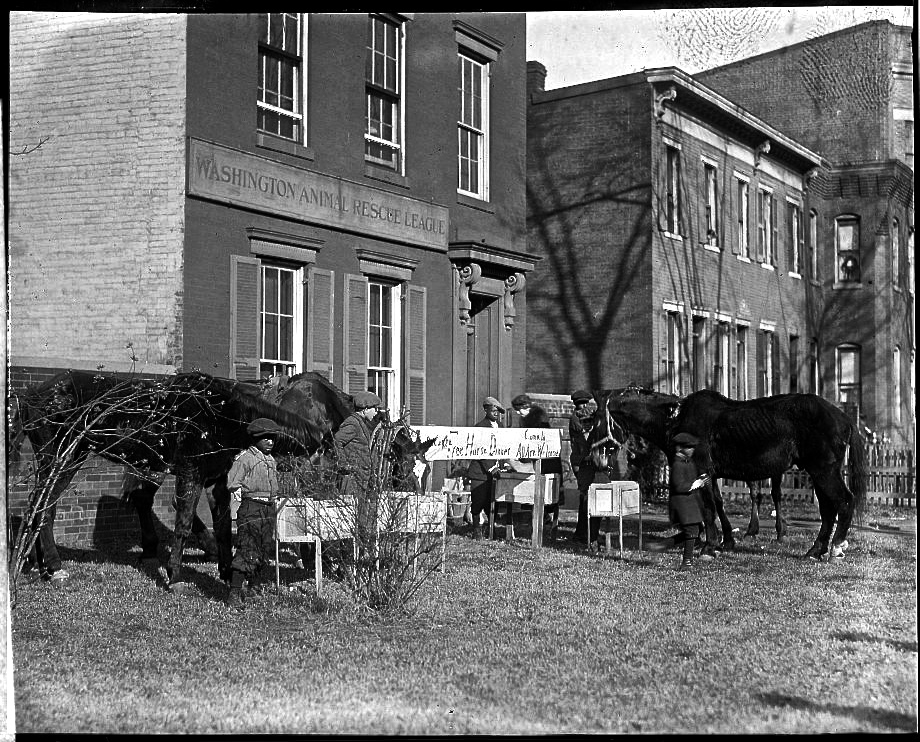
The photos below show the 1923 event in front of the League’s O Street, N.W., offices.

1923-1

The League was founded in 1914 and is the oldest animal shelter in Washington, D.C.  It is now located at 71 Oglethorpe Street, N.W.  (You can find out how to make a donation here.)

1923 -2

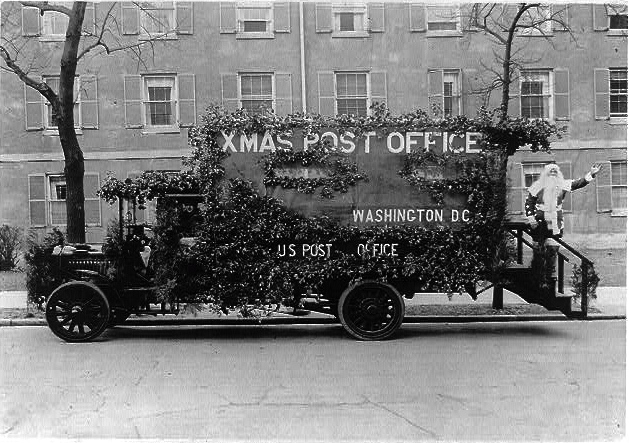
Another kind of antique seasonal cheer comes via this postal service truck liberally festooned with greenery.

mobile post office, LoC

In early December of 1921, it drove around Washington urging residents to mail their Christmas packages early.

All photos via the Library of Congress Prints and Photographs Division.  The three photos  just above  are from the National Photo Company Collection.  The top photo is by Harris & Ewing.

Vintage landscape: the national tree

White House, 19 December 1939, via LoC

On December 19, 1939 — in the photo above — the White House was being decorated for Christmas.  But the “gayly colored” lights on the wreath and trees would not be lit until Christmas Eve when President Roosevelt would also light the “community Xmas tree.”

At that time, what is now known as the National Christmas Tree was called the National Community Christmas Tree (I like that).

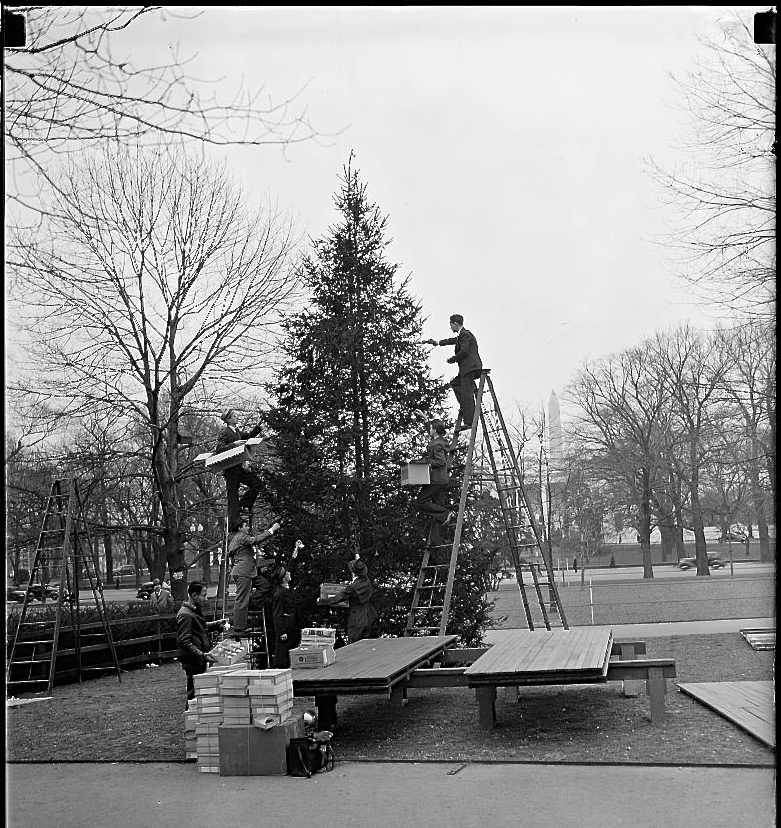
For most of the 1930s, the tree was installed in Lafayette Park, on the north side of the White House.  In the photo below, workers (in suits) decorate the 1937 tree on December 23.

1930's tree, L0C

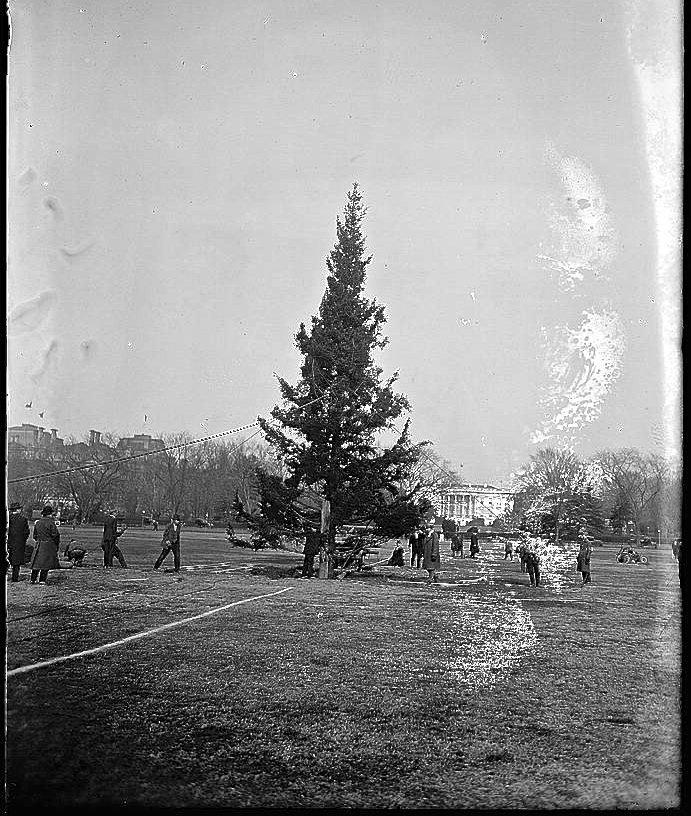
However, the first national tree had been placed on The Ellipse (also its current location), on the south side of the White House, in 1923 (below).

1923 tree setup, L0C

In the early 1920s, according to Wikipedia, “The Society for Electrical Development (an electrical industry trade group) was looking for a way to encourage people to purchase more electric Christmas lights and use electricity, and [Frederick Morris] Feiker [past editor of Electrical World] suggested that President Calvin Coolidge personally light the tree as a way of giving Christmas lights prominence and social cachet.”

The 48′ tall balsam fir was cut and donated by Middlebury College in the President’s home state of Vermont. The Electric League of Washington donated the 2,500 red, green, and white lights.

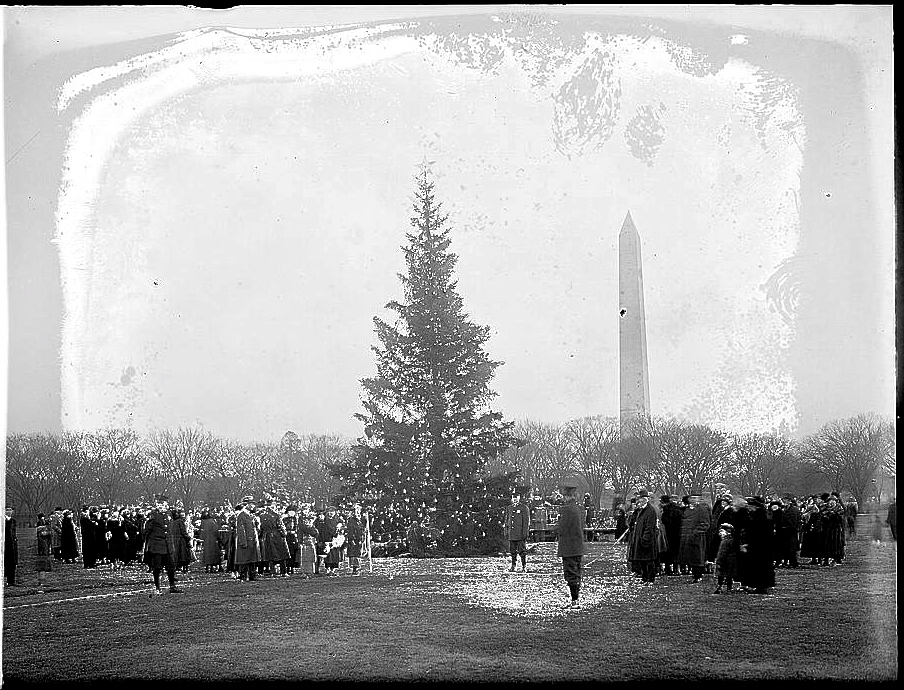
1923 tree, LoC

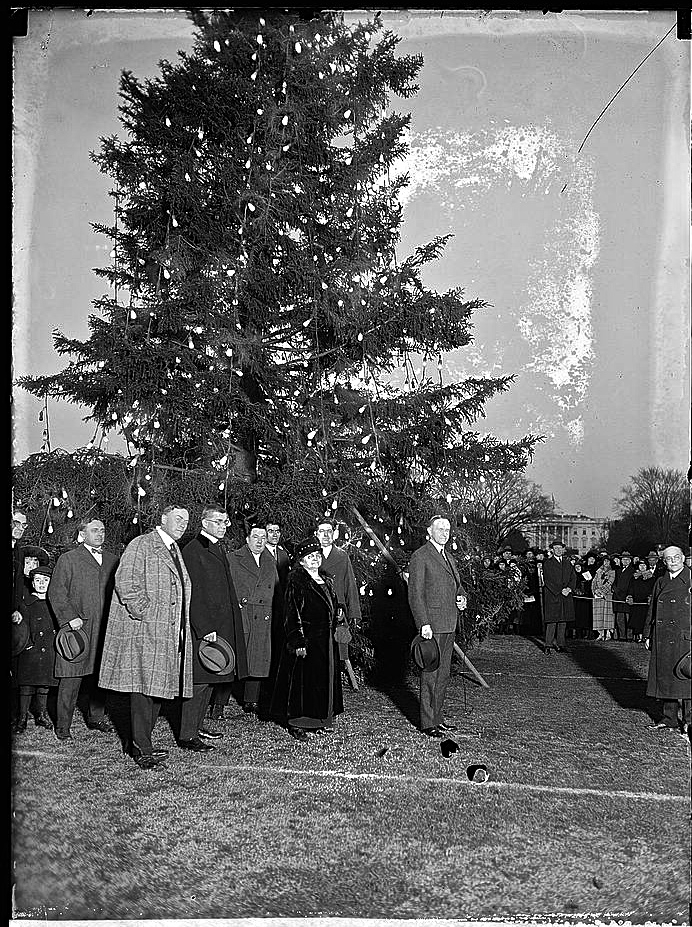
President Coolidge lit the tree on Christmas Eve without making any remarks (below).  A two-hour music concert was then held. Wikipedia notes that “after the white residents of the city had dispersed, African American residents of the city were permitted on the park grounds to see the National Christmas Tree.”

1923 tree lighting, LoC

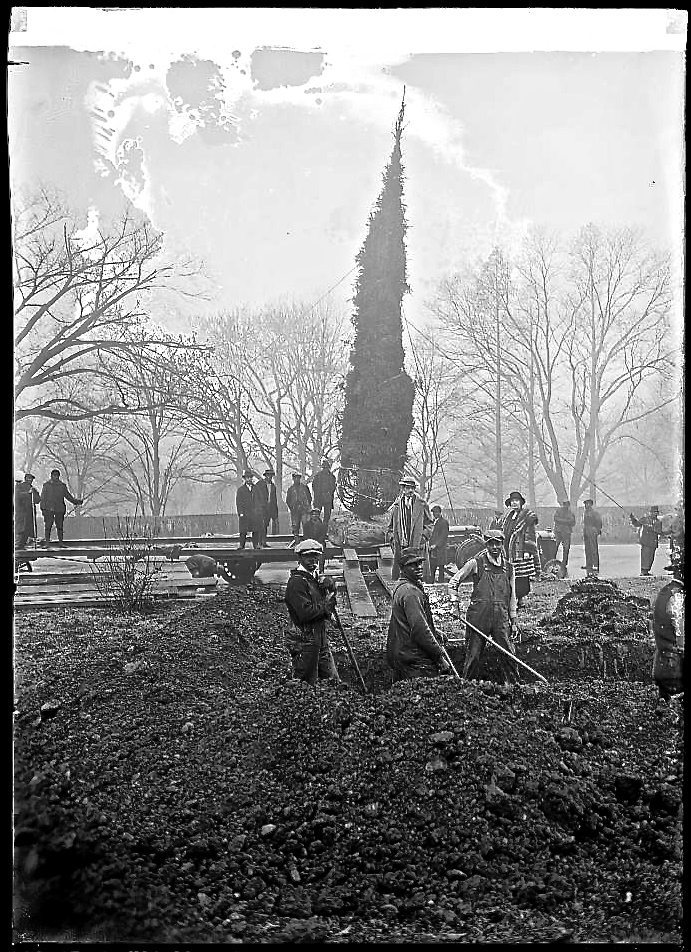
On December 17, 1924 (below), a live “community” tree was planted in Sherman Park (just southeast of the White House).  This had become necessary after Coolidge, speaking before the American Forestry Association that April, had criticized cutting trees for Christmas decorations. (The national tree had to be replaced in 1929 and has been replaced many times since. From the early 50s to the early 70s, cut trees were used.)

1924 tree planted, LoC

Below is a rather solemn moment from the lighting. The Coolidges’ son had died of blood poisoning earlier in the year, and a new Christmas carol, “Christmas Bells” — dedicated to Mrs. Coolidge — was performed at the ceremony.

1924 tree lit, L0C

Wikipedia has an interesting complete history of the National Christmas Tree here. Two more facts from the article:

“During the 1931 ceremony, a buzzer went off when Hoover lit the tree at 5:00 p.m. Because the button he pressed was not actually connected to the electricity, the buzzer alerted another official to actually light the tree.  The button the president pushed would not be reconnected to actual electricity again until 1980.”

In 1932, “loudspeakers connected to a phonograph were concealed in the branches of the tree, and Christmas carols were played every night from 6:00 p.m. to 10:00 p.m. until New Year’s Day.  The Singing Tree was a hit with the public, and although music and choirs continued to perform each year, the tradition of the Singing Tree lasted for several more decades.”

Facts about this year’s tree are here.

Photo Sources:

1. and 2. Photos by Harris & Ewing via Library of Congress Prints and Photographs Division.

3. to 8.  National Photo Company collection via Library of Congress Prints and Photographs Division.