Lorraine, France

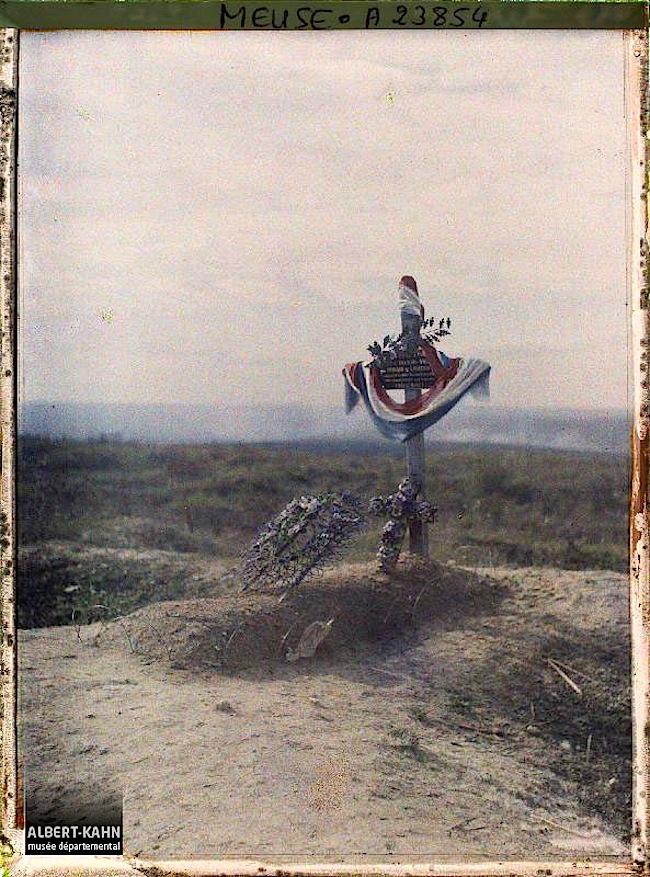
Grave of General Ernest Ancelin, Fort de Douaumont (Lorraine), France, September 20, 1920, by Georges Chevalier, via Archives of the Planet Collection – Albert Kahn Museum /Département des Hauts-de-Seine.

The General fell during an attack on the fort in October 1916.

The image above is one of about seventy-two thousand that were commissioned and then archived by Albert Kahn, a wealthy French banker and pacifist, between 1909 and 1931. Kahn sent thirteen photographers and filmmakers to fifty countries “to fix, once and for all, aspects, practices, and modes of human activity whose fatal disappearance is no longer ‘a matter of time.'”* The resulting collection is called Archives de la Planète and now resides in its own museum at Kahn’s old suburban estate at Boulogne-Billancourt, just west of Paris. Since June 2016, the archive has also been available for viewing online here.


*words of Albert Kahn, 1912. Also, the above photo (A 23 854) is © Collection Archives de la Planète – Musée Albert-Kahn and used under its terms, here.

Ronde kom

Round enclosure on Eeuwigelaan (street) in Bergen, The Netherlands, 1926, by A. J. Bondavia Archief Alkmaar Commons on flickr.

I have been wondering about the purpose of this really nice rustic fence in a wooded area (there’s another view here). In a much larger version of the photo, you can see barbed wire all around the top rails. The ground inside has either been dug out or worn away.  There are two benches nearby, with more barbed wire fencing behind them. What appears to be a road in the background is actually a canal. (And you can also see that the man standing on the right is wearing wooden shoes.)

It could have been the site of a large tree of special local significance, which then died and was removed. Or the spot of some other removed shrine or monument.  But why not take away the fence and fill the hole after dismantling what was inside?  Then I thought it might have been the small crater itself that was important — perhaps the remains of a WWI shelling in the area.

Today, this street is lined with very large homes.

ADDENDUM:  Nope, wrong all round. 🙂 Please see the very interesting comment below.

Gerbéviller, France

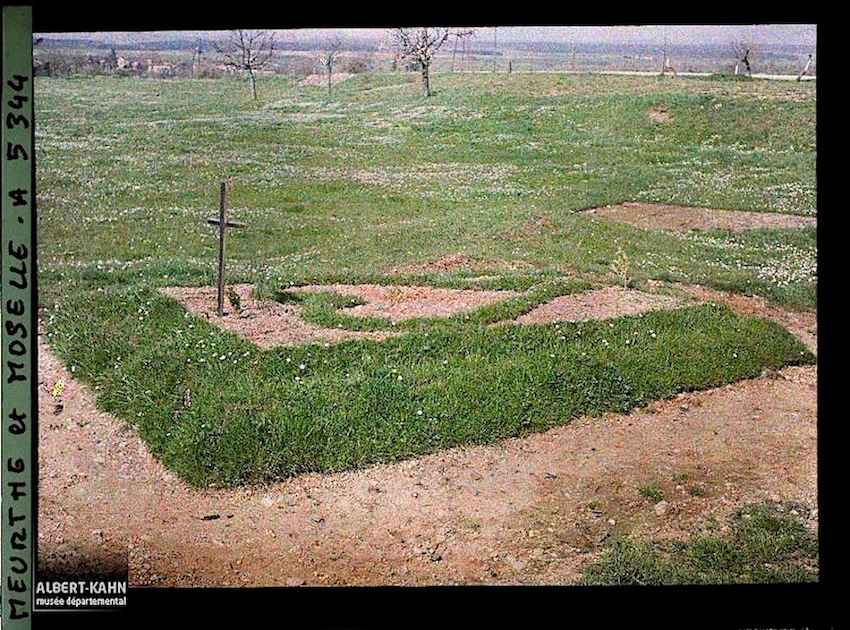
“La Tombe des Coloniaux, a heart of grass, near Gerbéviller,” April 28, 1915, by Georges Chevalier, via Archives of the Planet Collection – Albert Kahn Museum /Département des Hauts-de-Seine.

This seems to be the grave of a soldier (or perhaps soldiers) from one of the French Colonial Infantry Regiments. He probably fell in the Battle of Lorraine about seven or eight months before the photo was taken. Such men, called “Marines,” were recruited from both France and the white settler and indigenous populations of the French colonial empire.

The town of Gerbéviller itself had been caught in the same battle’s crossfire. German troops had systematically burned over 400 houses and killed over 60 inhabitants. It became “Gerbéviller-la-Martyre” in the press and a kind of pilgrimage site.

Today, there are both French and German WWI cemeteries in Gerbéviller.

This autochrome is one of about seventy-two thousand that were commissioned and then archived by Albert Kahn, a wealthy French banker and pacifist, between 1909 and 1931. Kahn sent thirteen photographers and filmmakers to fifty countries “to fix, once and for all, aspects, practices, and modes of human activity whose fatal disappearance is no longer ‘a matter of time.'”* The resulting collection is called Archives de la Planète and now resides in its own museum at Kahn’s old suburban estate at Boulogne-Billancourt, just west of Paris. Since June 2016, the archive has also been available for viewing online here.


*words of Albert Kahn, 1912. Also, the above photo (A 5 344) is © Collection Archives de la Planète – Musée Albert-Kahn and used under its terms, here.
Clement’s Inn, London

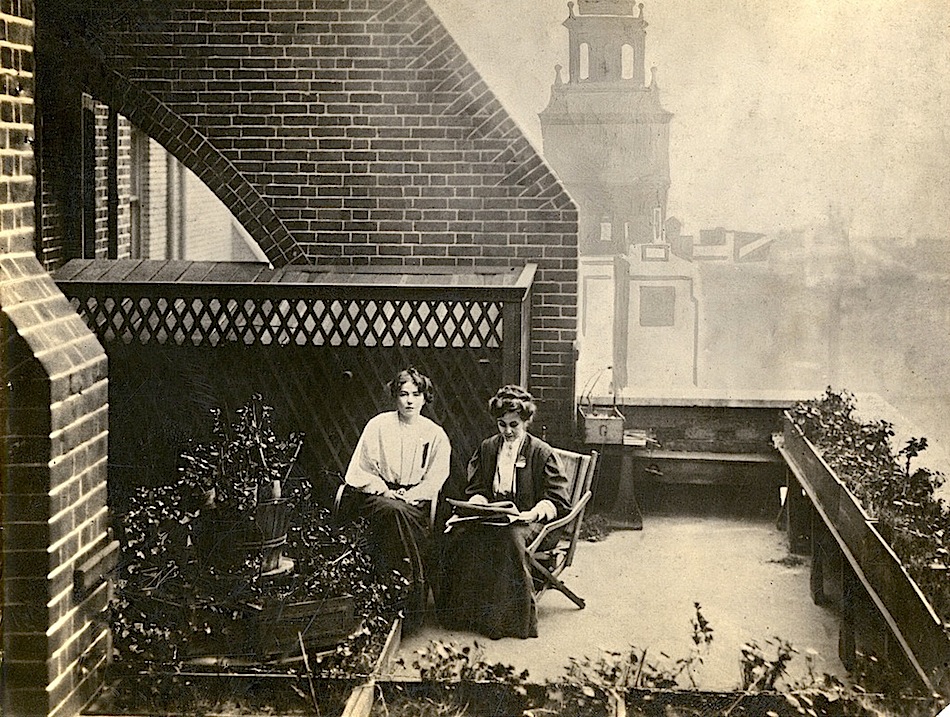
pankhursts-on-roof-garden1908-lse-libraryChristabel and Emmeline Pankhurst on the roof at Clement’s Inn, London, October 1908, via LSE (London School of Economics) Library Commons on flickr. A note on the back of the photo says that they were hiding* from the police.

At the time of the photo, numbers 3 and 4 Clement’s Inn† housed the offices of the Women’s Social and Political Union (WSPU), which Emmeline had founded in 1903. The organization was an all-female group campaigning for women’s suffrage and was known for its physical confrontations with police, hunger strikes, and arson. Christabel was Emmeline’s oldest daughter and eventually took over leadership of the group.  At the outbreak of WWI, both women called for a halt to WSPU militant activities in support of the war effort and became involved in the “white feather” movement, handing out the traditional symbol of cowardice to men in civilian clothes.

There’s an interesting history of the Pankhurst women (there were two more daughters, Sylvia and Adela) here.


* A warrant had been issued for their arrest.  After the photo was taken, they went down to the street and were arrested.

†Located about here. The Clement’s Inn buildings, built in the 1880s, were five to seven stories high and housed both offices and apartments.  They were all demolished by 1977. The photo above was taken from the roof garden of the apartment of another WSPU member.