
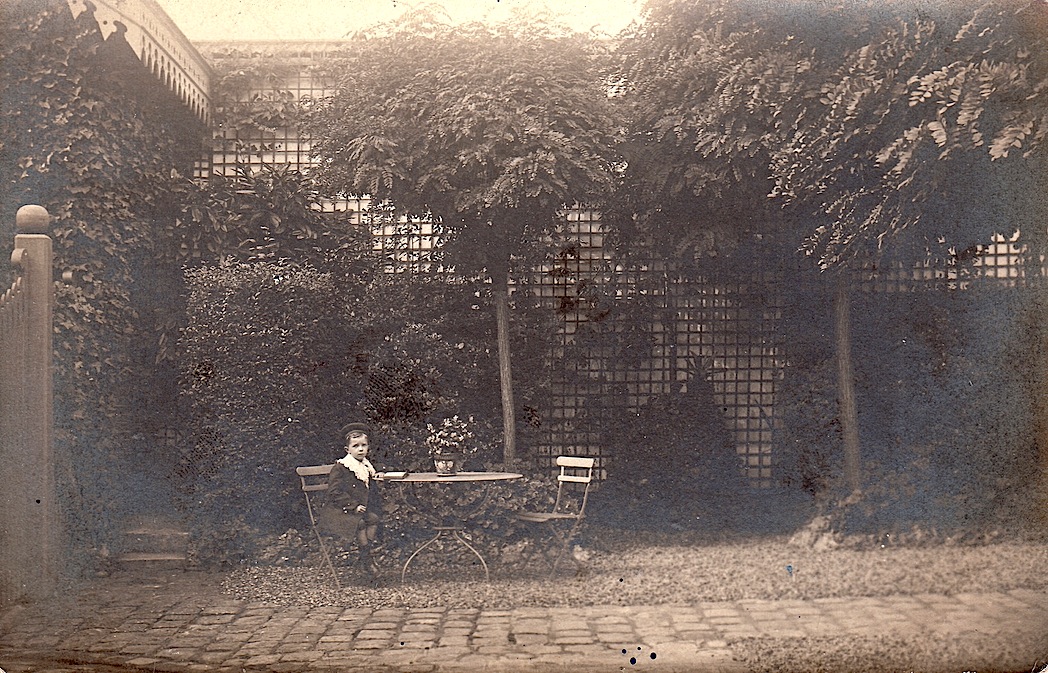
 “In a courtyard, somewhere in France (undated),” a photo postcard by an unknown photographer, via pellethepoet on flickr (under CC license). You can click on the image for a larger view.
Tag: well-dressed children
Poppies, Sweden

A young woman and two little girls in front of a row of double poppies, Gagnef, Sweden, August 1910, by Auguste Léon, via Archives of the Planet Collection – Albert Kahn Museum /Département des Hauts-de-Seine (both photos).

The autochromes above are two of about seventy-two thousand that were commissioned and then archived by Albert Kahn, a wealthy French banker, between 1909 and 1931. Kahn sent thirteen photographers and filmmakers to fifty countries “to fix, once and for all, aspects, practices, and modes of human activity whose fatal disappearance is no longer ‘a matter of time.'”* The resulting collection is called Archives de la Planète and now resides in its own museum at Kahn’s old suburban estate at Boulogne-Billancourt, just west of Paris. Since June 2016, the archive has also been available for viewing online here.
*words of Albert Kahn, 1912. Also, the above photos (A 436 and A 425) are © Collection Archives de la Planète – Musée Albert-Kahn and used under its terms, here.
Spruce Grove, Alberta
 Alan, Mary, and Robert Brebner, Spruce Grove, Alberta, ca. 1900, by Robert McKay Brebner, via Provincial Archives of Alberta Commons on flickr (both photos).
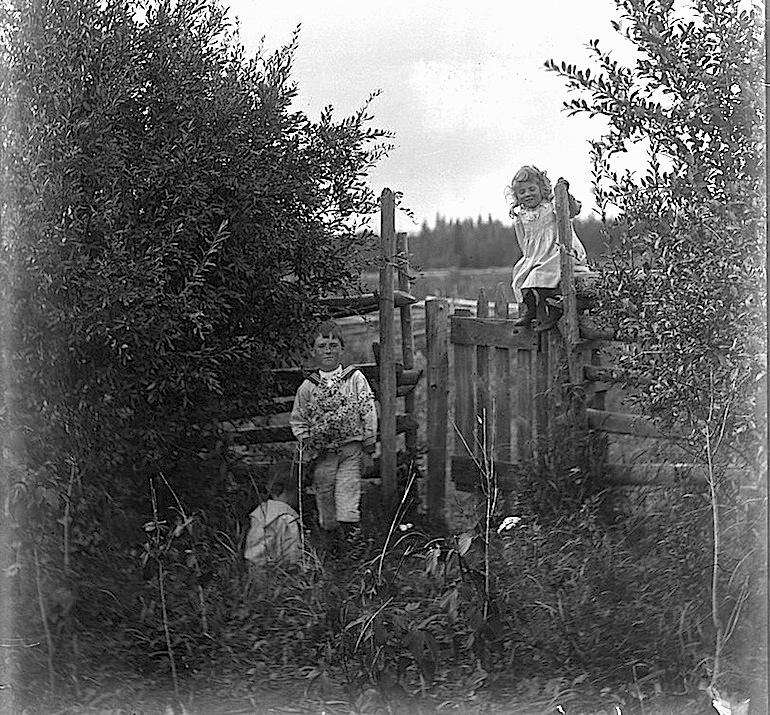
There is more about the Brebner family here.
Hamilton, Ontario
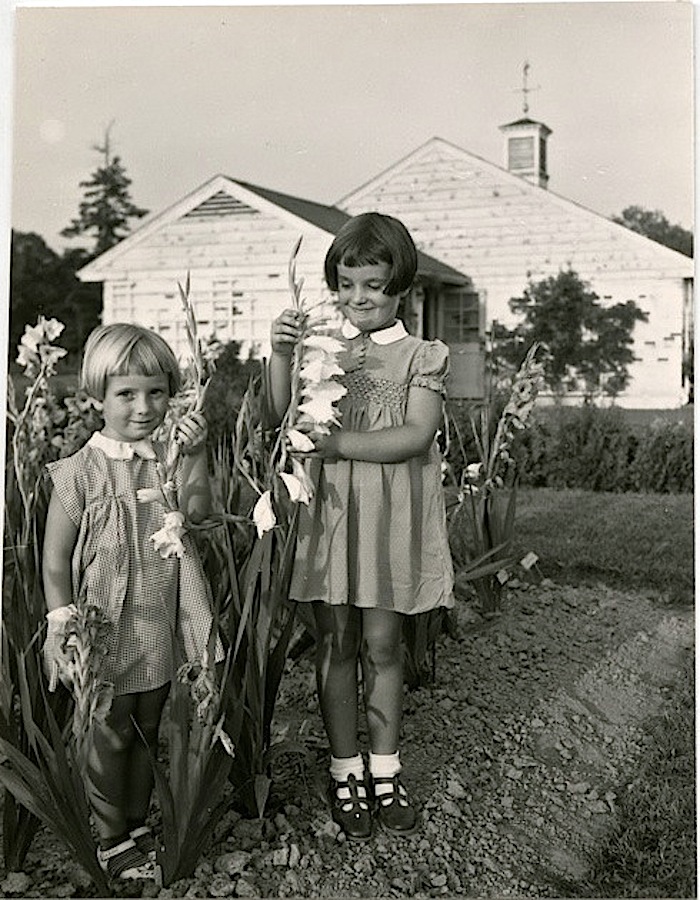
Gladiolus in the Children’s Garden, Royal Botanical Gardens, Ontario, 1955, via Local History & Archives, Hamilton Public Library (used with permission).
The Sunday porch: wedding party
 Sanders-Eckles wedding party, Lincolnville, Florida, ca. 1925, from the Richard Twine Collection, via Florida Memory (State Archives and Library of Florida) Commons on flickr.
Lincolnville is an historically African-American neighborhood of St. Augustine. It was established after the Civil War, in 1866, by several freedmen and women who leased the land for $1 a year. By the 1880s, it had begun to grow and “was characterized by narrow streets, small lots, and houses built close to the street line, similar to the colonial St. Augustine style and land-use pattern,” according to Wikipedia. By the 1930s, it was an important subdivision of the city in size and in political participation of its residents, and by the 1960s, it drew national attention for its role in the Civil Rights Movement.
In 1991, Lincolnville was listed on the National Register of Historic Places for its many late Victorian Era buildings and its place in African-American history. It is now known as the Lincolnville Historic District.
 enclos*ure