What better setting for some summertime snapshots than a charming porch dripping with vines?
This slideshow requires JavaScript.
These are the Cabot children (and probably their mother), photographed by Thomas Warren Sears and via the Smithsonian Institution, Archives of American Gardens, Thomas Warren Sears Collection.*
The Archives’ website says that these images were taken in 1930, but I would guess between 1900 and 1910, based on the clothing.
Sears studied landscape architecture at Harvard University between about 1900 and 1906. During that time, he also won awards for his amateur photography. One can well imagine him taking his camera to the summer home of friends and taking some casual pictures.
After graduation, he worked for Olmsted Brothers Landscape Architects. By 1913, he had established his own office in Philadelphia, from where he designed various types of landscapes in the mid-Atlantic region until the mid 1960s.
Earlier this month, the Archives announced the acquisition of the Ken Druse Garden Photography Collection, which includes thousands of transparencies and slides of over 300 American gardens. Selected images will eventually be added to the Smithsonian’s online catalogue.
Little girl. . . .
She has things to do,
you can tell. Places to explore
beyond the frame . . .
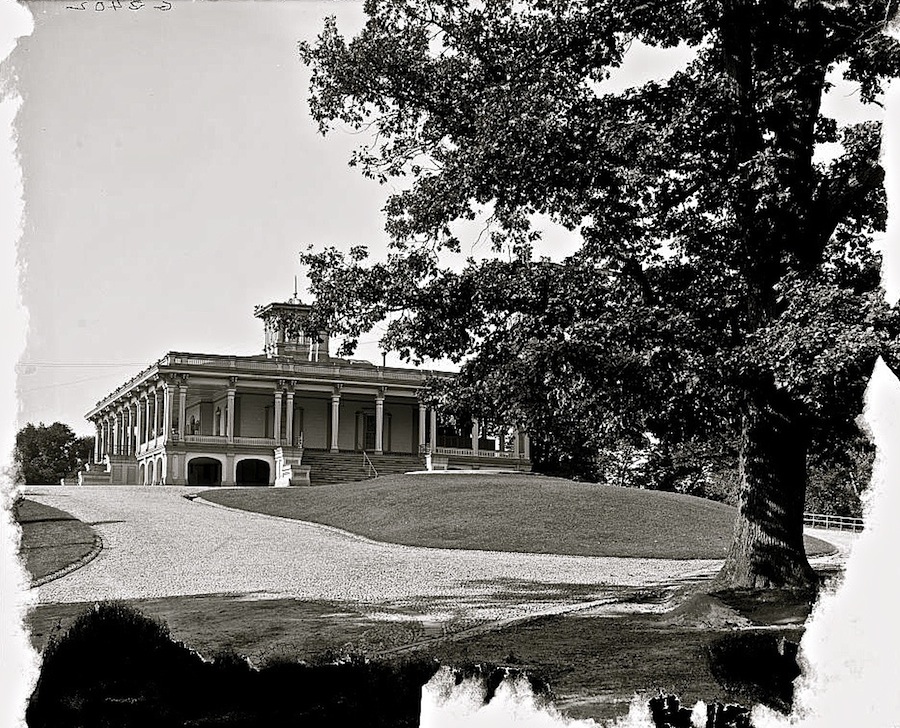
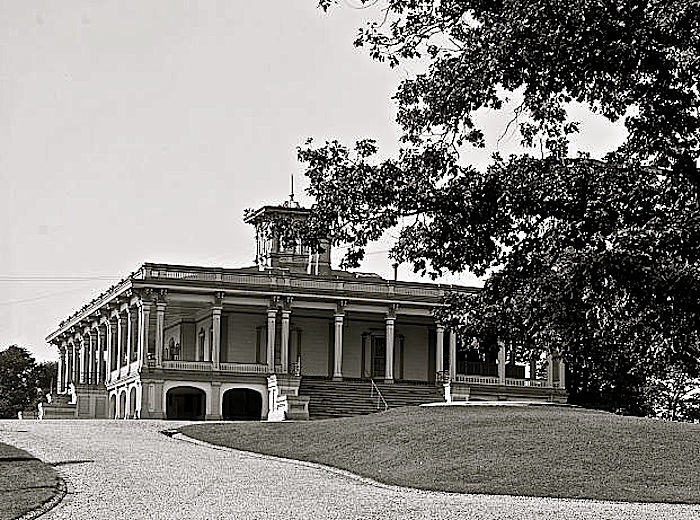
The Mansion House at Druid Hill Park, Baltimore, Md., between¹1900 and 1910, by Detroit Publishing Co., via Library of Congress Prints and Photographs Division.
It was built by landowner Nicholas Rogers as a summer house for his family, and it later became their primary residence. In 1860, his grandson sold the property to the city — which soon began turning it into a landscaped park.²
A closer look. There’s a round fountain on the grassy area in front of the steps.
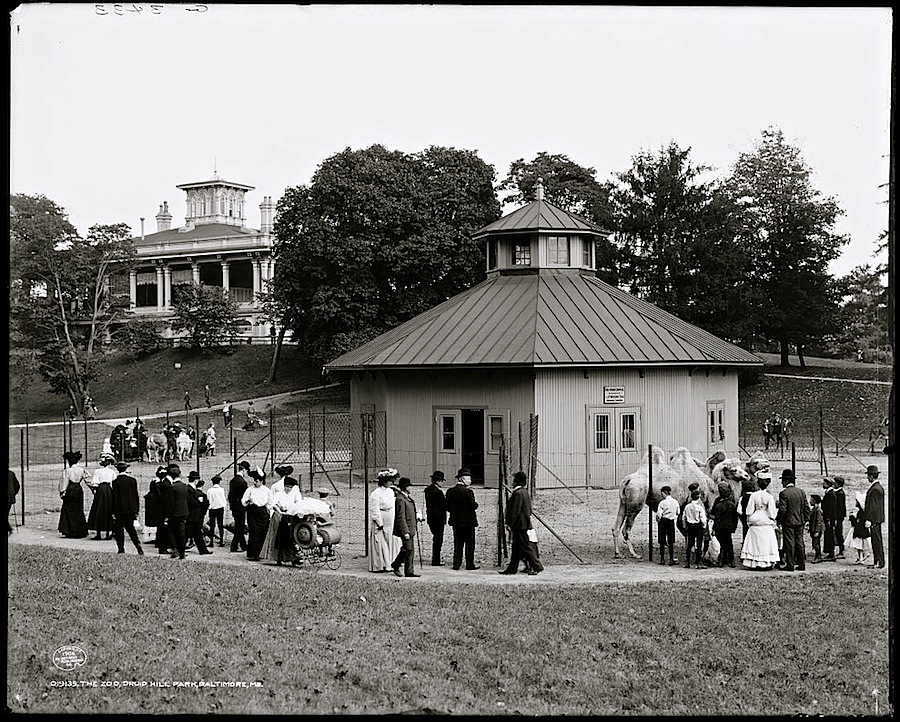
The new park’s (19-year-old) architect, George A. Frederick, added the open 20′-wide porch to all four sides of the mansion, and it was re-opened as a public pavilion, with refreshments sold in the basement. From the new tower, visitors could view the city. After 1876, a “zoological collection” could also be seen near the house.
In 1935, the porch was enclosed with large windows, and a Milk Bar and doughnut-making machine were installed. The Mansion House was advertised as “every man’s³ country club in the heart of Baltimore.”
In the 1940s, the building became a day school. Then, from the mid 1950s to 1978, exotic birds were displayed on the porch. In 1978, the house was renovated to hold the administration offices of The Maryland Zoo.
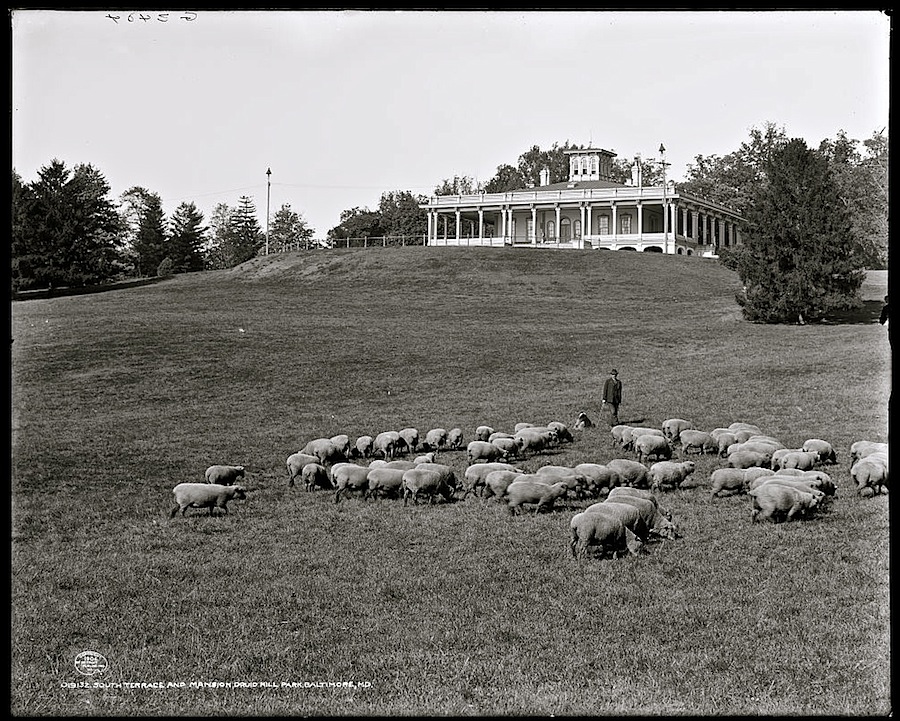
From about 1870 until his retirement in 1926, shepherd George Standish McCleary, cared for the park’s grass-cutting herd of Southdown sheep. He was assisted by three Scotch collies.
It so happens that I spent quite a bit of time in this house during the summer of 1979, when I was a student at Goucher College. I had an internship with the zoo’s Education Department.
Very newly renovated, the building was fresh, light, and airy, and almost empty. I can’t remember any other people in it: just the Education Director, his assistant, and me — perching, as is the usual situation for an intern, at the corner of the assistant’s desk.
I spent most of my time there working on the opening of a rather short-lived Insect Zoo ( possibly an idea ahead of its time). I learned to write exhibit labels, which had to be very brief and at the level of a 4th grade reader. This is actually quite difficult to do and was very good for me — I had to figure out what was really important or interesting about the animal or bug and then state it as simply as possible; no filler or showing off allowed.
A large part of the 745-acre park is forested, and one day the three of us went off to poke around the woods not too far from the house. I remember seeing old steps, discarded garden ornaments, and broken statuary — or maybe I only think I remember such a romantic thing.
The Maryland Zoo (formerly The Baltimore Zoo) is the third oldest zoo in the U.S.
Today, the building is still used for the zoo’s administrative office, and the porch can be rented for private events, such as weddings. The interior is very pretty in “buttery yellow,” with white trim, gold detailing, and rows of chandeliers.
ADDENDUM: A few months after this was posted, I received a email from a retired city employee confirming that the woods did contain a collection of old stone work, salvaged from houses that had been torn down.
I went by the Druid stone
That broods in the garden white and lone,
And I stopped and looked at the shifting shadows
That at some moments fall thereon
From the tree hard by with a rhythmic swing,
And they shaped in my imagining
To the shade that a well-known head and shoulders
Threw there when she was gardening. . . .
¹The two other photos are c. 1906, by Detroit Publishing Co., via Library of Congress.
²It quickly sold off the Rogers’s grove of 40,000 pear trees.
³At that time, every white man’s, I suspect. Although African-Americans used many parts of the park from its beginning, some areas were “whites only.” The swimming pool and tennis courts were not integrated until 1956.
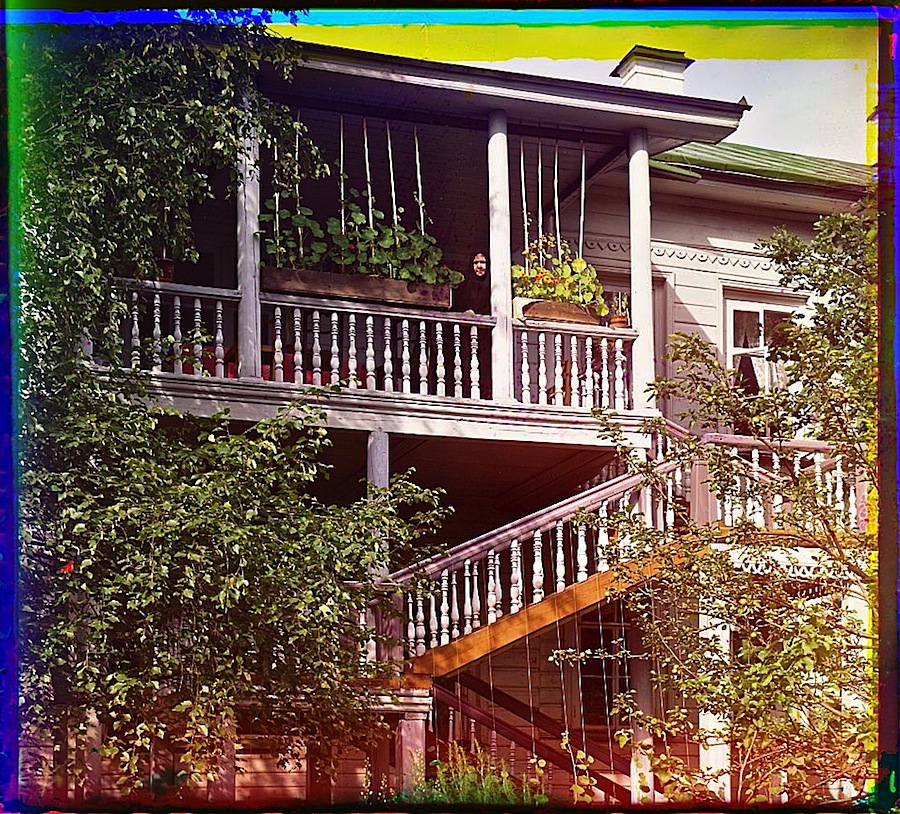
“Mother Superior Taisila on the veranda, Leushinskii Monastery” in 1909, by Sergei Mikhailovich Prokudin-Gorskii, via Library of Congress Prints and Photographs Division.
The monastery was (and possibly still is) in Leushina, in the Tver (or Tverskaya) Oblast of Russia — between St. Petersburg and Moscow.
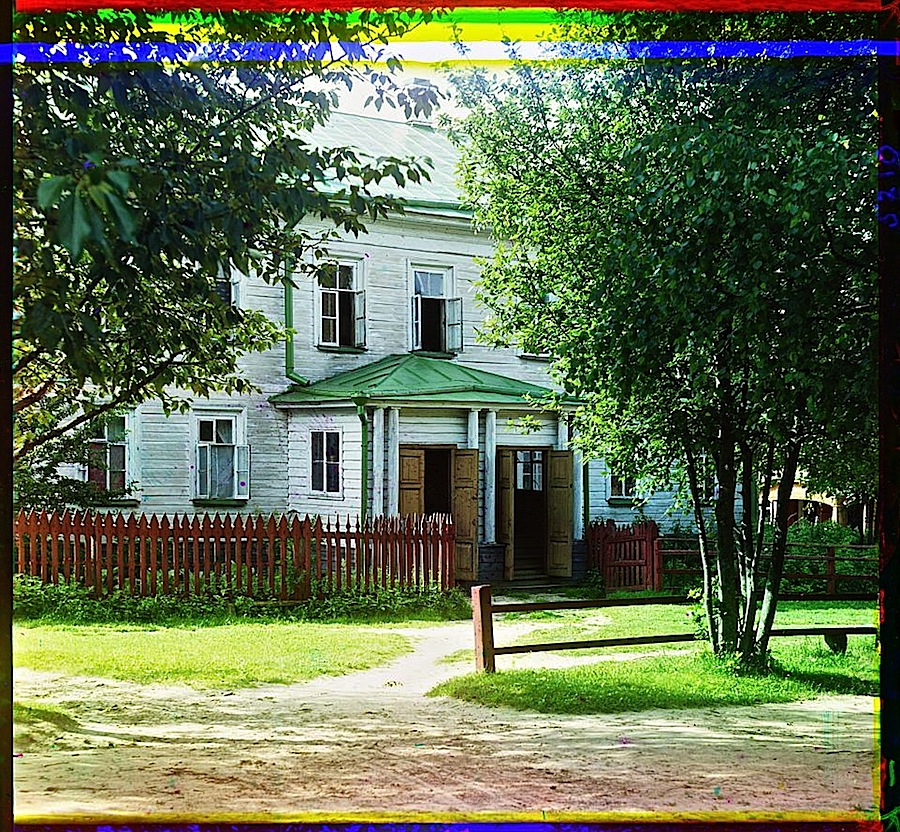
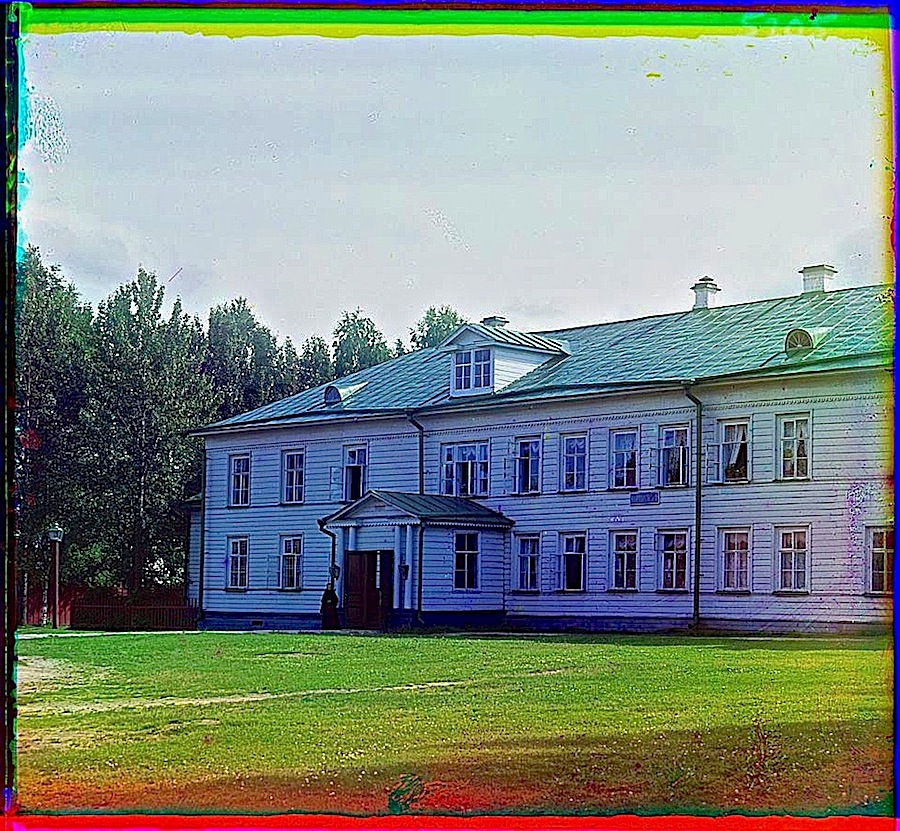
Prokudin-Gorskii made early color photographic surveys of the Russian Empire between 1905 and 1915. The Library of Congress purchased his collection of 2,607 images from his sons in 1948.
“Residence for the sisters of the Leushinskii Monastery.”
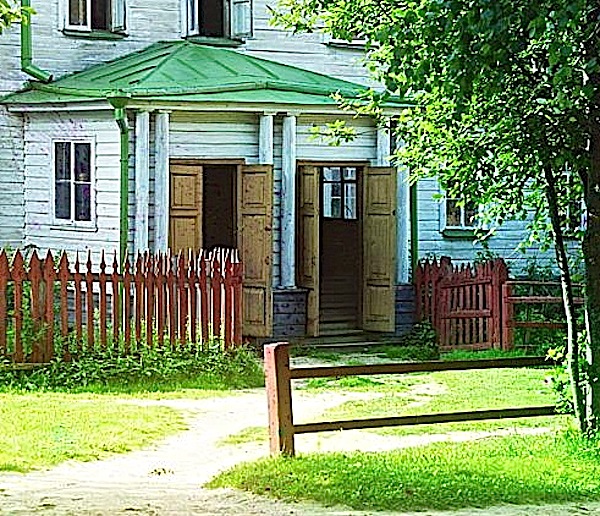
Detail above: the interior steps start right at the door frame.
“Residence of the Mother Superior.” All photos here by Prokudin-Gorskii, via the Library of Congress.
You can scroll through larger images by clicking on ‘Continue reading’ below and then on any thumbnail in the gallery.
Everything that slows us down and forces patience, everything that sets us back into the slow circles of nature, is a help. Gardening is an instrument of grace.
Piazzas and garden, Charleston, South Carolina, ca. 1910-20, by Detroit Publishing Co., Library of Congress Prints and Photographs Division.
The double side porches of Charleston are traditionally called ‘piazzas’ (pee-AH-ahs), a term that came into local use about 1730.
It’s also a feature of the city’s 18th and 19th century homes to have the formal front door (behind the cute little dog above) open onto the lower piazza instead of to the interior of the house.
If you click on the photo and enlarge it, you can better see all the little terracotta pots and geraniums lined up on the shelves along the railings.
I’ve sent my empty pot again
To beg another slip;
The last you gave, I’m grieved to tell
December’s frost did nip.
I love fair Flora and her train
But nurse her children ill;
I tend too little, or too much;
They die from want of skill.
I blush to trouble you again,
Who’ve served me oft before;
But, should this die, I’ll break the pot,
And trouble you no more.
— Christian Milne, “Sent with a Flower-Pot Begging a Slip of Geranium”
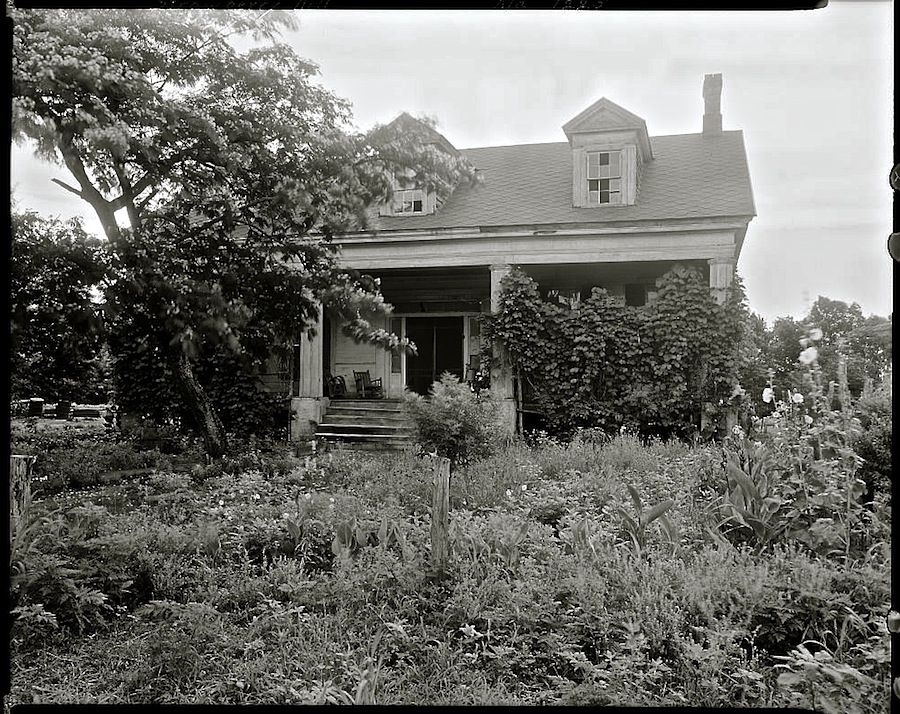
Strawberry Hill, Greene County, Alabama, in 1939. Photo by Frances Benjamin Johnston, via the Library of Congress Prints and Photographs Division. (Click on the image for a larger view.)
I’ve been looking at and bookmarking a lot of old photographs of beautiful porches lately, so today, I’m starting a Sunday series for these pictures.
The porch, particularly the front porch, connects — with a pause — the private interior of the house with the communal landscape beyond it. Andrew Jackson Downing wrote:
A porch strengthens or conveys expression of purpose, because, instead of leaving the entrance door bare, as in manufactories and buildings of inferior description, it serves both as a note of preparation, and an effectual shelter and protection to the entrance. . . .
The unclouded splendor and fierce heat of our summer sun, render this general appendage a source of real comfort and enjoyment; and the long veranda round many of our country residences stands instead of the paved terraces of the English mansions as the place for promenade; while during the warmer portions of the season, half of the days or evenings are there passed in the enjoyment of cool breezes, secure under the low roofs supported by the open colonnade, from the solar rays, or the dews of night.
In his pattern books of the 1840s and 50s, Downing popularized the front porch for the American home as a link to nature.
I see it as a box seat for the theater of the garden or of the street. Although the one above seems to have half drawn its curtains against the buzzing and chirping action of the cottage garden below.
The porch — and 1821 house attached — still exist, although without the vines and flowers. The surrounding land is now a cattle ranch. In fact, it is currently for sale for about $3.8 million.


 enclos*ure