The Sunday porch: rustic pavilion

Rustic building, Philadelphia, Library Company of PhiladelphiaThis whimsical shelter was located on a ridge in Philadelphia overlooking the Schuylkill River.  It was “one of the thatch-roof rustic pavilions installed at the [Fairmount Water Works] between 1864-1866 as a decorative improvement,” according to the website Philadelphia Architects and Buildings.

The photo, via Library Company of Philadelphia Commons on flickr, is dated ca. 1870.

In the lower left corner of the picture, you can just see one of the water work’s Classical Revival buildings at the river’s edge below. They housed and disguised the pumping equipment of the city’s water supply system from 1815 until 1911.

I love the birdhouses near the top of the pavilion’s roof.

The little buildings seem to have been replaced during the 20th century by white gazebos more closely matching the style of the other water works buildings, which now house a restaurant and interpretive center.
The Sunday porch: the collector

This slideshow requires JavaScript.

Farm House, Crowell’s Cross Road, Halifax County, North Carolina, between 1935 and 1938, by Frances Benjamin Johnston, via Library of Congress Prints and Photographs Division.

Still, as I went about my potting on a glorious afternoon, one small treasure after another, the world of nature that is so terrible and so beautiful appeared only in its sweetest aspect.

— Henry Mitchell, On Gardening

The Sunday porch: New York City

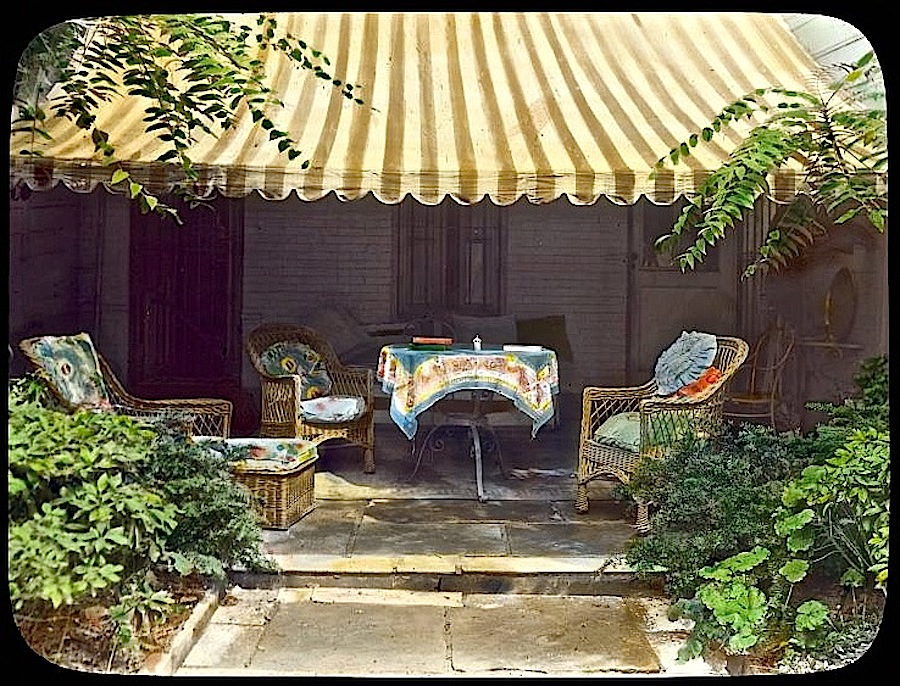
Murray house, 1922, NYC, by Frances B. Johnston, via Library of CongressAwning-covered back terrace of the Murray house, 129 East 69th Street, New York City, 1922. Hand-colored glass lantern slide by Frances Benjamin Johnston, via Library of Congress Prints and Photographs Division.

This looks so pleasant, but I also like the view in the other direction.

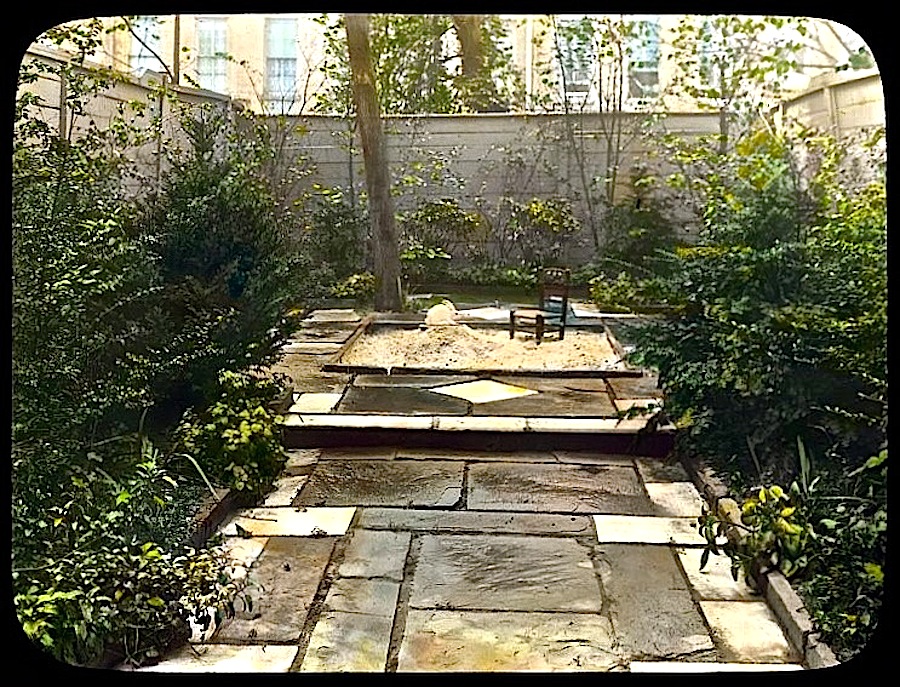
Murray house, 1922, NYC, by Frances B. Johnston, via Library of CongressLooking from the terrace to the sandbox, same house, photographer, and source.

What a nice-looking small outdoor space for both the parents and a child. (For grass, they had Central Park only three blocks away.)

According to the Library’s online catalogue, this garden was designed by Clarence Fowler. It was awarded the second prize for a city garden at the 1922 City Gardens Club of New York City photography exhibition at the New York Camera Club. Today, the house and garden no longer exist.

Johnston used these slides in her lectures on city and suburban gardens.

The Sunday porch: Airlie, N.C.

This slideshow requires JavaScript.

“Miss Lula Thorne’s house,” Oakland Plantation, Airlie in Halifax County, North Carolina, between 1935 and 1938, by Frances Benjamin Johnston, via Library of Congress Prints and Photographs Division.

Beautiful vines and interesting columns.  And I really like the four small sconces — one on each side of the door and one at each corner.

There were similar vines and sconces on this other North Carolina house here.

Oakland house was probably built between 1823 and 1828 for Elizabeth Williams Thorne Drake and either her first or second husband. It still stands, but, at some point after the 1930s, the porch was rebuilt to match the late Federal “temple form” style of the rest of the house. You can see it about 2012 here and here.


The Sunday porch: Centerville, Calif.

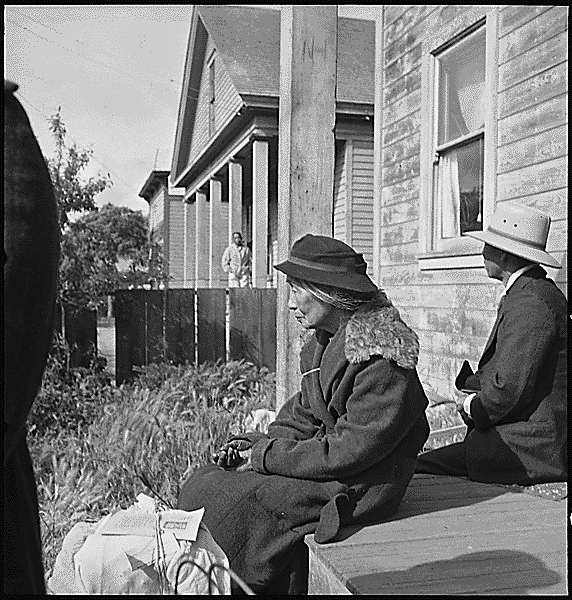
Japanese-American grandmother on porch 1942, U.S. National Archives“Grandmother of farm family awaits evacuation bus. Evacuees of Japanese ancestry will be housed in War Relocation Authority centers for the duration,” May 9, 1942, by Dorothea Lange for the U.S. War Relocation Authority, via U.S. National Archives on flickr.

Centerville is a community in northern California. All along the Pacific coast — from 1942 to January 1945 — over 110,000 people of Japanese heritage were forced into internment camps.  Sixty-two percent were American citizens.

In 1988, in the Civil Liberties Act, the U.S. Government admitted that its actions had been based on “race prejudice, war hysteria, and a failure of political leadership.”