A Saturday porch: The Firs

A Halloween porch. . .

5 The Firs, ca. 1900, Library of Congress

This was the front porch of “The Firs” in New Baltimore, Michigan, between 1901 and 1910.* At that time, it was a summer boarding house.
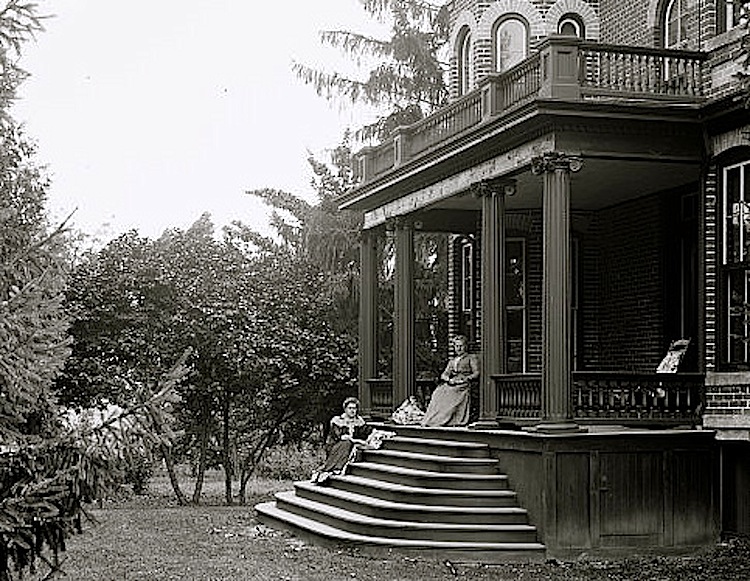
Detail.
Detail.

Although the ladies above look calm enough, throughout the 20th century — and up until the house was torn down in 2005 — many residents, visitors, and trespassers reported weird phenomena there.

Lights flickered, dishes flew off the table, strange voices were heard, and invisible fingers stroked girls’ hair. Ghostly figures were sometimes seen — particularly those of a young woman, an older man, and a child playing in the yard — or so ’twas said.
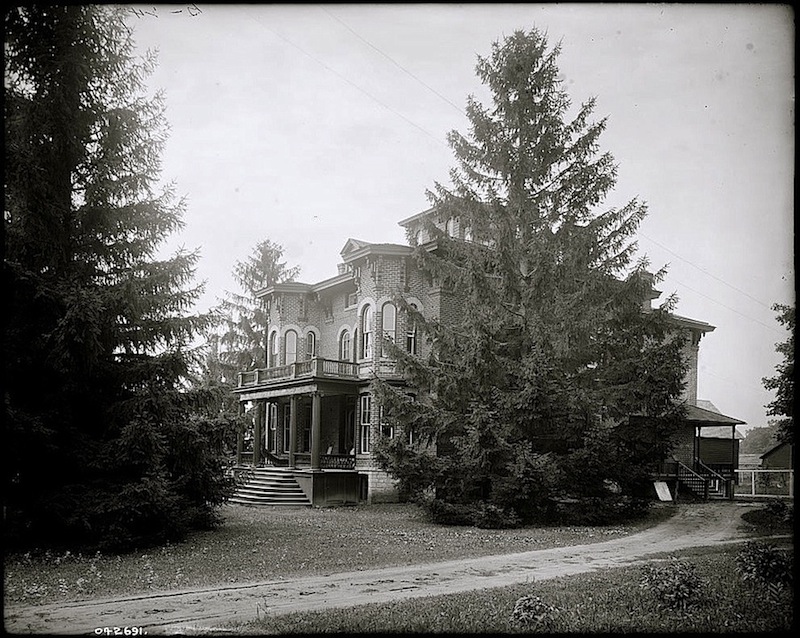
1 The Firs, ca. 1900, Library of Congress

The residence was first known as Hatheway House, for Gilbert Hatheway, a businessman who built it about 1860.

When he died in 1871, the house went to his son, James S. H. P. Hatheway. James had one daughter, Mabel, who died in March of 1881.

Mabel was only twenty at the time of her demise and had married a man from another town just three months earlier. Local legend has her being killed from a fall down the Hatheway House stairs.

One account of the alleged incident notes that her father, irritable from chronic pain, was also unhappy with her choice of husband; another brings up an older cousin with anger management issues. In at least one version of Mabel’s slight history, she is mentally ill.
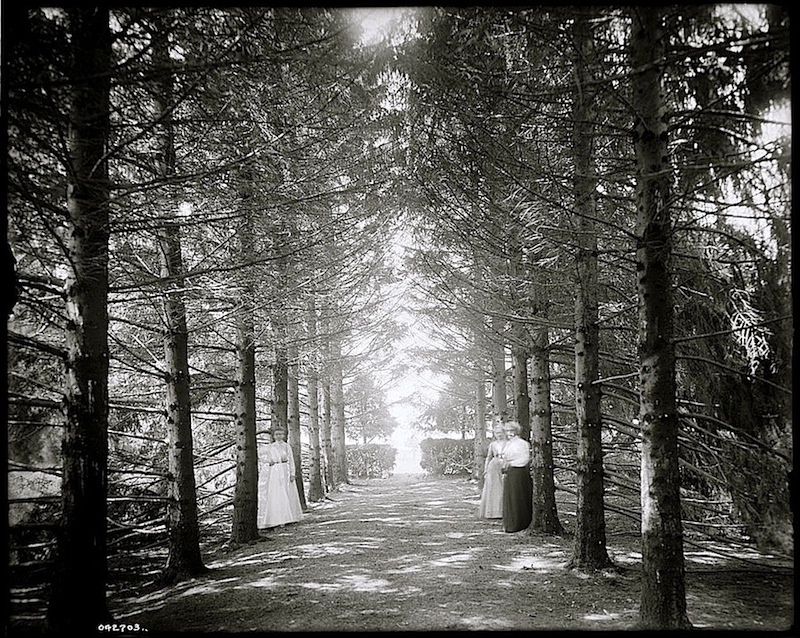
6 The Firs, ca. 1900, Library of Congress
A slightly spooky allée in front of the porch.

In the late 1800s, the Hatheway family moved out of the house, and it became The Firs.

About the same time, or perhaps later during the WWI years, the west side of the building was turned into a small hospital, run by Dr. Virginia French.  It was never a home for the insane, although that was the creepier story often passed down.

3 The Firs, ca. 1900, Library of Congress

I haven’t been able to find out what happened to the property later in the 20th century, except that it seems to have been empty by the late 1990s, if not well before — perhaps because of its reputation as a haunted house.

Naturally, teenagers found it a fun place to explore at night and vandalize. In August 2005, much to the neighbors’ relief by one account, the house was demolished. However, there continue to be reports of strange lights and noises in the ruins of the basement.

2 The Firs, ca. 1900, Library of Congress
A fairly cheerful side garden.

You can scroll through more (and larger) images of The Firs by clicking on ‘Continue reading’ below and then on any thumbnail in the gallery.

*Photos by Detroit Publishing Co., via Library of Congress Prints and Photographs Division.

Continue reading “A Saturday porch: The Firs”

The Sunday porch: Newport, R.I.

Wakehurst, Newport, RI, 1950s, via Library of Congress:The Sunday porch-enclos*urePorch at the residence of Margaret Brugiere, Wakehurst, in Newport, Rhode Island, August 6, 1958, by Gottscho-Schleisner, Inc., via Library of Congress Prints and Photographs Division.
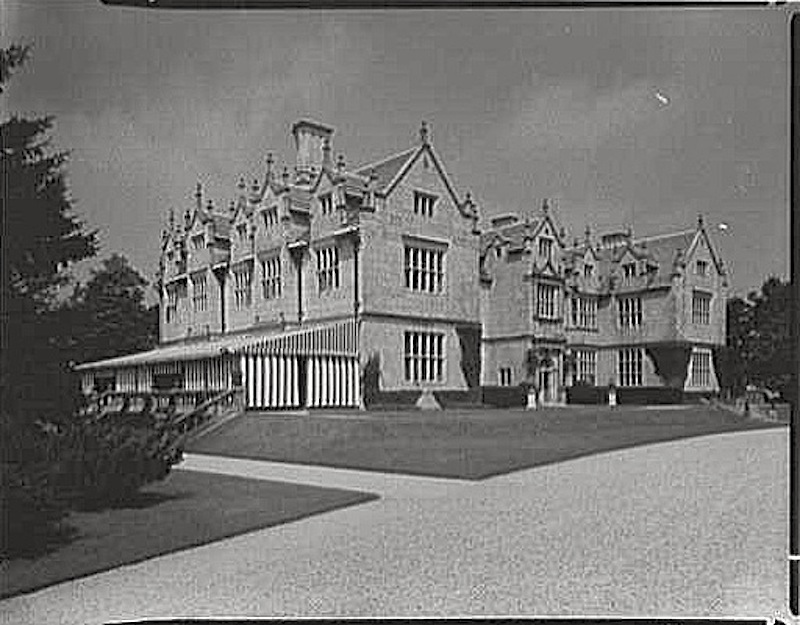
The house was built in 1887 by James J. Van Alen as an exact replica of 16th century Wakehurst Place in West Sussex, England.

Margaret, or “Daisy,” Brugiere was Van Alen’s daughter-in-law (widowed and remarried), and she kept the place going in a high style until her death in 1969.

At some point, the family must have wanted the comforts of an American porch and created one with awning.  Its interior style seems inspired by Naples — both the city in Italy and the one in Florida.

Wakehurst porch, Newport, RI, 1950s, via Library of Congress:The Sunday porch-enclos*ure

The property exists today as the student center for Salve Regina University.

The Sunday porch: Queensland

Queensland porch with shell, ca. 1895, via State Library of Queensland“Decorated corner of a veranda,” Queensland, Australia, ca. 1895, photographer unknown, via State Library of Queensland.

The shell of the giant clam (Tridacna gigas) pictured above was probably taken from the waters around the Great Barrier Reef.  Today, the mollusk is a “vulnerable” species due to overharvesting.

The Sunday porch: cozy

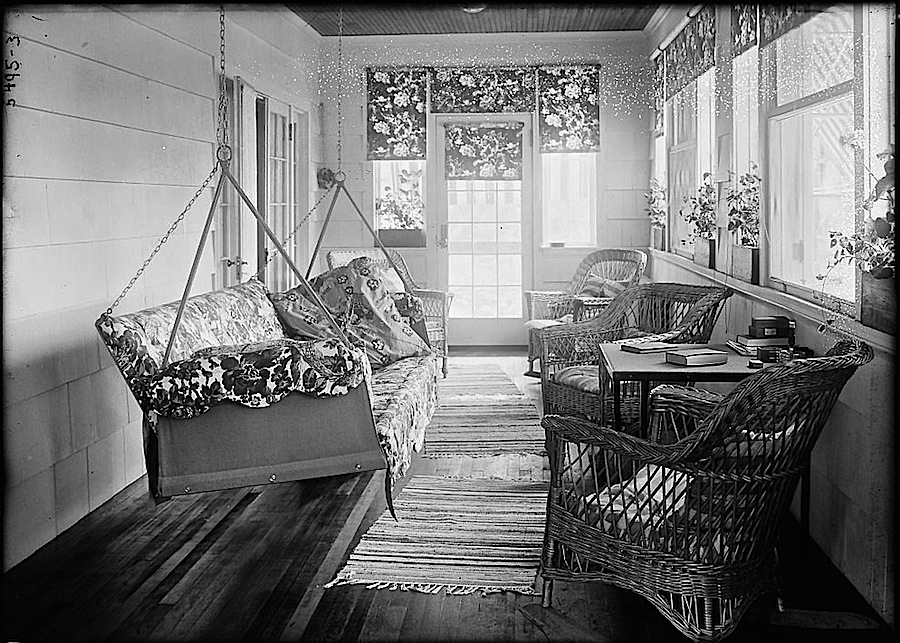
The Sunday porch:enclos*ure- cozy porch interior, ca. 1900, via Library of CongressEnclosed porch, location unknown, ca. 1900 – ca. 1920s, by Bain News Service, via Library of Congress Prints and Photographs Division.

Nice. . . chintz, wicker, books, and potted geraniums — and I love that swing.  There are striped awnings outside over the windows.

. . . You’re bunkered in your
Aerie, I’m perched in mine. . .
We’re content, but fall short of the Divine.
Still, it’s embarrassing, this happiness—
Who’s satisfied simply with what’s good for us
When has the ordinary ever been news?

Rita Dove, from “Cozy Apologia

The Sunday porch: luncheon

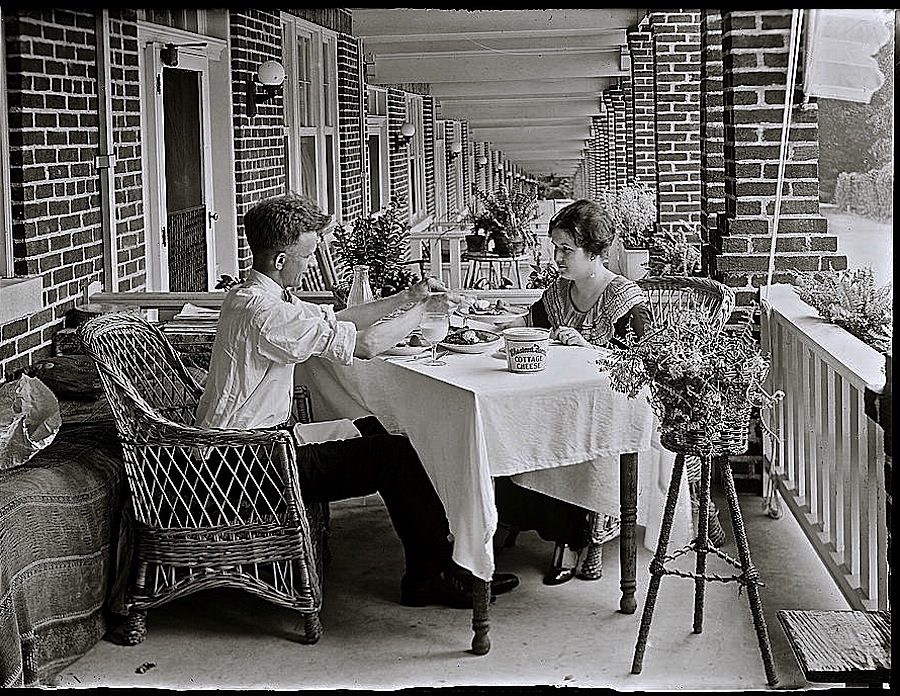
The Sunday porch:enclos*ure- cozy porch interior, ca. 1900, via Library of Congress“Man and woman eating at table on front porch of row house,” Washington, D.C., 1924, by National Photo Company, via Library of Congress Prints and Photographs Division.
I’m sure that this photo was taken to illustrate an advertisement for the maker of that tub of cottage cheese on the table.  (I can’t make out the name of the dairy company.)

You can click on the picture to enlarge it — then you can see that the couple are drinking their milk from wine glasses.

The location could have been in any one of several northwest D.C. neighborhoods — so popular in the city was the Wardman-style of rowhouse by the 1920s.

ADDENDUM:  I found another photo of the same couple, here, having a picnic lunch in Rock Creek Park — again with plenty of cottage cheese.