
 “Table in picnic grove set for St. Thomas church supper near Bardstown, Kentucky,” August 1940, by Marion Post Wolcott via the Library of Congress Prints and Photographs Division.
Tag: Library of Congress Prints and Photographs Division
Vintage landscape: stump fences
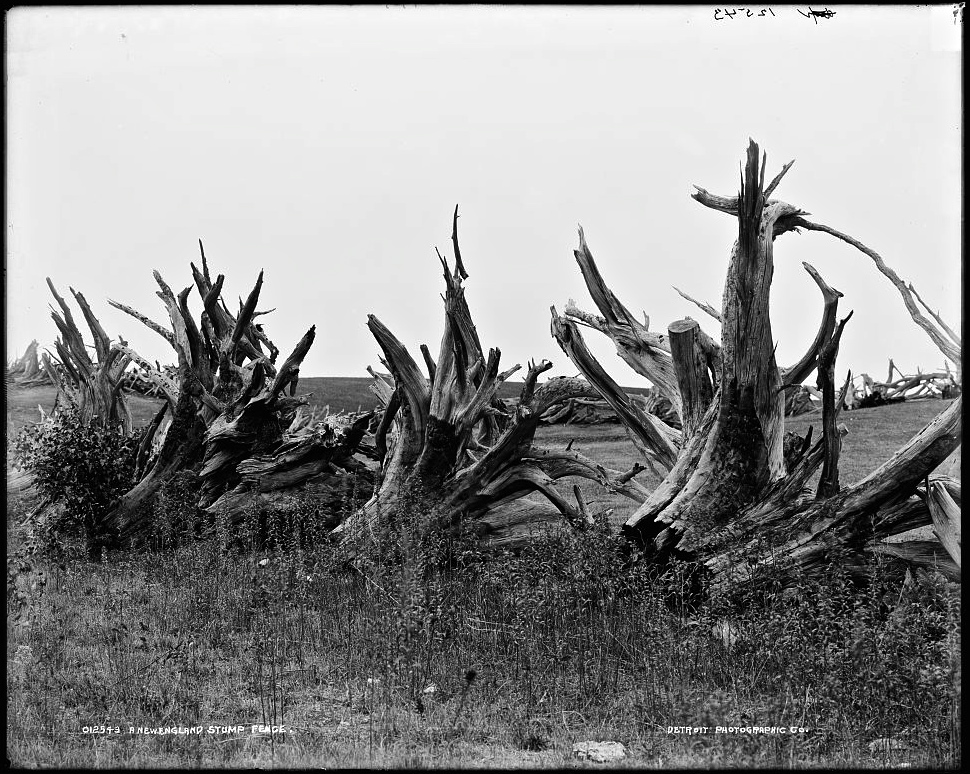
The stump or root fences on the Corner road remind me of fossil remains of mastodons, etc., exhumed and bleached in sun and rain.
— Henry David Thoreau, Journal (July 19, 1851)
Both photos: “A New England stump fence,” ca. 1890-1901, by Detroit Publishing Co., via Library of Congress Prints and Photographs Division.
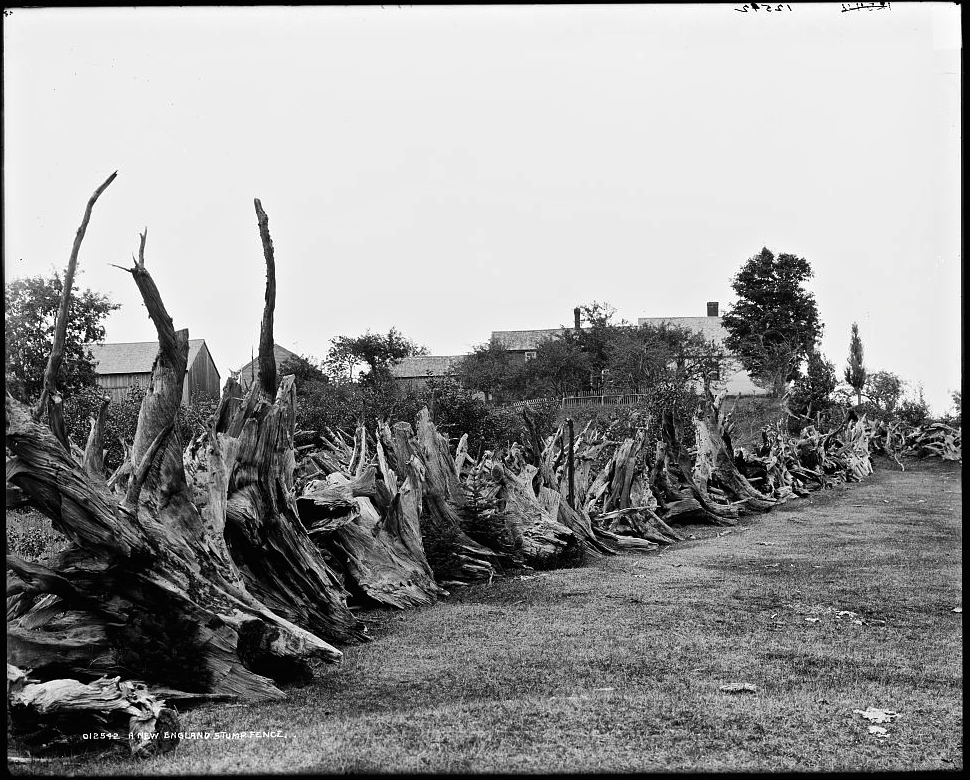
I had heard of ‘stumperies,’ but not of stump fences (sometimes called root fences), however now I’ve learned that . . .
[s]tump fences, as their name implies, were made by dragging the stumps of trees to the edge of a field and placing them side by side, with their interlacing roots facing outward and their trunks inward. In the days when “ugly as a stump fence” was a simile in common usage, the stump fence had its critics, but in 1837 one observer called it “a singular fence…needing no mending, and lasting the ‘for ever’ of this world.” “The devil himself couldn’t move a stump fence,” farmers used to say, an opinion borne out by the fact that stump fences well over a hundred years old can still be seen in parts of Canada and in the Midwest.
Stumps were often the product of the first clearing of the land, but stump fences didn’t appear in the first generation of a settlement’s fences because stumps need to sit in the ground for six to ten years before they are loose enough to be pulled out and hauled away. Extracting even a loosened stump was never easy; it required oxen and strong chains, something that many settlers lacked at first. In the 1800s, stump pulling would become a cash business and one way that a man could make a good living. Twenty-five cents a stump was the standard price in 1850 when men operating such mechanical stump pullers as the “Portable Goliath,” “The Little Giant,” and “Roger’s Patent Extractor” could extract from twenty to fifty stumps a day.
–Susan Allport, Sermons in Stone: The Stone Walls of New England and New York (older edition here)
Quotes via the blog Laudator Temporis Acti.
I’m traveling for the next couple of weeks, but I’ll be posting a ‘vintage landscape’ from time to time.
Going green in 1938

“Golf course grass now dyed green for nervous putters. Washington, D.C., Aug. 5 [1938].
“Nervous golfers who have complained that some insecticides used on greens turned the grass brown, thus creating a mental hazard which spoiled their game, have no excuse now. Experts of the U.S. Department of Agriculture, working with the United States Golf Association, have combined an insecticide with a green [dye], which, when sprayed does not harm healthy grass but improves both the color of uneven greens and the tempers of the golfers who blame their putting on the uneven color of the greens. The new dye is being used on football gridirons and baseball fields.
“A.E. Rabbit, grass specialist of the United States Golf Association, is pictured spraying the new dye on an experimental green at the Department of Agriculture.”
First of all: Mr. Rabbit, a grass specialist?! And he’s very nattily dressed to be out spraying colored poison.
Here’s a link to a brief history of pesticides, and here’s a link to “How Green is Golf?” by John Barton, which ran in the May 2008 Golf Digest and features a variety of voices from golf course superintendent to environmental activist.
There’s also this.
The further adventures of Mr. R. here.
Photo and text in quotes via Library of Congress Prints and Photographs Division.
Vintage landscape: Central Park
 “View from apartment 9D, 146 Central Park West, in the rain, New York City, 1946 July 9.” By Carl Van Vechten, via Library of Congress Prints and Photographs Division.
Don’t threaten me with love, baby. Let’s just go walking in the rain.
— Billie Holiday
Central Park: An Anthology by Andrew Blauner was published this April. Read the New York Times review here.
Vintage landscape: flowers and cabbages
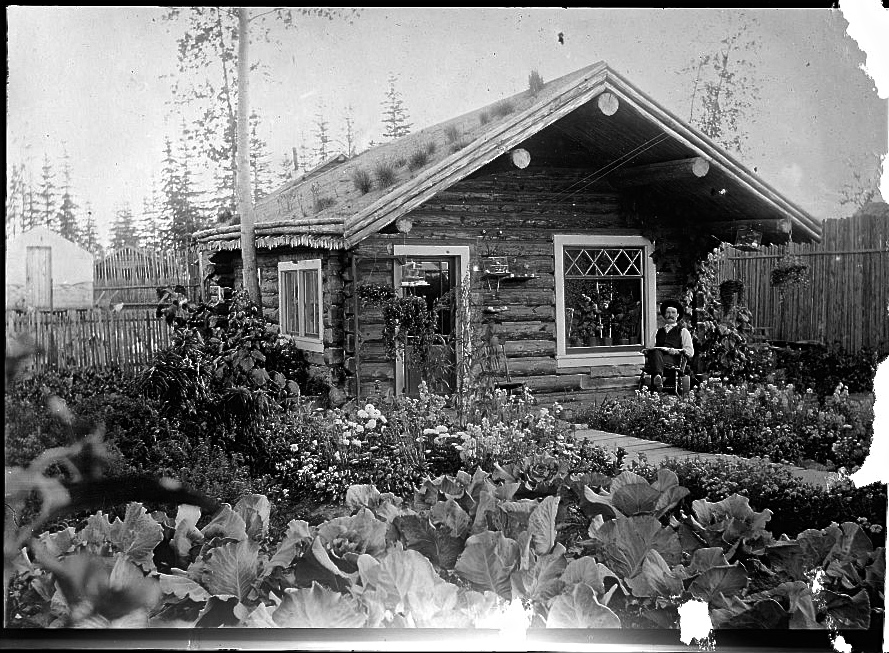 “A cottage & garden, Alaska,” ca. 1909-1920. By National Photo Company, via Library of Congress Prints and Photographs Division.
A similar photo of this cottage was labeled “a sourdough’s home.” The word ‘sourdough’ was slang in Alaska for an oldtimer, probably from the Klondike gold rush. You can click on the image to enlarge it.
O cabbage gardenssummer’s elegysunset survived— Susan Howe, from “Cabbage Gardens”
 enclos*ure