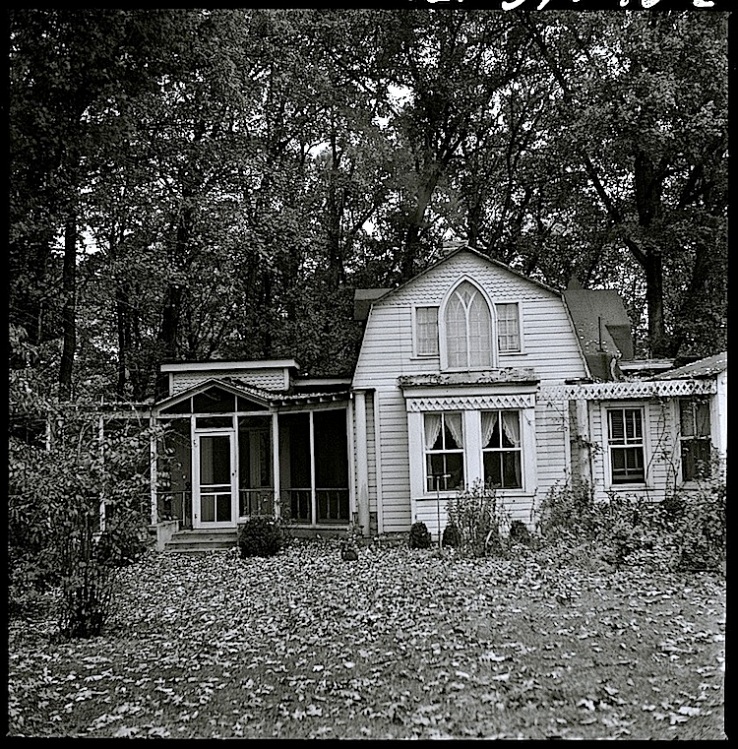
 “Washington, D.C. The home of Miss Norma Kale, a Woodrow Wilson High School English teacher,” October 1943, by Esther Bubley, via Library of Congress Prints and Photographs Division (all photos here).
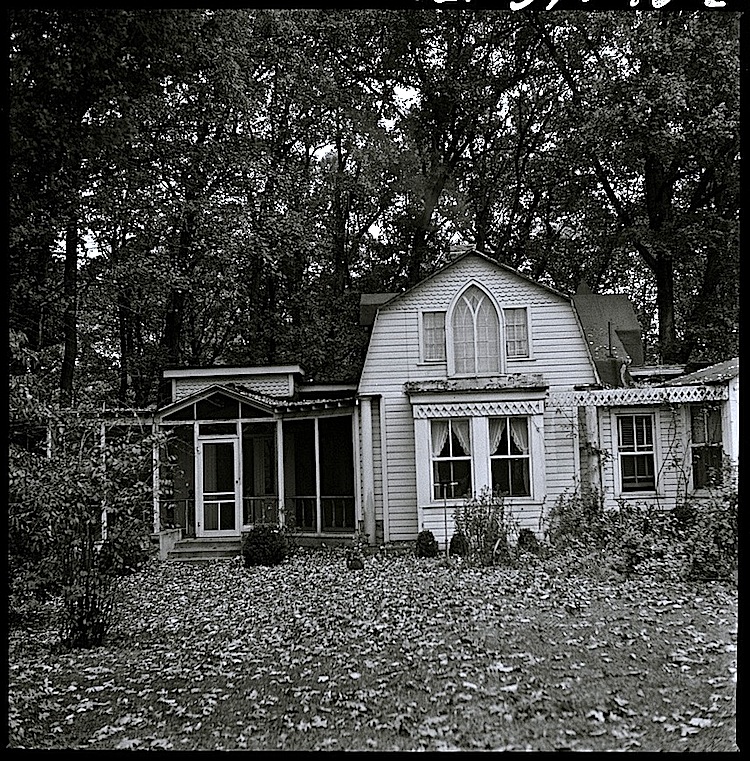
What a charming, patchwork quilt of a house: a Gothic window, a Dutch Colonial Revival shape, and a couple of Greek columns. The screened porch angles away from each side of the door. There are climbing rose canes around the downstairs windows.
This slideshow requires JavaScript.
The specific location is not given. The Palisades neighborhood in northwest Washington comes to mind. It still has old tall trees and funny little houses set among them. But much more of the city must have looked that way 70 years ago.
Bubley took a large number of photographs of students and teachers at Woodrow Wilson High School — including several of Miss Kale grading papers at home and hosting the editors of the student newspaper in front of the fire in her living room.
Two of the pictures also include an elderly man, who may have been her father; she was about 40 at the time.
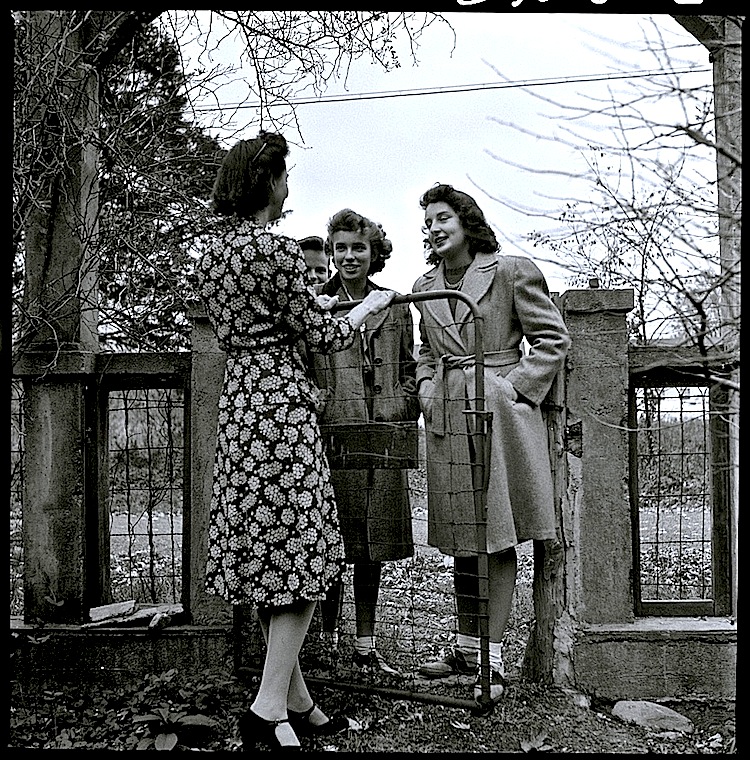
 “Miss Norma Kale. . . greeting some of her students who have come to her home on a Sunday afternoon.”
I like the old concrete and wire fence and gate too. It looks like the posts go up to support an arbor over the gate.
Sadly, an In Memoriam page in the 1956 Woodrow Wilson yearbook said that Miss Kale had died in March of that year. It noted that “Miss Kale placed importance on nature and the worth of human character, rather than on material possessions.”
. . . I love
this garden in all its moods,
even under its winter coat
of salt hay, or now,
in October, more than
half gone over: here
a rose, there a clump
of aconite. . . .
— James Schuyler, from “Korean mums“

 Federal Hill, Fredericksburg, Virginia, between 1927 and 1929, Frances Benjamin Johnston, via Library of Congress Prints and Photographs Division.
 enclos*ure