This slideshow requires JavaScript.
“The Appletrees,” Henry Eugene and Eva Johnston Coe house, Southampton (on Long Island), New York, 1914, by Frances Benjamin Johnston,* via Library of Congress Prints and Photographs Division.
The porch of this 19th century “cottage” is actually an arbor — covered, I believe, in grape vines. The flower-filled boxwood parterre immediately surrounding the house ends rather abruptly in country fields and woods.
I haven’t been able to discover much about the property and its owners: Mrs. Coe co-authored a book on American embroidery samplers, and Mr. Coe was evidently considered an arbiter of social acceptance for the wealthy Southampton of his time. He signified who was in and who was out by issuing (or not) invitations to his annual dinner at The Appletrees (or The Apple Trees).
I could not find out whether the house still exists.
This hand-colored glass lantern slide was used by Johnston in her garden and historic house lectures.
*Photographed when Frances Benjamin Johnston and Mattie Edwards Hewitt worked together.
ADDENDUM, October 2018: A kind reader who lives in Southampton just wrote to me and confirmed that the Coe house no longer exists.
“The last time I was on the property was in the 1960’s. It was a beautiful house and had wonderful out buildings, one of which was a large 2 story barn which was located near the property line that abutted the Catholic Church to the south. The horses were stabled below and the men were housed above.”

 Tea time in the front garden of Mena House, an hotel in Cairo, Egypt. Taken between 1934 and 1939 by the Photo Department of the American Colony of Jerusalem, via Library of Congress Prints and Photographs Division (both photos).
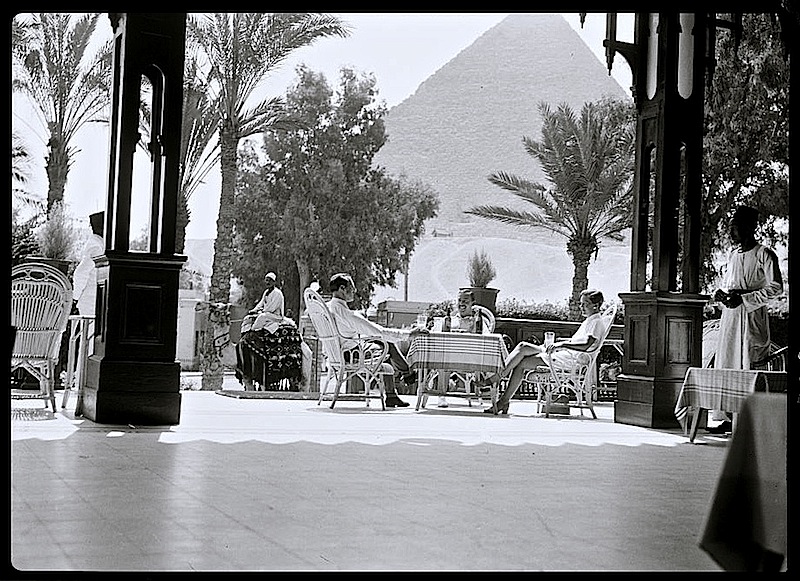 View of a pyramid from the front porch, Mena House, Cairo, Egypt.
 enclos*ure