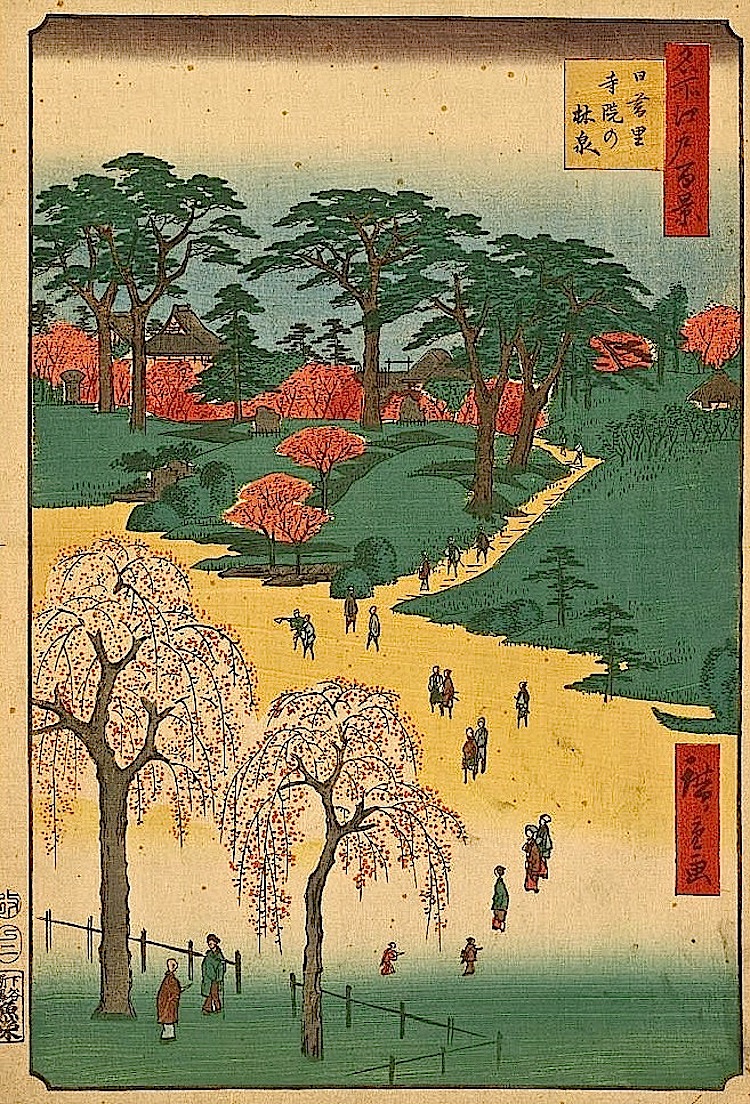
Vintage landscape: Edo blossoms

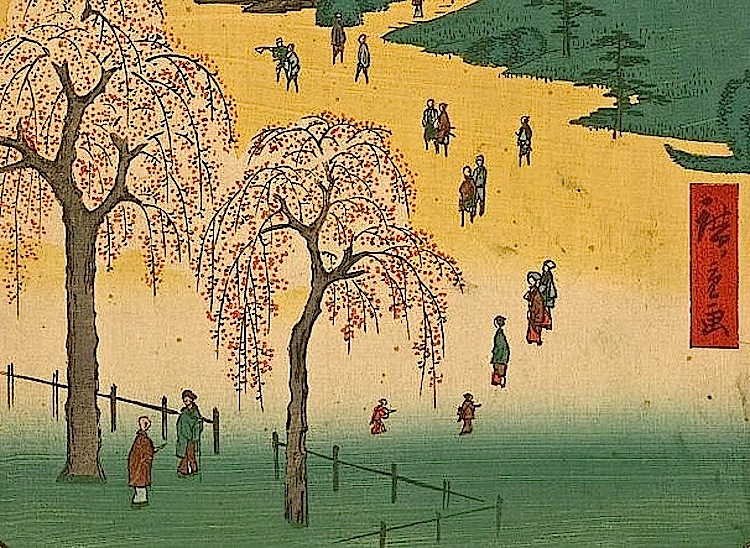
Cherry blossoms in Japan, Library of Congress“Higurashi no sato jiin no rinsen” (Temple Gardens, Nippori), 1857, a woodblock print by Andō Hiroshige, via Library of Congress Prints and Photographs Division.

The view is from Ueno Hill of Shūsō-in, one of three Buddhist temple gardens known as Hanamidera or Flower-viewing Temples. This print is one of fifty in an album of Edo (present day Tokyo) by Hiroshige.
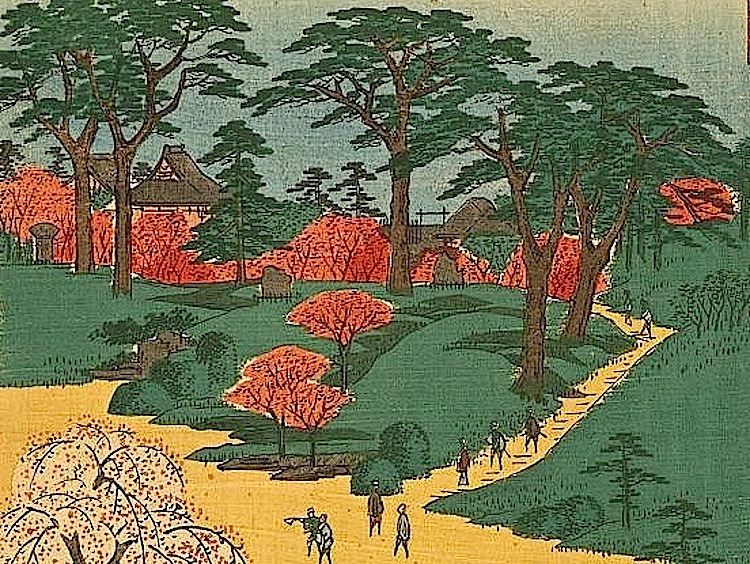
Detail of print above.

There’s a nice essay on cherishing the brief beauty of the cherry blossoms by Diane Durston in today’s Washington Posthere.

Detail of print above.
The cherry trees in our neighborhood here in Stuttgart have just begun to bloom this week.

Life in gardens: colored eggs

chicken fed food color, Library of Congress“Possible now to color yolks of eggs “red, white and blue” by feeding hens different feeds,” April 7, 1939, by Harris & Ewing, via Library of Congress Prints and Photographs Division.

Washington, D.C., April 7. . . . Charles A. Denton, Junior Chemist, poultry nutrition laboratory of the National Agriculture Research Center, Beltsville, Maryland, feeding a hen a certain food to produce a definite colored yolk.

— from the original Harris & Ewing caption

Blue eggs and ham?

More photos of the Department of Agriculture in action in the 1930s here and here.

. . . Yesterday the egg so fresh
it felt hot in his hand and he pressed it
to his ear. . . .
riveted to the secret of birds
caught up inside his fist. . . .

— Naomi Shihab Nye, from “Boy and Egg

Vintage landscape: tulip magnolia

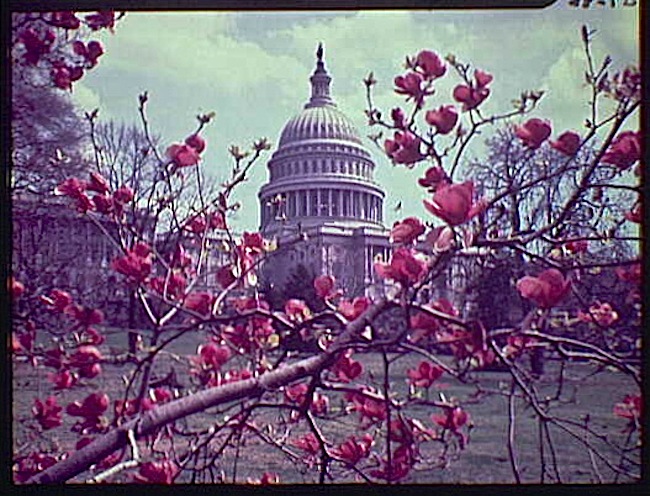
Magnolias at the Capitol, Library of Congress“U.S. Capitol through tulip magnolia,” ca. 1920 – ca. 1950, by Theodor Horydczak, via Library of Congress Prints and Photographs Division.

The late March and April blooms of tulip and saucer magnolias are a well-loved sign of spring in Washington, D.C.

Life in gardens: spring dance

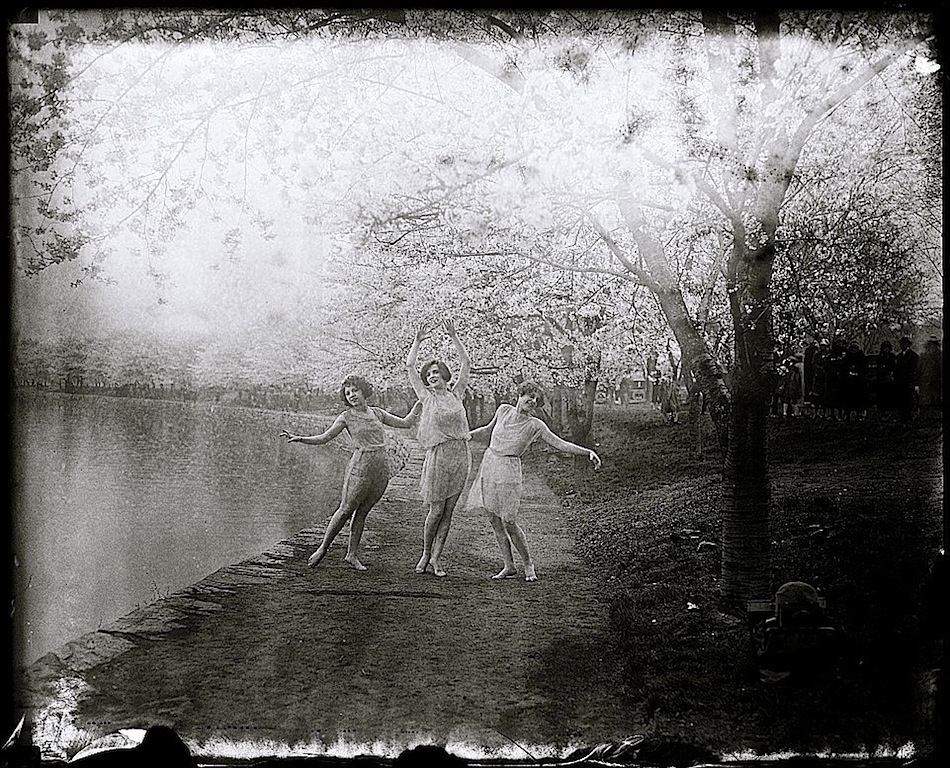
Rites of Spring, 1927, Wash.DC, Library of CongressDancers and cherry blossoms, [Tidal Basin,] Washington, D.C.,” between 1923 and 1929, by Harris & Ewing, via Library of Congress Prints and Photographs Division.

The National Cherry Blossom Festival in Washington, D.C., began on March 20 and continues until April 12. This year, the National Park Service is predicting that peak bloom will occur between April 11 and 14.

The first Tidal Basin Yoshino cherry trees — a gift from the city of Tokyo — were planted in 1912. The first organized celebration of them was held in 1927, when D.C. schoolchildren reenacted the planting.  The first Cherry Blossom Festival, which became the annual event, took place in 1935.

Life in gardens: sowing

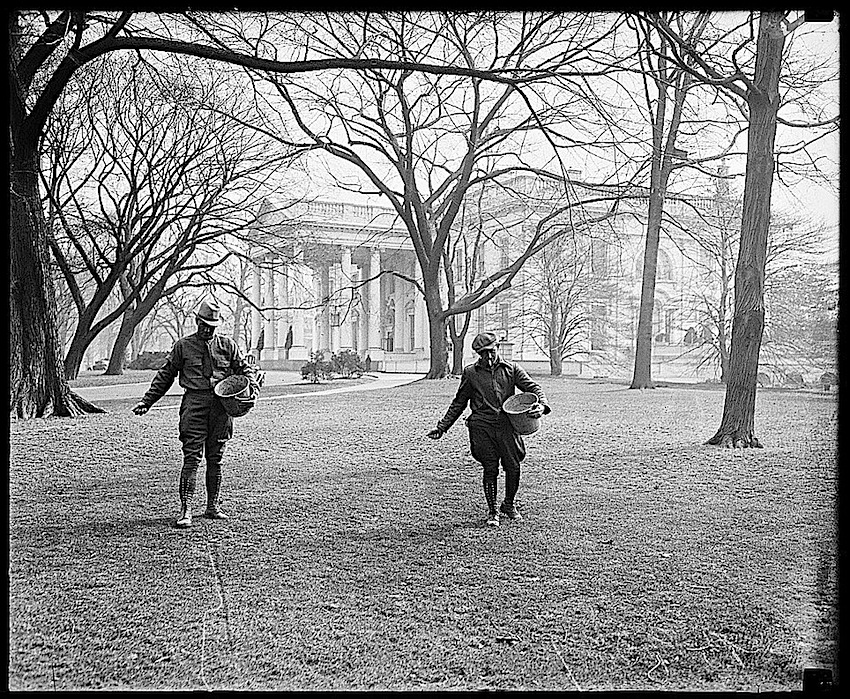
Gardeners at the 1936 White Hse., Library of Congress“Grounds workers at White House, Washington, D.C.,” March 1936, by Harris & Ewing, via Library of Congress Prints and Photographs Division. (You can click on the photo to enlarge it.)

The National Park Service has maintained the White House gardens since 1933.

. . . [W]hile lawns are cultural (in the sense that they are meaning-laden), they are not the product of some pre-existing “culture,” and are instead the meaningful expression of political and economic forces. . . . Lawns are propelled into the landscape both by economic imperatives (e.g., real estate growth) and also by intentional and thoughtful efforts to produce certain kinds of subjects. Lawns are a strategy, therefore, both for capital accumulation and making docile and responsible citizens.

— Paul Robbins, from Lawn People: How Grasses, Weeds, and Chemicals Make Us Who We Are (p. 32)