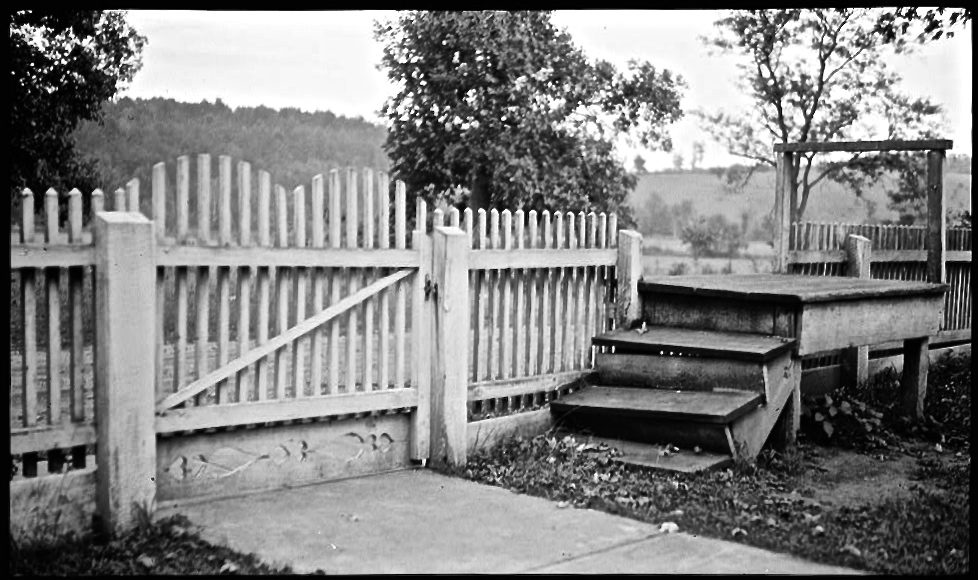
“Fence style — Hebron Lutheran Church, State Routes 638 & 654, Madison, Madison Co., Virginia.” The photo — taken 1937 or 1941, photographer unknown — is part of an Historic American Building Survey (report written 1979), via Library of Congress Prints and Photographs Division.
The church was constructed in 1740 by German settlers. The Madison area is between the cities of Culpepper and Charlottesville.
The church and at least one of its platforms (there were three) still exist, but the fence is gone.
I’m traveling for the next week or so, but I’ll be posting a “vintage landscape” from time to time. Thanks for your comments. I’ll try to answer everyone when I get home.
A west window of Thomas Jefferson’s Poplar Forest revealing a view of the curtilage. Photo by Jack E. Boucher, via Library of Congress Prints and Photographs Division.
Curtilage –a piece of ground (as a yard or courtyard) within the fence surrounding a house. Origin: Middle English, from Anglo-French curtillage, from curtil garden, curtilage, from curt court. First known use: 14th century. — Merriam-Webster Dictionary
A bit more: a cortil was ‘little yard’ in Old French: cort + il (diminutive suffix). A ‘cortile’ (in English, in architecture) is an internal courtyard of a palazzo.
As a legal term, curtilage means the land immediately surrounding a residence that “harbors the intimate activity associated with the sanctity of a man’s home and the privacies of life.” In U.S. law, it is important for dealing with cases involving burglary, self defense, and unreasonable searches and seizures under the Fourth Amendment.
I came across the word while reading the website of Poplar Forest, Thomas Jefferson’s second home and getaway (I remembered something about it after Apartment Therapy posted a slideshow of presidential retreats). Its curtilage originally included an octagonal house (possibly the first in America), orchards, ornamental and vegetable gardens, and slave quarters. It was surrounded by a ‘snake’ or ‘worm’ stacked-rail fence, as well as fields of tobacco and wheat.
Because little visual evidence of Jefferson’s plantings remain, the 61-acre area is being reconstructed through archeology and research of his papers. Letters do indicate that a sunken garden behind the house contained “lilacs, Althaeas, g[u]elder roses, Roses, and clianthus.”
At Poplar Forest, Jefferson was working from a concept of “an ornamental villa retreat within an isolated agricultural setting.” He was thinking of ancient Roman villas, as they were reinterpreted in the 16th century by Andrea Palladio.
The estate is located in Forest, Virginia, near Lynchburg.

 “Fence style — Hebron Lutheran Church, State Routes 638 & 654, Madison, Madison Co., Virginia.” The photo — taken 1937 or 1941, photographer unknown — is part of an Historic American Building Survey (report written 1979), via Library of Congress Prints and Photographs Division.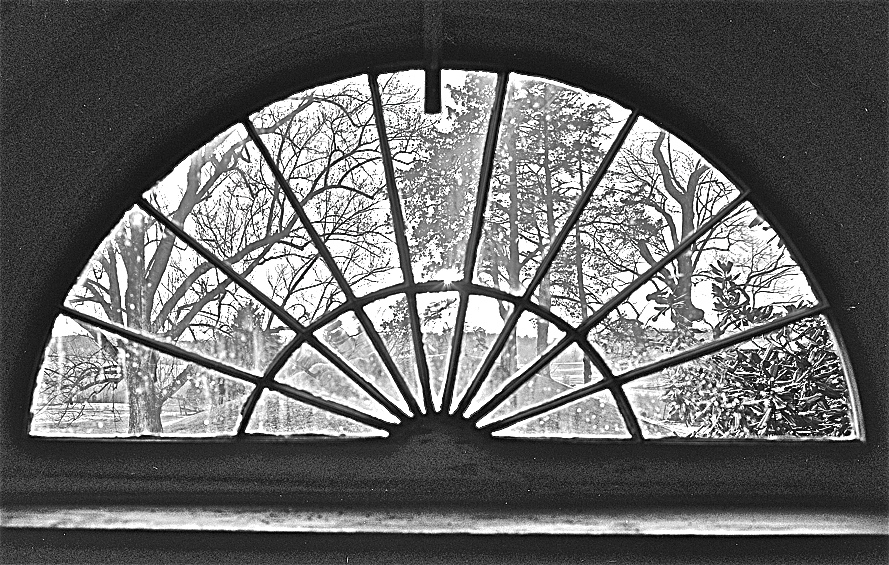
 enclos*ure