The Sunday porch: Venice patio

Venice hotel patio, Library of CongressProfessional photographers Gertrude Käsebier and Frances Benjamin Johnston eating together on a hotel patio in Venice, Italy, 1905, via Library of Congress Prints and Photographs Division.

Johnston — from Washington, D.C. — and Käsebier — from New York City — had traveled across the Atlantic at the invitation of the Royal Photographic Society of Great Britain.  On the same trip, they also visited France, Switzerland, and Italy.

The older and more successful Gertrude Käsebier had been born in a log cabin in Iowa in 1852.   After marrying* a successful businessman of aristocratic German origins and having three children,  she began to study photography at the Pratt Institute in Brooklyn.  Within ten years, by the late 1890s, she had opened a studio on Fifth Avenue in Manhattan.

At the time of this photo, she was  “one of the best known photographers in the United States,” according to her Library of Congress biography. Her portraits of women and children were shown in major exhibitions and won her critical acclaim and financial independence.

Käsebier’s ability to discern the complexities of situations helped her achieve conflicting goals. She aimed to be associated with fine art and the upper classes but she enjoyed the relatively déclassé technical art of photography. She also wanted to earn a living, a desire that brought criticism from [Alfred] Stieglitz for sacrificing art to commerce, while society frowned on women participating in any kind of business. At a time when a salesman challenged women’s right to purchase high quality photographic equipment, Käsebier encouraged women to enter the professional world. For example, she befriended and supported Frances Benjamin Johnston, whose ambition and need to earn an income may have surpassed her own.

Kasebier worked until the mid-1920s, when she turned her studio over to her daughter, Hermine.

Johnston had a long career as well, ultimately specializing in architectural and garden photography.  She retired at age 81 in 1945.


*It was an unhappy marriage and inspired her to make this photo.
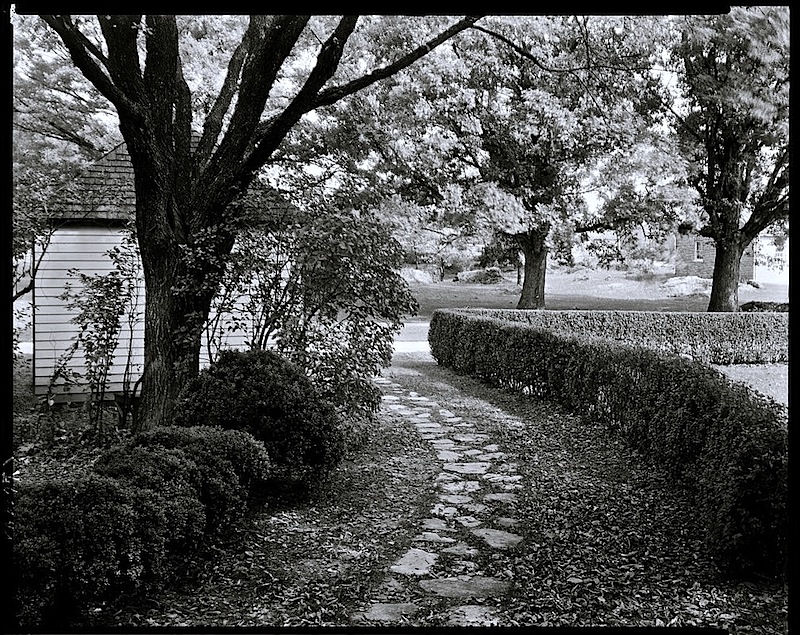
Wordless Wednesday: flagstone path

Rockland, Leesburg, Va.Rockland, near Leesburg, Virginia, 1929, by Frances Benjamin Johnston, via Library of Congress Prints and Photographs Division.

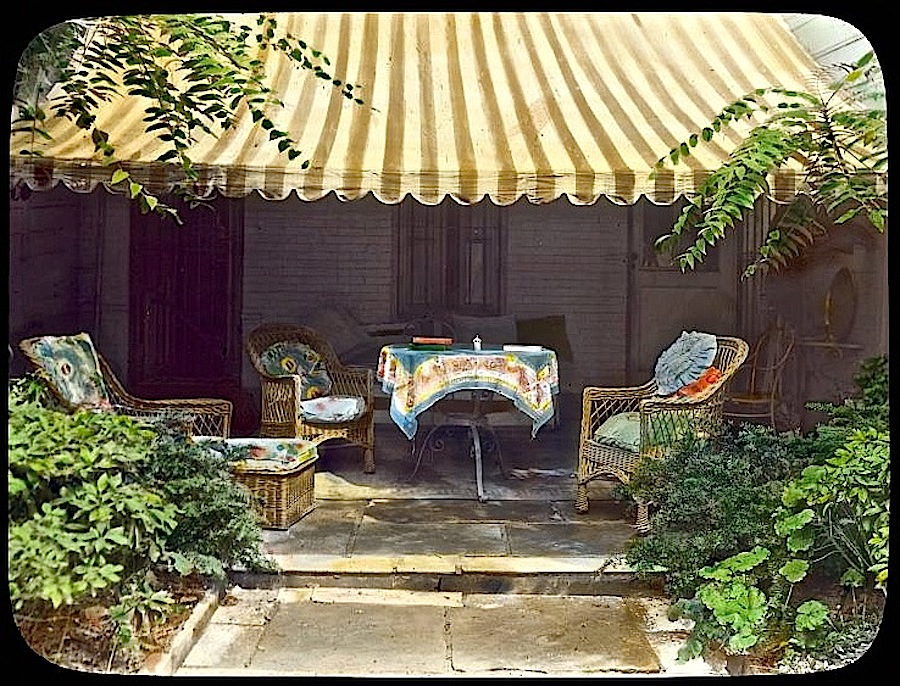
The Sunday porch: New York City

Murray house, 1922, NYC, by Frances B. Johnston, via Library of CongressAwning-covered back terrace of the Murray house, 129 East 69th Street, New York City, 1922. Hand-colored glass lantern slide by Frances Benjamin Johnston, via Library of Congress Prints and Photographs Division.

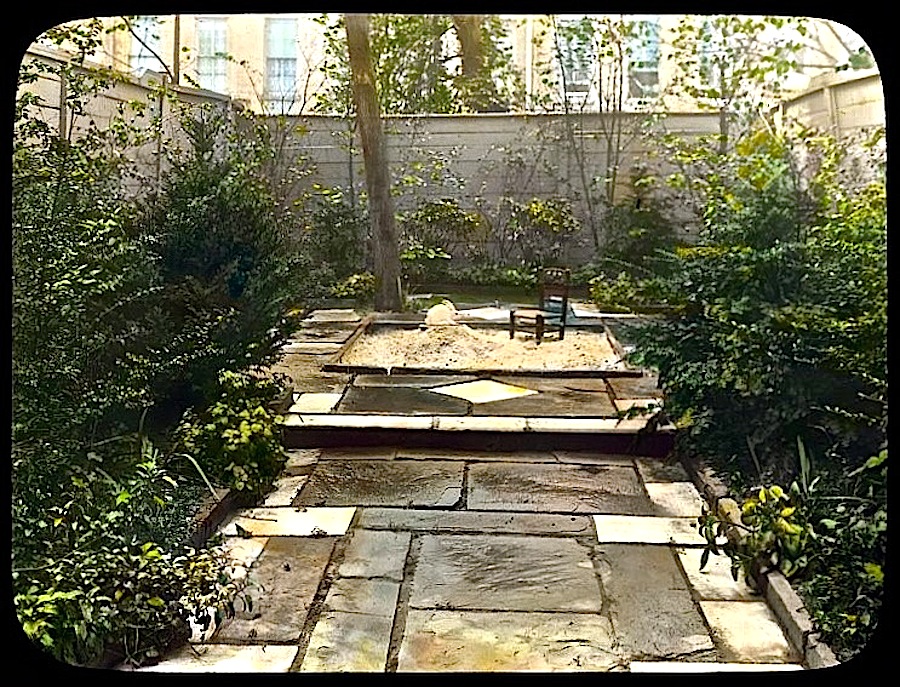
This looks so pleasant, but I also like the view in the other direction.

Murray house, 1922, NYC, by Frances B. Johnston, via Library of CongressLooking from the terrace to the sandbox, same house, photographer, and source.

What a nice-looking small outdoor space for both the parents and a child. (For grass, they had Central Park only three blocks away.)

According to the Library’s online catalogue, this garden was designed by Clarence Fowler. It was awarded the second prize for a city garden at the 1922 City Gardens Club of New York City photography exhibition at the New York Camera Club. Today, the house and garden no longer exist.

Johnston used these slides in her lectures on city and suburban gardens.

The Sunday porch: Airlie, N.C.

This slideshow requires JavaScript.

“Miss Lula Thorne’s house,” Oakland Plantation, Airlie in Halifax County, North Carolina, between 1935 and 1938, by Frances Benjamin Johnston, via Library of Congress Prints and Photographs Division.

Beautiful vines and interesting columns.  And I really like the four small sconces — one on each side of the door and one at each corner.

There were similar vines and sconces on this other North Carolina house here.

Oakland house was probably built between 1823 and 1828 for Elizabeth Williams Thorne Drake and either her first or second husband. It still stands, but, at some point after the 1930s, the porch was rebuilt to match the late Federal “temple form” style of the rest of the house. You can see it about 2012 here and here.


Vintage landscape: Yorktown, Va.

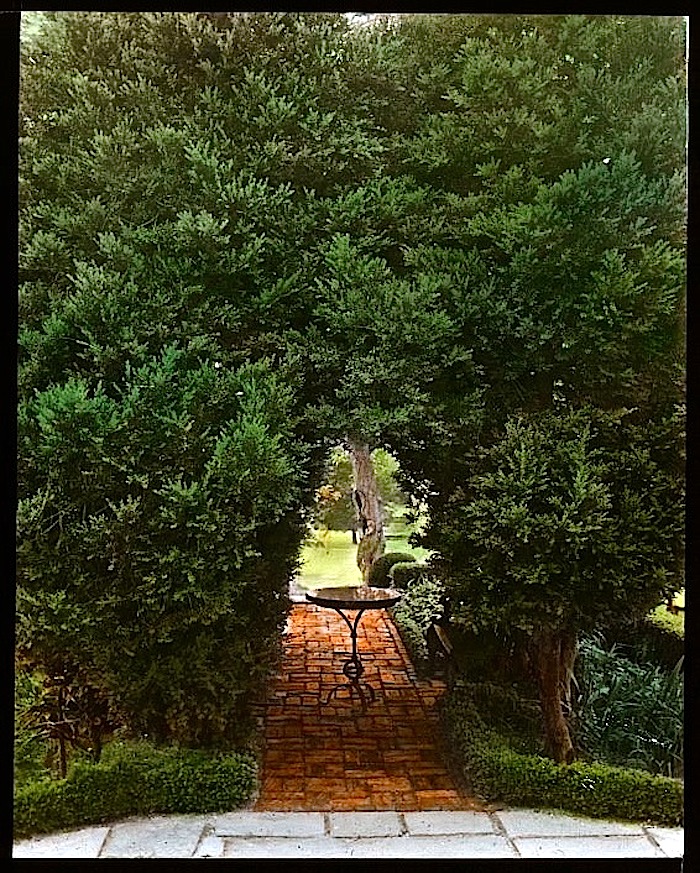
More big (boxwood) love.  .  .

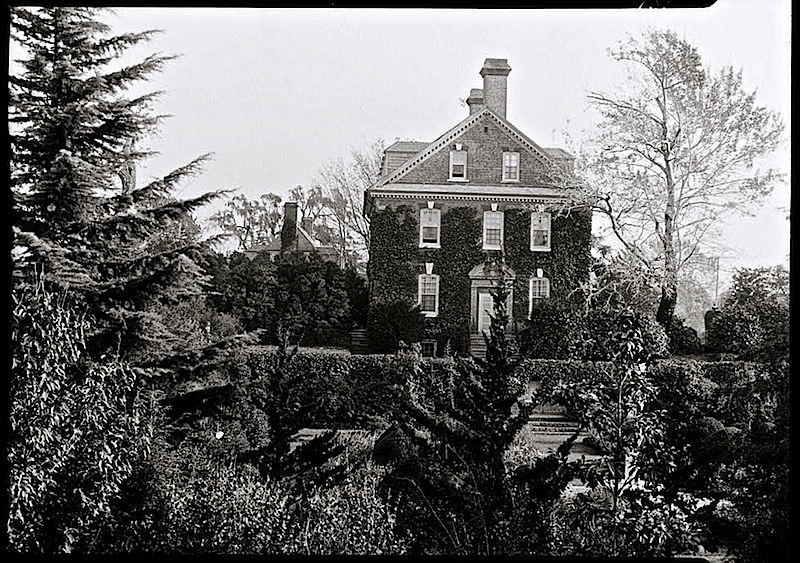
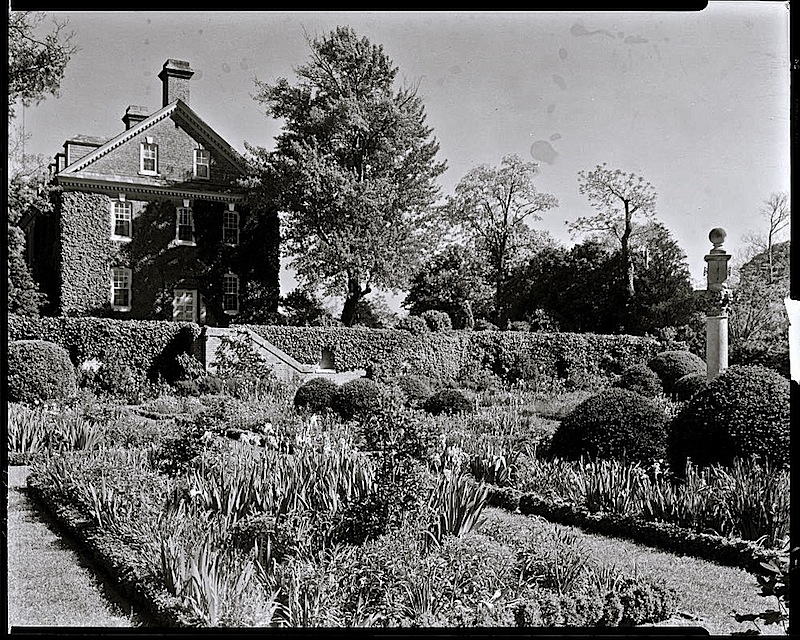
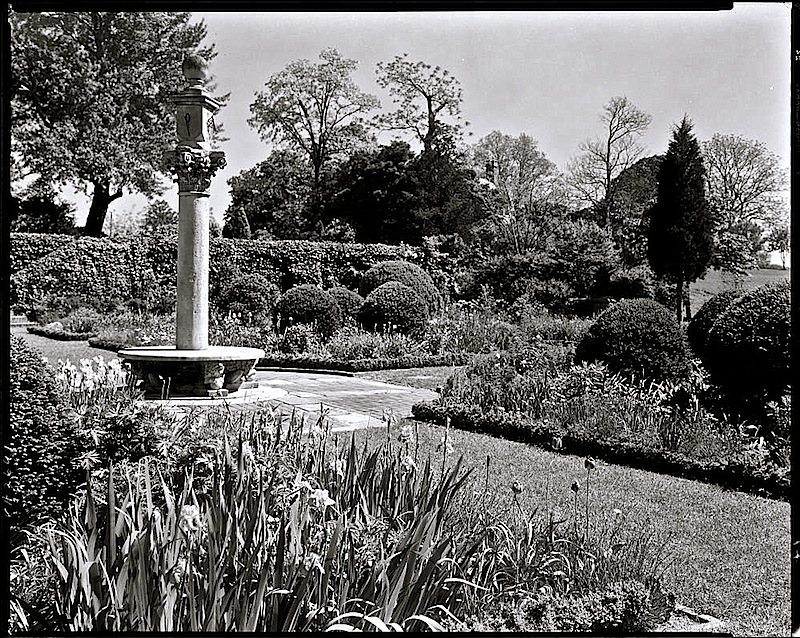
#1, Nelson Hse. garden, ca. 1930, FBJohnston, LoC“‘York Hall,’ Captain George Preston Blow house, . . . Main Street, Yorktown, Virginia. Table in boxwood garden,” 1929, by Frances Benjamin Johnston.*

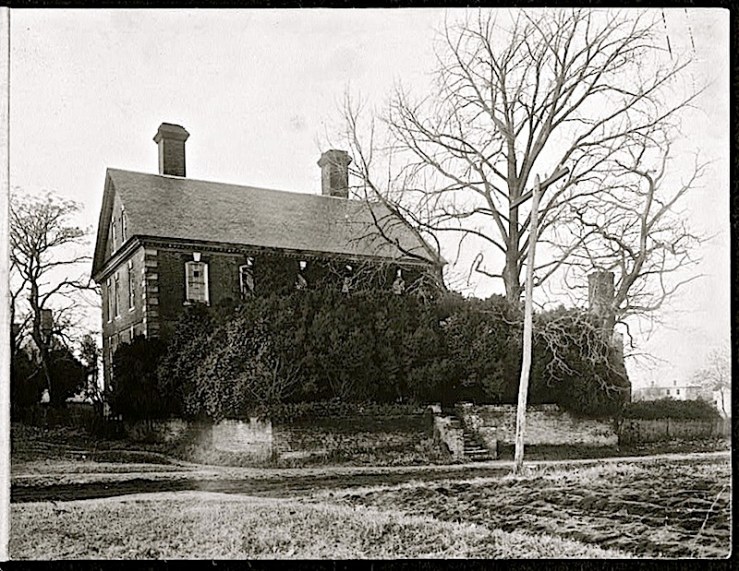
The house is more often called the Nelson House for the family that built it in the 1740s and owned it throughout the 19th century.  George and Adele Blow purchased it and began to restore it in 1914.  In 1968, it became a National Park Service site.

#2, Nelson hse., 1903, WHJackson, LoCThe front of the house and Main Street as it appeared about 1902. Photo by William Henry Jackson for Detroit Photographic Co.

#4, Nelson Hse., c. 1915, HABS, LoC The front of Nelson House in 1915. This photo is part of an Historic American Buildings Survey (HABS).

(There’s a photo of the front of the house and the younger boxwoods in 1862 here.)

#5, Nelson Hse., c. 1915, HABS, LoCThe front door, inside the boxwood hedge, 1915, HABS.

#9, view from hall, Nelson house, ca. 1915, LoCThe center hall, looking out the front door, 1915, HABS (photo cropped by me).

#6, Nelson Hse., c. 1915, HABS, LoCThe side view of the house, ca. 1915 (I think it may be later), HABS.  The front boxwood hedge is on the left.

#16, Nelson Hse, ca. 1930s, FBJohnston, LoCThe side garden in the 1930s by Frances Benjamin Johnston.

The garden during the Blow’s ownership was designed by Charles Freeman Gillette, a landscape architect known for working in the Colonial Revival style. Today, little remains.  The giant boxwoods at the front of the house are gone.

#19, Nelson Hse, ca. 1930s, FBJohnston, LoCAnother view of the side garden in the 1930s by  Frances Benjamin Johnston.

More big boxwood photos here and here and here and here.


*All photos here via Library of Congress Prints and Photographs Division.