Orpheus with his lute made trees. . .*
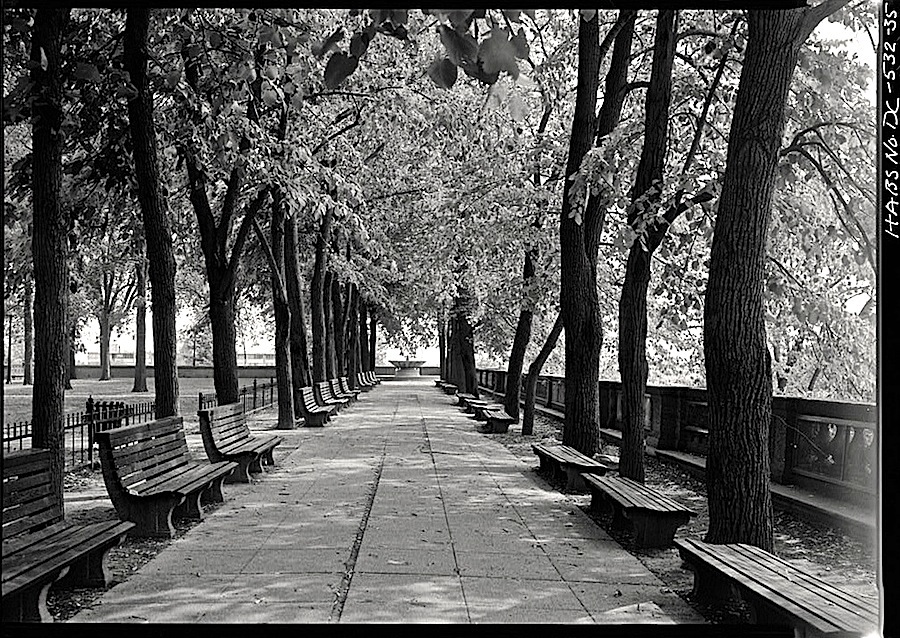
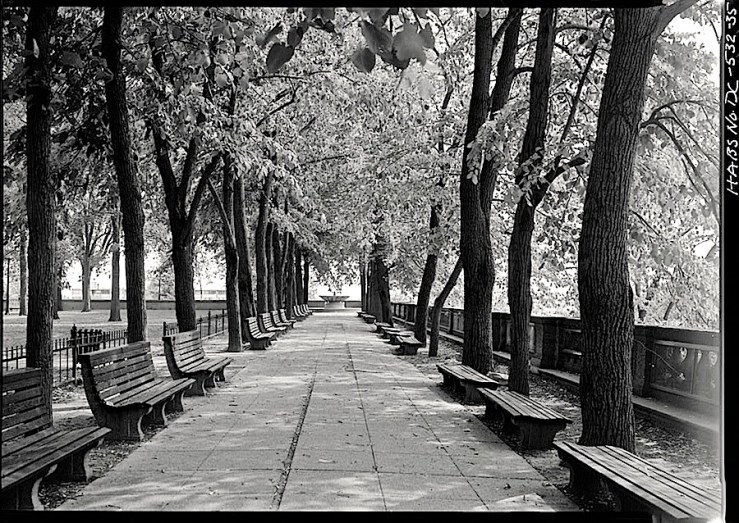 The Linden Walk, Meridian Hill Park,* Washington, D.C., August 1976, by Jack Boucher for an Historical American Buildings Survey (HABS), via Library of Congress Prints and Photographs Division.
This HABS has photos from 1976 and 1985. The report, which contains a very detailed description and history of the park’s design, was completed in 1987.
Unfortunately, the report notes that the linden trees shown above had to be cut down between 1976 and 1985 because they were threatening the 16th St. retaining wall (on the right side). They were replaced quickly, however, as you can see here.
The HABS report summarizes the importance of Meridian Hill Park this way:
One of the first public parks in the United States to be designed as a formal park, generally considered to be in the continental tradition, rather than in the “natural” mode associated with the English park; Meridian Hill Park was constructed [from about 1914 to 1936]. . . . Under the guidance of the Commission of Fine Arts, the park benefited from the finest criticism of the day. The technologically innovative use of exposed aggregate concrete provided a facsimile of the stone and mosaic masonry traditionally employed in the Italian Garden. The Park represents an effort in a democratic society to match the major European city park.
Today, the last Friday in April, is Arbor Day in many states in the U.S. The day was established to encourage people to plant and care for trees.
The words themselves are a delight to learn,
You might be in a foreign land of terms
Like samara, capsule, drupe, legume and pome,
Where bark is papery, plated, warty or smooth.
— Howard Nemerov, from “Learning the Trees“
*Meridian Hill Park is bounded by Fifteenth, Sixteenth, Euclid and W Streets, N.W. The quote above the photo is by William Shakespeare, from Henry VIII.

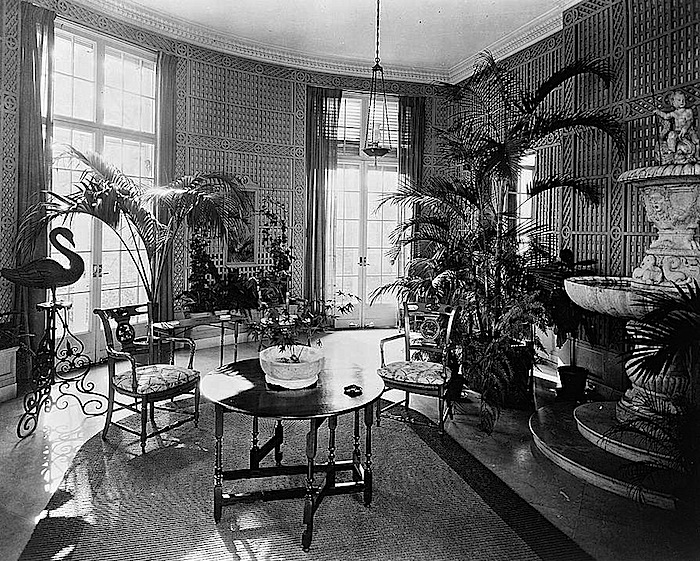 The conservatory of “The Causeway,” or James Parmelee house, Northwest Washington, D.C., 1919, by Frances Benjamin Johnston, via Library of Congress Prints and Photographs Division.

 enclos*ure