Vaux-le-Vicomte

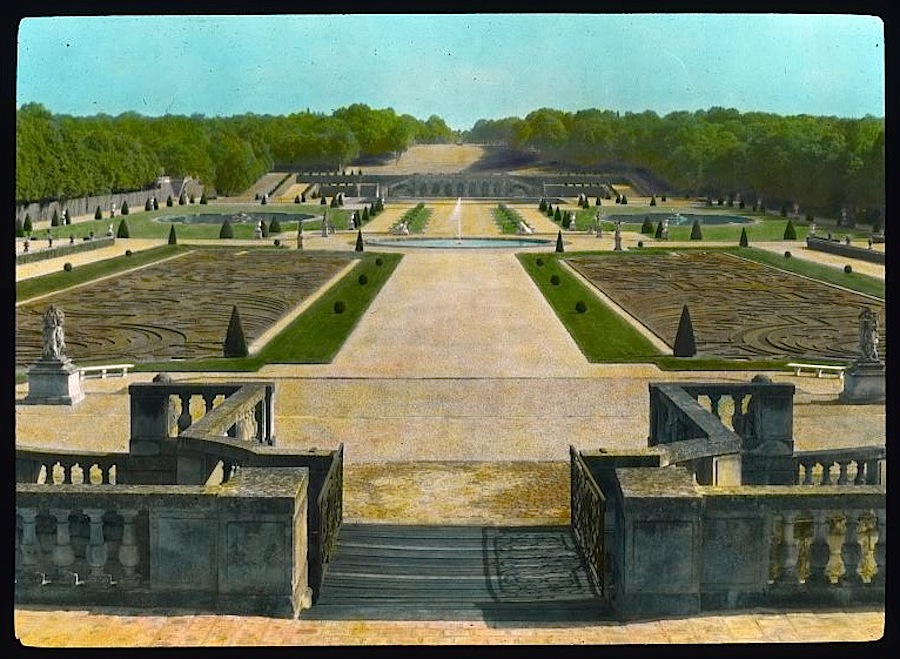
Vaux le Vicomte, France, 1925, Library of Congress
View from the château, Maincy, France, 1925, by Frances Benjamin Johnston, via Library of Congress Prints and Photographs Division.

Vaux-le-Vicomte — the château and garden together — was “the first great work of the French baroque,” according to garden historian Tom Turner.

In his book, The Seven Ages of Paris, Alistair Horne tells the story of the estate’s big reveal to Louis XIV, then only 22 years old and struggling with a nearly bankrupt treasury:

Nicolas Fouquet, a vain, ostentatious and ambitious parvenu, had been Louis’s minister superintendent of finance since 1653.  Now aged forty-five, he had just built himself a magnificent mansion at Vaux-le-Vicomte. . . . [O]n 17 August 1661, [he] audaciously invited the King to a lavish gala. . . The massive iron gates gleamed with freshly applied gilt; in the vast gardens laid down by André le Nôtre 200 jets d’eau and fifty fountains spouted on either side of a main alley nearly a kilometer long. For the previous five years, some 18,000 workmen had toiled to produce this wonder of the modern age, eradicating three villages that had happened to be in the way.  Certainly it trumped the modest royal hunting-lodge of the King’s father out at Versailles, which Louis was currently doing up.

Inside the imposing mansion the royal party dined off a magnificent gold service which likewise must have made its impression on the King, who had had to sell off his plate to meet military expenditure. . . . [T]he whole episode outraged him.  At various points in the evening, Louis came close to losing his temper — whispering to his mother, “Madame, shall we make these people disgorge?” . . . Less than three weeks later, just as he was arriving at a meeting in Nantes, Fouquet was arrested by the legendary D’Artagnan of Three Musketeers fame.

After the arrest, Louis took possession of artwork, furniture, and all the orange trees from Vaux-le-Vicomte. More importantly, he sent its architect, Louis Le Vau, and its painter-decorator, Charles Le Brun — and, of course, Le Nôtre — to Versailles. Fouquet died in prison in 1680.

Seven Ages . . . is a very good history to read if you are planning a trip to the Paris.

I have been taught never to brag but now
I cannot help it:  I keep
a beautiful garden, all abundance  .   .   .
I want to take my neighbors into the garden
and show them: Here is consolation.

Paisley Rekdal, from “Happiness

Life in gardens: travelers

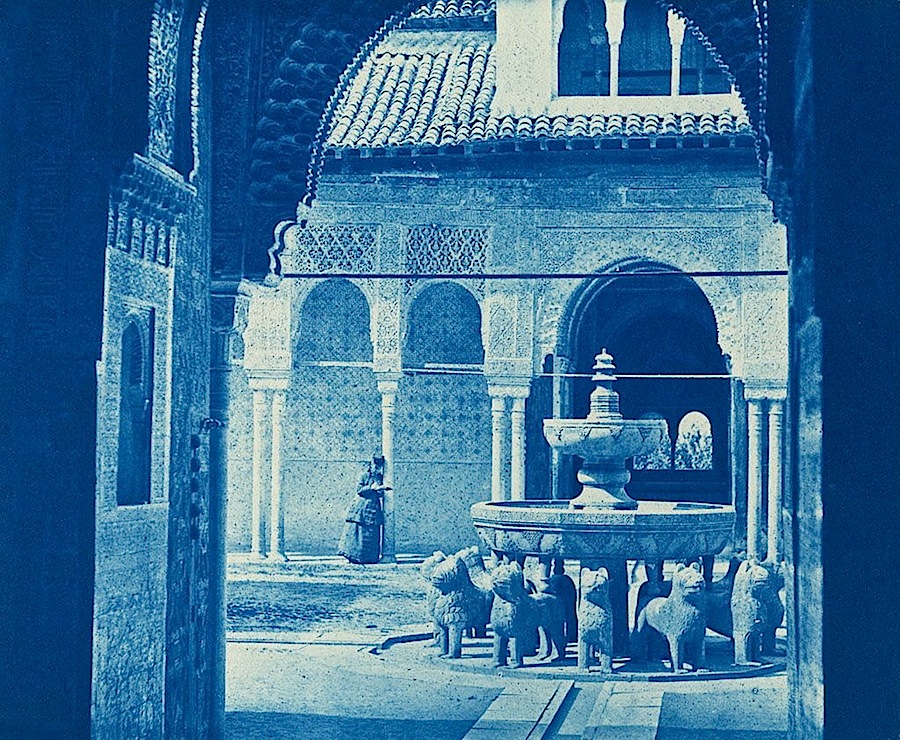
Alahambra, Spain, 1878, Swedish Natl Heritage BoardThe Alhambra, Granada, Spain, 1878, by Carl Curman, via Swedish National Heritage Board Commons on flickr.

The cyanotype shows the photographer’s wife, Calla, either sketching or reading during a visit to the Court of the Lions.  She was 28 at the time and just married to Curman. This may have been their honeymoon trip.

The Alhambra fortress/palace was built primarily in the 13th and 14th centuries by the Muslim Nasrid dynasty of southern Spain. After the Christian Conquest in 1492, it became the royal residence of Ferdinand and Isabella and, later, their grandson, Charles V. However, by the 18th century the site was derelict and largely abandoned.

In 1829, the American writer Washington Irving stayed in the Alhambra for three months and then turned his impressions into the romantic Tales of the Alhambra.

“The peculiar charm of this old dreamy palace,” he wrote, “is its power of calling up vague reveries and picturings of the past, and thus clothing naked realities with the illusions of the memory and the imagination.”

The book was popular, “the exotic was in vogue,” and cultured travelers — Calla was the daughter of a wealthy industrialist — began to visit the ruins in increasing numbers. Restoration work — often controversial — soon followed.  Today, the old complex is a UNESCO World Heritage site.

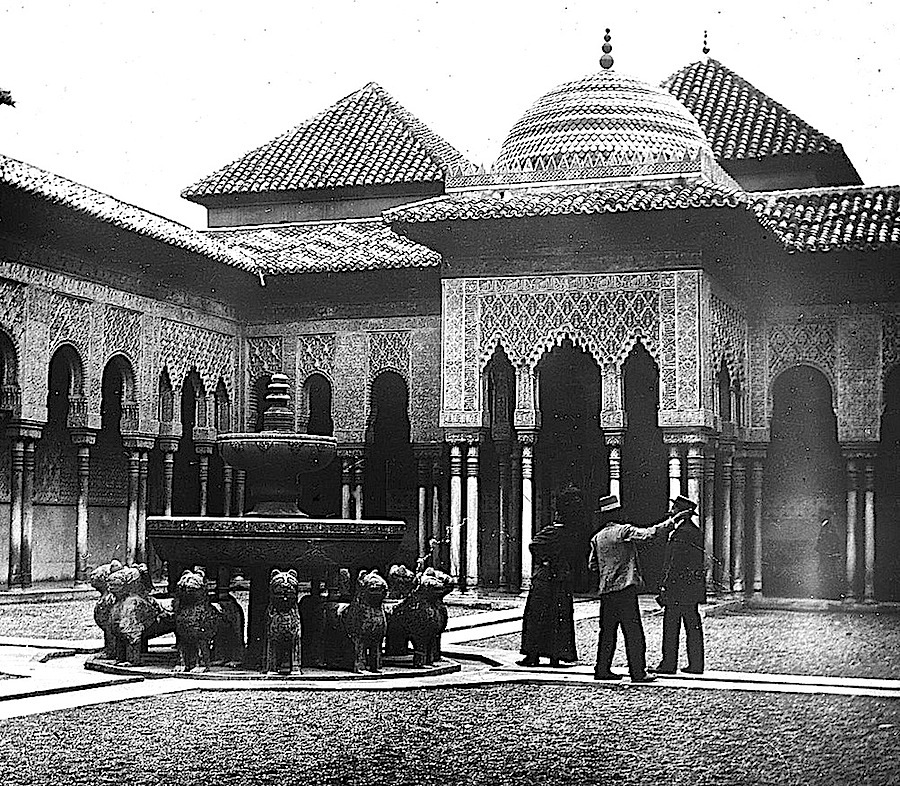
About 30 years after Carl and Calla’s trip, their son also visited the Court of the Lions and took the picture below.Alhambra, 1910, Tekniska museetGroup of tourists in the Court of the Lions,  ca. 1910, by Sigurd Curman, via Tekniska museet (Stockholm) Commons on flickr.

In the 14th century, the area around the fountain was a little lower than the walkways and planted in flowers, giving a tapestry or carpet effect.  Today, as in the photo above, the space is entirely covered in dry pebbles to preserve the building’s foundation.

I am the garden appearing every morning with adorned beauty; contemplate my beauty and you will be penetrated with understanding.

— Ibn Zamrak, from a poem on the wall of the Hall of the Two Sisters in the Alhambra.

Vintage landscape: Columbia, S.C.

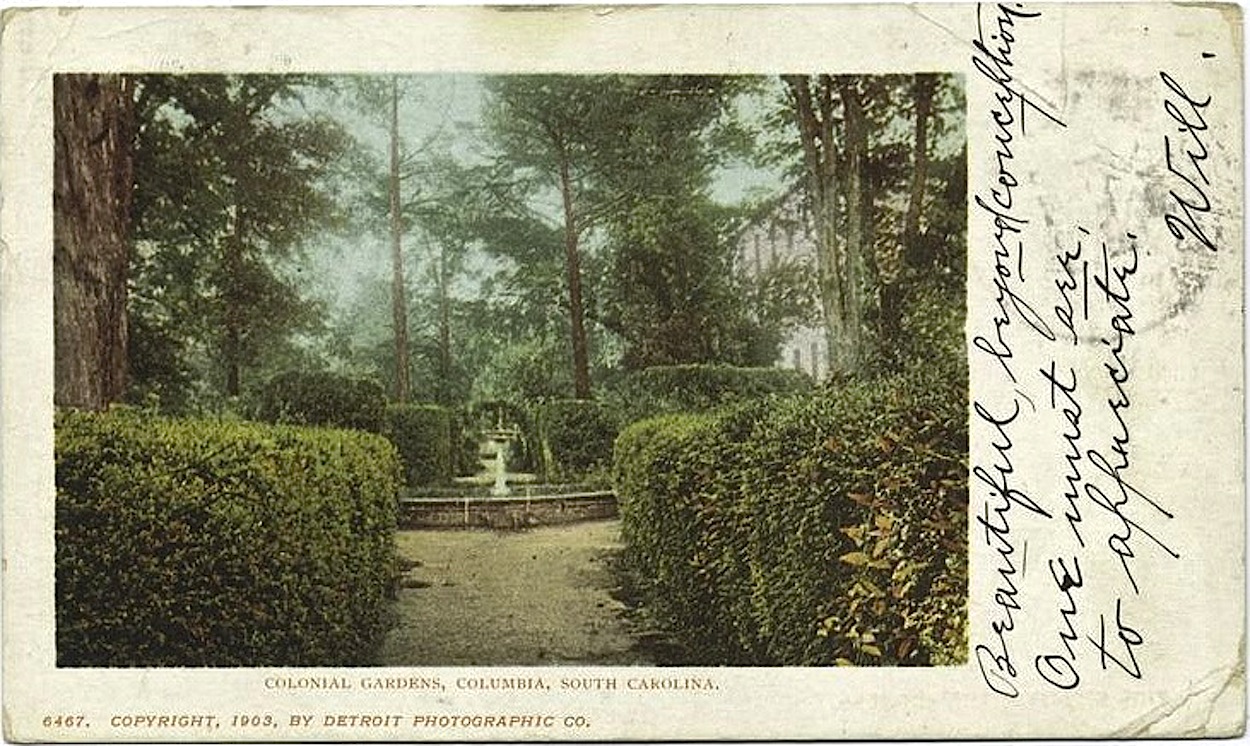
Colonial Gardens full ,nypl.digitalcollections.510d47d9-a7ba-a3d9-e040-e00a18064a99.001.w-3Colonial gardens, Columbia, South Carolina, ca. 1900, by Detroit Publishing Co., via The New York Public Library. (Click the image to enlarge it — or here.)

The handwritten message says:  “Beautiful beyond conception. One must err to appreciate.” Freudian slip?

A study in steps: Schürhof, Basel

12 Museum of Culture, Basel, 2015, enclos*ure

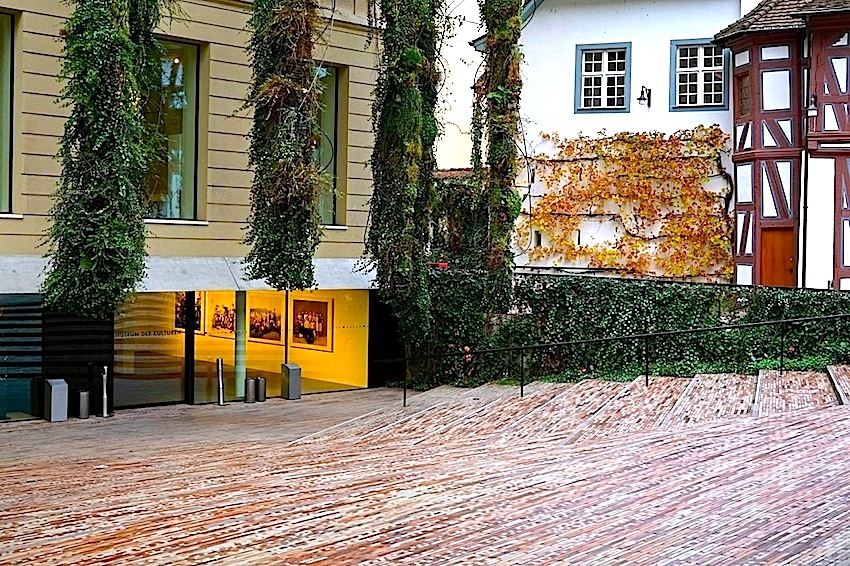
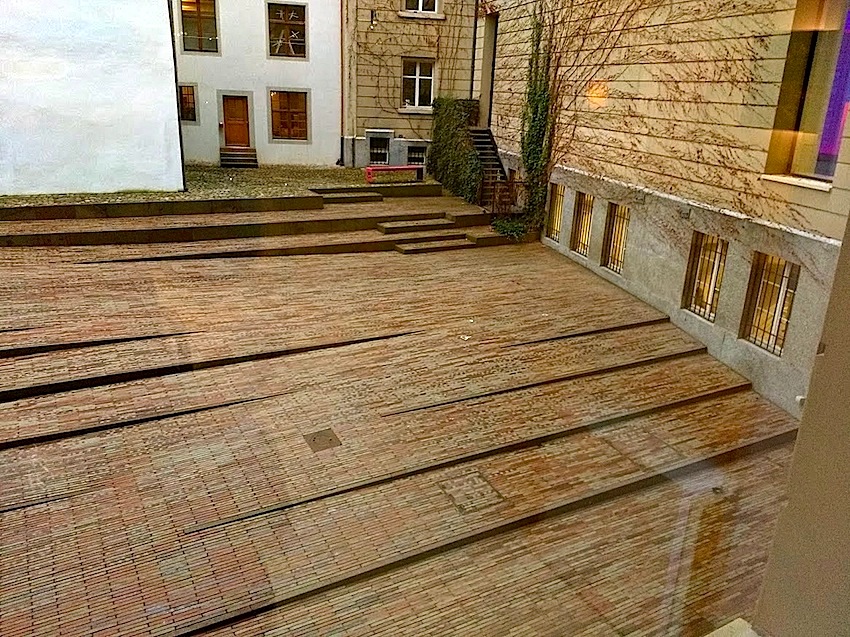
After I took a number of photos of the hanging plant columns of the Basel Museum of Culture (during our visit at Thanksgiving), I turned my attention to the courtyard around them — the Schürhof — the floor of which is largely a set of low, wide steps descending to the museum lobby and gift shop.

The entrance to the courtyard and museum on Munsterplatz.

The street entrance to the courtyard and thus to the museum is through a simple archway on the Münsterplatz.

Before the museum was renovated in 2011 by Herzog & de Meuron, the Schürhof* was not open to the public.  The museum shared a door with the Museum of Natural Sciences around the corner.

Looking at a “before” photo (here, fourth image), the old courtyard appears to have been used at least partly as a parking lot.

27 Museum of Culture, Basel, 2015, enclos*ure
Looking out on the courtyard from the lobby.

The renovation excavated it to open up a new museum entrance in the base of the existing 1917 neoclassical building.

The other buildings that enclose the Schürhof are medieval.

28 Museum of Culture, Basel, 2015, enclos*ure

Above and below are three views from upper windows inside the museum.

29 Museum of Culture, Basel, 2015, enclos*ure
The entrance to the courtyard is in the upper left corner.

30 Museum of Culture, Basel, 2015, enclos*ure
You can see a plan of the courtyard here (fifth image).

Continue reading “A study in steps: Schürhof, Basel”

Vintage landscape: repurposed

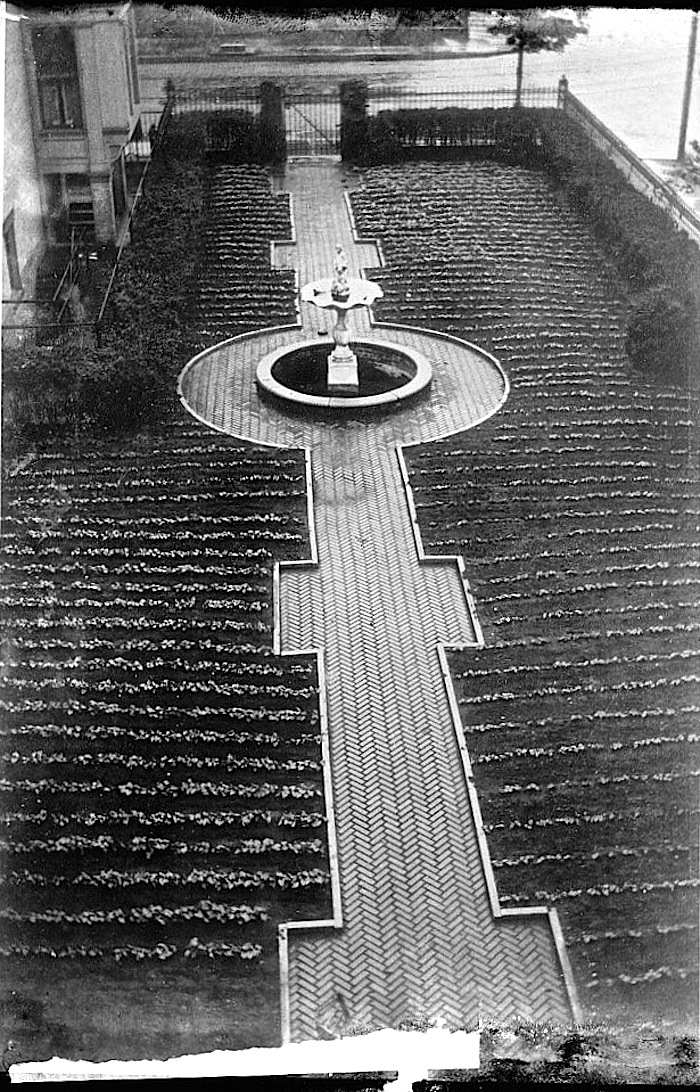
Formal victory garden, ca. 1918, Library of Congress

World War I victory garden in a formal setting, location unknown,* ca. 1917 – ca. 1920, by Harris & Ewing, via Library of Congress Prints and Photographs Division.

The photo seems to have been taken for the National War Garden Commission, also known as the National Emergency Food Garden Commission.

The organization was created in early 1917 by Charles Lathrop Pack.  It sponsored a campaign of pamphlets, posters, and press releases aimed at “arous[ing] the patriots of America to the importance of putting all idle land to work, to teach them how to do it, and to educate them to conserve by canning and drying all food that they could not use while fresh.”

Like it or not, what you do with the land around your house tells the world what sort of citizen you are.

Abby Adams, The Gardener’s Gripe Book

*Harris & Ewing was located in Washington, D.C.