
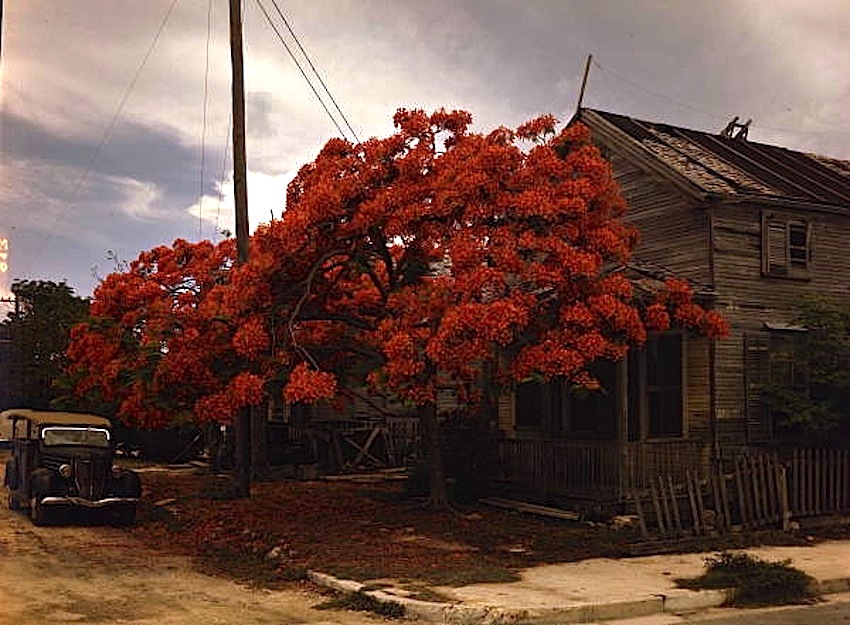
 Royal Poinciana (Delonix regia) in bloom, Key West, Florida, ca. 1945, by Joseph Janney Steinmetz, via Florida Memory (State Library and Archives of Florida) Commons on flickr.
Tag: Florida Memory
The Sunday porch: Miami, Florida
 House in Miami, Florida, July 11, 1955, via Florida Memory (State Library and Archives of Florida) Commons on flickr (cropped slightly by me).
Widely available by the 1950s, aluminum awnings were touted as longer-lasting and lower-maintenance than traditional [canvas] awnings. . . . [T]hey were especially popular with homeowners. Aluminum awnings were made with slats called “pans” arranged horizontally or vertically. For variety and to match the building to which they were applied, different colored slats could be arranged to create stripes or other decorative patterns.
— U.S. National Park Service “Preservation Brief“
The Sunday porch: wedding party
 Sanders-Eckles wedding party, Lincolnville, Florida, ca. 1925, from the Richard Twine Collection, via Florida Memory (State Archives and Library of Florida) Commons on flickr.
Lincolnville is an historically African-American neighborhood of St. Augustine. It was established after the Civil War, in 1866, by several freedmen and women who leased the land for $1 a year. By the 1880s, it had begun to grow and “was characterized by narrow streets, small lots, and houses built close to the street line, similar to the colonial St. Augustine style and land-use pattern,” according to Wikipedia. By the 1930s, it was an important subdivision of the city in size and in political participation of its residents, and by the 1960s, it drew national attention for its role in the Civil Rights Movement.
In 1991, Lincolnville was listed on the National Register of Historic Places for its many late Victorian Era buildings and its place in African-American history. It is now known as the Lincolnville Historic District.
The Sunday porch: Estero, Florida
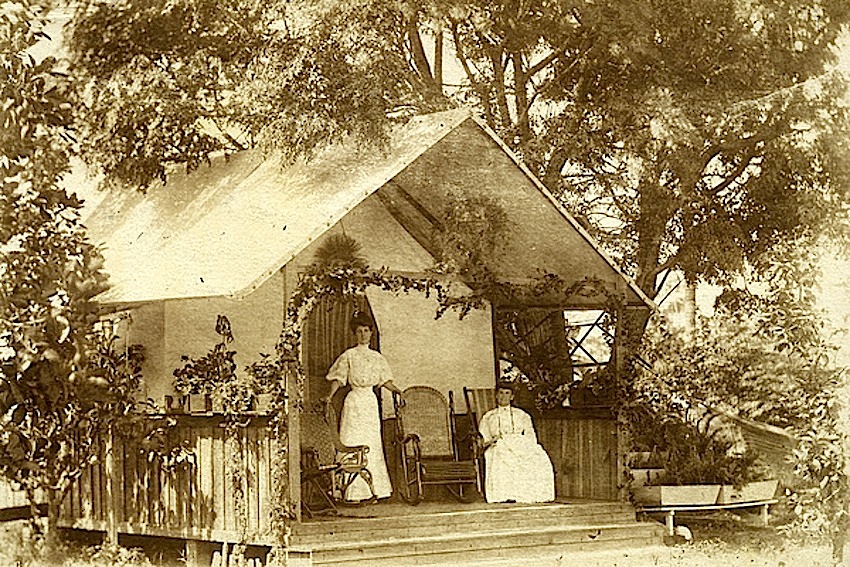
“Tent house on Koreshan property in Estero, Florida,” 1895, via Koreshan Unity Collection, Florida Memory Commons on flickr (State Library and Archives of Florida).
The Koreshan Unity was a late 19th and early 20th century utopian community whose members believed in a god that was both male and female, as well as in reincarnation, celibacy, collectivism, equality of the sexes, and cellular cosmogony.* It was founded by Cyrus Teed in upstate New York in the 1870s, and later there were also followers in Chicago and San Francisco. In 1894, the community began moving to a donated 320-acre property in Estero, Florida. During the next decade, it purchased over 5,000 additional acres and began building a settlement that “included a sawmill, cement works, bakery, machine shop, general store, art gallery, symphony, theater troupe, plant nursery and more,” according to USA Today. Its population peaked at 250 residents between 1903 and 1908; the majority were well-educated middle-class women, seven of whom managed the day-to-day affairs of the commune.
When Teed died in 1908 — and his body was not resurrected as he had promised — the commune began to decline; there were 10 members left in 1948. The last Koreshans deeded the site of its village to the state of Florida in 1961. It is now a state park.
*”Among the most interesting beliefs of Koreshan Unity was the cellular cosmogony, or the hollow earth,” according to Florida Memory. “According to the cellular cosmogony, the earth was not a convex sphere but instead a hollow, concave cell containing the entire universe with the sun at its center and Earth’s populace living on the inside surface of the hollow cell.”
Bee allée
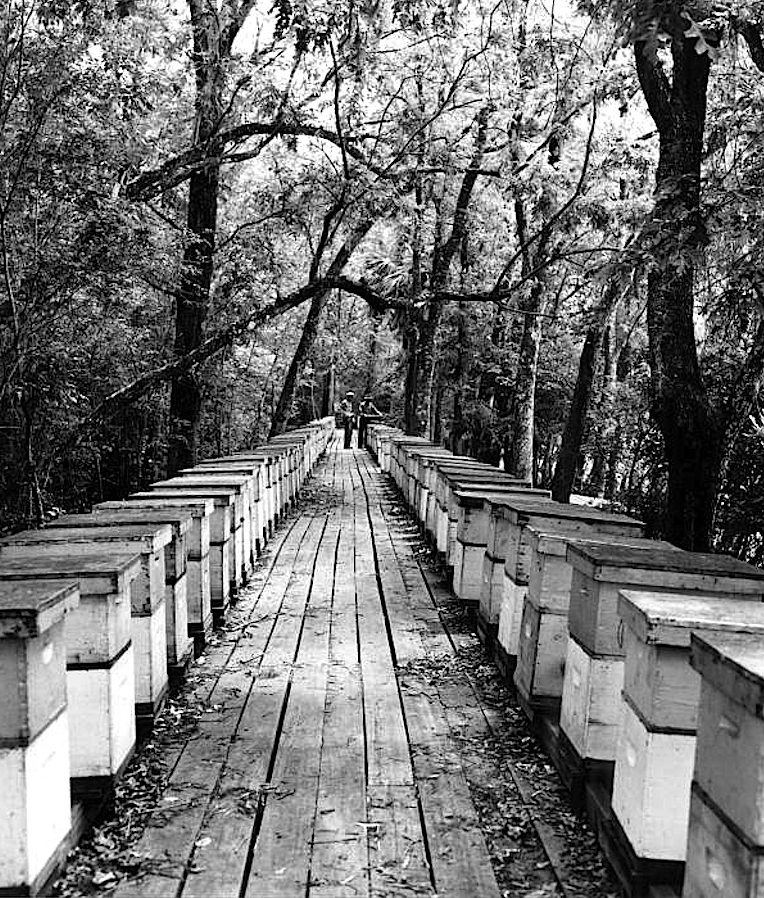
“Beekeepers Wallace Anderson and R.R. Talbert tending to tupelo honey beehives in Apalachicola, Florida,” May 6, 1948, via Florida Memory (State Library and Archives of Florida) Commons on flickr.
Another note on the Archive’s website says, “Typical scaffold, platform 14 to 16 feet high and 300 to 700 feet long on which colonies (hives) are placed.”
 enclos*ure