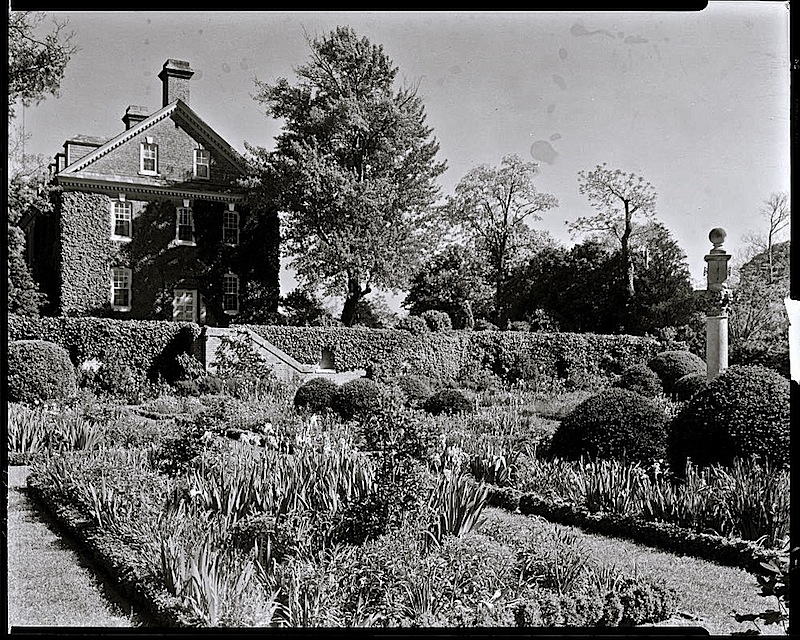
“The Appletrees,” Henry Eugene and Eva Johnston Coe house, Southampton (on Long Island), New York, 1914, by Frances Benjamin Johnston,* via Library of Congress Prints and Photographs Division.
The porch of this 19th century “cottage” is actually an arbor — covered, I believe, in grape vines. The flower-filled boxwood parterre immediately surrounding the house ends rather abruptly in country fields and woods.
I haven’t been able to discover much about the property and its owners: Mrs. Coe co-authored a book on American embroidery samplers, and Mr. Coe was evidently considered an arbiter of social acceptance for the wealthy Southampton of his time. He signified who was in and who was out by issuing (or not) invitations to his annual dinner at The Appletrees (or The Apple Trees).
I could not find out whether the house still exists.
This hand-colored glass lantern slide was used by Johnston in her garden and historic house lectures.
*Photographed when Frances Benjamin Johnston and Mattie Edwards Hewitt worked together.
ADDENDUM, October 2018: A kind reader who lives in Southampton just wrote to me and confirmed that the Coe house no longer exists.
“The last time I was on the property was in the 1960’s. It was a beautiful house and had wonderful out buildings, one of which was a large 2 story barn which was located near the property line that abutted the Catholic Church to the south. The horses were stabled below and the men were housed above.”
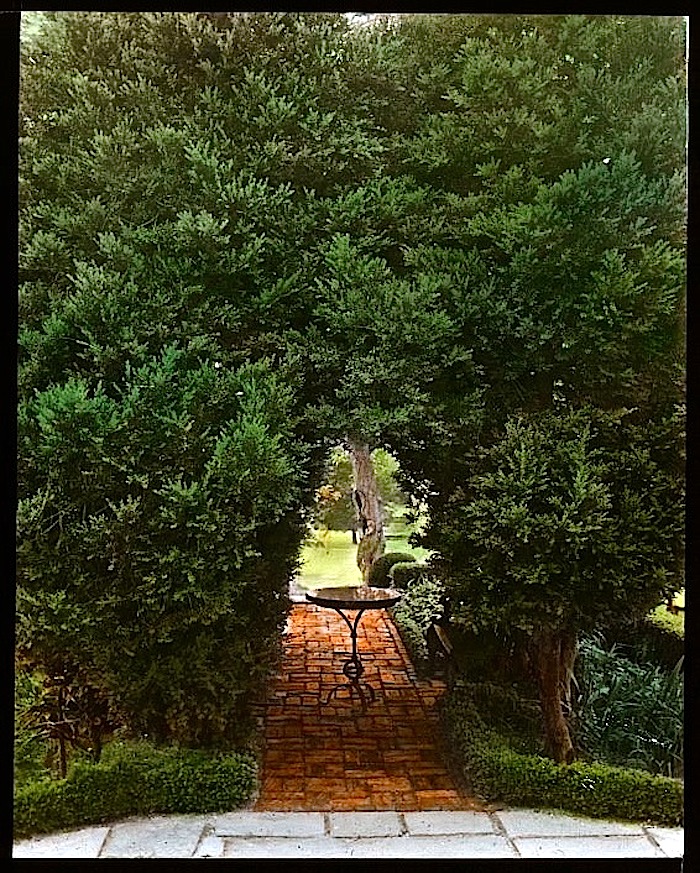
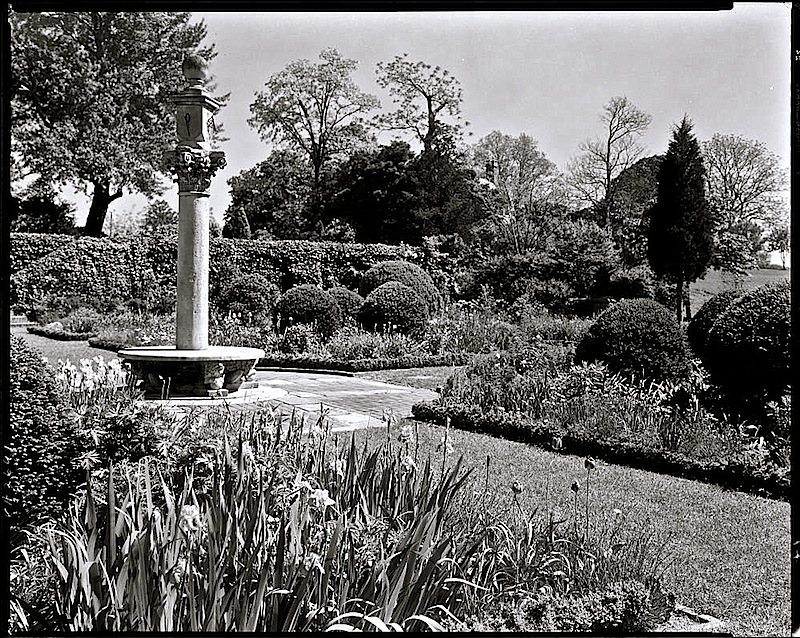
“‘York Hall,’ Captain George Preston Blow house, . . . Main Street, Yorktown, Virginia. Table in boxwood garden,” 1929, by Frances Benjamin Johnston.*
The house is more often called the Nelson House for the family that built it in the 1740s and owned it throughout the 19th century. George and Adele Blow purchased it and began to restore it in 1914. In 1968, it became a National Park Service site.
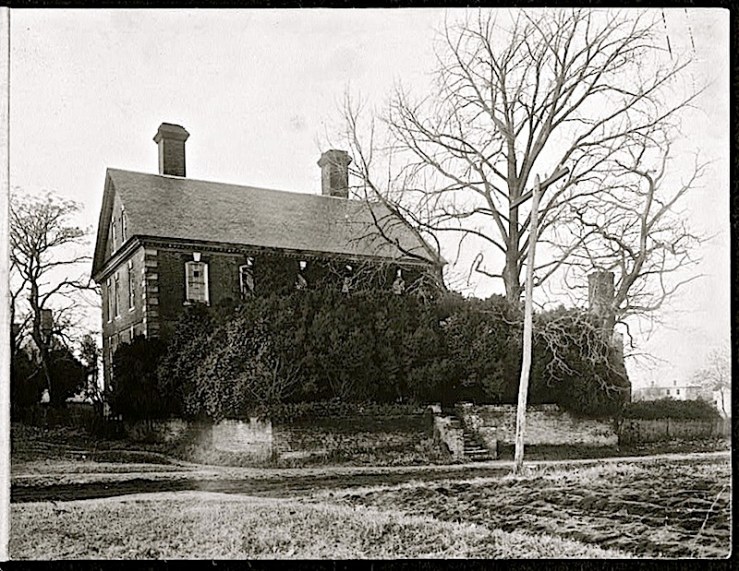
The front of the house and Main Street as it appeared about 1902. Photo by William Henry Jackson for Detroit Photographic Co.
(There’s a photo of the front of the house and the younger boxwoods in 1862 here.)
The front door, inside the boxwood hedge, 1915, HABS.
The center hall, looking out the front door, 1915, HABS (photo cropped by me).
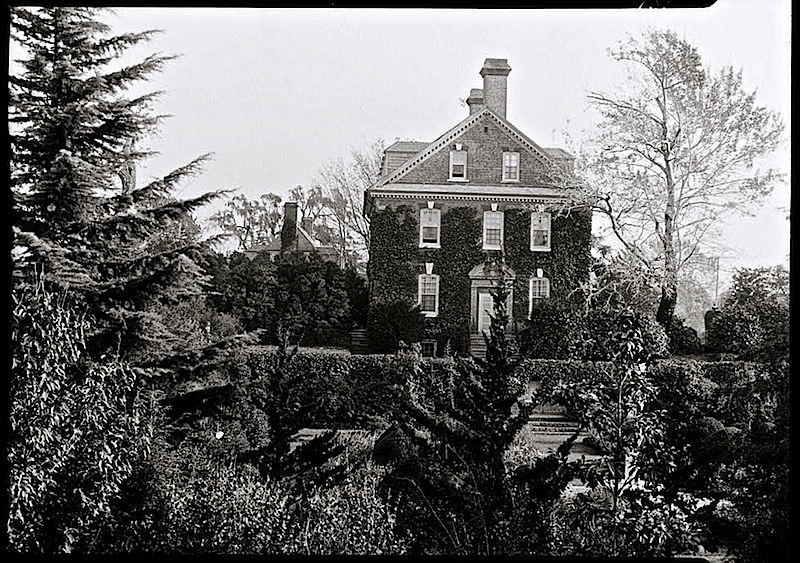
The side view of the house, ca. 1915 (I think it may be later), HABS. The front boxwood hedge is on the left.
The side garden in the 1930s by Frances Benjamin Johnston.
The garden during the Blow’s ownership was designed by Charles Freeman Gillette, a landscape architect known for working in the Colonial Revival style. Today, little remains. The giant boxwoods at the front of the house are gone.
Another view of the side garden in the 1930s by Frances Benjamin Johnston.
I am fascinated by the old boxwoods of Tudor Place, an historic estate in Georgetown.
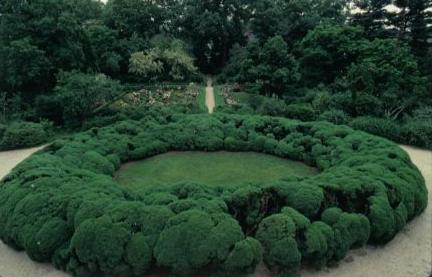
In 1805, soon after she and her husband purchased the property, Martha Custis Peter, the granddaughter of Martha Washington, planted (or more likely, directed to be planted) an ellipse of Buxus sempervirens ‘Suffruticosa’ in the center of the drive on the north side of the house.
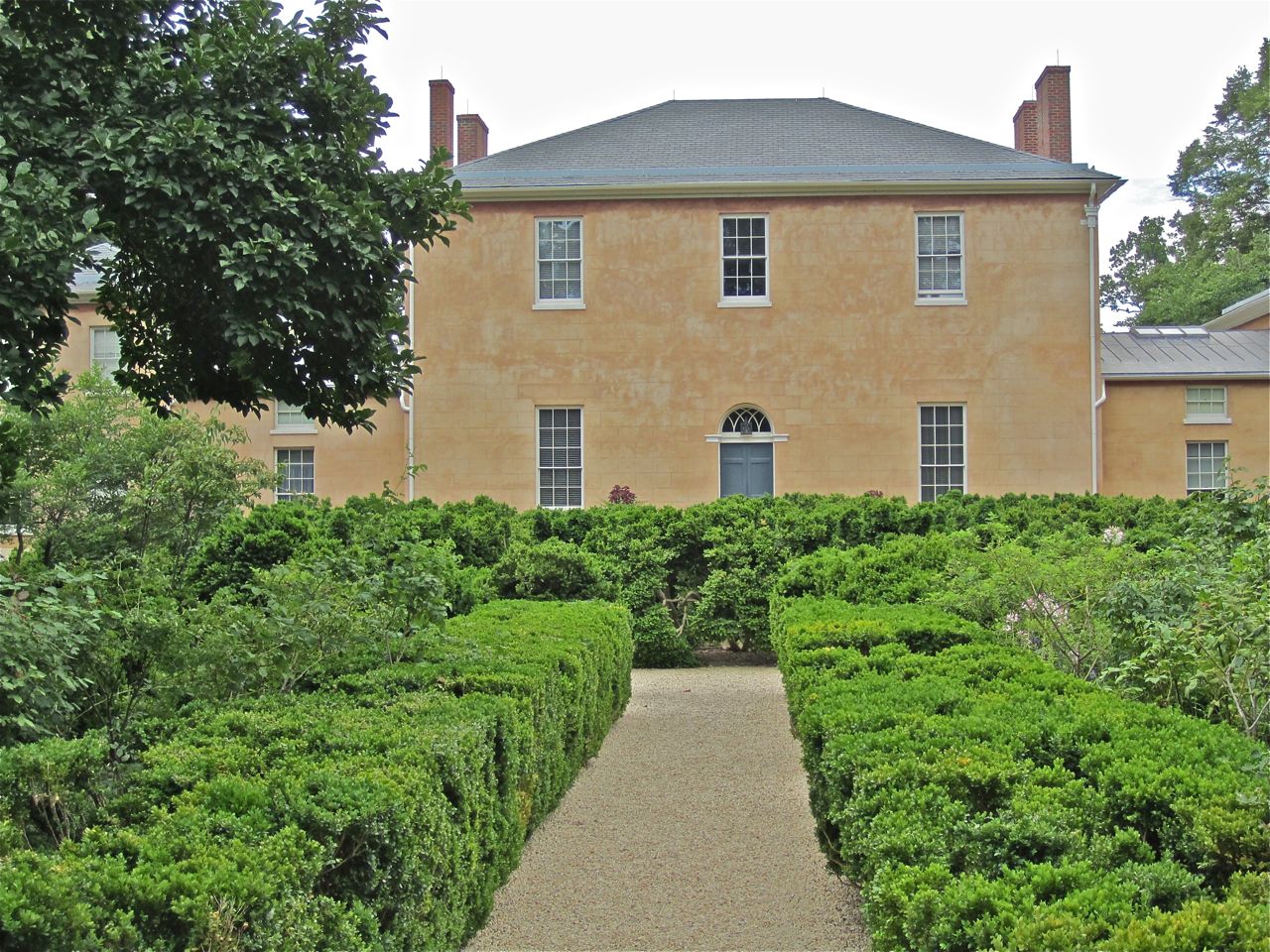
Walkway to the ellipse and house from the north side with rose garden on the right. The neoclassical house was designed by William Thornton, architect of the U.S. Capitol and completed in 1816. Six generations of the Peter family lived there until 1983.
For the Tudor Place Foundation, who received the estate in 1983 from a direct descendant of Martha’s, they must be a much-loved treasure and (I suspect) a big preservation headache.
Today, the ellipse is over 5′ tall, as one might expect, given its age. When I toured the property almost ten years ago during a Landscape Design class, the teacher fretted that it was too large for the original design and for the scale of the house and drive.
Boxwood ellipse before 2010. Photo via the Tudor Place Foundation website.
At that time, the boxwoods were nearly as tall as now, but still nicely filled out all around. As such, I found them impressive, but not particularly interesting.
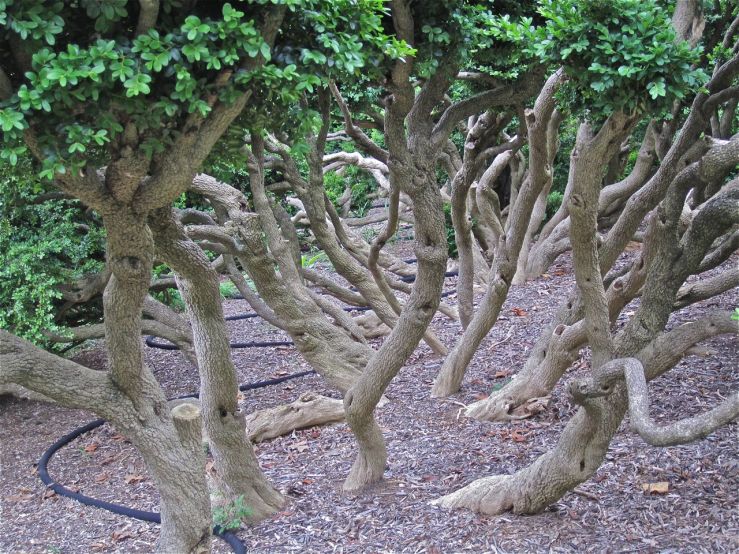
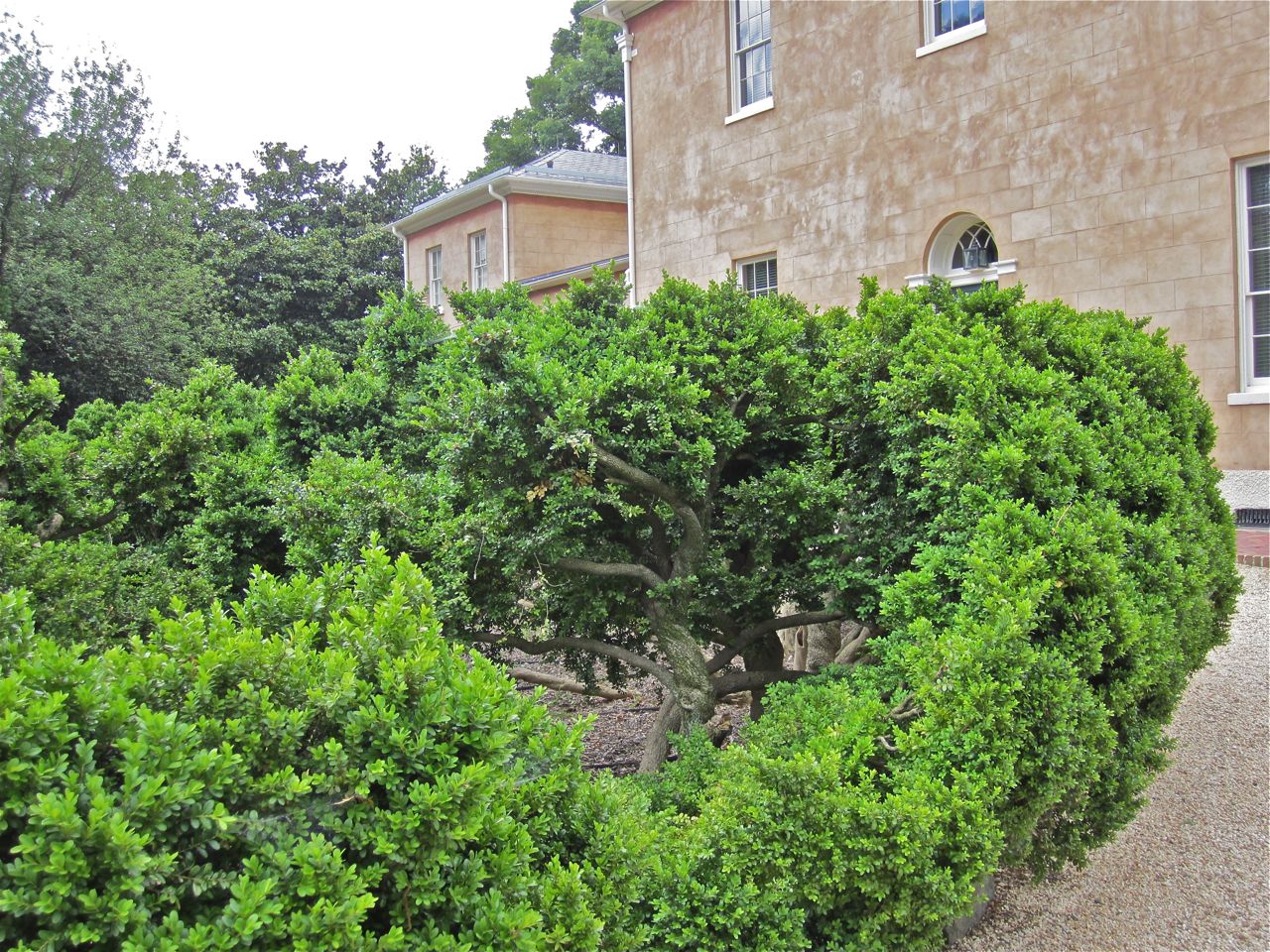
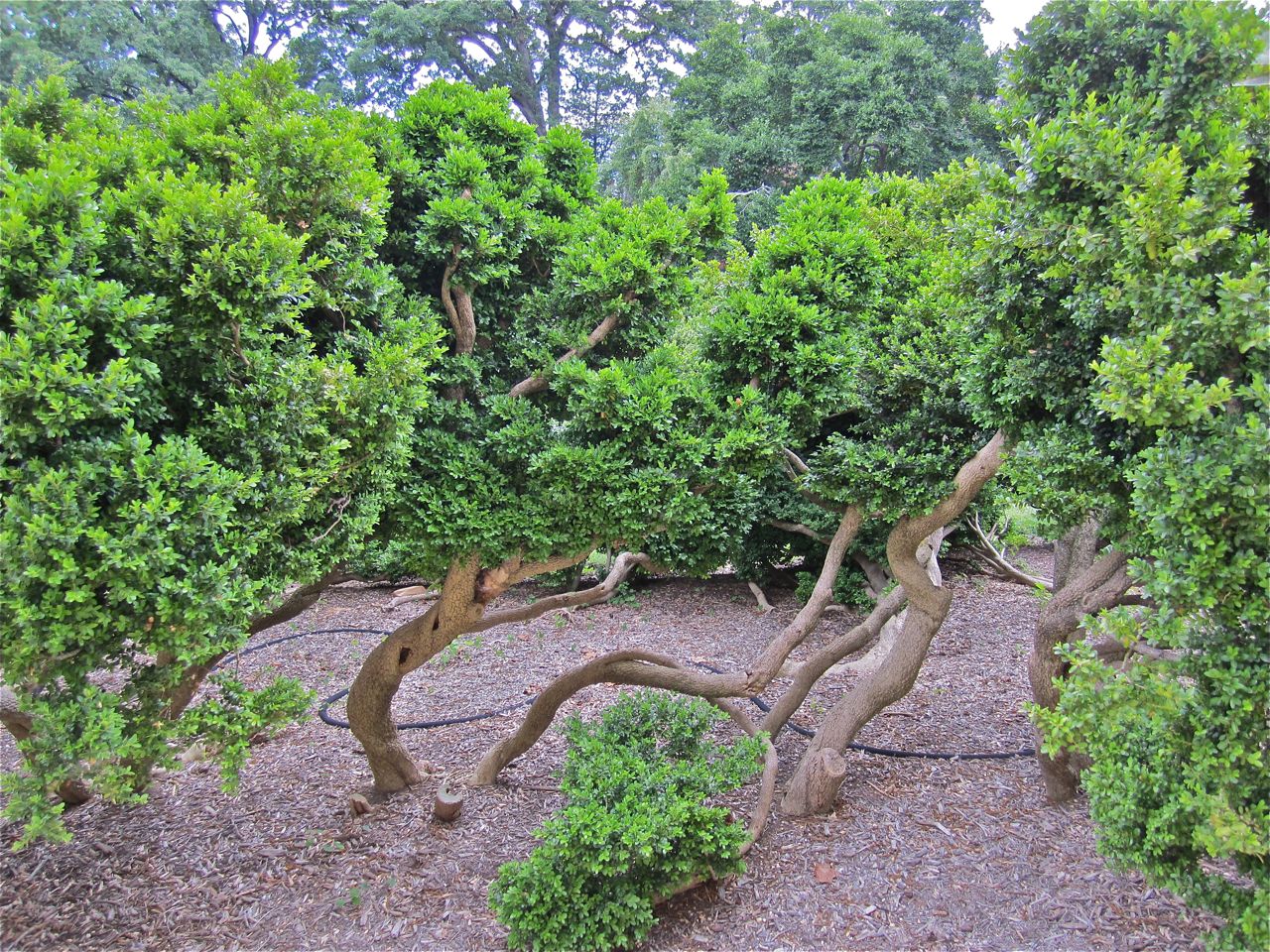
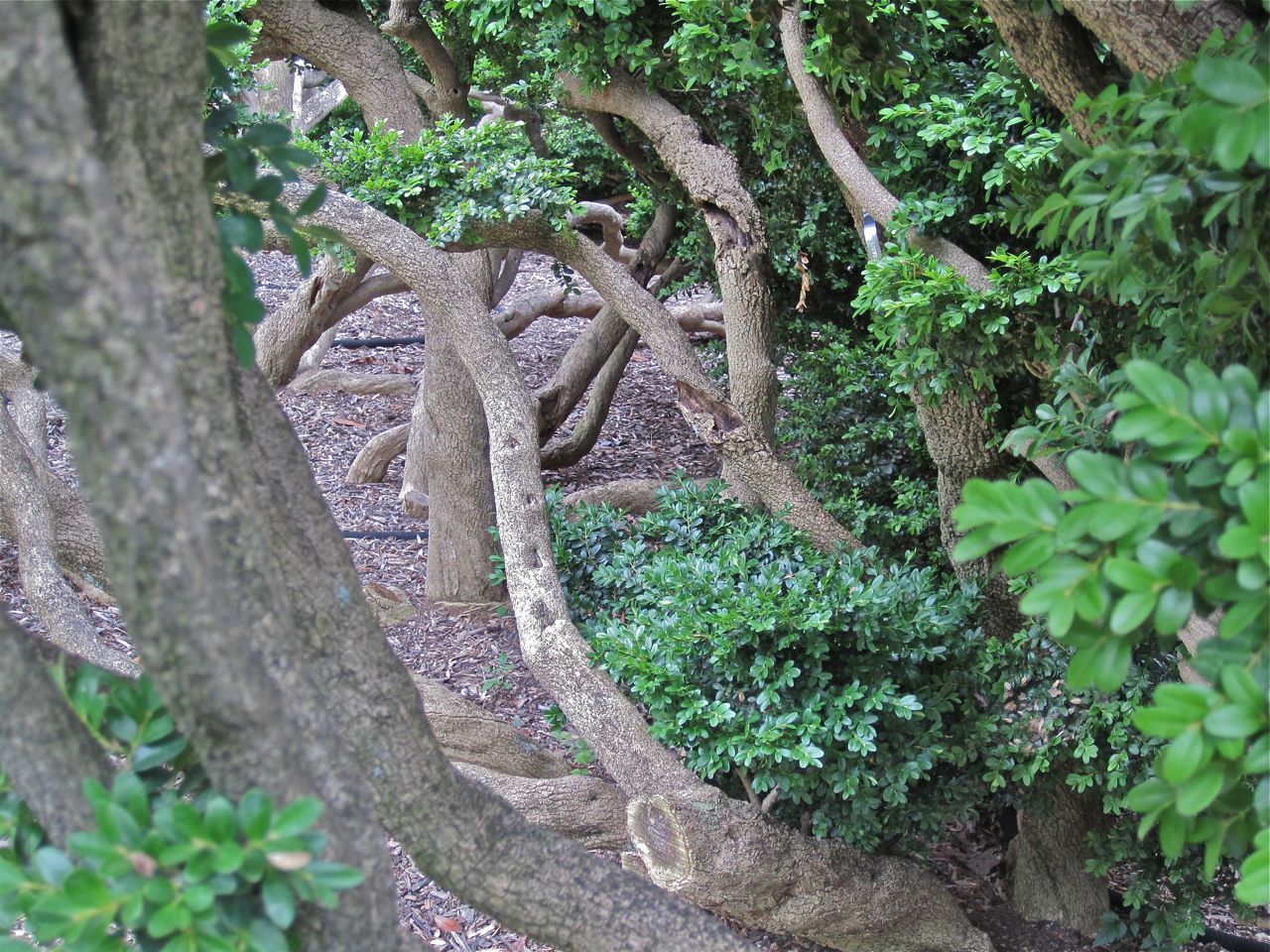
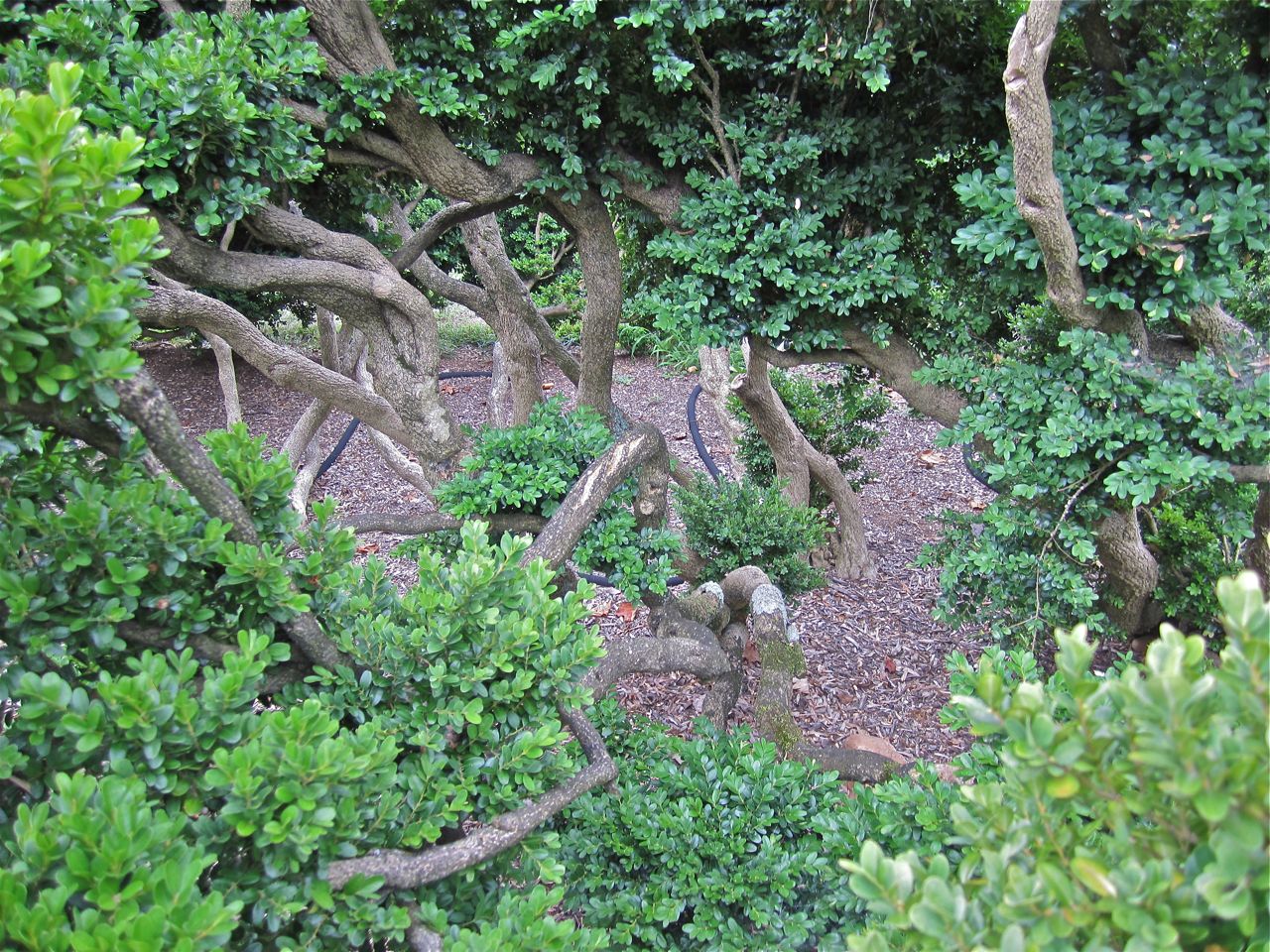
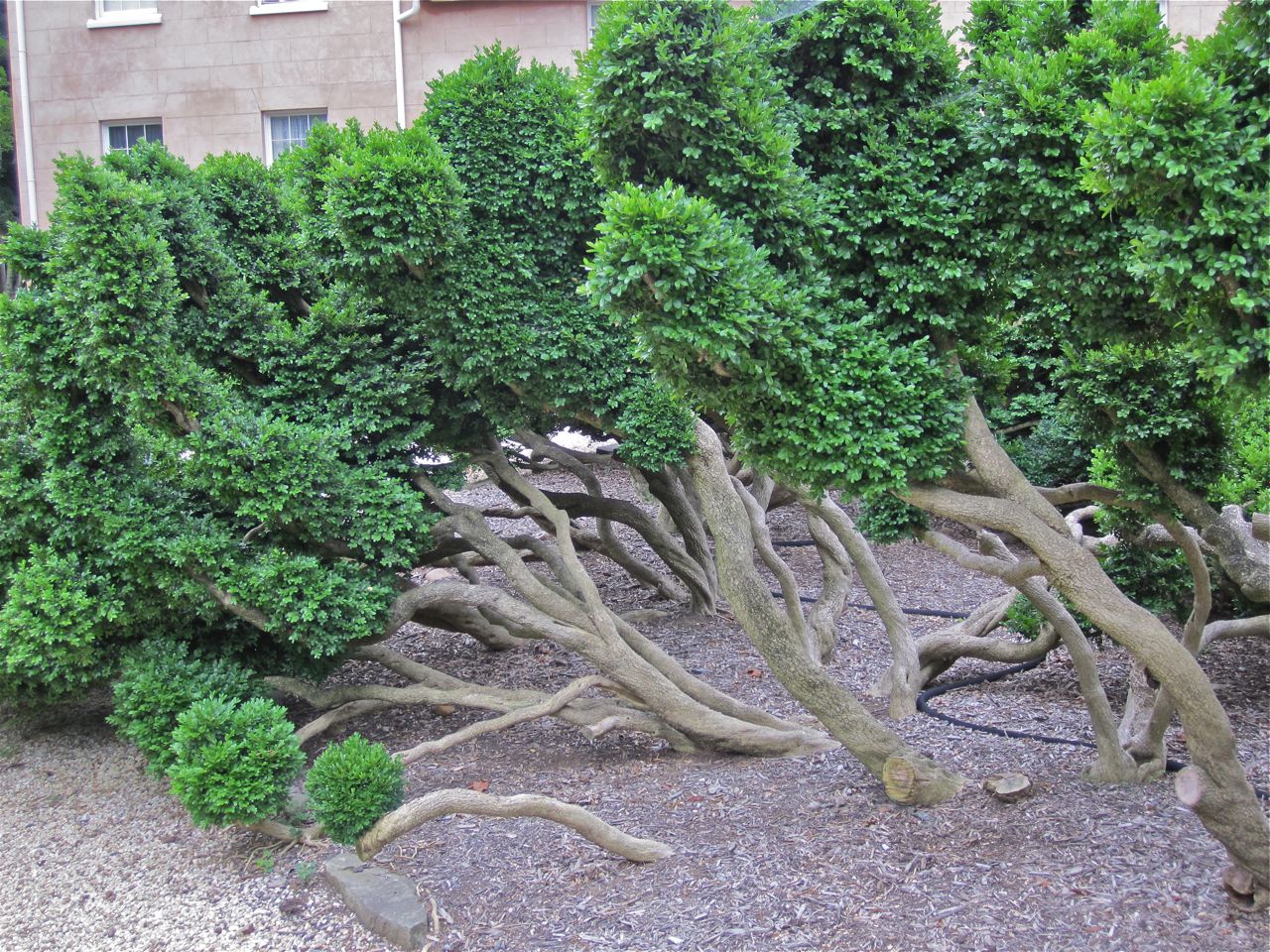
However, in February 2010, Washington had the deepest snows in over 100 years. The damage to the boxwood ellipse and to many other old specimens at Tudor Place was severe, and the hedge’s interior was opened to view in many places. Now the ellipse shows interior volume as well as exterior.
My sympathies to the Foundation, but I find the old shrubs’ new negative spaces and sculptural qualities beautiful and rather moving, and I took photo after photo.
Ellipse from west side. The bushes are English boxwood.Ellipse boxwood. Click on the photos to enlarge.Ellipse boxwood.Ellipse boxwood.Ellipse boxwood.
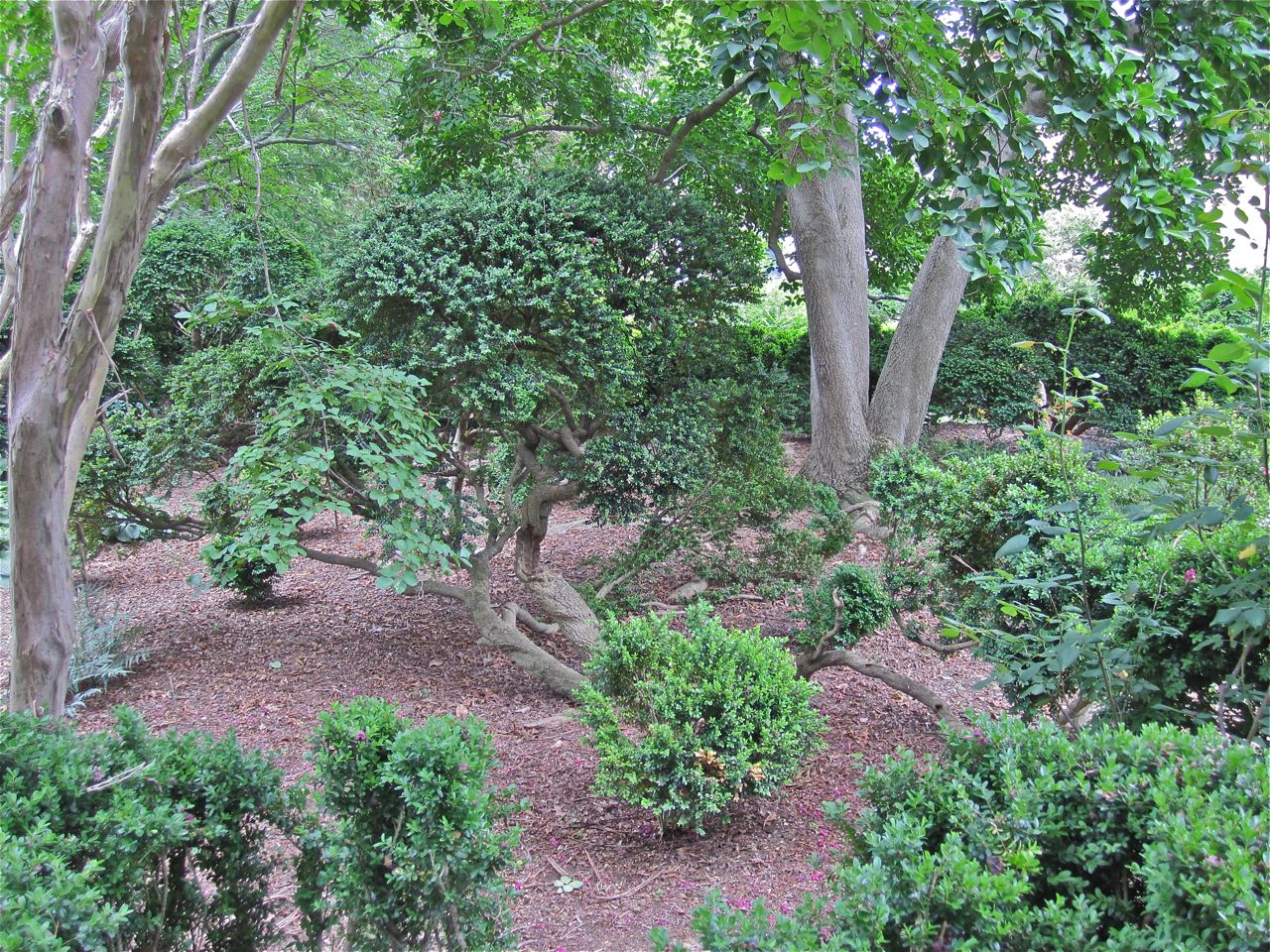
There are other old boxwoods in the north-side garden, like these in a planting bed near the old “tennis lawn.”
Boxwood in the “tennis lawn” planting bed.
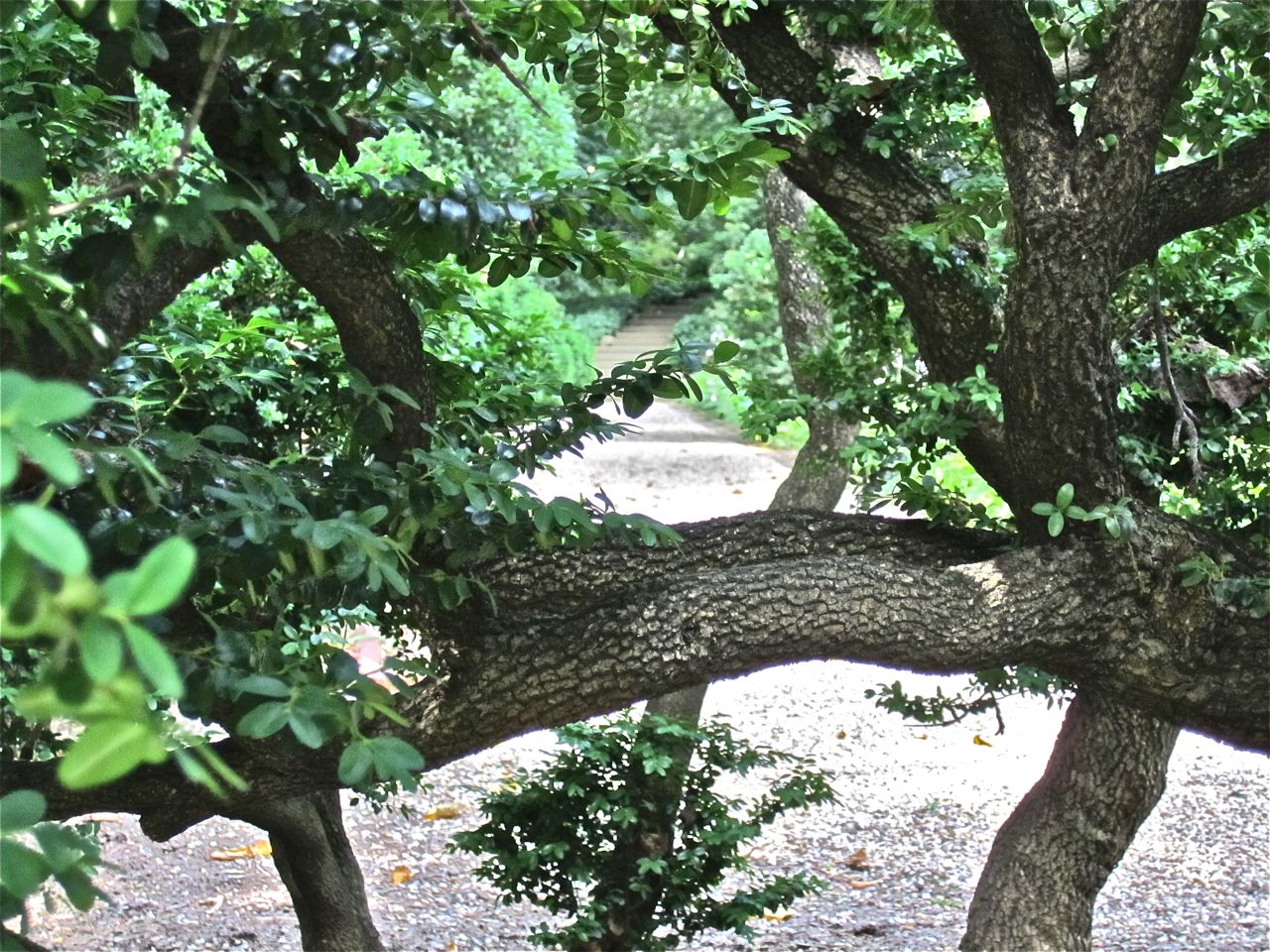
And these along a walkway near the bowling green.
A walk along the bowling green seen through old boxwood. Click on photo to enlarge.
I wonder how long they will be left in place, given their current condition. I find them beautiful, but they don’t really conform to a classic neat Federal or Colonial Revival aesthetic. But who wants to replace bushes planted by the step-granddaughter of the father of our country?
If they were mine, I think I would want to turn the old ellipse’s design somewhat inside out and fill many of the open spaces with the contrasting foliage of other perennials planted inside them — as is happening among some of the equally ancient boxwoods at the Bishop’s Garden at the National Cathedral. I’d like to see a few Rudbeckia maxima flowers waving over the center (although whether the ground beneath the ellipse, full of old roots, would support more plants is a practical question).
Beyond boxwood
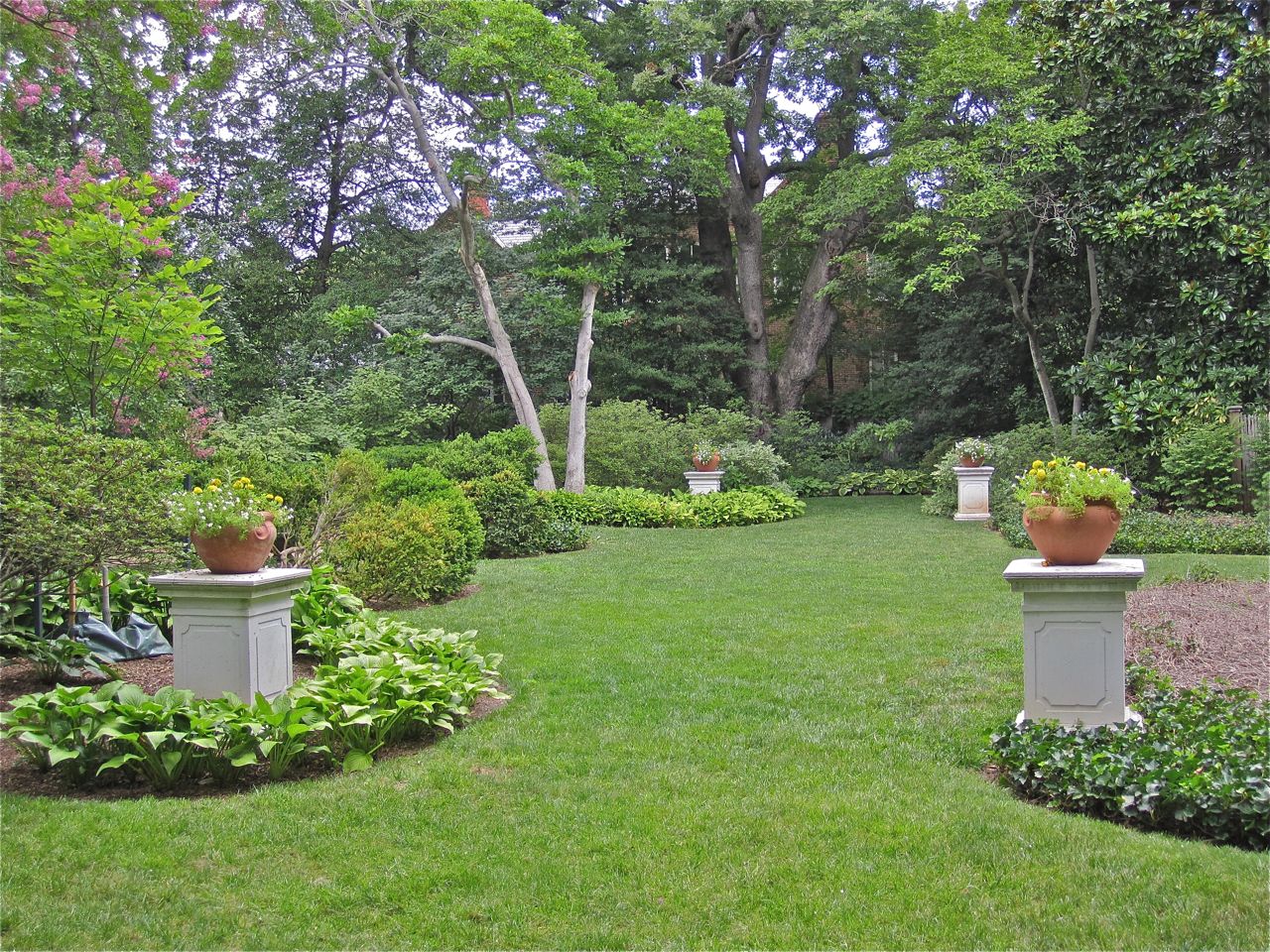
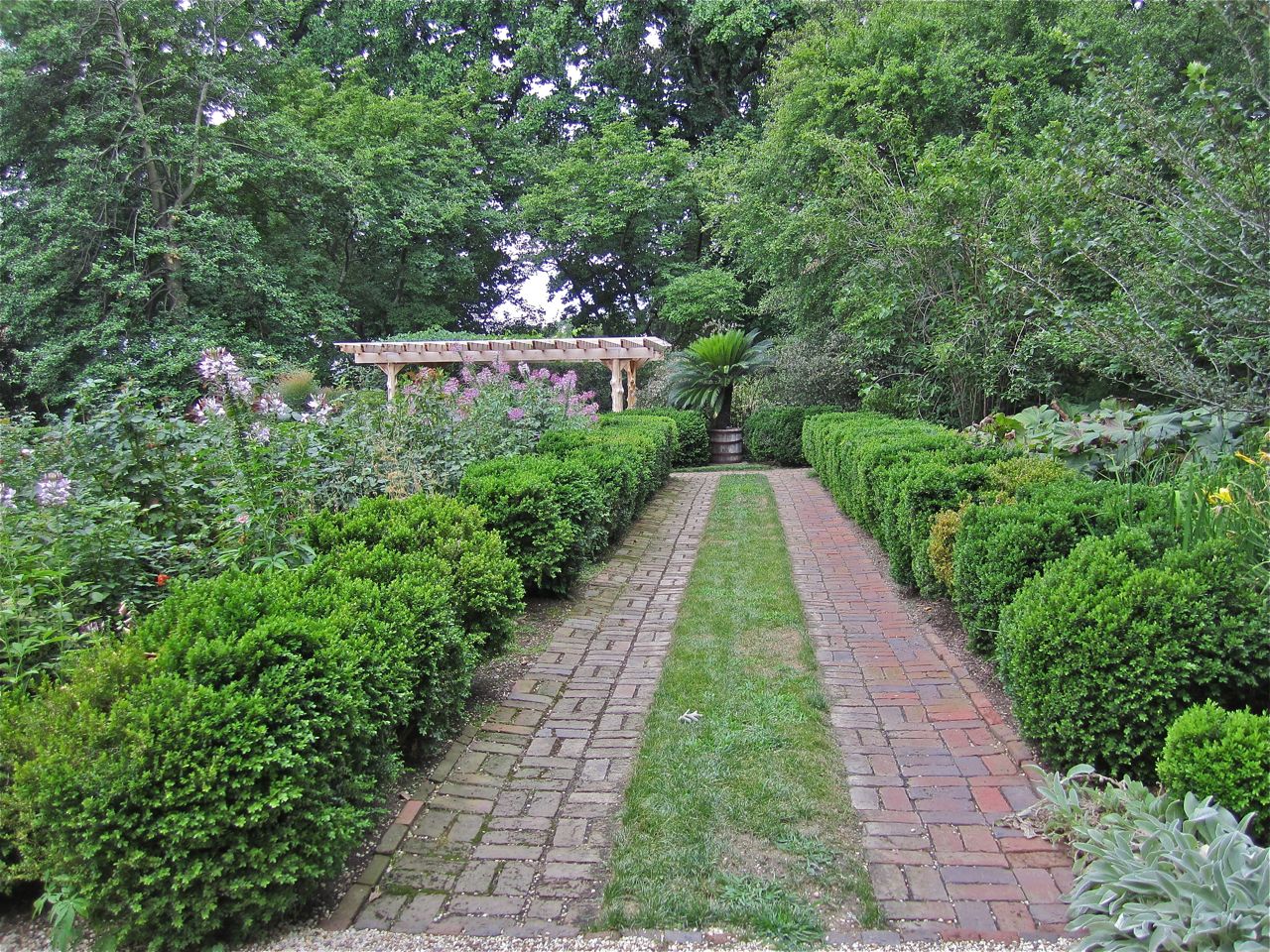
The rest of the Tudor Place garden is lovely as well, with the center north-side area symmetrically squared off in true C.R. style with brick and gravel walkways.
The well-maintained property actually shows off an interesting continuum of original and reconstructed functions and design styles from the last two centuries.
Tennis lawn.
According to an archaeological study and plan by the University of Maryland, the planting of the south-side lawn, which contains the 200-year old tulip poplar and once had a view of the Potomac River, has changed relatively little since the building of the house (and therefore is of little archaeological interest). And, of course, the ellipse is also truly from the Federal period.
The walkways and rose/knot garden existed in their current layouts by the 1830s. But the knot garden was destroyed in the 1860s by intruders seeking boxwood for Christmas wreaths. It was replanted by the last Peter owner in the 1930s, using old family plans, although he moved it to the opposite side of the center walkway.
Walkway from center to west side with rose garden on left.
The northeast-side garden with lawn and curving beds was an orchard and a tennis lawn before its current 20th century design. On the west side, there is a 20th century bowling green and a fountain on what had once been a wooded area.
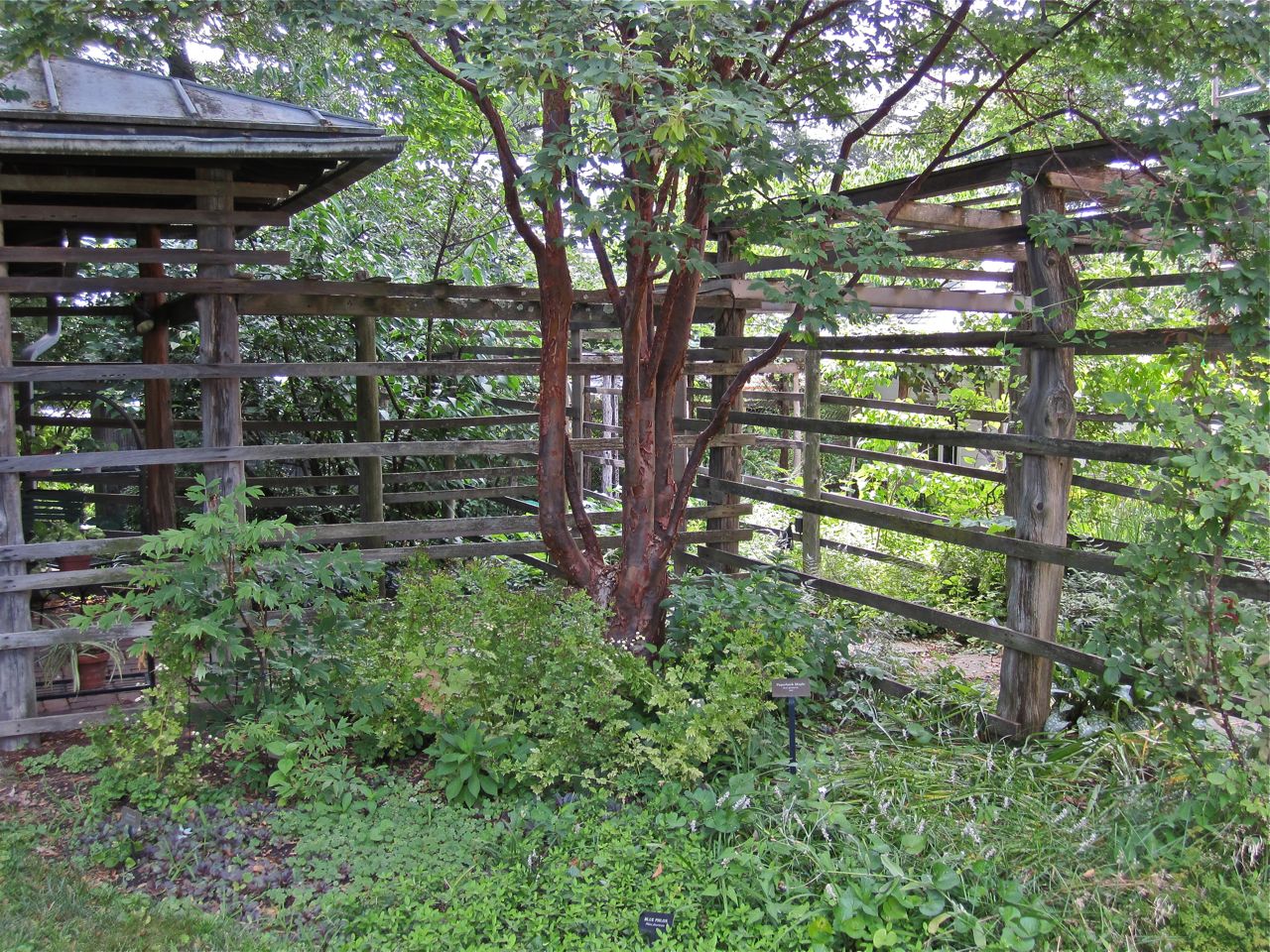
A pretty 20th century patio, “Japanese” teahouse, and arbor sit off the west wing of the house, more or less in the location of the 19th century kitchen garden. They look Tidewater southern more than anything else.
“Japanese” tea house and arbor.
The garden is open to the public Monday through Saturday, 10 a.m. to 4 p.m., Sunday, noon to 4 p.m. There’s a small charge of $3. See this link for information about touring the house.
To see more photos and a garden plan, click “Continue reading” below and click on any thumbnail scroll through large pictures.Continue reading “Tudor Place, part two”→


 The front of Nelson House in 1915. This photo is part of an

 enclos*ure