
The flower sellers, Paris

Flower sellers at Place Louis-Lépine on the l’île de la Cité, at Quai de la Corse, Paris, France, May 2, 1918, by Auguste Léon, via Archives of the Planet Collection – Albert Kahn Museum /Département des Hauts-de-Seine (both photos).

There has been a flower market on or near this spot since 1808. Since June 2014, it has been called Queen Elizabeth II Flower Market, to commemorate the visit of the British queen just prior to the 70th anniversary of D-Day.

Behind the sellers, on the other side of the river, is the Palmier Fountain and Châtelet Theater.
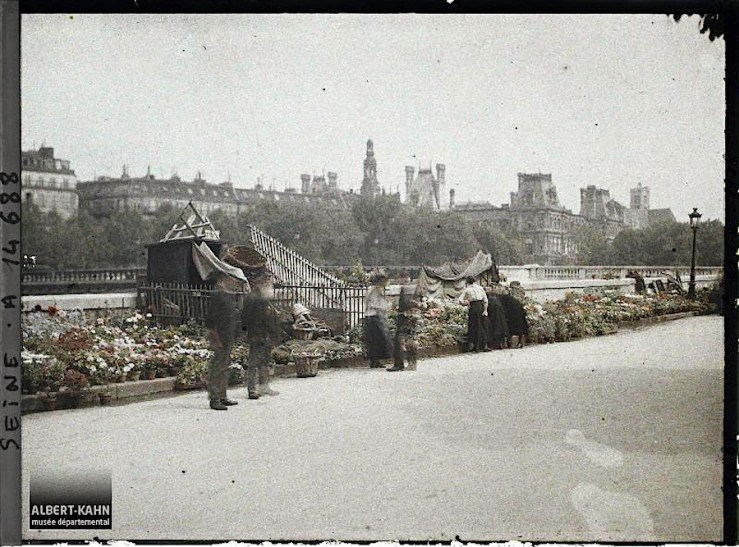
France, Paris, Marché aux fleurs
Looking the other directions, with the Hotel de Ville in the background across the river.

These autochromes are two of about seventy-two thousand that were commissioned and then archived by Albert Kahn, a wealthy French banker and pacifist, between 1909 and 1931. Kahn sent thirteen photographers and filmmakers to fifty countries “to fix, once and for all, aspects, practices, and modes of human activity whose fatal disappearance is no longer ‘a matter of time.'”* The resulting collection is called Archives de la Planète and now resides in its own museum at Kahn’s old suburban estate at Boulogne-Billancourt, just west of Paris. Since June 2016, the archive has also been available for viewing online here.


*words of Albert Kahn, 1912. Also, the above photos (A 13 994, A 14688) are © Collection Archives de la Planète – Musée Albert-Kahn and used under its terms, here.
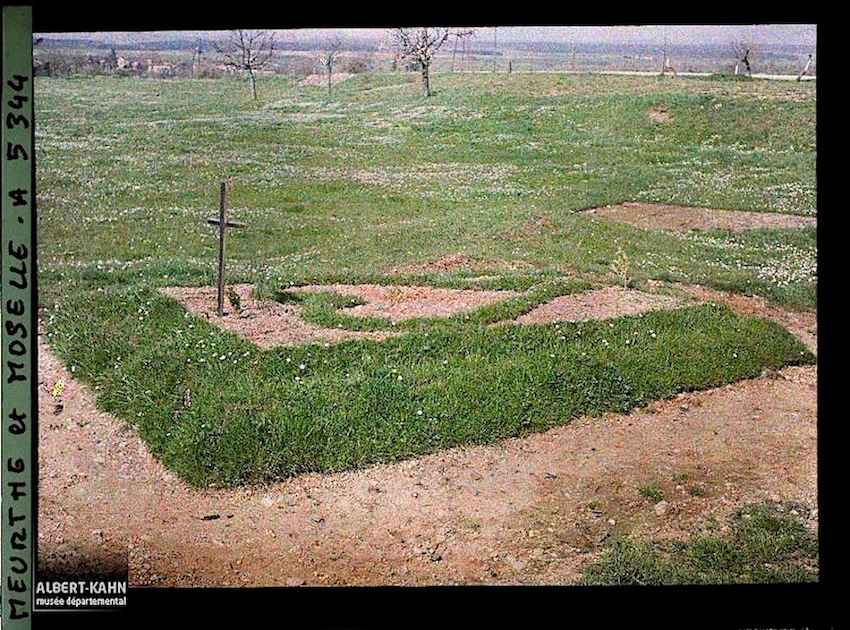
Gerbéviller, France

“La Tombe des Coloniaux, a heart of grass, near Gerbéviller,” April 28, 1915, by Georges Chevalier, via Archives of the Planet Collection – Albert Kahn Museum /Département des Hauts-de-Seine.

This seems to be the grave of a soldier (or perhaps soldiers) from one of the French Colonial Infantry Regiments. He probably fell in the Battle of Lorraine about seven or eight months before the photo was taken. Such men, called “Marines,” were recruited from both France and the white settler and indigenous populations of the French colonial empire.

The town of Gerbéviller itself had been caught in the same battle’s crossfire. German troops had systematically burned over 400 houses and killed over 60 inhabitants. It became “Gerbéviller-la-Martyre” in the press and a kind of pilgrimage site.

Today, there are both French and German WWI cemeteries in Gerbéviller.

This autochrome is one of about seventy-two thousand that were commissioned and then archived by Albert Kahn, a wealthy French banker and pacifist, between 1909 and 1931. Kahn sent thirteen photographers and filmmakers to fifty countries “to fix, once and for all, aspects, practices, and modes of human activity whose fatal disappearance is no longer ‘a matter of time.'”* The resulting collection is called Archives de la Planète and now resides in its own museum at Kahn’s old suburban estate at Boulogne-Billancourt, just west of Paris. Since June 2016, the archive has also been available for viewing online here.


*words of Albert Kahn, 1912. Also, the above photo (A 5 344) is © Collection Archives de la Planète – Musée Albert-Kahn and used under its terms, here.
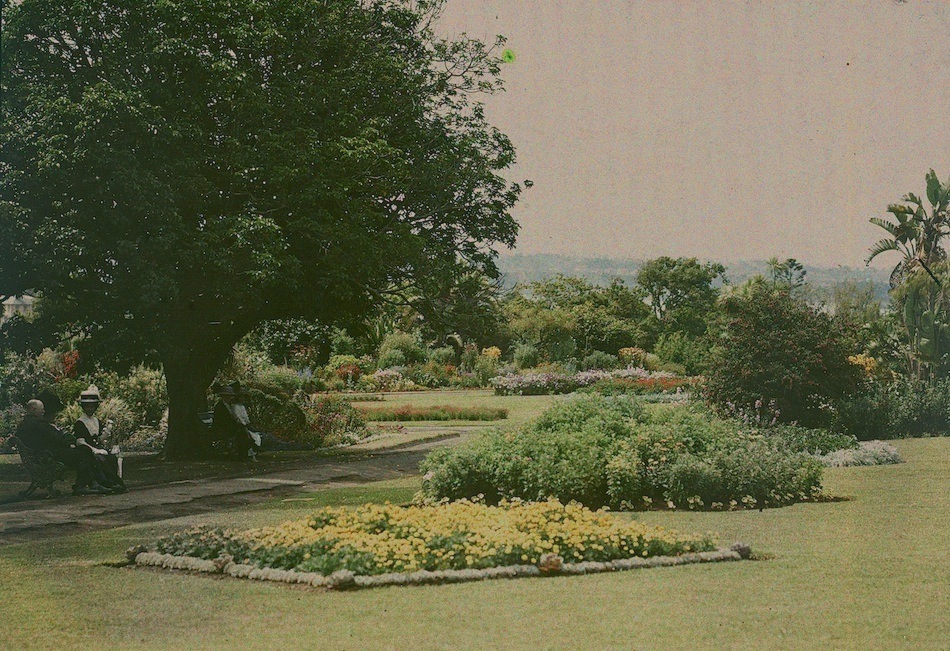
The Domain, Auckland

“In the Domain Gardens,” Auckland, New Zealand, 1913, an autochrome by Robert Walrond, via Museum of New Zealand (Te Papa Tongarewa).

Some Monday morning color. . .

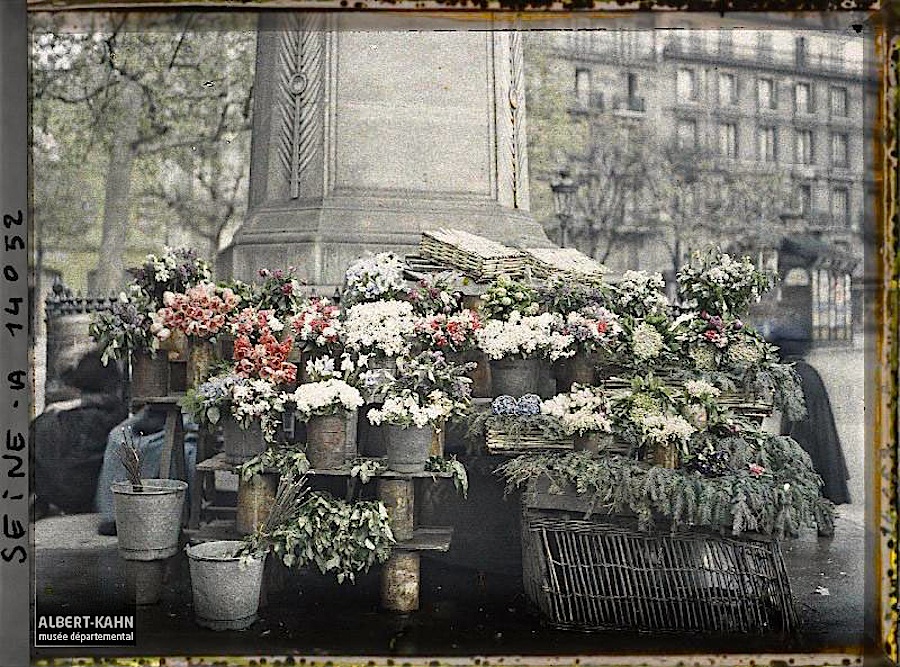
The flower seller, Paris


A flower seller, Place Voltaire, now Place Léon-Blum, Paris, France, May 1918, by Auguste Léon, via Archives of the Planet Collection – Albert Kahn Museum /Département des Hauts-de-Seine.

The autochrome above is one of about seventy-two thousand that were commissioned and then archived by Albert Kahn, a wealthy French banker, between 1909 and 1931. Kahn sent thirteen photographers and filmmakers to fifty countries “to fix, once and for all, aspects, practices, and modes of human activity whose fatal disappearance is no longer ‘a matter of time.'”* The resulting collection is called Archives de la Planète and now resides in its own museum at Kahn’s old suburban estate at Boulogne-Billancourt, just west of Paris. Since June 2016, the archive has also been available for viewing online here.


*words of Albert Kahn, 1912. Also, the above photo (A 14 052) is © Collection Archives de la Planète – Musée Albert-Kahn and used under its terms, here.
Three boys


“Three boys in western costumes holding flowers,” ca. 1915, an autochrome, place and photographer unknown, via George Eastman Museum Commons on flickr.

I think these are twins and their younger brother (on the left). What do you think the flowers are? Could the yellow-orange ones be California poppies?