

“Porches, New Jersey,” February 1936, by Carl Mydans for the U.S. Farm Security Administration, via The Miriam and Ira D. Wallach Division of Art, Prints and Photographs, The New York Public Library.
Life in gardens: puppies
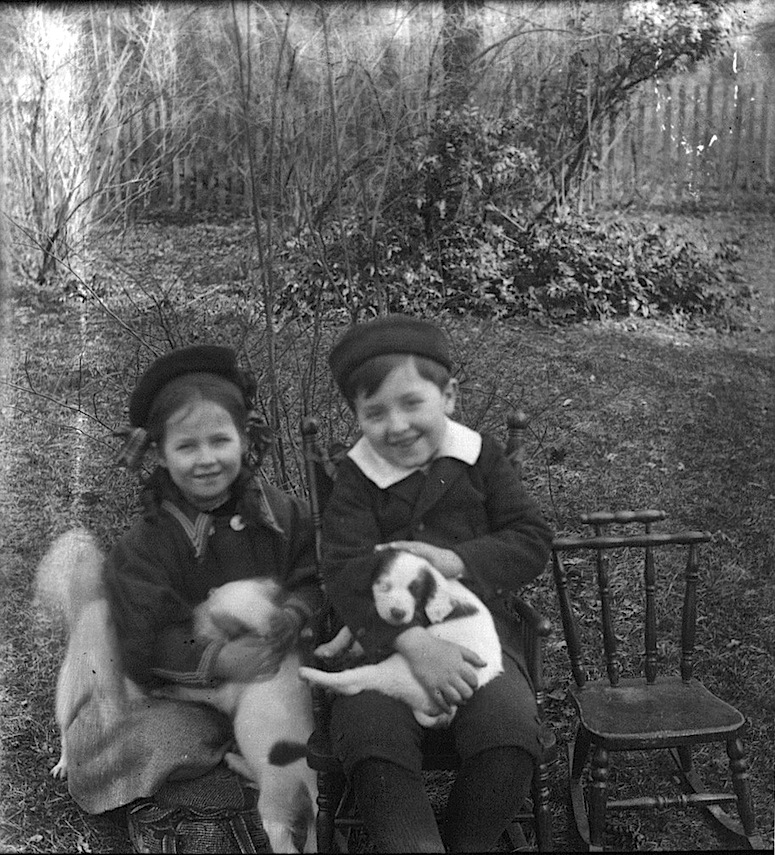 Children with puppies, Oxford, Ohio, ca. early 20th c., by Frank R. Snyder, via Miami University Libraries on flickr (both photos).

The one on the left above is particularly slippery.
Industry
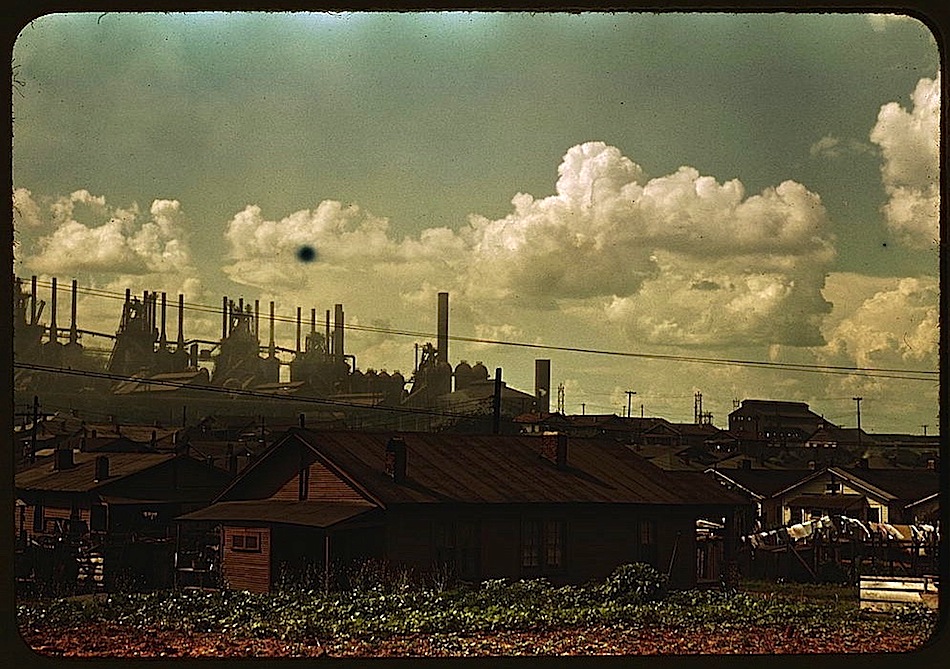
Vegetable gardens beside workers’ housing; factory in the background, place unknown, between 1941 and 1942, color slides by unknown photographer for the U.S. Office of War Information, via Library of Congress Prints and Photographs Division.

It was suggested by commenters on the photos’ flickr pages that the factory is for steel and the location is Pittsburg or Bethlehem, Pennsylvania.
Mount Vernon
A repeat “Vintage” from 2012. . .
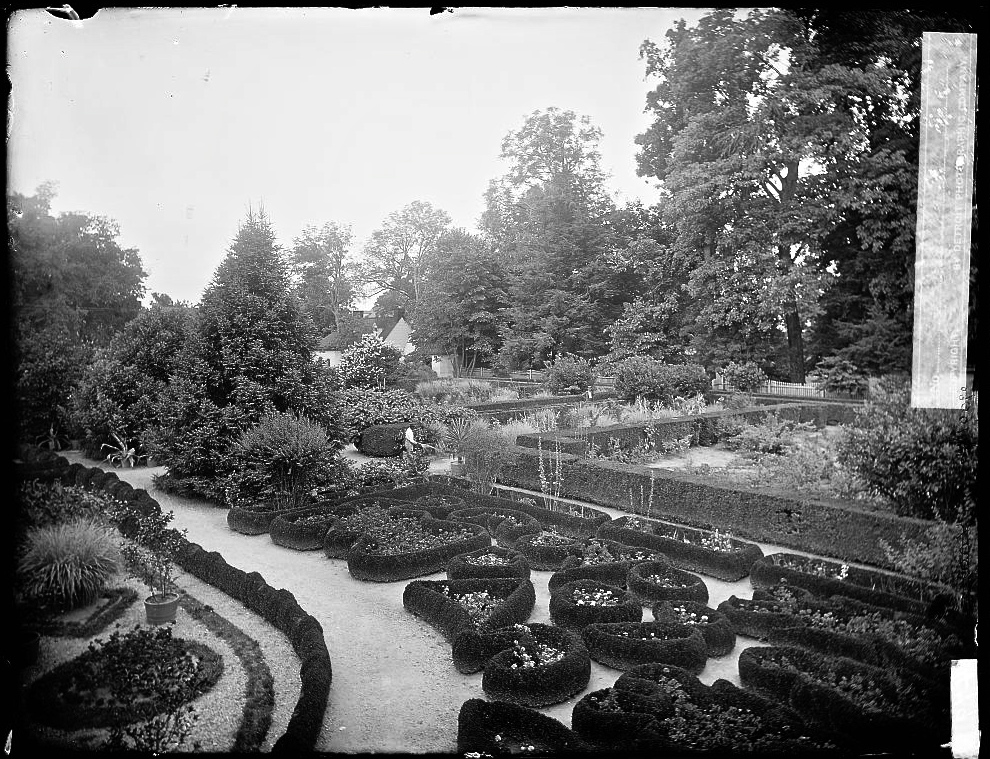
I love this 1902 photograph of the Upper Garden at George Washington’s home, Mount Vernon. It’s so high Colonial Revival.
Early American Gardens has a post this week, “Mount Vernon after George Washington’s death,” with images from the 19th century. While looking at them I remembered the picture above and the two below.
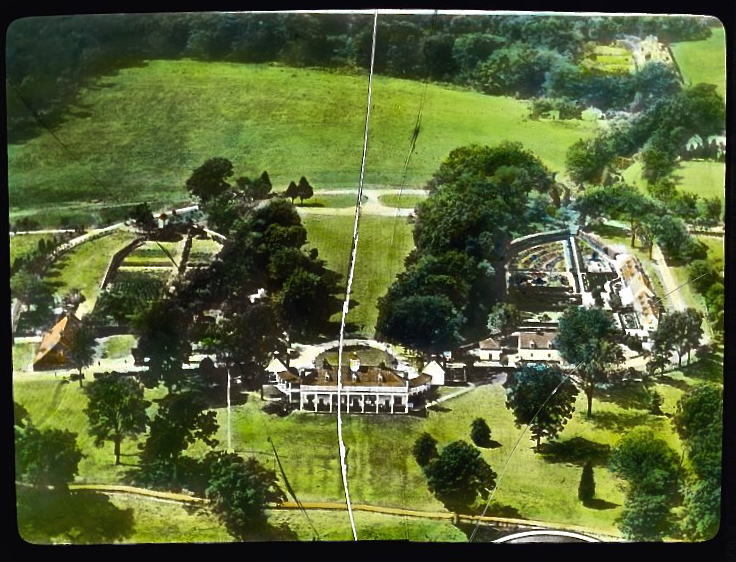
Above is a hand-colored slide from a 1929 aerial photo, part of the lantern slides collection of Frances Benjamin Johnston. The Upper Garden is on the right side.
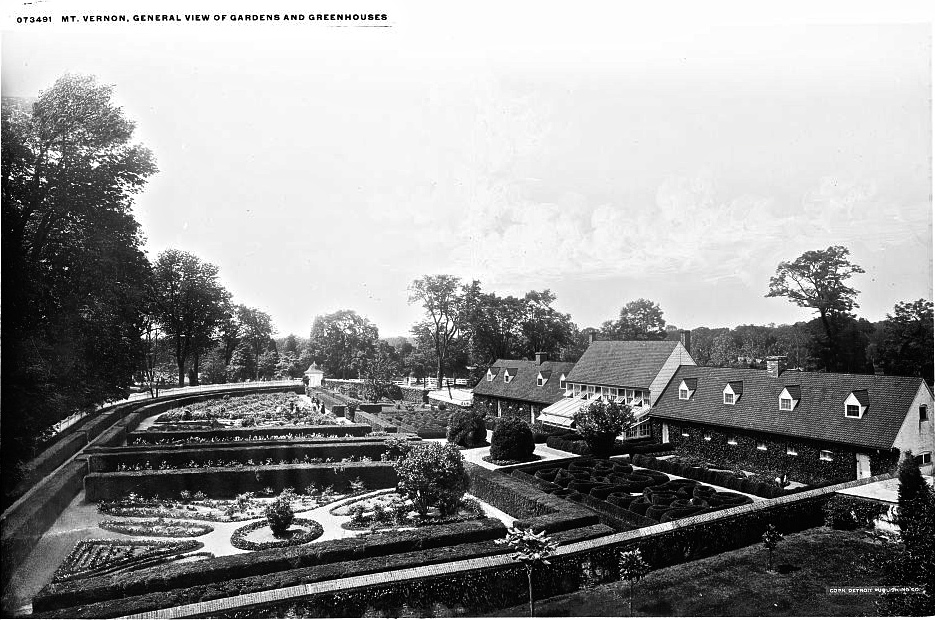
And here is a general view (c.1910 – 1920) of the the Upper Garden by the Detroit Publishing Co. All three images above via the Library of Congress Prints and Photographs Division.
The 20th century photos are pretty, but they don’t accurately represent the Upper Garden of Washington’s time. In the late 19th century, restorers thought that the boxwood parterres (many filled with hybrid tea roses) were original to Washington’s time, but research in the 1980s found that they were actually planted in the 1860s or 70s (although they may have been rooted from Washington’s boxwood).
The garden was substantially re-worked in 1985, but such is the romantic power of a boxwood hedge that the mid-19th century bushes were largely “kept in place by their own mythology and the mythology they supported of Washington as American royalty,” according to The History Blog, here.
But by the early 2000s, those boxwoods were dying, so the Mount Vernon Ladies’ Association, which owns the estate, decided to make an extensive (six-year) archaeological dig on the site. This culminated in a “new” (1780s) design in 2011. The area now holds large open beds of vegetables and flowers. They are bordered by low boxwood hedges and centered by a 10′ wide gravel walkway.
You can read about the restoration in this Washington Post article, here. And I really recommend watching this very interesting 30-minute C-Span video about the research and archaeology that informed it.
(There’s more about the garden in 2017 here.)
Life in gardens: Aoyama
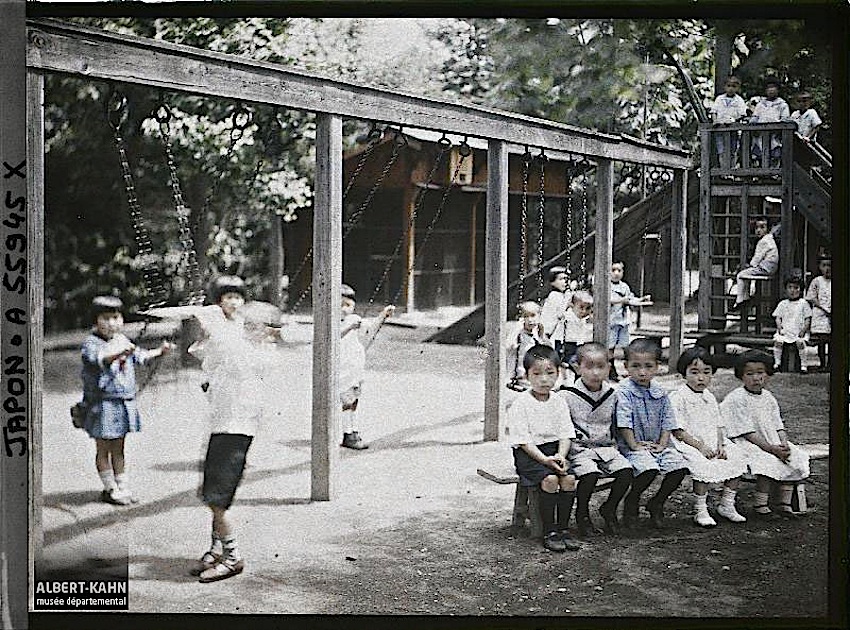 A very nice playground at a school in Aoyama, a neighborhood of Tokyo, summer 1926, by Roger Dumas, via Archives of the Planet Collection – Albert Kahn Museum /Département des Hauts-de-Seine.
This autochrome is one of about 72,000 that were commissioned and then archived by Albert Kahn, a wealthy French banker who was committed to the ideal of universal peace and believed that “knowledge of foreign cultures encourages respect and peaceful relations between nations.”* He was also acutely aware that the 20th century was going to bring rapid material change to the world.
Accordingly, from 1909 to 1931, Kahn sent thirteen photographers and filmmakers to 50 countries “to fix, once and for all, aspects, practices, and modes of human activity whose fatal disappearance is no longer ‘a matter of time.'”† The resulting collection is called Archives de la Planète and now resides in its own museum at Kahn’s old suburban estate at Boulogne-Billancourt, just west of Paris. Since June 2016, the archive has also been available for viewing online here.
*Collections Albert Kahn website. Also, the above photo (A 55 945 X) is © Collection Archives de la Planète – Musée Albert-Kahn and used under its terms, here.
†words of Albert Kahn, 1912.
 enclos*ure