I’ll take one more pass at the interesting photographs of the Library of Congress Matson Collection (American Colony of Jerusalem).
“Garden of Gethsemane in snow,” February 28, 1938.
The American Colony photographers took many pictures of the Garden of Gethsemane during the first half of the 20th century. Presumably, they were big sellers in the Colony’s tourist shop near Jaffa Gate.
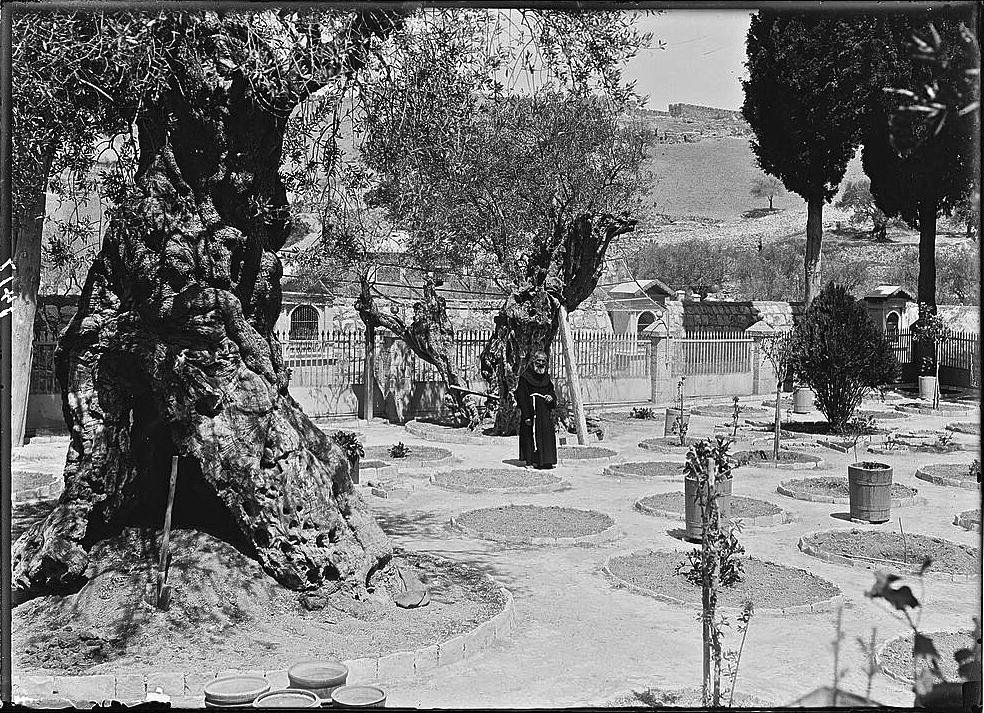
“Garden of Gethsemane semi-distant with overhanging olive branch,” c. 1898-1946. The garden is in the middle of the photo. Click the image to enlarge it.
‘Gethsemane’ is a Greek word derived from an Aramaic word for ‘oil-press.’ The Roman Catholic-administered garden is located at the foot of the Mount of Olives. It is one of four locations in the area currently claimed by different religions as the place where Jesus prayed the night before the crucifixion.
“Jerusalem. Gethsemane from convent roof showing city wall and Golden Gate.” Image hand-colored c. 1950 – 1970, but original black and white photo was probably taken earlier.
In the gospels of Matthew and Mark, it is called by a word meaning ‘place,’ ‘property,’ or ‘estate.’ In the gospel of John, the Greek word ‘kepos’ is used; it can mean ‘garden,’ but also ‘cultivated tract of land.’
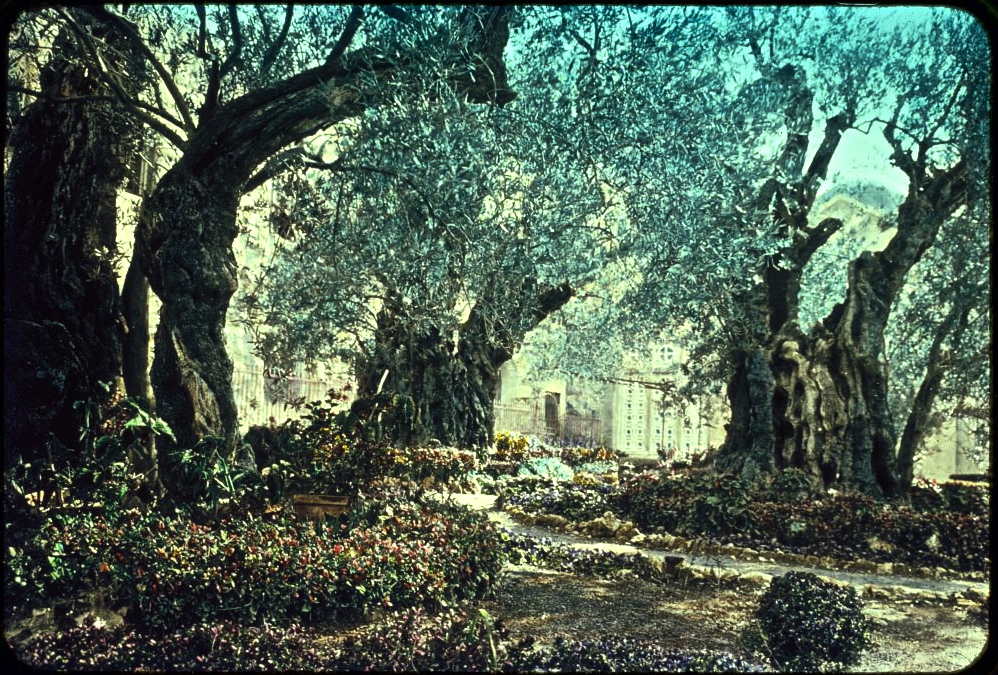
“Garden of Gethsemane, inside enclosure.”
The first recorded pilgrimage to the site was made in 333 A.D. by the anonymous “Pilgrim of Bordeaux,” who recorded his travels in the Holy Land in Itinerarium Burdigalense.
“Jerusalem (El-Kouda, Garden of Gethsemane, interior),” c. 1898-1914.
The building attached to the garden, the Church of All Nations, was built in the 1920s. The garden’s olive trees are said to be 2,000, 1,000, or 900 years old, depending on the source.
“The terrible plague of locusts in Palestine, March-June 1915. The same garden after visitation by the locust.”
In 1915, a plague of locusts swept through Palestine, stripping areas — including the garden — of all vegetation. The American Colony was asked to photograph the devastation, which caused food shortages, by the Ottoman-Turkish governor for “Syria and Arabia.”
While looking through the online catalogue of the Library of Congress for photos of gardens and landscapes, I keep coming across pictures by the American Colony of Jerusalem.
Golden Gate and east wall of Jerusalem seen through group of century plants [agave], c. 1900-1920, by the American Colony, via Library of Congress.The American Colony was a Christian utopian society established in Jerusalem in 1881 by Americans Anna and Horatio Spafford. Its whole story is very interesting, but long, so you can read about it here and here and here.
Around 1898, a member of the colony, Elijah Meyers, began photographing places and events around the region and eventually formed a photography service that earned income for the group. He was later joined in the endeavor by Lewis Larsson and G. Eric Matson, among others. When the colony dissolved in the early 1930s, Matson and his wife took over the studio and its archives and renamed it the Matson Photo Service.
Wild flowers of Palestine. Flowers, c. 1898-1946.
Matson moved to California in 1946. He began donating negatives and contact sheets to the Library of Congress in the 1960s.
Among the over 20,000 images in the Matson Collection are about 200 photos of “wild flowers of Palestine.” In 1907, the Colony had published The Plants of the Bible and, in 1912, TheJerusalem Catalogue of Palestine Plants. The group also sold photographs and stereographs from its Jerusalem store and contributed pictures to National Geographic articles.
Wood-mallow (Malva sylvestris L.), c. 1900-1920.
The photos that I’ve chosen are best seen in a larger size, so please click on the first thumbnail below to scroll though them. The plant names come from the images’ original labels.
Wild flowers of Palestine. Wood-mallow (Malva sylvestris L.), 1900-1920 by the American Colony, via Library of Congress.
Agriculture, etc. Various shades of anemones. Colours ranging from snow white to all shades of pink, dark purple and blue, c. 1930-1933.
Flowers [Maritime squill — Urginea maritima Baker), September 21, 1915.
Flowers [cyclamen], c. 1898-1946.
Flowers [cyclamen], c. 1898-1946.
Flowers, c. 1898-1946.
Flowers [wild pink onion — Allium trichocoleim Bonm.), c. 1898-1946.
Flowers [wild garlic — Allium ampeloprasum L.], c. 1898-1946.
(Taken in their natural setting) “Lily of the field.” (Anemone — Anemone coronaria L.), c. 1898-1946.
Onopordon (cotton-thistle) (O. heteraconthum), c. 1900-1920.
Great carrot (Daucus maximus Desf.), c. 1900-1920.
Palestine arum (Arum palaestinum Boiss), c. 1900-1920.
Palestine arum (Arum palaestinum Boiss), c. 1900-1920.
Poison hemlock (Conium maculatum L.), c. 1900-1920.
Bethlehem-star (Ornithogalum fimbriatum Wild), c. 1900-1920.
Golden Gate and east wall seen through group of century plants [agave], c. 1900-1920.
Hand-colored transparency, “Pomegranate Tree in Fruit,” by the American Colony Photo Department (later Matson Photo Service), taken between 1925 and 1946, via Library of Congress.
I think about pomegranates, as I put the seeds on my oatmeal every morning. The tree in our garden has been producing fruit pretty steadily since September.
Wikipedia says, “In the Northern Hemisphere, the fruit is typically in season from September to February. In the Southern Hemisphere, the pomegranate is in season from March to May.” Perhaps because Rwanda is pretty much on the equator, we get both seasons.
Looking for poems about pomegranates, I found this poem by Billy Collins. It has only a little to do with the fruit, but it’s funny.
Almost as soon as their medium was invented in 1839, early photographers sought to make panoramic images that would capture a field of view as wide as or wider than that of the human eye.
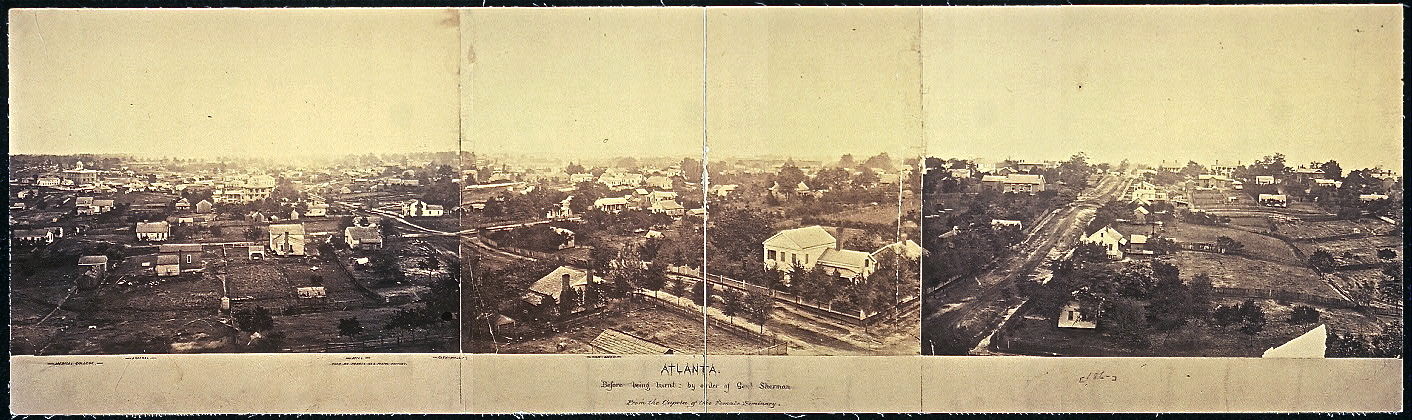
Specialized panoramic cameras with extra long negatives and rotating lenses were available by the 1840s, but the simplest method (well, actually nothing was simple with early photography) was to take a series of photographs and paste them together side by side to form one long picture, as shown in the image below.
“Atlanta, before being burnt; by order of Gen’l. Sherman, from the cupola of the Female Seminary” by George N. Barnard, October 1864. Click on the photo to enlarge it.
By 1899, Kodak had developed a panoramic camera for amateurs. In 1904, the Cirkut camera, based on improved 1840’s technology, was introduced and soon became popular with commercial photographers.
The Library of Congress has a collection of approximately 4,000 panoramic photographs, mainly assembled during the late 19th and early 20th centuries, when panoramic scenes were most popular. It includes landscapes, group portraits, and cityscapes.
I made a search of city parks and other urban recreational spaces and found a number of interesting images from 1902 to 1921.
(You can click each photo to enlarge it or click on “Continue reading” below and then on the first thumbnail in the gallery to scroll through all the larger versions.)
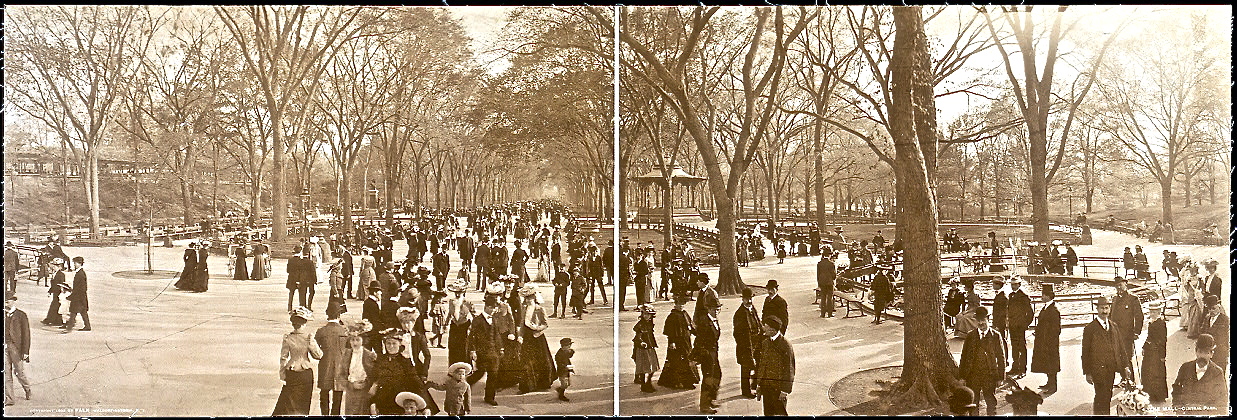
The photo above shows The Mall in Central Park, New York City. This part of the park was designed by Olmstead and Vaux to be an “open air hall of reception,” and it certainly was on this day in 1902.
Such a “grand promenade” was considered an “essential feature of a metropolitan park,” even by the designers, who created a more naturalistic plan for most of the rest of the park.
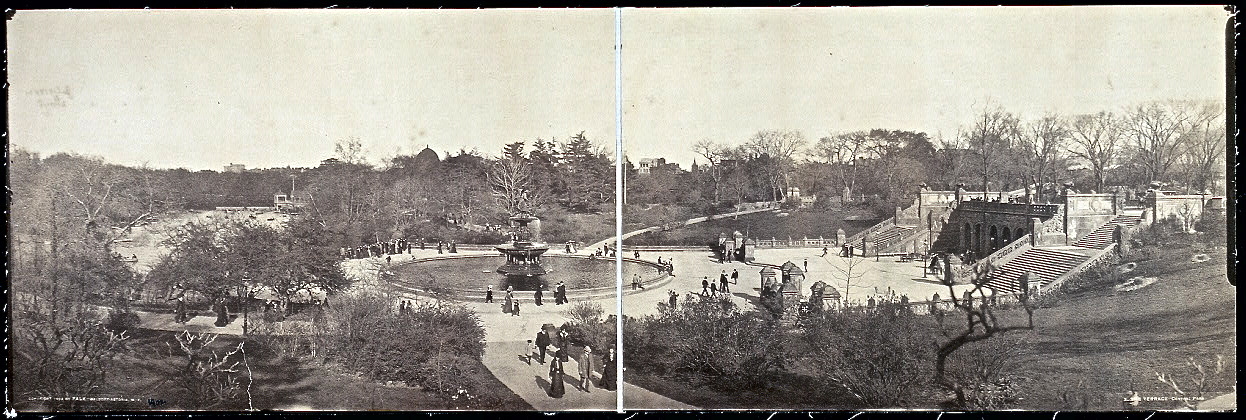
The Mall leads to The Bethesda Terrace, shown above. Both Central Park pictures were taken by Benjamin J. Falk.
Diamond Park in Meadville, Pennsylvania, had the same features as Central Park’s Mall, although on a smaller, simpler scale. The photo above was taken c. 1910 by W.R. Hites. The round pool and gazebo exist in the park today.
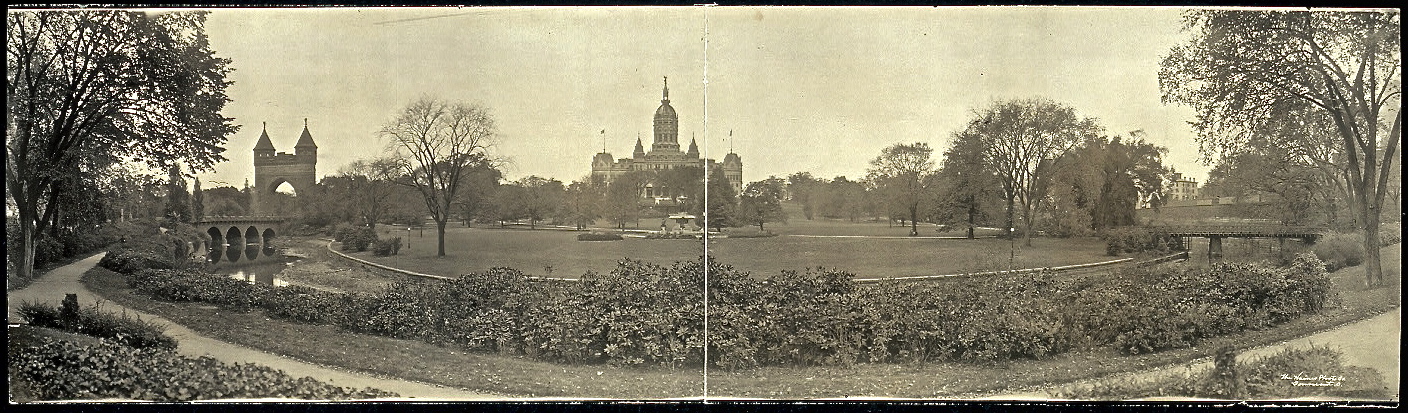
The photo of Diamond Park, and those of the two pictures below, may have been taken with a Cirkut camera, which distorted images and made straight paths or roads in the centers of its photos appear curved.
Bushnell Park of Hartford, Connecticut, shown above, was the first municipal park in the U.S. to be conceived of and paid for with public funds. It was designed in 1861 by Jacob Weidenmann in a natural style that featured informal clusters of 157 varieties of evergreen and deciduous trees, which buffered the sights and sounds of the city.
This photo was taken c. 1909, by Haines Photo Co. The state capitol building can be seen in the background.
Grand Circus Park was a social center of Detroit, Michigan, when the photo above was taken by Manning Bros. in 1921. It was surrounded by eight theaters, as well as ornate hotels.
At the time of the picture, the Russell Alger Memorial Fountain would have just been completed. It was designed by Henry Bacon, who also designed the Lincoln Memorial in Washington, D.C. The fountain featured a sculpture by Daniel French, who also sculpted Abraham Lincoln for the Memorial.
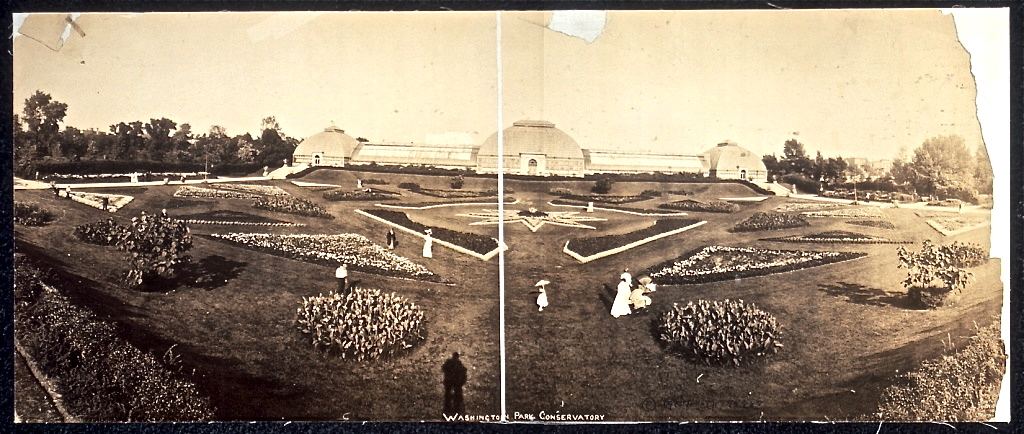
This 1907 picture of Victorian “bedding out” at the Conservatory in Washington Park seems at odds with Olmsted and Vaux’s original 1870 vision for the park in south Chicago, Illinois. (Their blueprint was destroyed in the Great Fire of 1871.) Olmsted designed a natural feel to the park, including a meadow surrounded by trees and maintained by grazing sheep.
The conservatory and ornate sunken garden were designed by D.H. Burnham & Co. and built in 1897. By the Great Depression, the building was too expensive to maintain and was torn down. The photo was by George R. Lawrence Co.
In this 1909 photo, Oxnard, California, still shows its roots as an agricultural boomtown. About 1897, local ranchers had thought that growing sugar beets would be profitable and had convinced Henry Oxnard to build a factory in the midst of the new fields. A town, with plaza, rapidly sprung up alongside it.
The city was incorporated in 1903, and by 1907, it even had a classically styled Andrew Carnegie library — which I think can be seen above the park about a third of the way from the photo’s left side, partly covered by a tree. The photo was taken by West Coast Art Co.
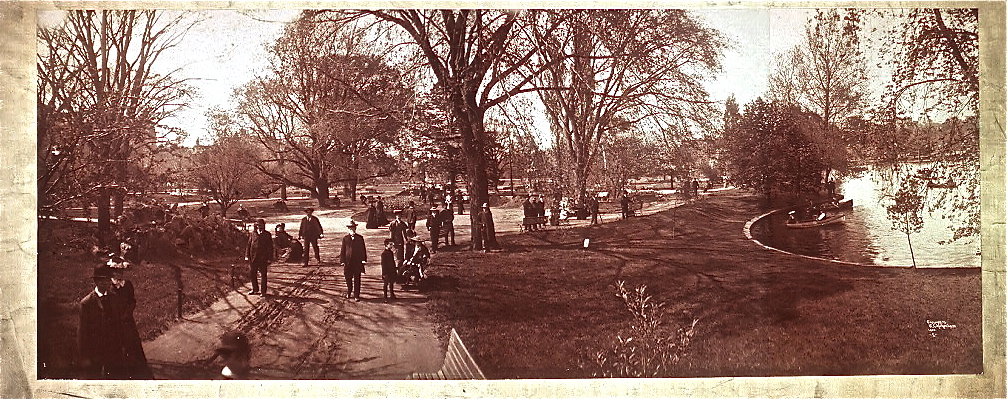
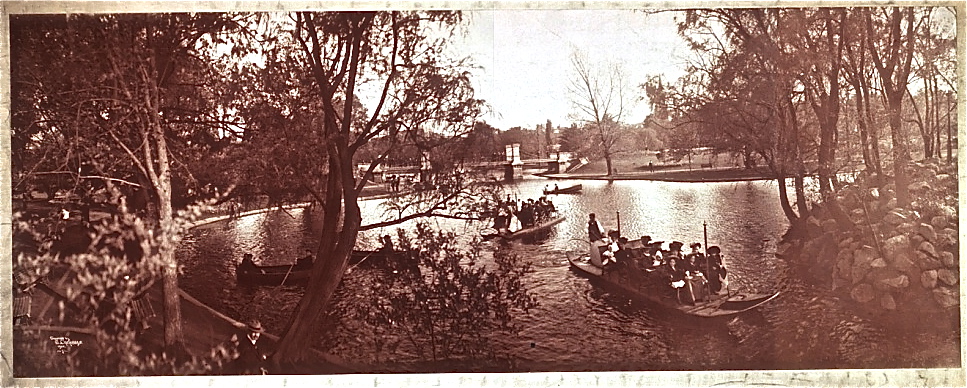
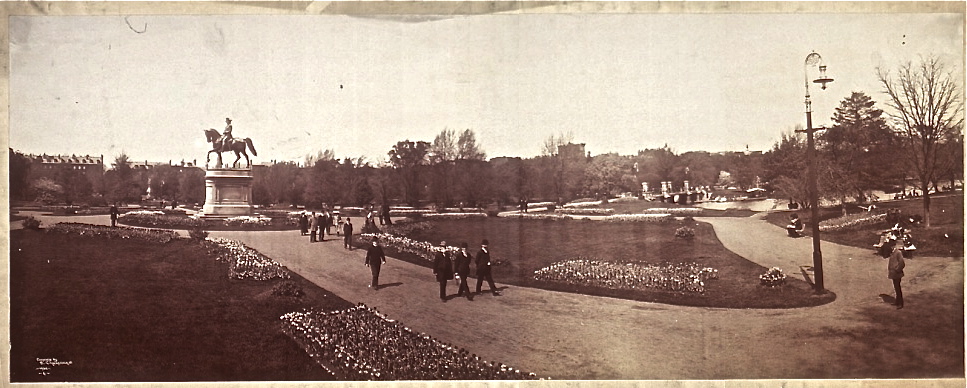
The Boston Public Garden, designed by George F. Meacham, was first proposed to the city fathers in 1837, but construction did not begin until the early 1860s.
It has always been an ornamental pleasure garden, famous for its flower beds, meandering paths, and swan pond and boats.
With the adjoining Boston Common, it forms the northern end of Olmsted’s great string of parks called the Emerald Necklace. The three photos above were taken c. 1904, by E. Chickering & Co.
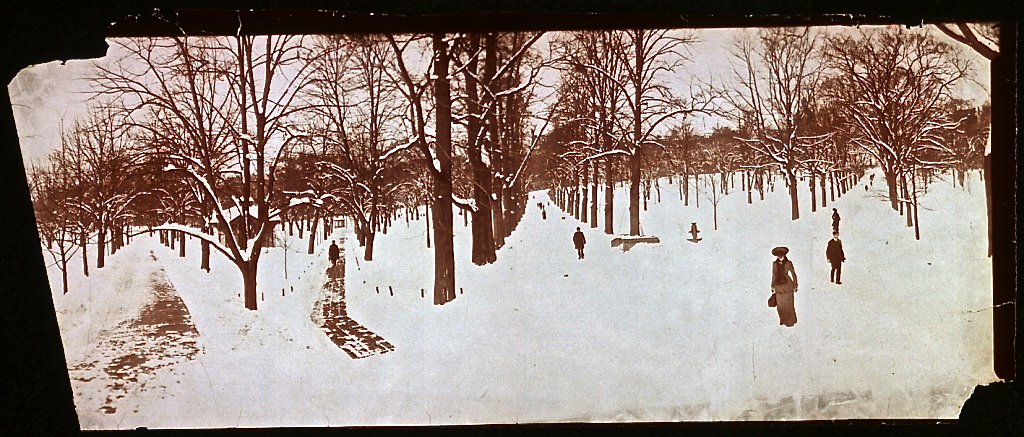
This snow scene taken of Boston Common, taken January 10, 1904, by E. Chickering & Co., has the feel of a post-impressionist painting.
The Common was a public livestock grazing space from 1634 to 1830. In 1836, it was enclosed by an ornamental iron fence, and its five perimeter malls or recreational promenades were completed. In contrast to the Public Garden, it is laid out with straight lines and open areas for recreation and public gatherings.
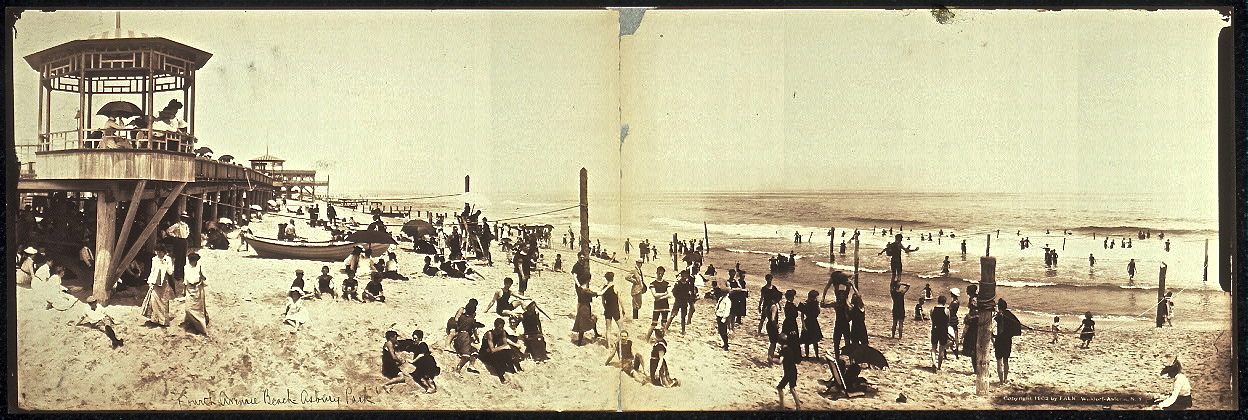
In the three decades after 1871, developers took Asbury Park, New Jersey, from a small seaside community to a residential resort of more than 600,000 vacationers. They built a boardwalk, orchestra pavilion, changing rooms, and a pier along its beachfront, as well as a number of grand hotels. The above photo by Benjamin J. Falk shows the Fourth Avenue Beach c. 1902.
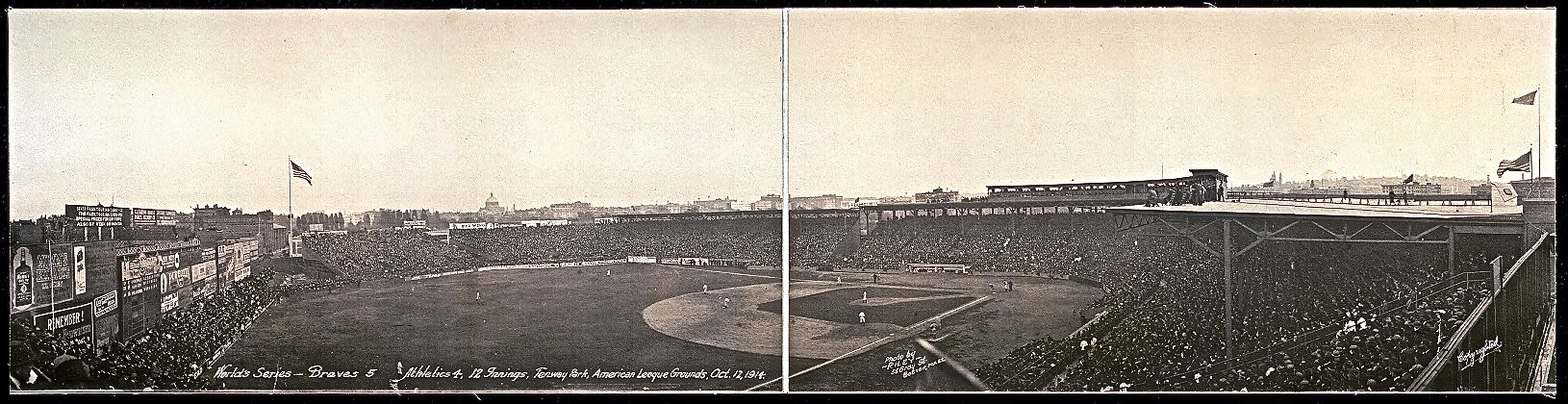
This photo shows another kind of Boston park, the American League Grounds at Fenway Park, and the World Series game of October 12, 1914. The score was [Boston] Braves 5 – [Philadelphia] Athletics 4 in 12 innings. The photo is by John F. Riley.
The first World Series had taken place ten years earlier, also in Boston, on what is now the campus of Northeastern University. A panoramic photo of one of those games is here.
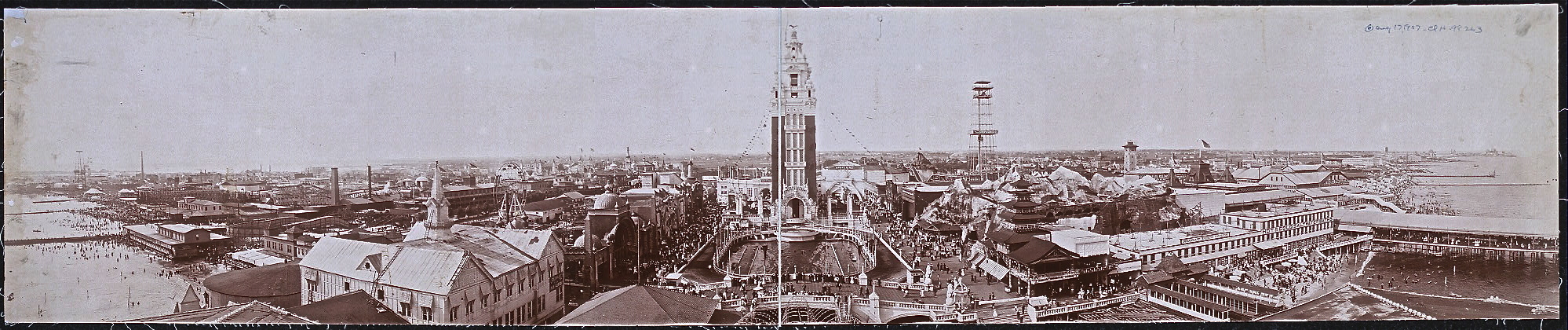
The above photo shows Brooklyn’s Coney Island and Luna Park (also known as Dreamland) around 1907. This picture and the one below were taken by Charles E. Stacy.
Luna Park was created by Frederick Thompson and Elmer Dundy and opened in 1903. There’s a very interesting history of the enterprise at this link.
By 1915, another inventor, Frederick Ingersoll, had opened Luna Parks all over the world, and the term “luna park” became a generic name for amusement parks. The blog Poemas del rio Wang features a series of photos of Paris’s Luna Park in 1910.
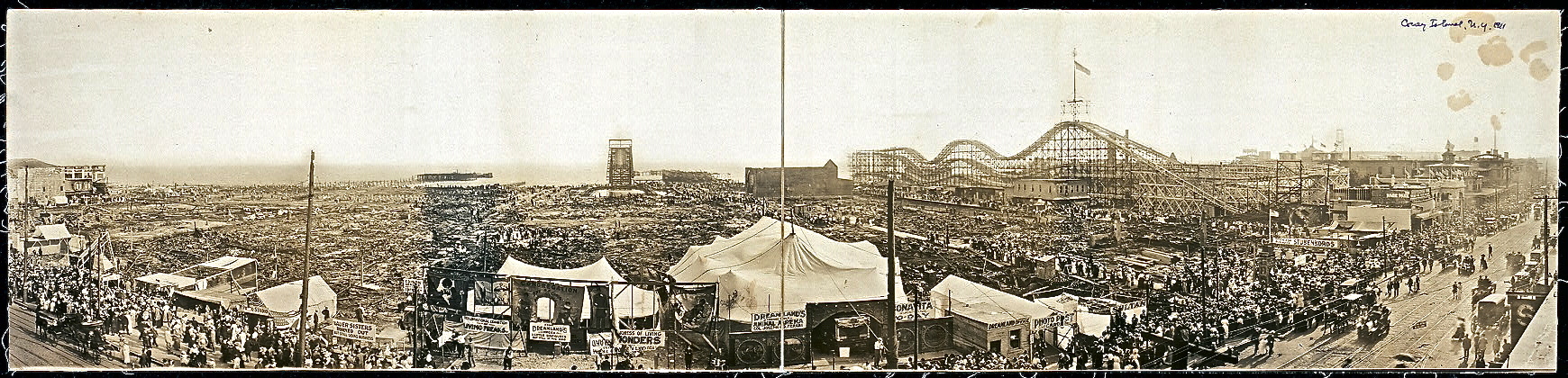
The above photo shows the destruction of part of the park after a fire on December 11, 1911.
We’ll take a trip up to the moon
For that is the place for a lark
So meet me down at Luna, Lena
Down at Luna Park.
— recorded by Billy Murray, 1905 (hear him singing it here)






![Flowers [cyclamen], c. 1898-1946.](https://i0.wp.com/enclosuretakerefuge.com/wp-content/uploads/2012/05/14021v.jpg?ssl=1 "14021v")
![Flowers [cyclamen], c. 1898-1946.](https://i0.wp.com/enclosuretakerefuge.com/wp-content/uploads/2012/05/10199v.jpg?ssl=1 "10199v")


![Flowers [wild garlic -- Allium ampeloprasum L.], c. 1898-1946.](https://i0.wp.com/enclosuretakerefuge.com/wp-content/uploads/2012/05/10205v.jpg?ssl=1 "10205v")


![Golden Gate and east wall seen through group of century plants [agave], c. 1900-1920.](https://i0.wp.com/enclosuretakerefuge.com/wp-content/uploads/2012/05/19021v.jpg?ssl=1 "19021v")




 enclos*ure