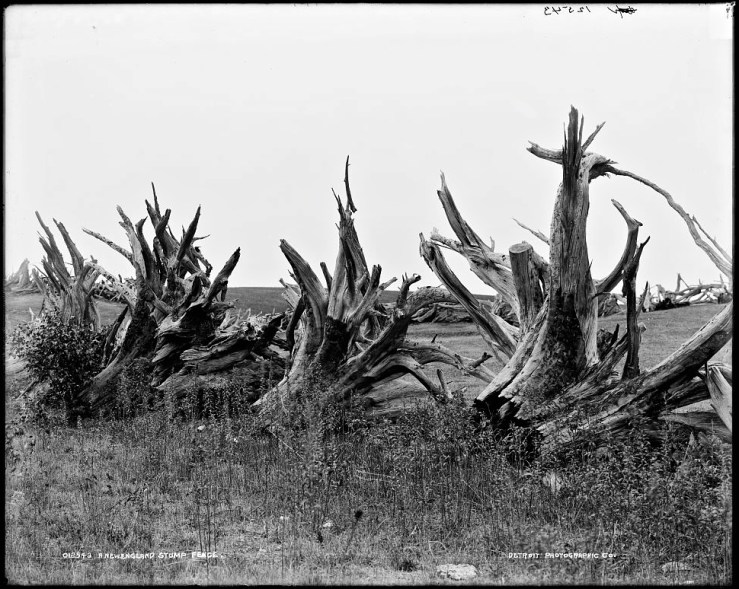
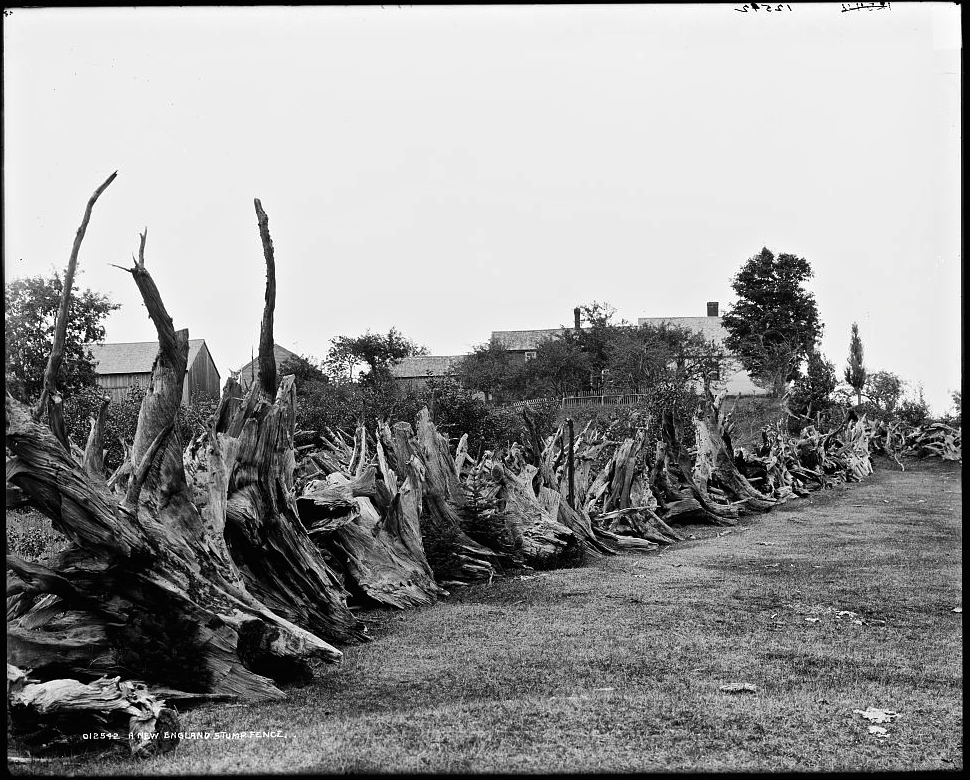
The stump or root fences on the Corner road remind me of fossil remains of mastodons, etc., exhumed and bleached in sun and rain.
— Henry David Thoreau, Journal (July 19, 1851)
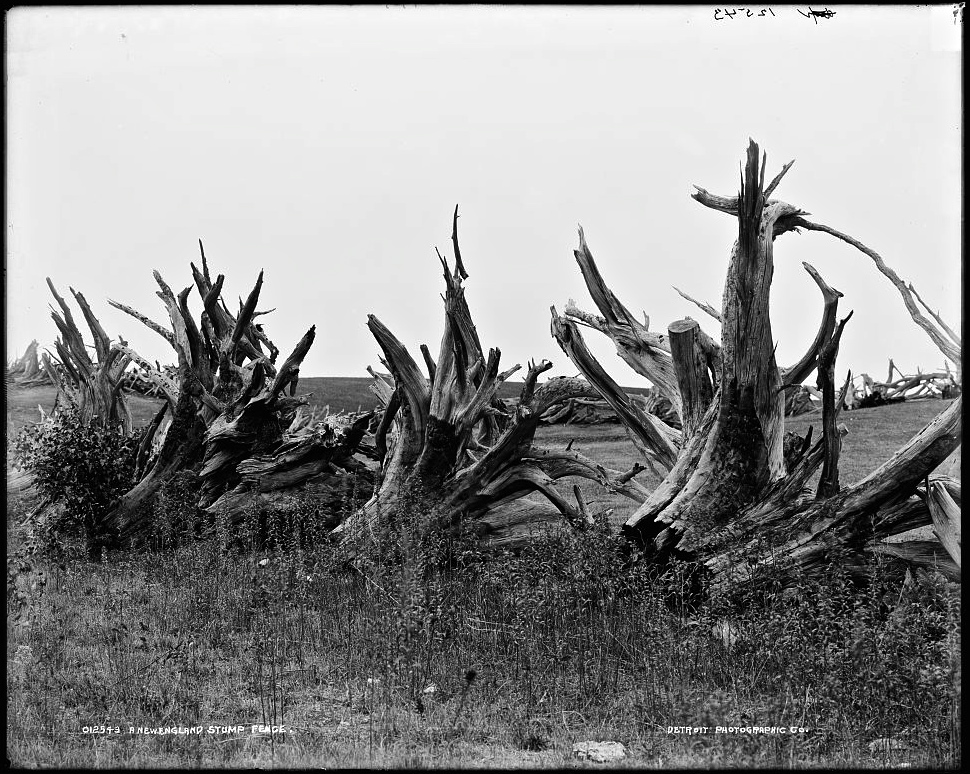
Both photos: “A New England stump fence,” ca. 1890-1901, by Detroit Publishing Co., via Library of Congress Prints and Photographs Division.

I had heard of ‘stumperies,’ but not of stump fences (sometimes called root fences), however now I’ve learned that . . .
[s]tump fences, as their name implies, were made by dragging the stumps of trees to the edge of a field and placing them side by side, with their interlacing roots facing outward and their trunks inward. In the days when “ugly as a stump fence” was a simile in common usage, the stump fence had its critics, but in 1837 one observer called it “a singular fence…needing no mending, and lasting the ‘for ever’ of this world.” “The devil himself couldn’t move a stump fence,” farmers used to say, an opinion borne out by the fact that stump fences well over a hundred years old can still be seen in parts of Canada and in the Midwest.
Stumps were often the product of the first clearing of the land, but stump fences didn’t appear in the first generation of a settlement’s fences because stumps need to sit in the ground for six to ten years before they are loose enough to be pulled out and hauled away. Extracting even a loosened stump was never easy; it required oxen and strong chains, something that many settlers lacked at first. In the 1800s, stump pulling would become a cash business and one way that a man could make a good living. Twenty-five cents a stump was the standard price in 1850 when men operating such mechanical stump pullers as the “Portable Goliath,” “The Little Giant,” and “Roger’s Patent Extractor” could extract from twenty to fifty stumps a day.
–Susan Allport, Sermons in Stone: The Stone Walls of New England and New York (older edition here)
Quotes via the blog Laudator Temporis Acti.
I’m traveling for the next couple of weeks, but I’ll be posting a ‘vintage landscape’ from time to time.

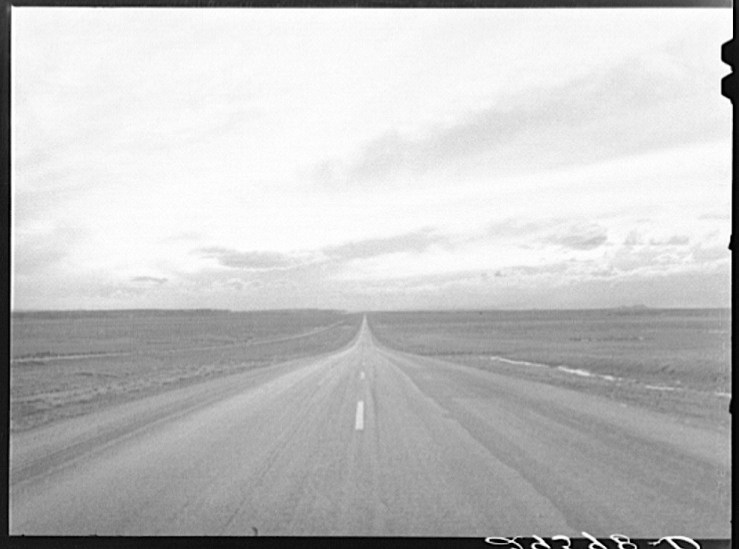 “Highway U.S. 30, Sweetwater County, Wyoming” by Arthur Rothstein, March 1940, via Library of Congress Prints and Photographs Division.

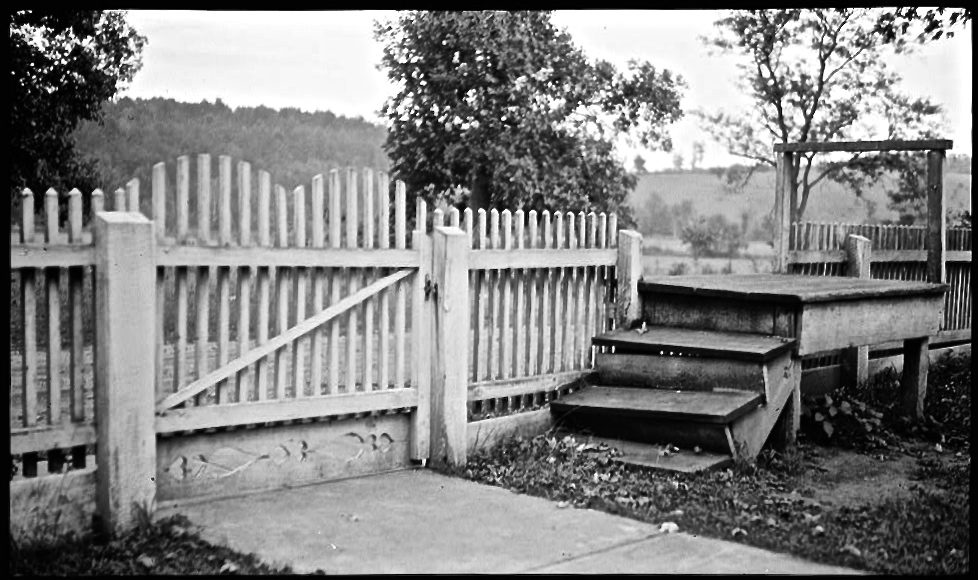

 enclos*ure