The Sunday porch: Leushinskii Monastery

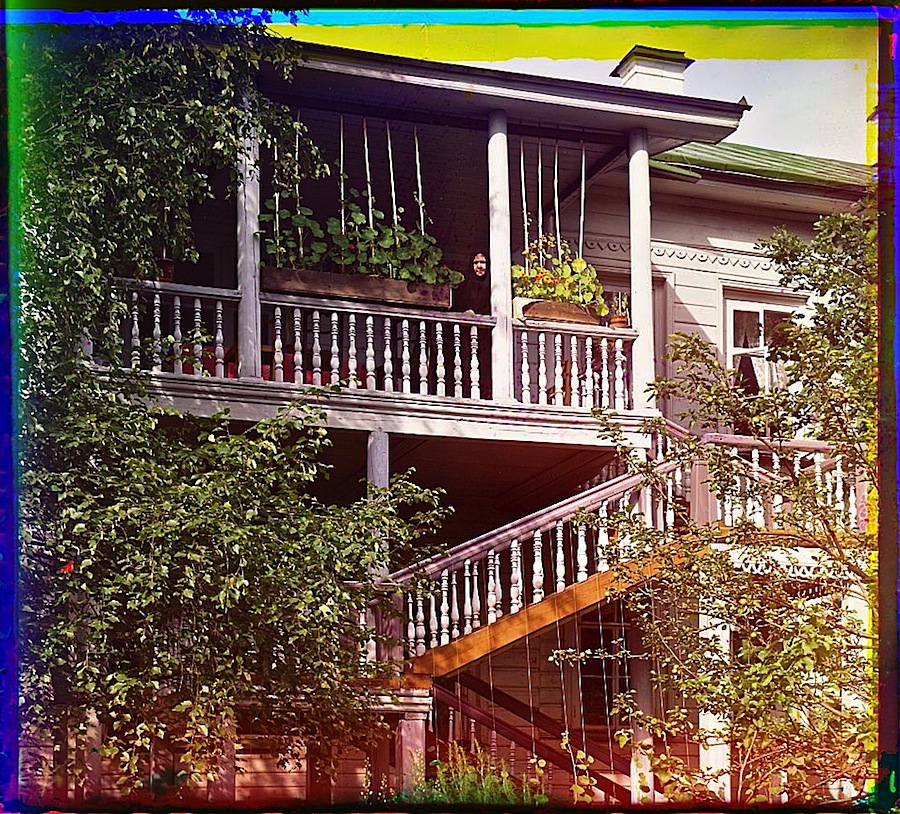
20996v“Mother Superior Taisila on the veranda, Leushinskii Monastery” in 1909, by Sergei Mikhailovich Prokudin-Gorskii, via Library of Congress Prints and Photographs Division.

The monastery was (and possibly still is) in Leushina, in the Tver (or Tverskaya) Oblast of Russia — between St. Petersburg and Moscow.

Prokudin-Gorskii made early color photographic surveys of the Russian Empire between 1905 and 1915. The Library of Congress purchased his collection of 2,607 images from his sons in 1948.
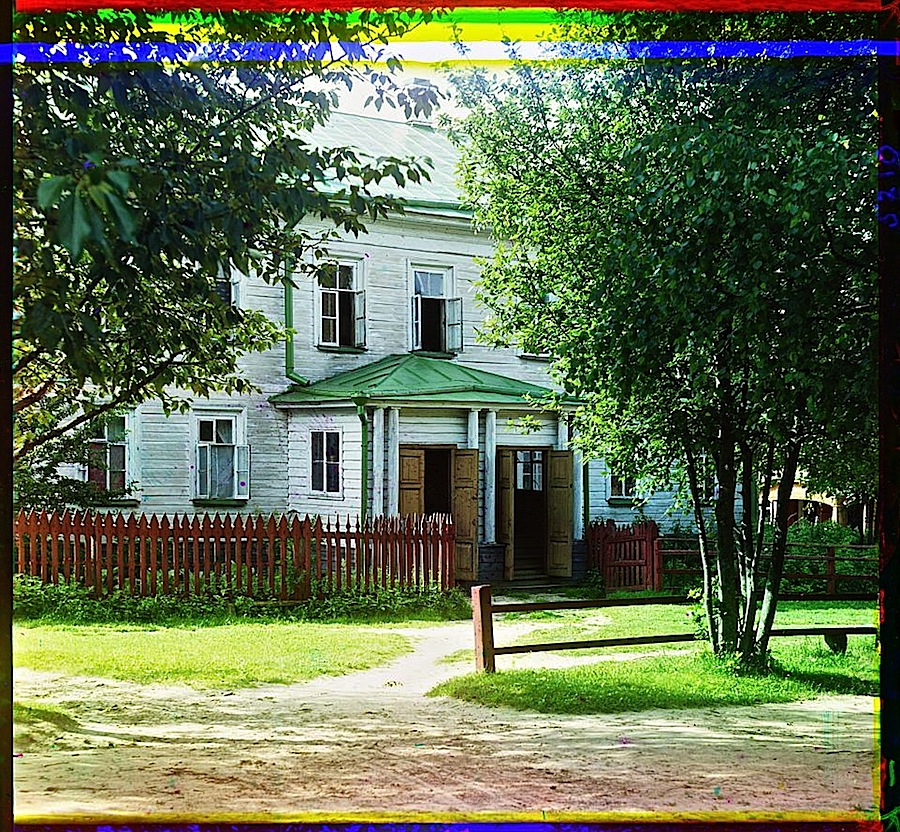
21002v“Residence for the sisters of the Leushinskii Monastery.”
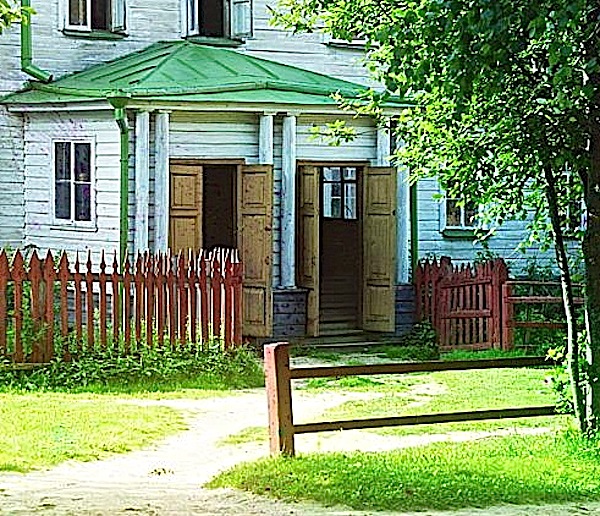
21002vdetailDetail above:  the interior steps start right at the door frame.
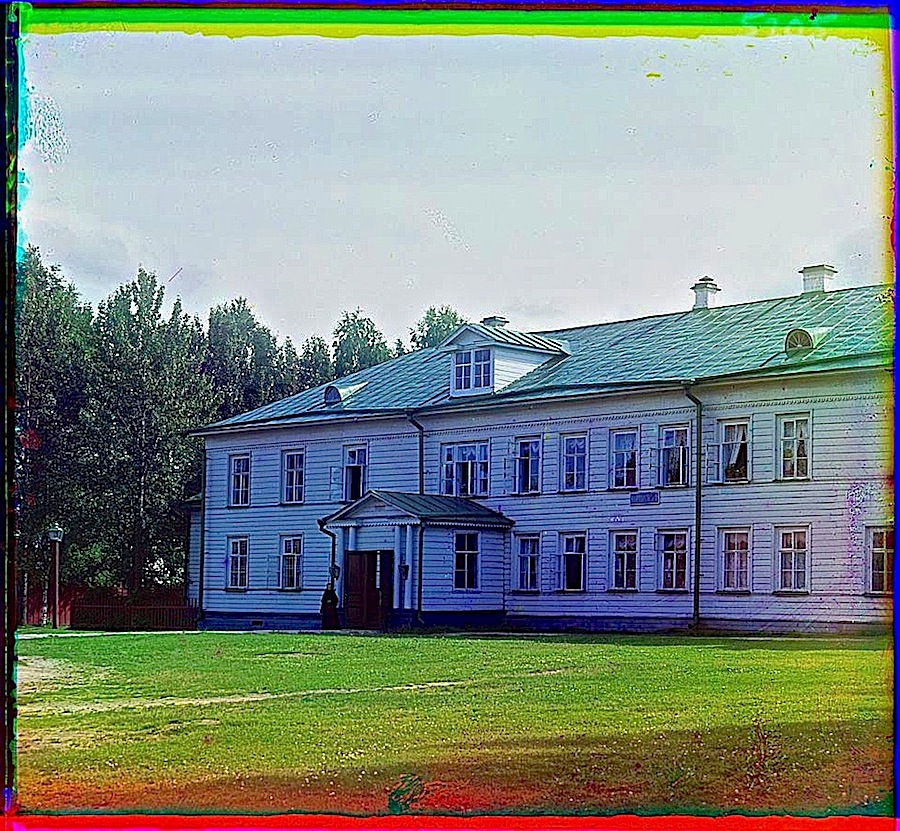
20997v“Residence of the Mother Superior.” All photos here by Prokudin-Gorskii, via the Library of Congress.

You can scroll through larger images by clicking on ‘Continue reading’ below and then on any thumbnail in the gallery.

Everything that slows us down and forces patience, everything that sets us back into the slow circles of nature, is a help.  Gardening is an instrument of grace.

May Sarton


Vintage landscape: The Kittatinny

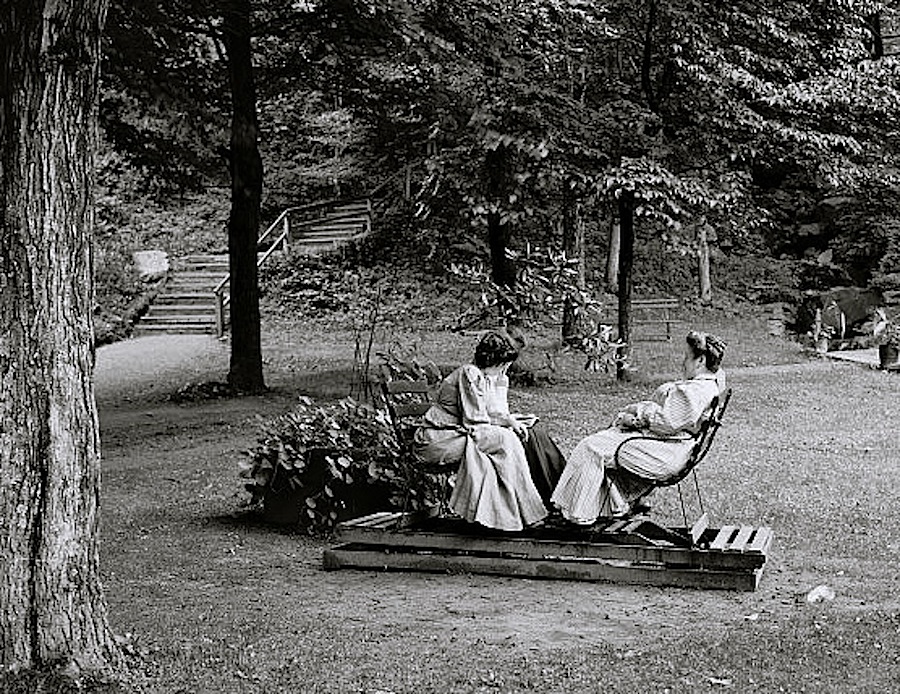
The Kittatinny, Delaware Water Gap, Pa., c. 1905, via Library of Congress/enclos*ure“In the grounds of The Kittatinny, Delaware Water Gap, Pa.,” c. 1905, by Detroit Publishing Co. via Library of Congress Prints and Photographs Division.

What a pleasant spot. What do you think they’re talking about?
detail: The Kittatinny, Delaware Water Gap, Pa., c. 1905, via Library of Congress/enclos*ure

The Kittatinny was the first of the resort hotels at Delaware Water Gap in the Poconos Mountains — opening in 1832. In its heyday in the early 20th century, it could accommodate hundreds of guests.

The Kittatinny, Delaware Water Gap, Pa., c. 1905, via Library of Congress/enclos*ure

The hotel burned down in 1931. Some of the foundation is still visible, as well as a stream that used to run through the basement kitchen, according to a National Park Service newsletter.

Vintage landscape: two trees

Vintage landscape: Bartram's old tree, c. 1908, Philadelphia, Pa./enclos*ure“Old tree in Bartram’s Park [sic], Philadelphia, Pa.,”  by Detroit Publishing Co. via Library of Congress Prints and Photographs Division.

I can’t find out why this apparently dead tree was fenced off so nicely in Bartram’s Garden in about 1908.  Does anyone know?

Bartram’s is the oldest surviving botanic garden in North America.  It was founded in 1728 and became a city park in 1891.

This photo made me think of the Tree of Ténéré, an acacia that was famous for being the only tree for 250 miles on the cavavan routes through the Sahara Desert in northeast Niger.  In 1973, a drunk truck driver managed to knock it down.

Arbre-du-tenere-1961
The tree in 1961. Photo by Michel Majeau, via Wikimedia Commons.

The dead tree was moved to the National Museum of Niger in Niamey later that year — where it was given its own pavilion.  I saw it there several years ago.

The trunks of the fallen tree in its pavilion in the museum in 1985. Photo by Holger Reineccius, via Wikimedia Commons.
The tree at the museum in 1985. Photo by Holger Reineccius, via Wikimedia Commons.

A metal sculpture of the tree was erected at its old location.   (There are more photos  here.)

One must see the Tree [of Ténéré] to believe its existence. What is its secret? How can it still be living in spite of the multitudes of camels which trample at its sides. How at each azalai does not a lost camel eat its leaves and thorns? Why don’t the numerous Touareg leading the salt caravans cut its branches to make fires to brew their tea? The only answer is that the tree is taboo and considered as such by the caravaniers. . . .  The Acacia has become a living lighthouse; it is the first or the last landmark for the azalai leaving Agadez for Bilma, or returning.

— Michel Lesourd, Commander of the Allied Military Mission of the Central Service of Saharan Affairs after he saw the tree in 1939

After the rain

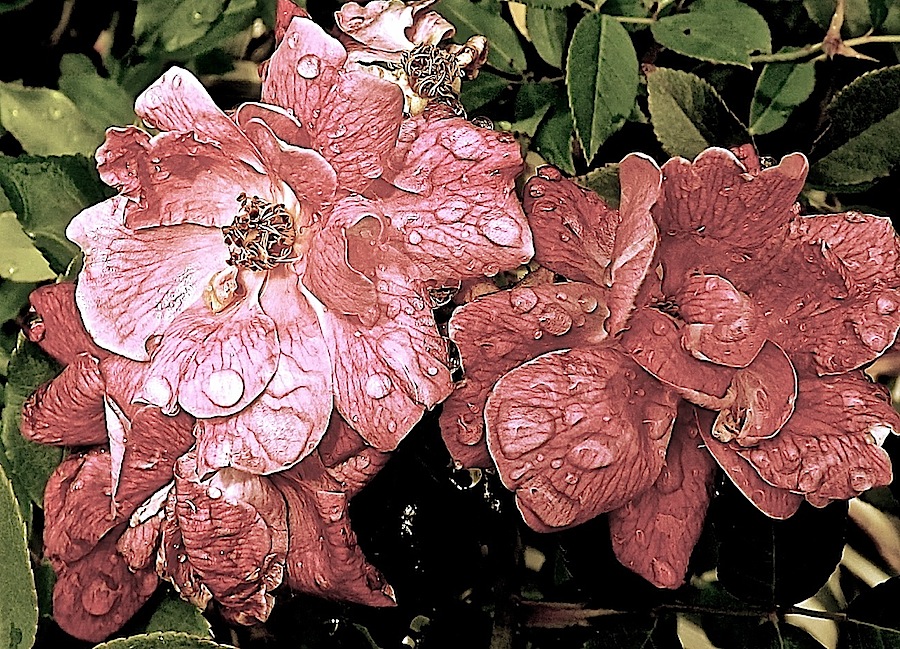
Pink rose in the rain/enclos*ure. . . this morning.

In my Autumn garden I was fain
To mourn among my scattered roses;
Alas for that last rosebud that uncloses
To Autumn’s languid sun and rain
When all the world is on the wane!

— Christina Rossetti, from “An October Garden”