Snapshots: Istanbul

After visiting Prague, we spent Christmas Eve, Christmas, and Boxing Day in Istanbul. It was wonderful, of course, as everyone said it would be.

Here are some snapshots and a few travel tips.

This slideshow requires JavaScript.

(If you would like to scroll through larger versions of the images, click on ‘Continue reading’ below and then on any thumbnail in the gallery.)

We took a taxi from the airport to our hotel.  Going on public transportation would have involved a bus and then a tram.  It sounded do-able, but would have taken about an hour and a half, and we arrived rather late in the day.

We stayed at the Hotel Ibrahim Pasha, which I loved for its tasteful, comfortable decor and the thoughtful approach of its staff.  It’s a small place on a side street along the south side of the Museum of Turkish and Islamic Art, steps from the Hippodrome and the Blue Mosque.  Downstairs in front of the sofas, the fireplaces were lit all the time.  Books were everywhere.  The standard rooms are very small (think Paris small), but well designed. Breakfast was delicious.

We practically levitated off the bed every morning at about 6:00 a.m. when the call to prayer began, but I enjoyed it — and also listening to the sunset call from the rooftop, while looking at the Blue Mosque and the Sea of Marmara. Upon arrival, the hotel provided us with a map and their own lists of recommended restaurants, shops, and walking routes.  Everything we tried was excellent.  They also have their own app for iPhone and Android.

Really, if I ever run away from home, you will find me at the Hotel Ibrahim Pasha.

We really enjoyed the food at Khorasani,* a kebab restaurant very near the hotel.  We had dinner there twice (the kebabs “marinated” in pistachios were my favorite).  In Karaköy, the wharf area just to the east of the north end of the Galata Bridge, we had a lunch of mezes at Karaköy Lokantasi. It has a decor “reminiscent of the Turkish Republic of the 1930s,” in the words of the Ibrahim Pasha.

When eating in Sultanhmet, have your hotel make you reservations at your chosen restaurants, so that when you are lost, and the waiters of all the other eateries are trying to pull you in, you can say, “Sorry, we have reservations.”  Then, they will kindly guide you.

[Addendum:  If you are vegan or vegetarian, you might appreciate this guide to eating in Istanbul.]

Do buy your Turkish Delight candy** at a stall in the Spice (Egyptian) Market (rather than pre-packaged at the airport), so that  it will be fresh and you can choose the flavors (and taste samples). The best of it is so good. Get the kind made with honey and flavored with pomegranates, cherries, or pistachios.  We bought some rolled in chopped rose petals. (The merchants can vacuum seal your boxes.)

The only guidebooks we bought before leaving home were the e-book versions of DK’s Top 10 Prague and Top 10 Istanbul.  I think they were 99¢ each, which was about right.  After perusing the shelves at the hotel, I would recommend Istanbul: Memories and the City (a personal memoir) by Orhan PamukIstanbul’s Bazaar Quarter: Backstreet Walking Tours by Edda Renker Weissenbacher and Ann Marie Mershon, and Strolling Through Istanbul: The Classic Guide to the City by Hilary Sumner-Boyd  and John Freely.

Cornucopia magazine and its blog are also interesting.  There are some beautiful old photographs of Istanbul by Pierre Loti in a recent post, here.

When necessary, we had no problem finding people who spoke English or signs in English.


*Khorasani is at Divanyolu Caddesi Ticarethane Sokak, No. 39/41 Sultanahmet. Karaköy Lokantasi is at Kemankes Caddesi 37/A, Karaköy.
** I think it’s actually a requirement of your visa that you take home several boxes.  You will see crates of it at the airport.
Continue reading “Snapshots: Istanbul”
Vintage landscape: Lafayette Square

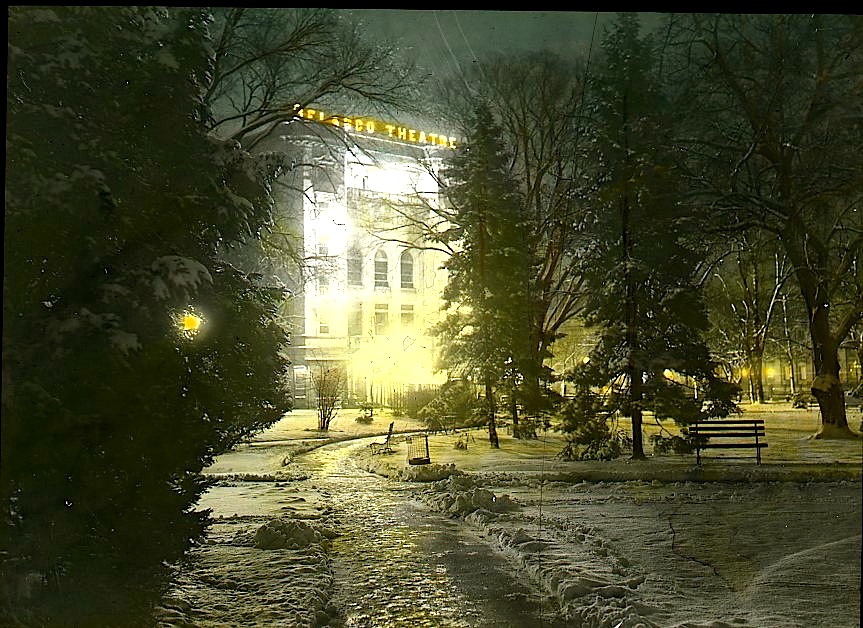
Lafayette Square, Washington, DC, via DCPL Commons on flickr “The Belasco Theatre as seen from Lafayette Square, ca 1910,”  via the D.C. Public Library Commons on flickr.  The photographer is not noted.

The Washington, D.C., theater was called the Lafayette Square Opera House when it was built in 1895.  It was renamed the Belasco in 1905.  In 1962, it was demolished to make way for the U.S. Court of Claims building.

Come see the north wind’s masonry.
Out of an unseen quarry evermore
Furnished with tile. . .
To mimic in slow structures, stone by stone,
Built in an age, the mad wind’s night-work,
The frolic architecture of the snow.

— Ralph Waldo Emerson, from “The Snow-Storm


Snapshots: Prague

We spent the week before and just after Christmas in Prague and Istanbul this year. In recent years, we’ve found that we like traveling during the cold-weather months, when the streets, museums, and restaurants are so much less crowded.

I loved the low, slightly hazy light in both cities (OK, I live near the equator the rest of the time).  And although the temperatures were between about 27°F and 40°F  (-3°C to 4°C), there was practically no wind and no rain or snow.  Maybe we were very lucky, but honestly, I’ve been colder in Amsterdam in July.

Below are some snapshots and a few travel tips for Prague.  Do not adjust your set:  with some pictures I got a bit carried away with the ‘Effects’ buttons on iPhoto.

This slideshow requires JavaScript.

(If you want to scroll through larger versions of the images, click on ‘Continue reading’ below and then on any of the thumbnails in the gallery.)

At the airport, just before you exit for the bus area, you will find a booth selling public transportation tickets.  We bought 3-day passes for about $15 each. They allowed us unlimited use of the metro (subway), bus, and tram lines.

If you like, you can take the 119 bus from the airport to the end of its line at Dejvicka (about 30 minutes) and then transfer to the green metro A  line.  (You could also buy tickets on a private bus line that will take you to any hotel in the Old City area.)

We stayed at the Courtyard Marriot (collecting points), which was not very atmospheric, but comfortable and the staff were friendly.  The hotel is in the neighborhood of Zizkov and is very convenient to the green metro line and tram lines to the Old City.

It is also near the huge and interesting Olšany Cemetery (1680 to today) — which you will find if you accidently walk in the opposite direction of the Old City, which we did first thing for about a half mile.

For some reason, we never chose the right direction in Prague, and we were lost just about every minute in the Old City and the Mala Strana.  This was not very important as those parts of the city are relatively small.  Eventually, we would stumble over the right tram line (and then take it going the wrong way).

(If the Prague tourism office is reading: “you are here” maps placed on the streets about every 5 or 6 blocks would be great.)

English is widely spoken in the parts of Prague where a visitor is likely to be, and there are signs in English everywhere.

We just wanted to wander around for two days enjoying the old architecture and the Christmas markets,* so the only museum we visited was the Prague City Museum.  My husband wanted to see the 19th century model of the city, which was remarkable — especially because they show a short 3D  movie where the camera “flies” over the town.  It’s a rather sleepy attraction, but I loved it.

The Czech food we ate was, well, filling.  Our meals consisted of a big piece of pork or duck, braised cabbage (very good), and potato and bread dumplings. Bread dumplings are really just steamed white bread.  The potato dumplings were something like gnocchi.  I can’t recommend any particular restaurants.

There were classical music concerts in churches all over the Old City.  We went two nights in a row to the 12th century St. Martin in the Wall Church to listen to, first, organ and violin and a soprano and, then, a string quartet.  The 5:00 p.m., one-hour performances were of a very high quality for about $25/ticket. Brochures** about these concerts are available all over town and at hotels.

There is a little more on the sidewalks of Prague here.

Next:  Istanbul.


* I bought small, 1″ to 2″ traditional Czech glass ornaments for about $2.50 to $3 each; they all made it home intact.

** The venue was advertised as “heated.”  I would say the translator did not fully understand the word.  We kept our coats on but were happy nonetheless.

Continue reading “Snapshots: Prague”

Vintage landscape: the capitol and the conservatory

Botanical garden at the CapitalThe U.S. Botanic Garden, 1917, by Harris & Ewing, via Library of Congress Prints and Photographs Division.

The conservatory will be decorated for the holidays through January 5.

I wish you a very happy 2014.

“. . . Botanic Goddess! bend thy radiant eyes;
O’er these soft scenes assume thy gentle reign,
Pomona, Ceres, Flora in thy train;
O’er the still dawn thy placid smile effuse,
And with thy silver sandals print the dews;
In noon’s bright blaze thy vermil vest unfold,
And wave thy emerald banner starr’d with gold.”

Thus spoke the Genius, as he stepp’d along,
And bade these lawns to Peace and Truth belong;
Down the steep slopes he led with modest skill;
The willing pathway, and the truant rill,
Stretch’d o’er the marshy vale yon willowy mound,
Where shines the lake amid the tufted ground,
Raised the young woodland, smooth’d the wavy green,
And gave to Beauty all the quiet scene.—

Erasmus Darwin, from  “The Botanic Garden”

Vintage landscape: the sunken garden

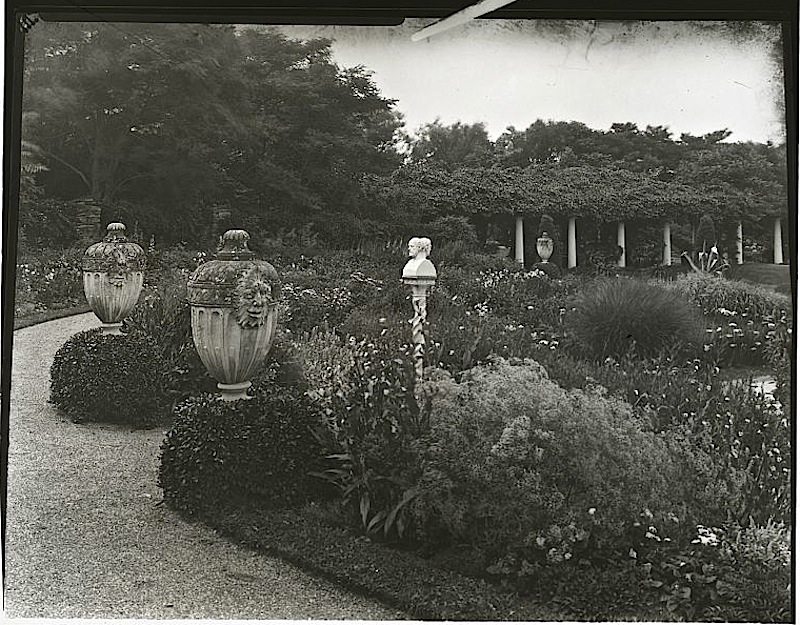
Vintage landscape/enclos*ure: sunken garden, Hammersmith Farm, 1917, by F.B. Johnston, via Library of Congress. . . at Hammersmith Farm, Newport, Rhode Island, 1917, by Frances Benjamin Johnston, via Library of Congress Prints and Photographs Division.

Vintage landscape/enclos*ure: sunken garden, Hammersmith Farm, 1917, by F.B. Johnston, via Library of CongressThe pergola overlooking the sunken garden. The hand-colored lantern slide is also by Johnston from 1917.

The house, originally on 75 acres, was built for the great-grandfather of Jackie Kennedy’s stepfather.  She lived there during her childhood, and her wedding reception was held there.

The garden at the time of the photo had been designed about 7 years before by James Frederick Dawson and Henry Hill Blossom of Olmsted Brothers. Today, the house still stands, but the garden is not the same, according to the Library’s online catalogue.