
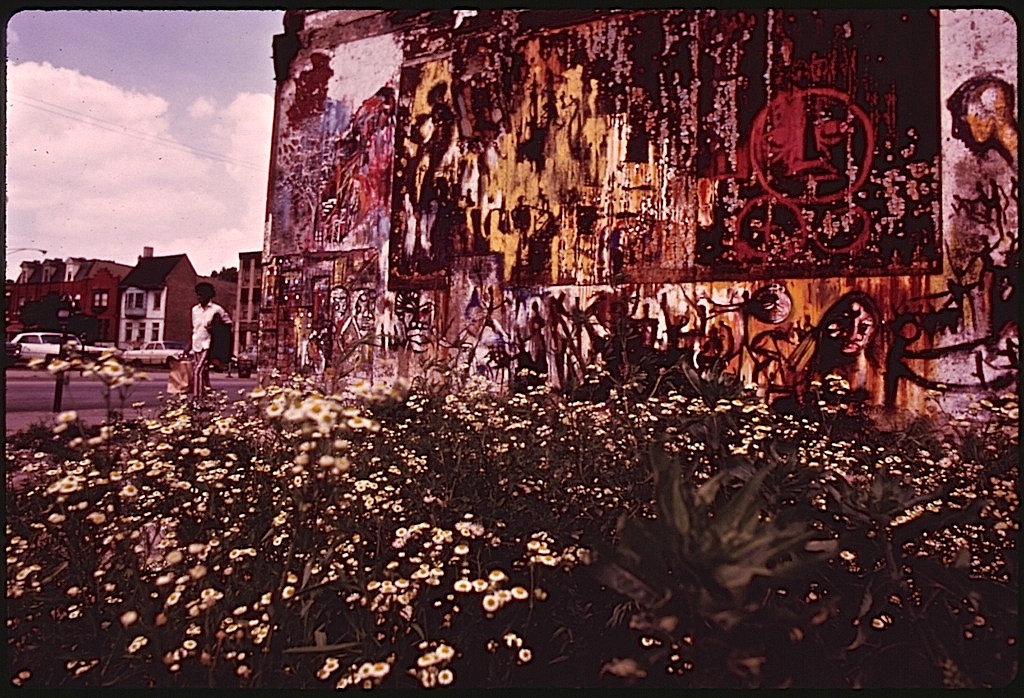
I believe L’ESSENZIALE, inscribed at the top, refers to a song written and sung by Marco Mengoni. Translated into English, one verse says:
As the world falls into pieces
I craft new spaces and needs
That belong to you too
You, whom I believe to be the ESSENTIAL
“L’essenziale” was Italy’s third best selling single of 2013. It came in seventh at the 2013 Eurovision Song Contest.
Visiting Naples
We were on vacation in Italy last week, spending two nights in Naples.
The city has a reputation and a reality that puts off many tourists, but I have to say, I loved it and wished that we could have stayed another night.
I liked the sense of theater in its architecture and that its narrow lively streets made me think of Morocco and Istanbul, as well as Caracas and Havana. And everywhere we looked, there was something wonderful to eat.
Added to that, we saw relatively few other tourists and no American food franchises.
While we were there at least, it was no more littered than Rome (granted, not really high praise). We saw many patrolling police officers and had no crime problems (except for a pickpocket attempt while getting on the Circumvesuviana commuter train).*
The sights
This living medieval city is its own best sight.
— Rick Steves
We are very low-achieving tourists, taking the flâneur approach. We spent most of our time walking along the little streets of the Spagnoli and Spaccanapoli (centro storico) neighborhoods. We also took the funicular up to Petraio for panoramic views of the city and Mt. Vesuvius — particularly good from the entrance to Certosa di San Martino.
The only museum we visited was the National Archeology Museum, which houses many of the frescoes and other artifacts from nearby Pompeii. This was essential preparation for a visit to the site, which took more than half a day of our stay in Naples.
If you arrive at the museum after lunch, don’t be disappointed if many of its galleries are closed off and dark. They will open a little later. The museum does not have the funds to keep all the rooms open during the lunch hours. (It’s closed entirely on Tuesdays.)
If we had stayed another day or two, I would have visited the Capodimonte, some churches in Spaccanapoli (particularly the Cappella Sansevero with its “veiled Christ”), and maybe the National Museum/Monastery of San Martino. There are also a number of interesting underground sites, but I don’t do well with underground.
Hotel
We stayed at the Chiaja Hotel de Charme on Via Chiaia, a pedestrian shopping street on the edge of the well-to-do Chiaia (or Chiaja) neighborhood.
The hotel is 27 rooms on the second floor of a multi-story apartment building with a central courtyard. Don’t panic if you come back from dinner and find the building shut up like a fortress. Push the hotel’s doorbell (on the panel to the left), and the front desk will buzz you in through a tiny door set into the huge main doors. The hotel is attractive, quiet, and comfortable in a traditional style. The staff was very helpful, and the breakfast was good (sfogliatella, fruit, yogurt, cereal).
The hotel is an easy walk to the waterfront and to Via Toledo, a north-south (partly pedestrian) street, which runs from the Piazza del Plebiscito — between the historic neighborhoods of Spagnoli and Spaccanapoli — to the National Archeology Museum (a little over a mile-long walk). It is also about a half mile to a subway stop on the line to the main train station.
(I got a better room rate on Expedia.com, by the way, than on the hotel’s own website, so check both.)
Restaurants
We wanted to eat our dinners fairly close to the hotel, so the staff directed us to Pizzeria Mattozzi (on Via G. Filangeri) and to Umberto (on Via Alabardieri). Both were excellent, and both serve traditional Napoli dishes, including pizza. We also enjoyed lunch one day at Hosteria Toledo on Vico Giardinetto in Spagnoli.
*We generally felt quite safe, but do carry a well-zipped crossbody bag. (Men might like one of these.) Avoid empty, dark side streets (well, they are all rather dark, but most are full of working or strolling people). I would only enter or leave the train station by the main Piazza Garibaldi entrance and only during daylight hours.

 enclos*ure