Life in gardens: for the birds

birdhouse-competition-winners-washington-dc-library-of-congress
“Birdhouse Group,” 1922, by National Photo Company, via Library of Congress Prints and Photographs Division (all pictures here).

I’m not certain, but I believe this happy group of young designers/builders were Washington, D.C., schoolchildren taking part in an annual “American Forestry Association National Bird House Contest.”

The Library of Congress  has a set of 1921 photos  labeled as such (and also as “bird house story”). You can scroll through them by clicking on any thumbnail in the gallery below.

Unfortunately, I could find almost no other information about the competition. Today, the American Forestry Association is known as American Forests. Their website does not mention the event.

The event must have continued until at least April 15, 1924, when Senator George W. Pepper made the presentation on the Capitol grounds.

Sen. Pepper, Birdhouse Contest, 1924, Library of Congress

Vintage landscape: gourds and cans

Gourd and Can birdhouses, via Library of Congress“Typical birdhouses, gourds and tin cans in Coffee County, Alabama,” April 1939, by Marion Post Wolcott, via Library of Congress Prints and Photographs Division.

Hanging clusters of gourd birdhouses for the purpose of attracting purple martins is an Alabama folk tradition, according to the blog Appalachian History.

Choctaw and Chickasaw gardeners began the practice.  The purple* martins would eat damaging insects and mosquitoes and drive away crows and blackbirds from the corn.  

Farmers of European and African origins later adopted the custom, particularly as the birds also protect chickens by scaring away hawks.

The gourds should be hung in groups of 10 or more, according to the National Wildlife Federation’s blog.  They should also swing from crossbars and wires on poles at least two-stories high.


*They are actually dark blue and black, or pale grey.

Vintage landscape: birds’ house view

Farmhouse birdhouse, via Library of Congress“Birdhouse and landscape at an old plantation home [probably this one] near Eutaw, Alabama,” May 1941, by Jack Delano, via Library of Congress Prints and Photographs Division.

Farmhouse birdhouse 2, via Library of Congress

As I was reading about the history of birdhouses, I learned that shelters like the one above, which mirror a builder’s own house or other nearby architecture, were common in Turkey from the 15th century (and probably earlier).

Their compassionate purpose was to provide winter protection to non-migratory birds.  Many were quite ornate and built right onto the sides of “mosques, madrasas, libraries, houses, inns, baths, tombs, bridges, churches, synagogues, and even palaces,” according to the Turkish Cultural Foundation website.*

In Europe, during the same period, birdhouses were built from baskets, wood, and clay as traps for collecting eggs or for capturing the birds themselves.

In colonial-era North America, both Native Americans and European settlers used birdhouses to attract and increase the local bird population for hunting and insect control.

Pines in the distance begin to brighten,
deep blue to something like green.

Everything winged must be dreaming.

Susan Ludvigson, from “Grace


*There is also a nice photo here of the very large birdhouses that were placed in Istanbul parks in the 1960s. Last December, I saw many small birdhouses in the trees along the Hippodrome, put there by the local government.

The Sunday porch: small house

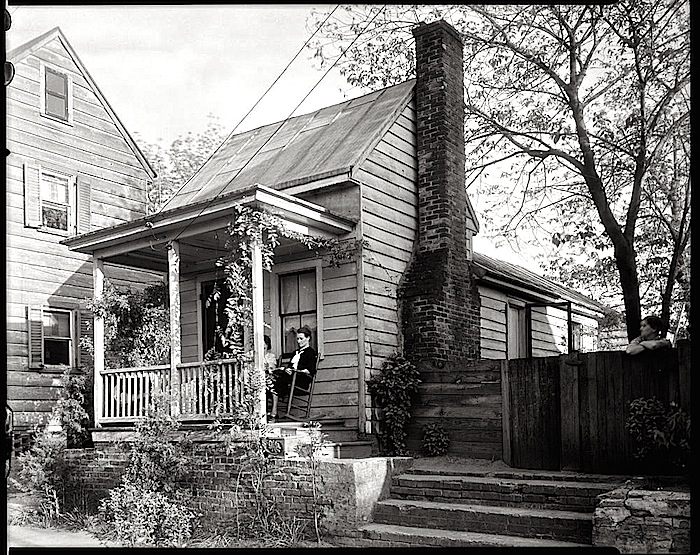
Wide enough for two rocking chairs, at least. . .

Small house, via LoCNew Bern, North Carolina, 1936, by Frances Benjamin Johnston, via Library of Congress Prints and Photographs Division.

Vintage landscape: sunflowers

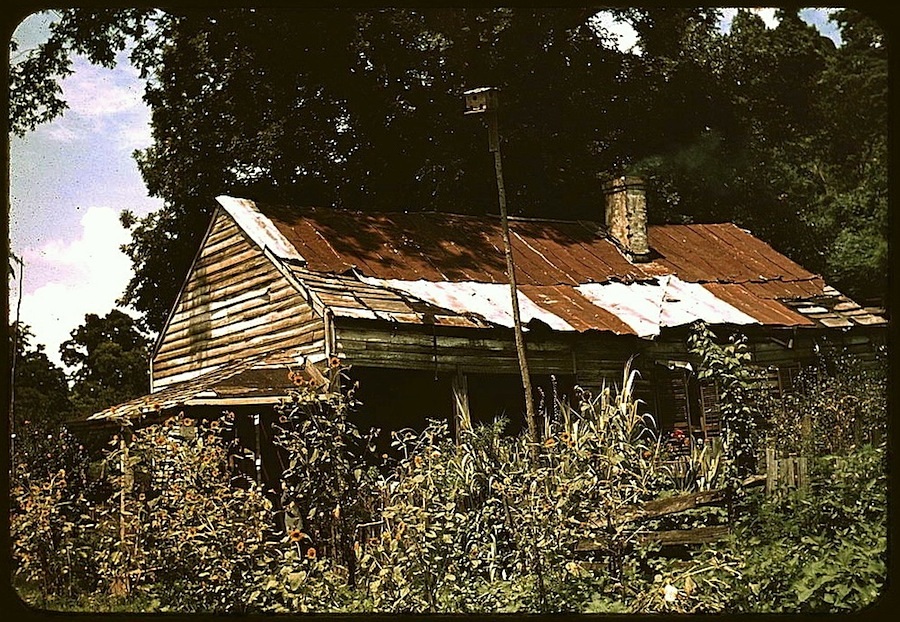
Miss. house surrounded by sunflowers, via LoC“An old house almost hidden by sunflowers, Rodney, Mississippi,” July 1940, by Marion Post Wolcott on Kodachrome color film, via Library of Congress Prints and Photographs Division on flickr.

I like the little birdhouse on the very tall pole.

Rodney was once a prosperous port on the banks of the Mississippi — until a large sand bar appeared  in the 1870s and changed the course of the river. The city was left two miles from the water.

By 1933, there were fewer than 100 people living there.  Today, it is considered a ghost town.