Garden classroom, Washington, D.C.

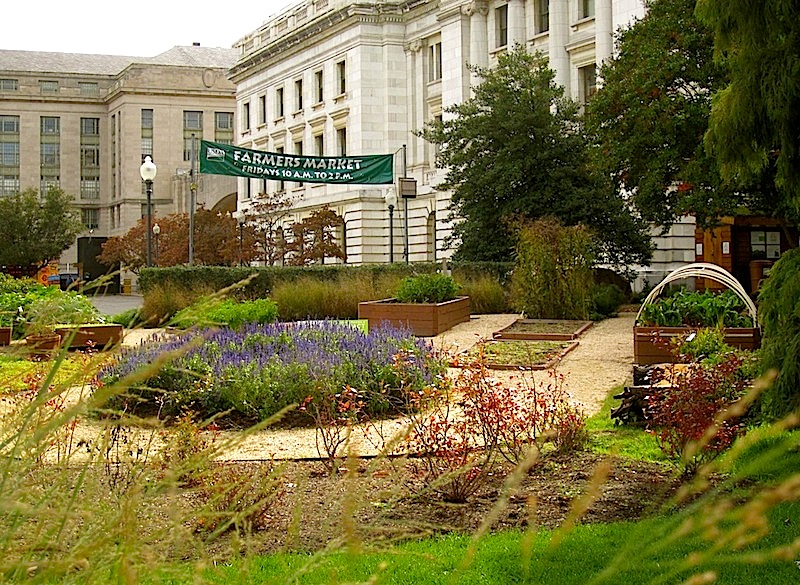
Department of Agriculture, Washington, D.C., October 2014, enclos*ure
In October, during our trip to the U.S., I poked fun at a Bradford pear tree (happily?) missing from the grounds of the U.S. Department of Agriculture (USDA) building on the National Mall.

But I did like all the other American specimen trees there — and the demonstration vegetable and flower garden on the corner of 12th Street and Jefferson Drive, S.W., (across from the Smithsonian Metro stop).

Outdoor classroom, USDA

I particularly liked the seating in what appeared to be an outdoor classroom.

Outdoor classroom, Oct. 2014, USDA

Earlier this year, an interesting 15-year plan was announced to turn all the green space (and parking lots) surrounding the USDA building into a “People’s Garden,” focusing on sustainable cultivation. You can read more about it here.

The Sunday porch: lattice and brick

This slideshow requires JavaScript.

“William Windom house, 1723 de Sales Place, Washington, D.C., Terrace,” ca. 1925, four hand-colored glass lantern slides by Frances Benjamin Johnston, via Library of Congress Prints and Photographs Division.

Johnston used these slides in her “Gardens for City and Suburb” lectures. (You can scroll through larger version by clicking on ‘Continue reading’ below.)

De Sales Place (now Row) is an alleyway between L and M Streets, N.W. (It connects 18th and 19th Streets.) The house is gone; an office building occupies the site.

The William Windom who gave his name to the home was twice Secretary of the Treasury, as well as a Congressman and Senator from Minneasota. He died in 1891. His son, also a William, may have been living in the house at the time of these photos.  He died in 1926.

[We] usually learn that modesty, charm, reliability, freshness, calmness, are as satisfying in a garden as anywhere else.

— Henry Mitchell, from The Essential Earthman

Continue reading “The Sunday porch: lattice and brick”

Urban Bird Habitat Garden

This slideshow requires JavaScript.

Last October, I posted two photos of a nice hellstrip along the west side (12th Street, N.W.) of the Smithsonian’s Museum of Natural History.

In mid October of this year I discovered the Urban Bird Habitat Garden, on the other side of the sidewalk. It’s essentially all the grounds of the museum on the north, west, and south sides (the east side is the Smithsonian’s Butterfly Habitat Garden).

The bird habitat was established in July 2012 (one of twelve Smithsonian gardens). Native trees, shrubs, and perennials were especially chosen to create “an oasis” for many of the more than 300 birds species found in Washington, D.C.

Although the garden is very narrow along 12th Street and the Mall, it was full of birdsong during my visit.

You can click on ‘Continue reading’ below to scroll through larger images of the garden. (And you can see the garden in other seasons here.)

Continue reading “Urban Bird Habitat Garden”

A little more. . .

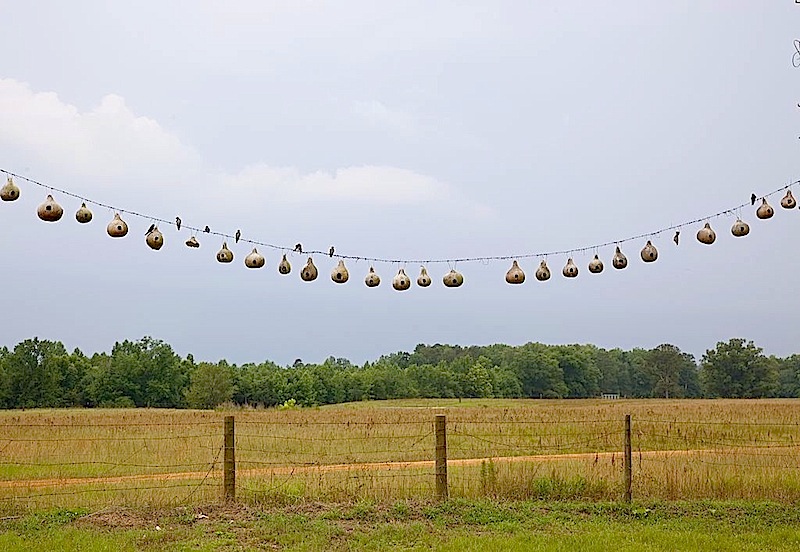
"Purple Martin gourd bird nests in rural Alabama," 2010, by Carol Highsmith via Library of Congress Prints and Photographs Division.
Purple martin gourd nests in Alabama, 2010, by Carol Highsmith, via Library of Congress.

About purple martins (see Tuesday’s post, “gourds and cans”): they have become entirely dependent on humans for nests in which to breed along the North American east coast.

Susie at pbmGarden sent me the link to a short (about 8 mins.) NPR documentary about the songbirds and the threats they face in the modern world (the fault is partly in Shakespeare).

Check it out here: “The Mystery of the Missing Martins” by Adam Cole

Vintage landscape: First Birds

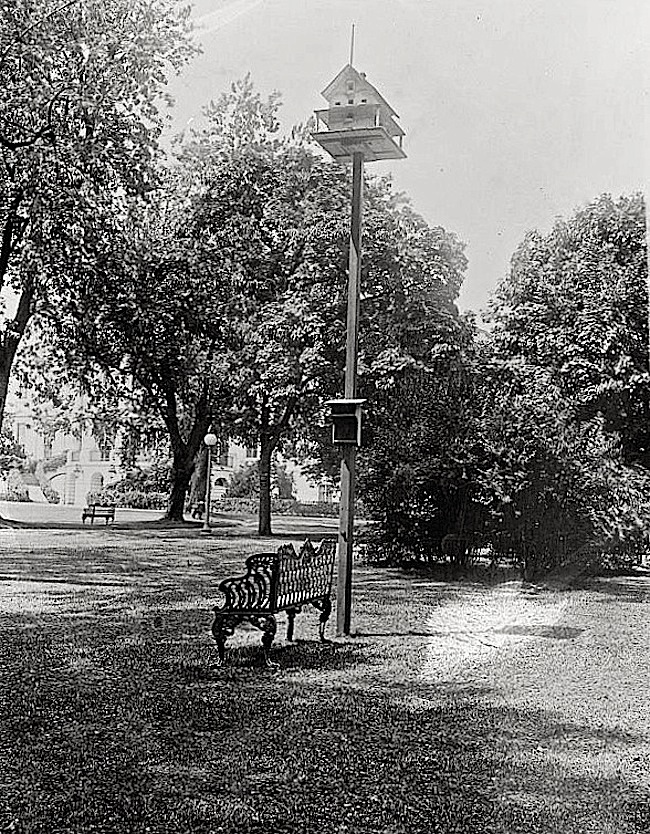
Wh.House birdhouse, Harding Admin., via Library of Congress“One of the many bird houses which Mrs. [Warren G.] Harding has installed in the White House grounds,” between 1921 and 1923, by National Photo Company, via Library of Congress Prints and Photographs Division.

First Lady Florence Harding was a great advocate for better animal care and protection. In addition to the birdhouses, she also had squirrel huts placed around the gardens  — and had the animal trophy heads removed from the State Dining Room, according to her biographer Carl Anthony.

Early changes to the residence’s outdoor space were part of the Harding  Administration’s determination to banish the “gloom” of the war years under President Wilson,  wrote John A. Morello in Selling the President, 1920. “More bulbs and flowers would be planted, and birdhouses were installed in trees.”

At least some of the official birdhouses came from Evans Brothers, “Manufacturers of Bird House and Lawn Accessories,” on Main Street in Evanston, Illinois.

A tiny article in the August 18, 1921, Chicago Tribune says, “Sparrows, robins, and other birds who are flat hunting at present may be interested to know that Conroy Evans. . . has just received an order from Mrs. Warren G. Harding for several bird houses to grace the White House grounds. . . and that Mrs. Harding will supervise the placing of the houses in trees.”

Conroy Evans contributed brief reports on the movements of Evanston birds to Bird Life magazine.  In its fall issue of 1919, Evans Brothers also placed a small ad:  “Who’s the ‘Mr. Hoover’ for the Birds? Why Evans Bros. of course.”

From 1917 to 1919, Herbert Hoover (later President Hoover) became well-known for his work on food relief for Europe as head of the U.S. Food Administration and then of the American Relief Association.