
 Peony garden, ca. 1890s, by Kusakabe Kimbei, via Museum of Photographic Arts on flickr.
Category: working in the garden
Vintage landscape: O cabbage gardens
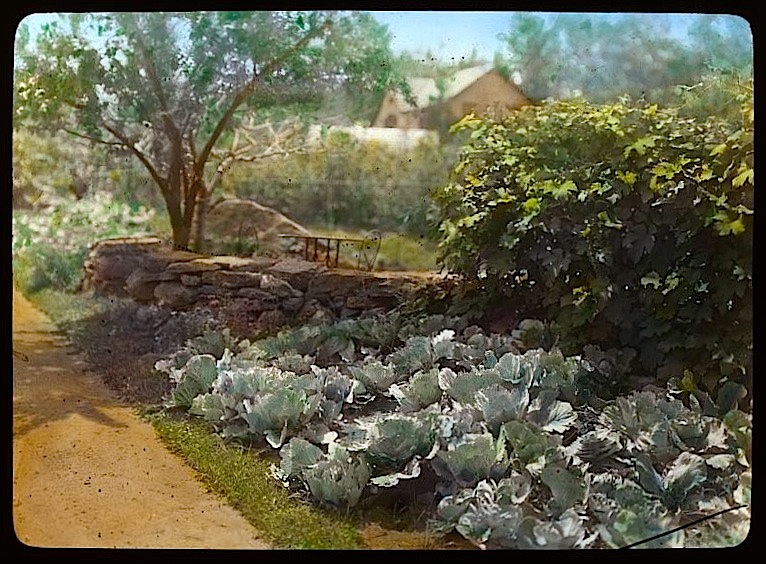 Cabbages in the vegetable garden of Chelmsford, Greenwich, Connecticut, ca. 1914, by Frances Benjamin Johnston, via Library of Congress Prints and Photographs Division.
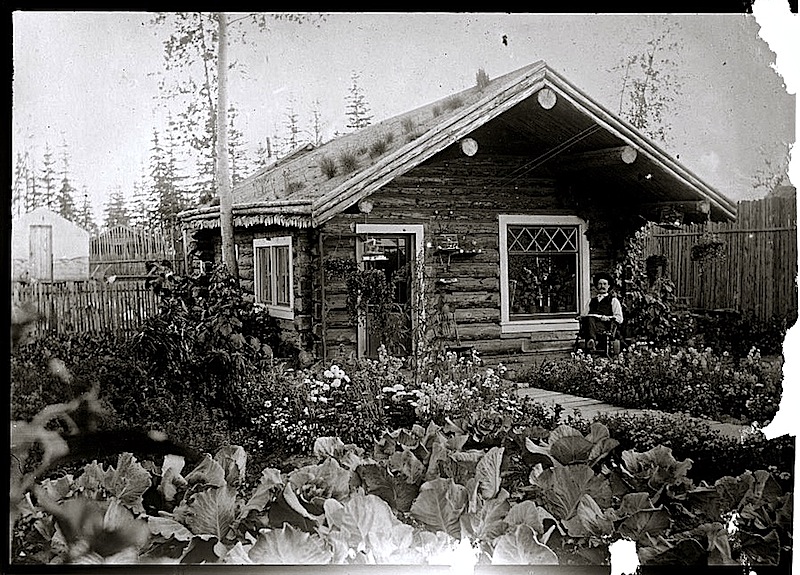 A cottage garden in Alaska, between 1909-1920. By National Photo Company, via Library of Congress Prints and Photographs Division.
 Woman in her garden, Puerto Rico, Winter 1941/42, by Jack Delano, via Library of Congress Prints and Photographs Division.
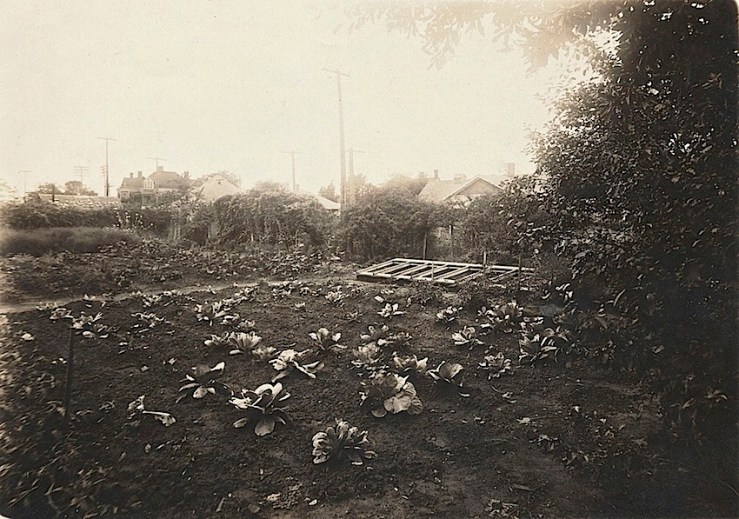 The vegetable garden and cold frames of the Maxey House, Paris, Texas, undated, from the Samuel Bell Maxey Collection, via Texas State Archives Commons on flickr.
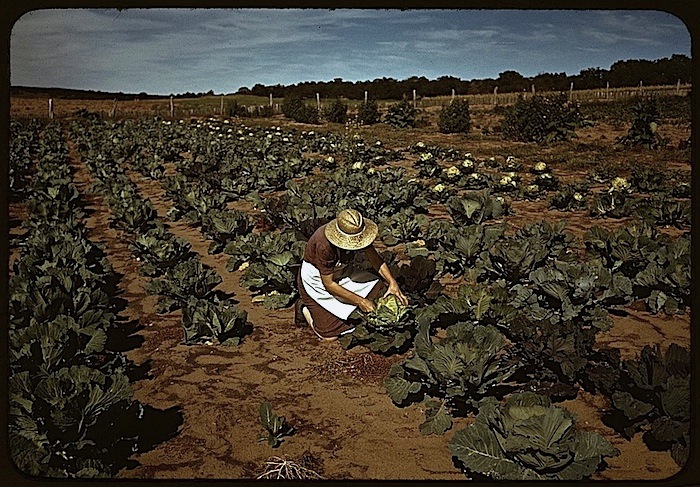 Mrs. Jim Norris with homegrown cabbage, Pie Town, New Mexico, October 1940, by Russell Lee, via Library of Congress Prints and Photographs Division.
eternity swallows up timeO cabbage gardenssummer’s elegysunset survived
— Susan Howe, from “Cabbage Gardens”
Life in gardens: coleslaw, anyone?
 “A cook holding up a giant cabbage at a camp in Wairarapa[, New Zealand],” ca. 1890s, photographer unknown, via National Library of New Zealand.
One of my favorite coleslaws is made by tossing shredded cabbage, a chopped apple or underripe mango, and some chopped peanuts with the dressing part of Vietnamese green papaya salad (recipe here).
At Samoa, hardly unpacked, I commenced planting. . .
I plant cabbage by moonlight, set out more cacao.
The heart of a death’s-head moth beats a tattoo in my hand.
— Carolyn Kizer, from “Fanny“
Before and after: the lower lawn
It has been two years since I made a number of significant changes to our Kigali, Rwanda, garden, and I thought this would be a good time to look back with a series of “before and after” pictures.
Today, I’ll focus on the “lower lawn” — the largest part of the garden, which is parallel to and just below the “upper lawn.”
(You can read about the upper lawn’s “before and after” in my July 25 post here).
Before
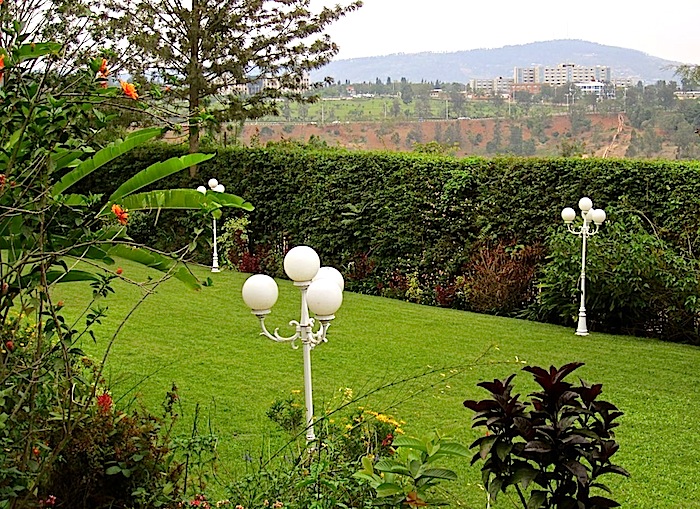 Photos above and below: late 2011.
Then and now, looking down on the lower lawn from the front of the house, you see grass and a clipped bougainvillea hedge along the front of the property — and then the view above.
 This is to the right of the previous photo; that’s Mt. Kigali over the front hedge — seen from the center steps that align with the middle of the house and terrace.
When you go down the center steps and stand on the lower lawn, the views of the city and hills are hidden and the flower/shrub borders are all you see.
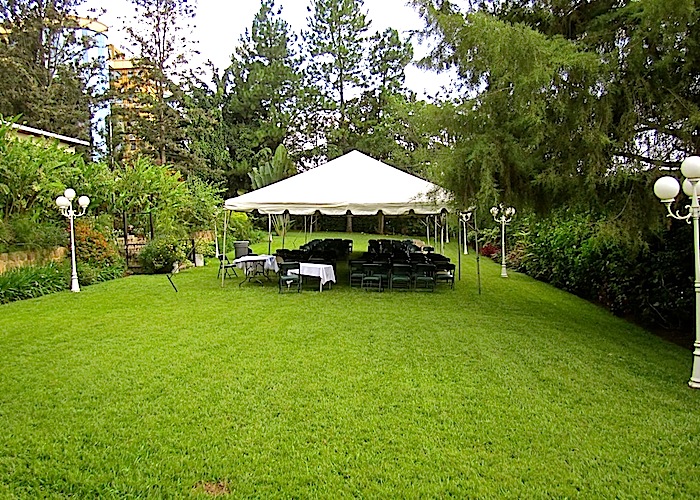
Back in 2011, I thought it was all too straight, too wide (the grass), too dull. And the bright white Victorian lampposts lined up out in the grass drove me crazy.
 There is a slight slope to the lawn, toward the front hedge. Along that hedge (shown above, right) was a very narrow planting strip, into which a variety of nice shrubs were wedged. I always had a feeling that they and the lawn could just slide down under the hedge.
The practical purpose of the lower lawn area is holding large events. And from that standpoint, it was already working well. The occasional need to put up tents meant that we could not remove a lot of the grass, but, as you can see in the picture just above, there was enough room to create a wider, much more interesting planting bed along the front hedge.
After
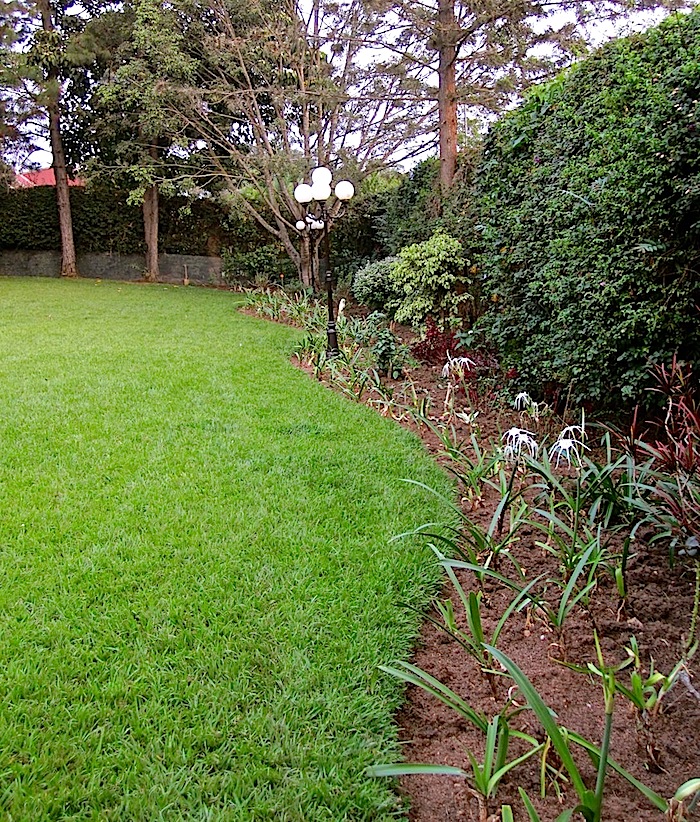 Above is the same area of the previous photo in the summer of 2012, soon after we started making changes. At this point, we had already painted the lampposts dark brown.
All the borders in the garden on the north side of the house (next post) and along the upper and lower lawns were re-cut in irregular curves — echoing the forms of the surrounding hills. The curves also provide a counterpoint to the long straight lines of the parallel lawns, borders, walls, and front hedge.
 Above: the same section in late June 2014.
While I couldn’t remove a lot of grass in the center section of the lawn, the curvy borders can swing out a bit at the north and south ends.
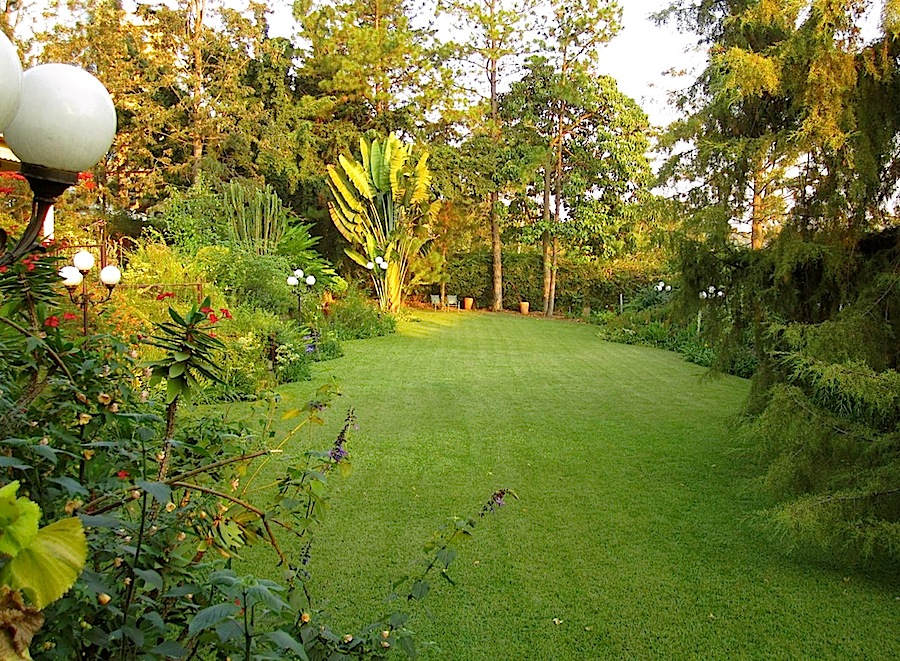 Above: the full lower lawn, looking from the north.
 Above: standing on the upper lawn, looking across to the front border in April 2014.
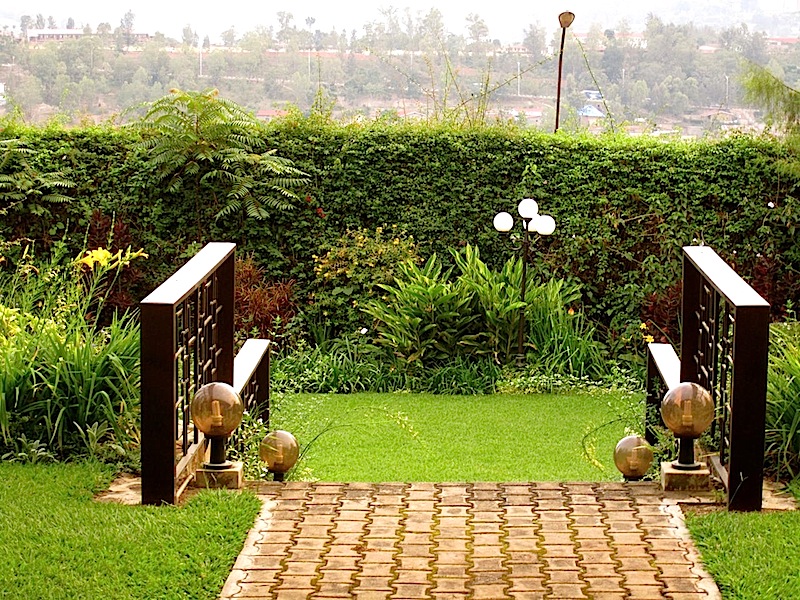 Above: standing at the center steps, looking across — this is the same view as in the second photo in this post, above.
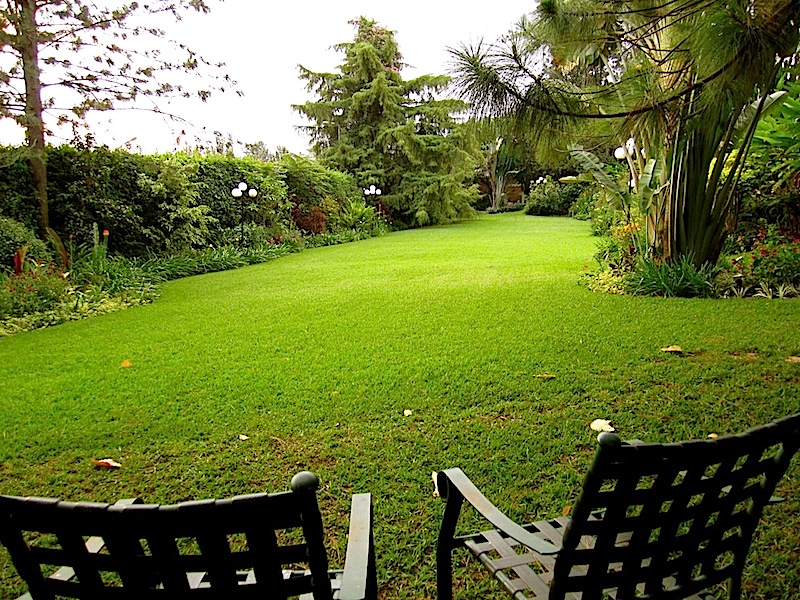 Above: the full lower lawn, looking from the south.
Before
 Above: in late 2011, on the house side of the lawn, the old 9′ heliconias in the border between the two retaining walls loomed down. . .
 . . . and were pretty tattered; I think we had had a hail storm not long before I took the photo above.
After
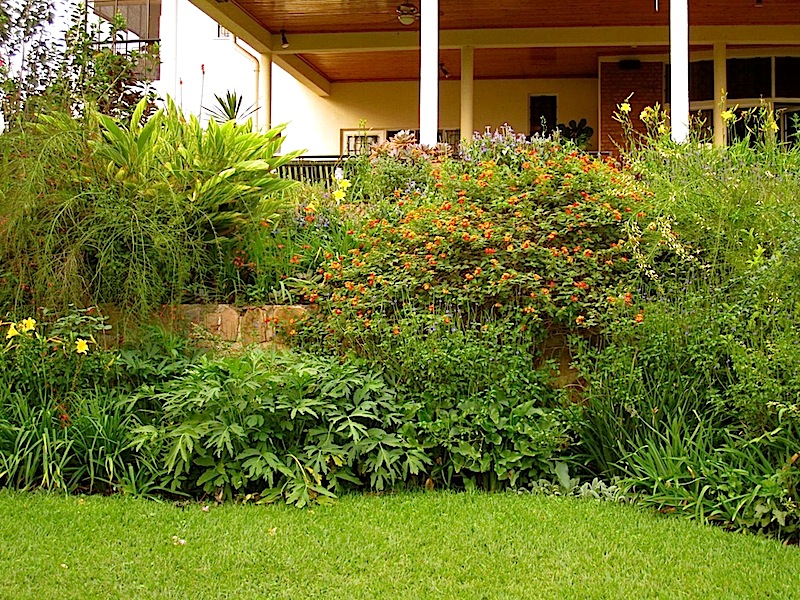 Above: the same section, in late June 2014.
 Above: the grass-level planting bed was extended out to contain the lampposts.
 Above: from the center of the lawn, looking at the south side of the retaining walls.
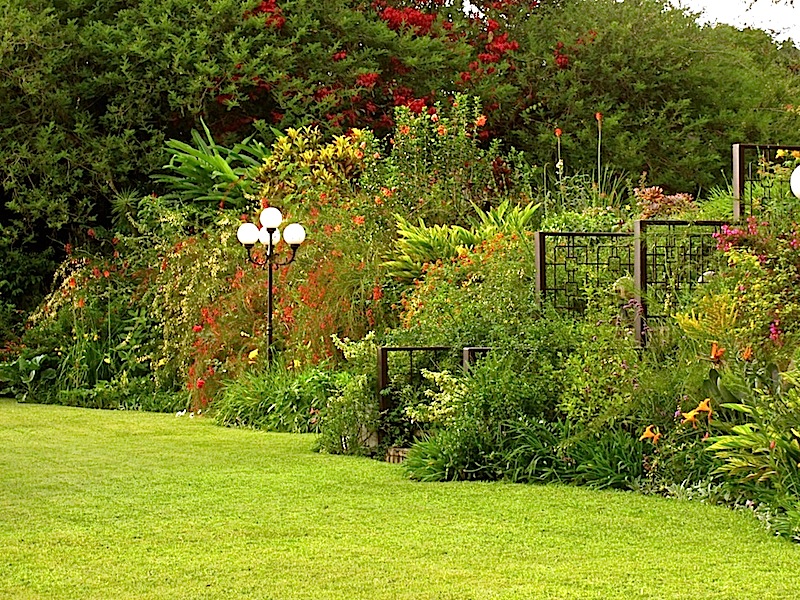 Above: looking north in April 2014.
Our garden: after two years
It has been two years since I made a number of significant changes to this garden, and I thought this would be a good time to look back with a series of “before and after” pictures.
I’ll start today with the area I call the “upper lawn” — just in front of the terrace off the front door.
Before
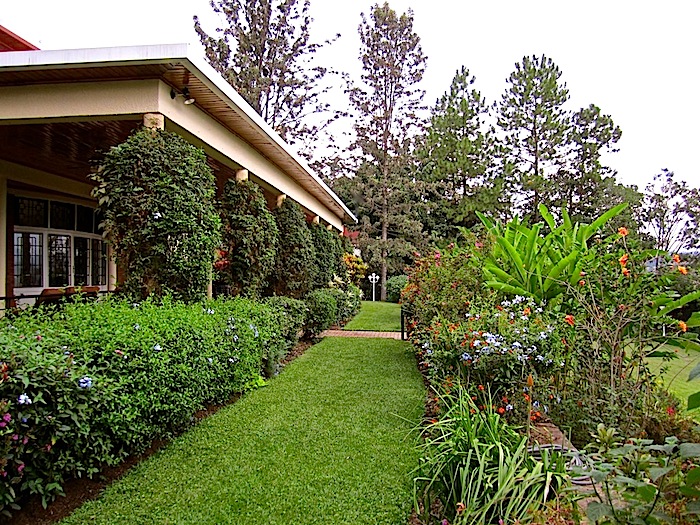 This space — photographed in the fall of 2011 — used to be composed of (left to right) 3′ to 4′ high sheared shrubs, a grass path, and a second border of shrubs and perennials. Further to the right was/is a stone retaining wall (just visible in the foreground above), another planting bed about 3′ below, and then another stone retaining wall.
Bright green 8′ to 9′ Heliconia rostrata or lobster claws were growing in the lower planting bed between the two walls, on either side of the center steps that lead to the “lower lawn.”
It was all very pretty, but with some important problems.
The tall Heliconia created a wall of large foliage right in front of what should have been a wide view from the front door.
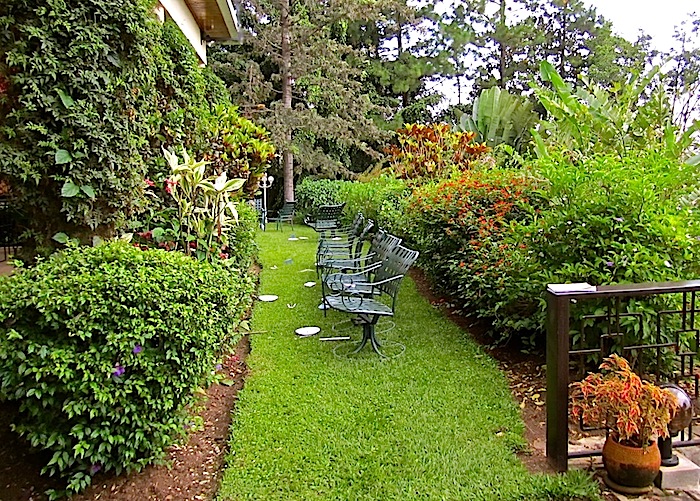 The grass path was not really wide enough to be a good seating area, as you can see from this picture of the aftermath of a rather messy large lunch event. The chairs had to be lined up, and the large bushes on either side created a tunnel effect.
After
The primary practical goals for the upper lawn were to expand our room for entertaining and open up the very good views of the city and hills on the west side of the property (the house is near the top of a ridge).
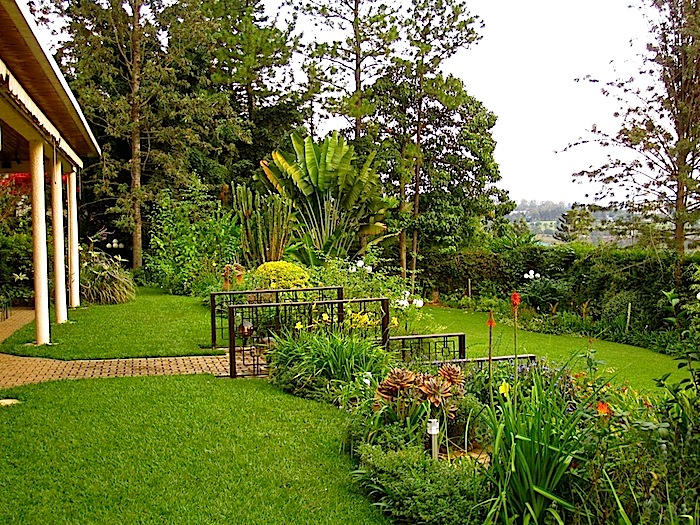 Now, two years later, the lawn is an extension of the terrace and is wide enough for groups of tables and chairs. Most of the plants in the border are low.
The pictures above and below were taken at the end of last month.
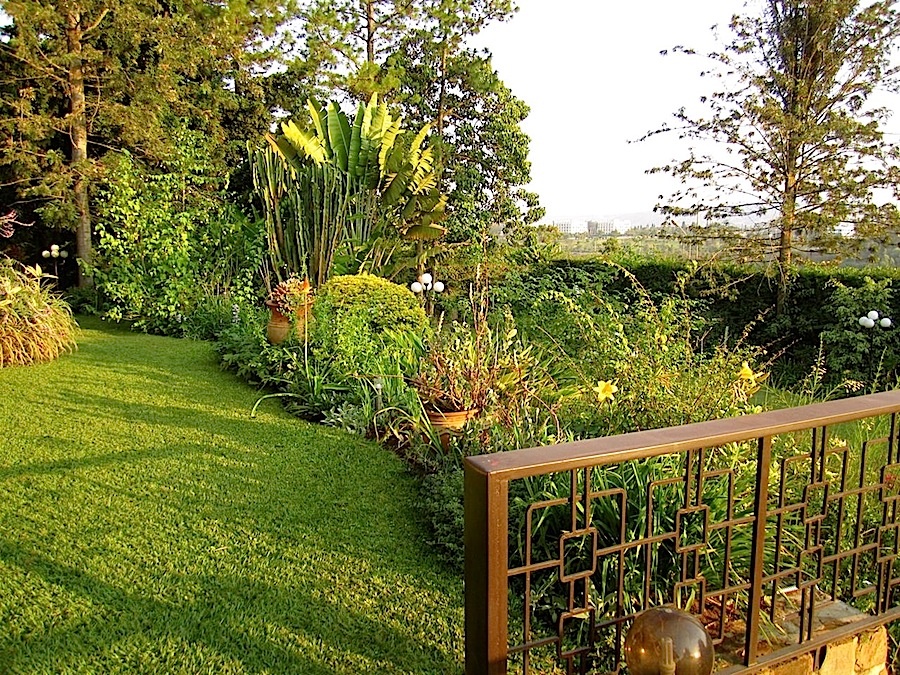 As soon as we* removed the old shrubs and the Heliconia, I was thrilled with the increased sense of light and air.
 I still feel happy every time I walk out the front door.
Before
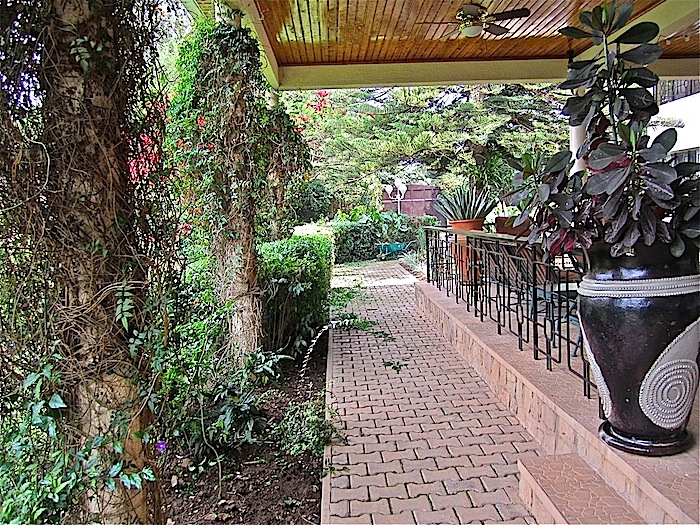 I did consider leaving the rather romantic vines on the columns — shown above in the fall of 2011. But they only gave us a few flowers at a time, and, on the terrace side, they were mostly a tangle of brown stems.
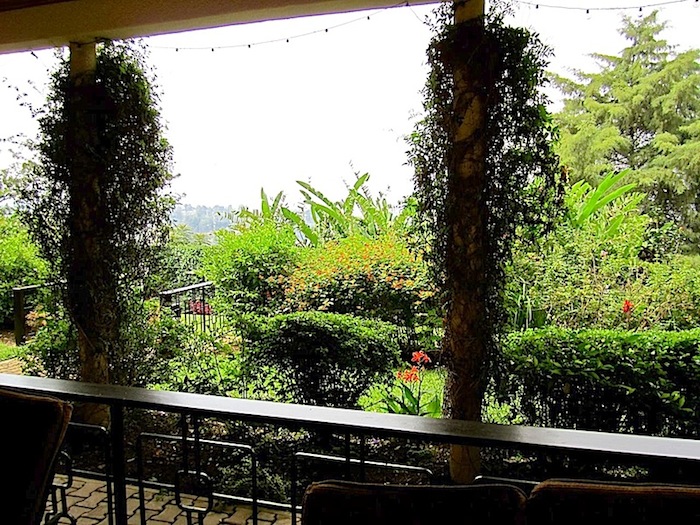 The effect was a little grubby and very claustrophobic.
After
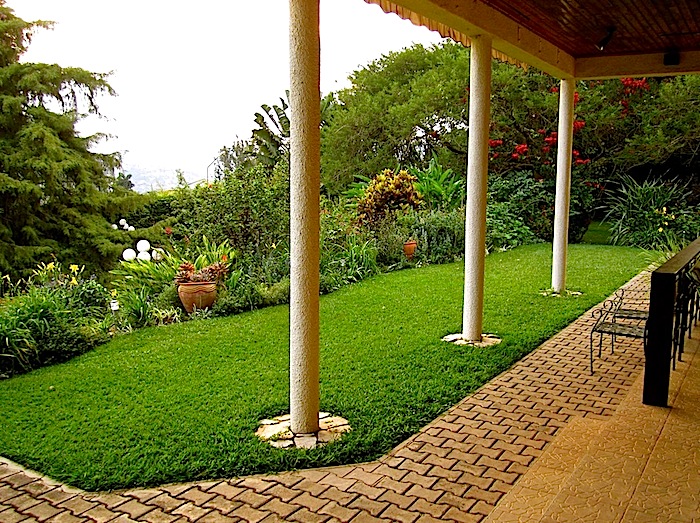 Now, more light, air, and space.
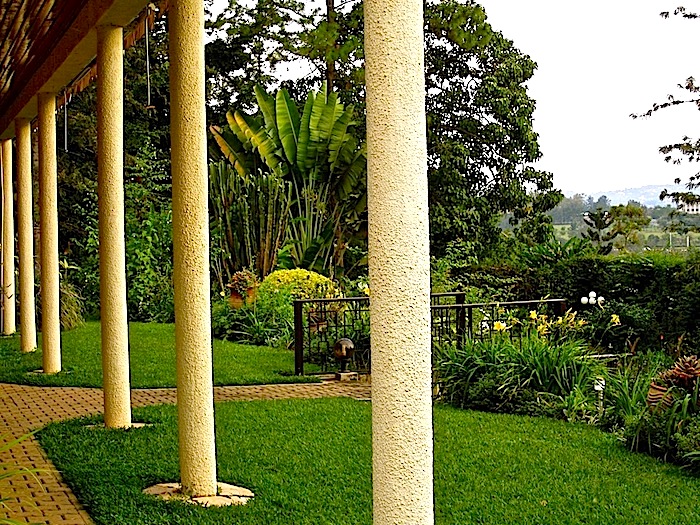
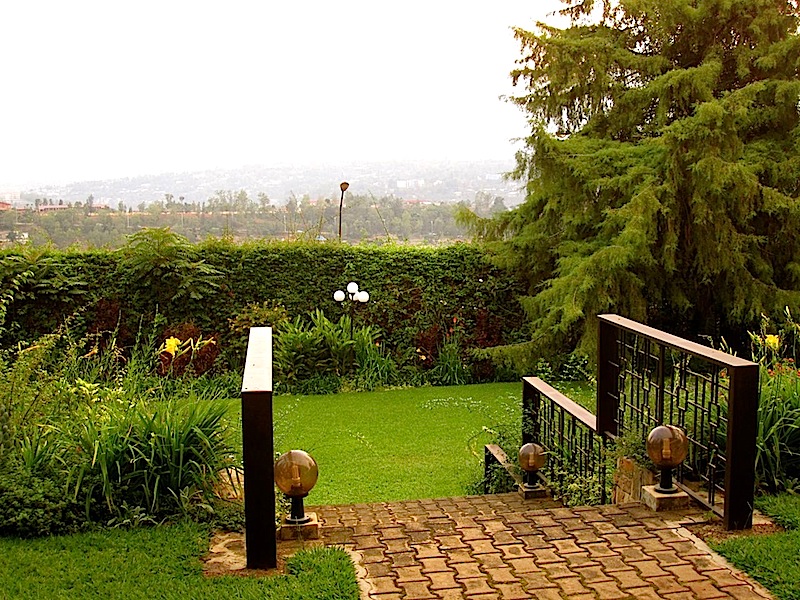 We have very wide, beautiful views, and now our guests can really appreciate them while sitting on the terrace. (Unfortunately, when I took these photos last month, they were somewhat obscured by the light of the setting sun.)
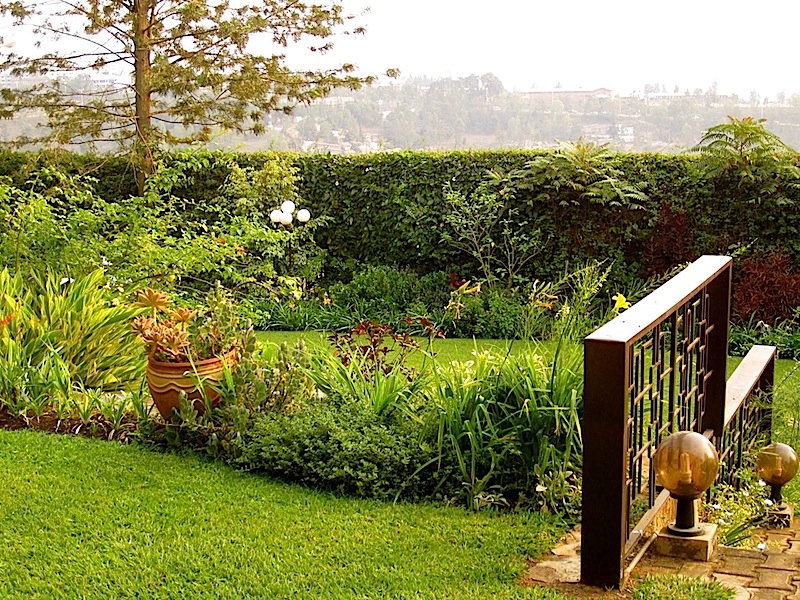
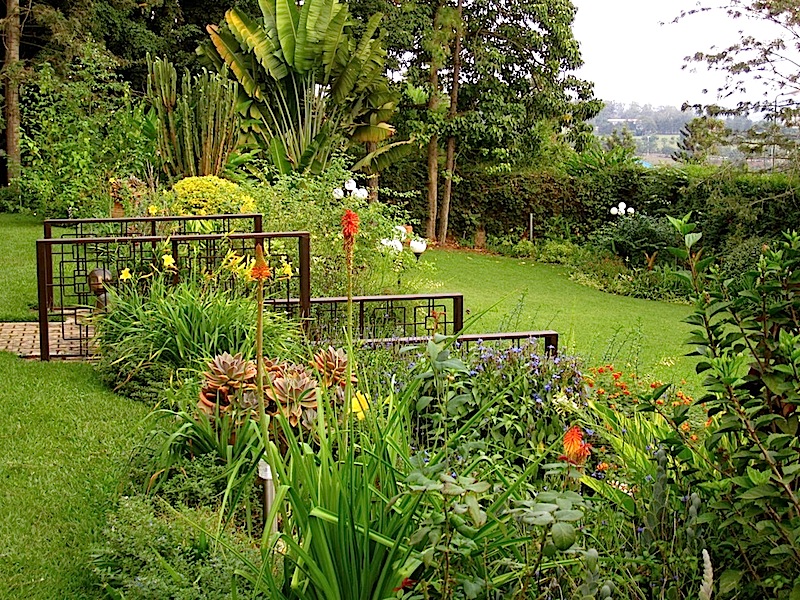 Bright orange red hot pokers punctuate all the borders at regular intervals.
The transition
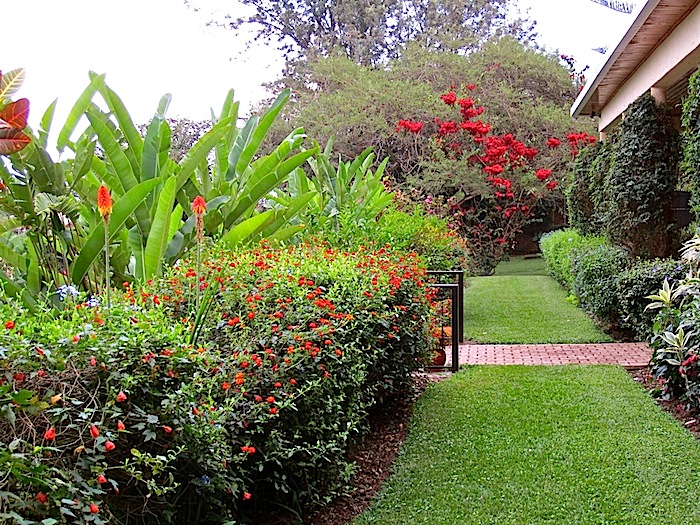 This, above, was the starting point in the spring of 2011.
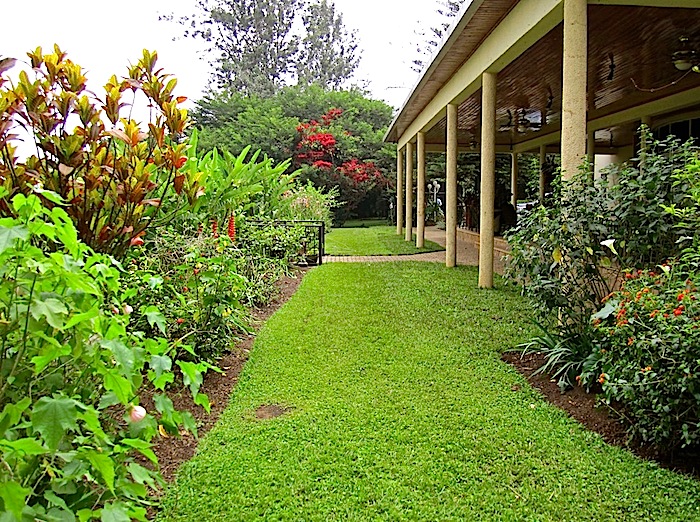 About May 2012, above, we first cleared out the shrubs and vines on the terrace side. Most of them were temporarily planted in a newly dug flower garden at the side of the house.
We had also just cut out a long border on the lower lawn (next post), so we brought that grass up and almost instantly made a wider lawn area.
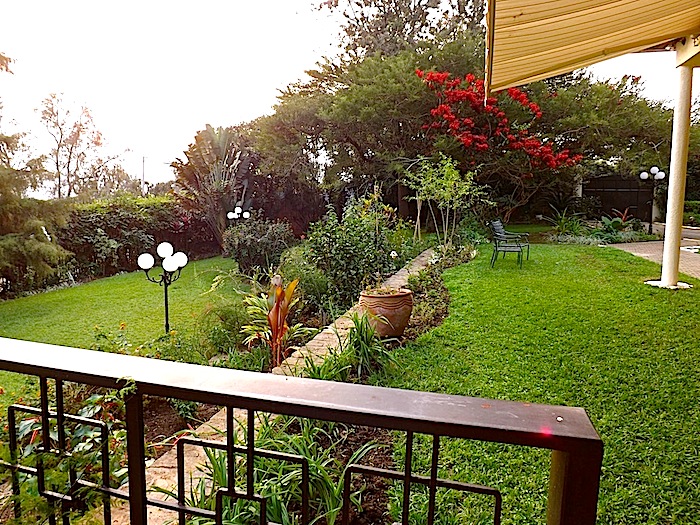 Then, we cleared out most of the shrubs on the other side, as well as in the planting beds between the retaining walls. (We moved most of them, as well as the bushes stored in the side garden, to the new lower lawn border).
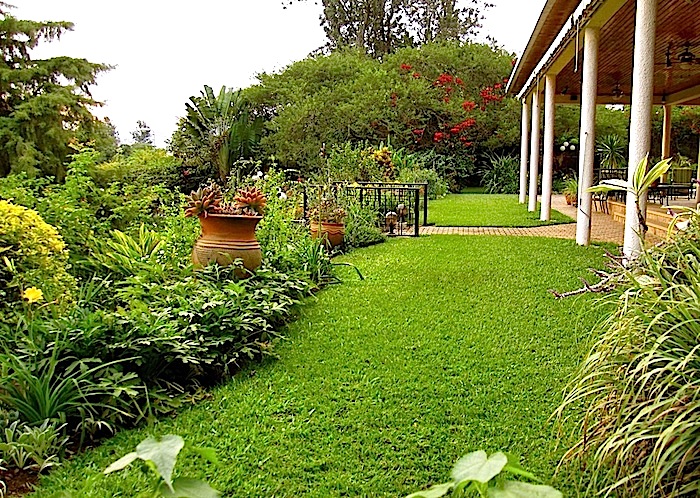 Above and below are the mature results, at the end of June 2014.
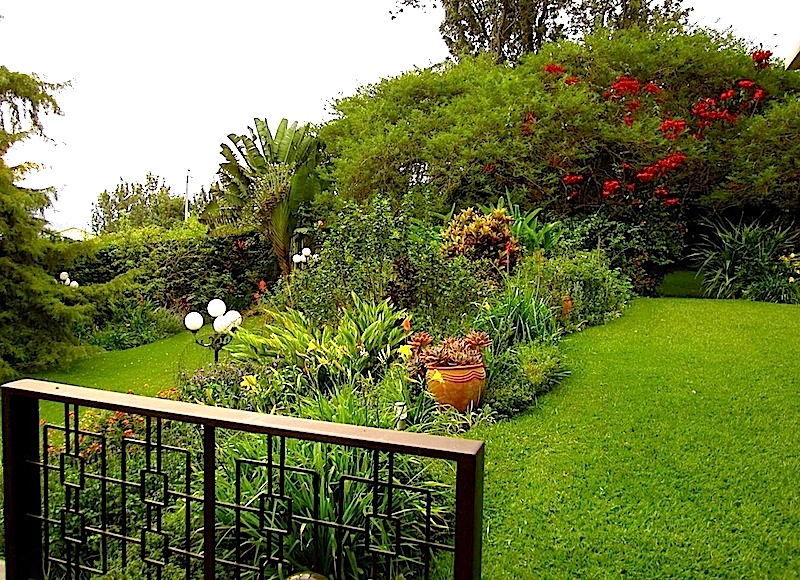 This border is full of little sunbirds and butterflies.
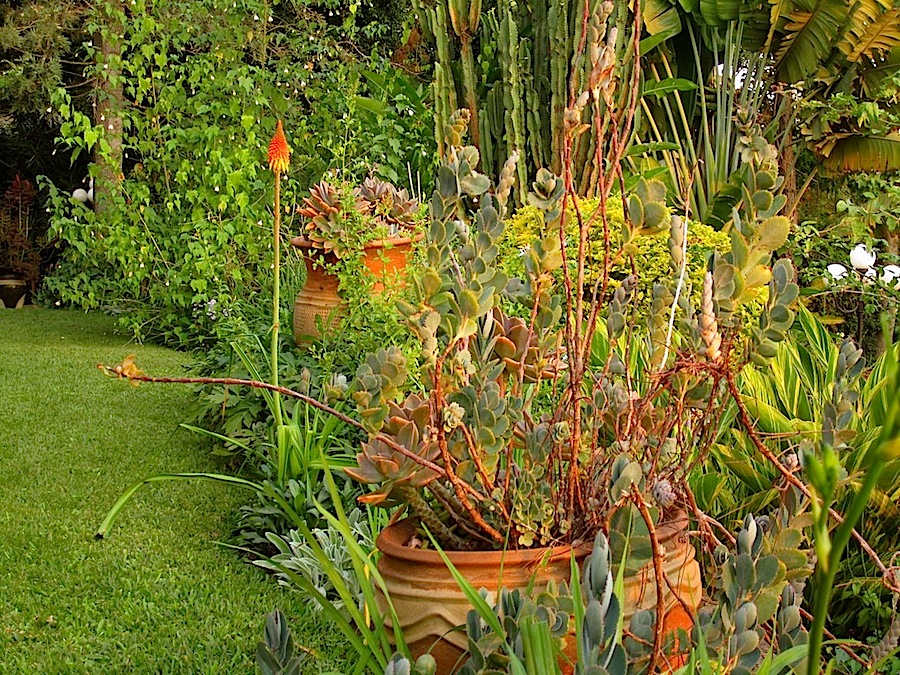
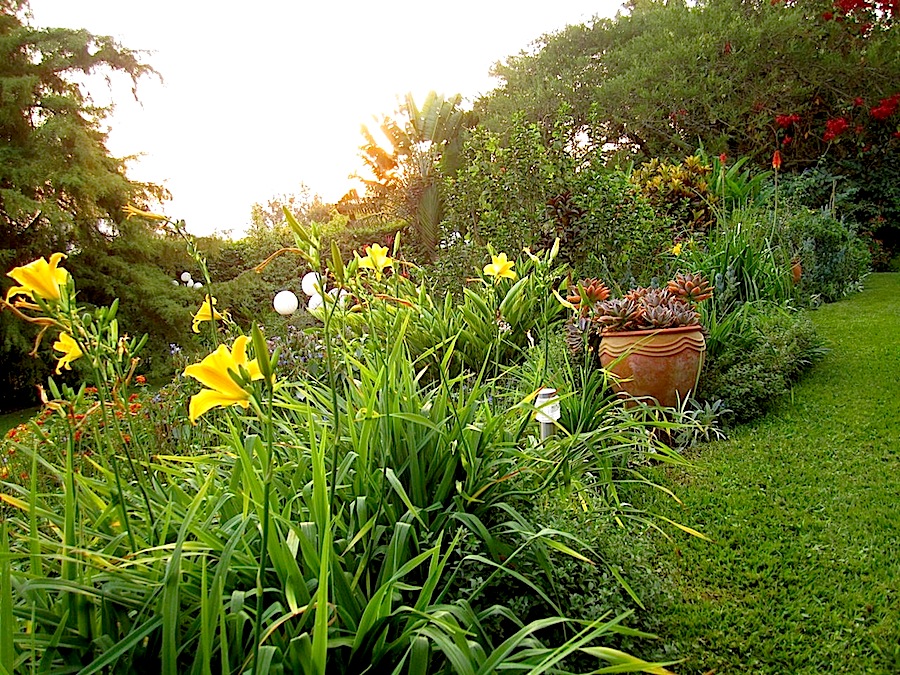 I planted the same coral and grey Graptopetalum in all the pots. The terra-cotta tones of the clay and of the edges of the succulent’s leaves repeat those of the roof tiles in the view.
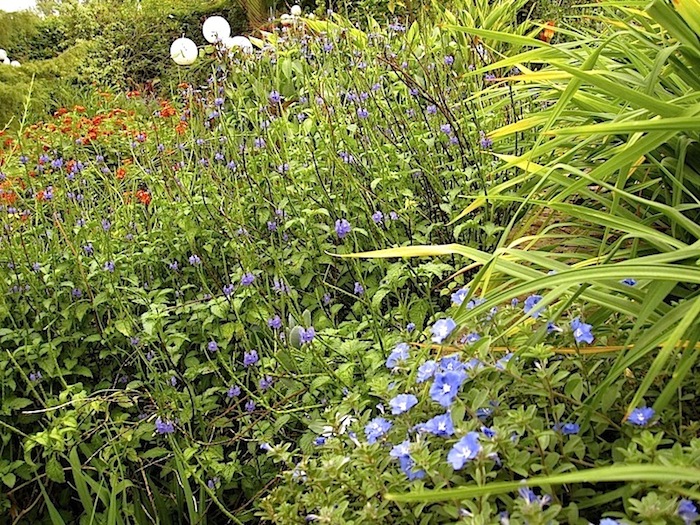 I planted yellow-blooming day lilies, Rudbeckia laciniata, and roses in the narrow border along the top of the stone retaining wall — and mainly blue and purple-blue flowering plants in the bed just below.
The yellow holds up well to the bright sun in this exposed spot and echoes the pale yellow paint on the house exterior (and on the living room walls just behind the front door).
The blues pick up the same tones in the hills on the other side — particularly in late afternoon.
*The “we” was me, the gardener, and, briefly, three extra helpers.
 enclos*ure