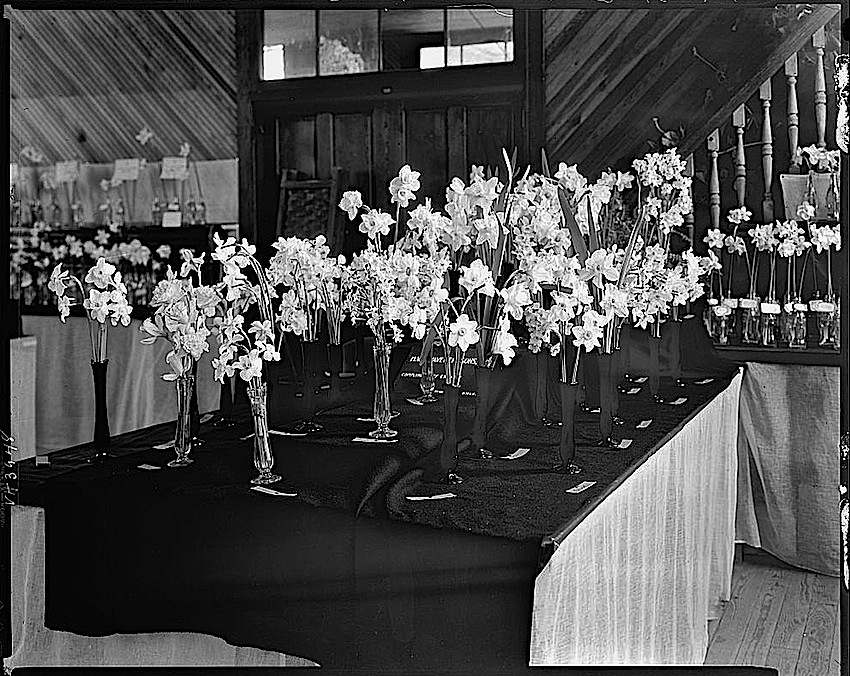
Vintage landscape: daffodils

Middleburg, Va., flower show, 1931, Library of CongressMiddleburg Flower Show, Middleburg, Virginia, April 1931, by Frances Benjamin Johnston, via Carnegie Survey of the Architecture of the South, Library of Congress Prints and Photographs Division.
Right now, here in Stuttgart, a few daffodils have poked up from our front yard. I will probably pick them. I don’t usually like Narcissus in the landscape in early spring — the bright yellow is too much, too soon.  But, like those in the photo above, they look really nice in a vase.

There are also some fat cultivated Dutch hyacinths by our front door. They’re going to get the chop too.

In the fall, for next March and early April, I want to plant snowdrops and snake’s head fritillarias.

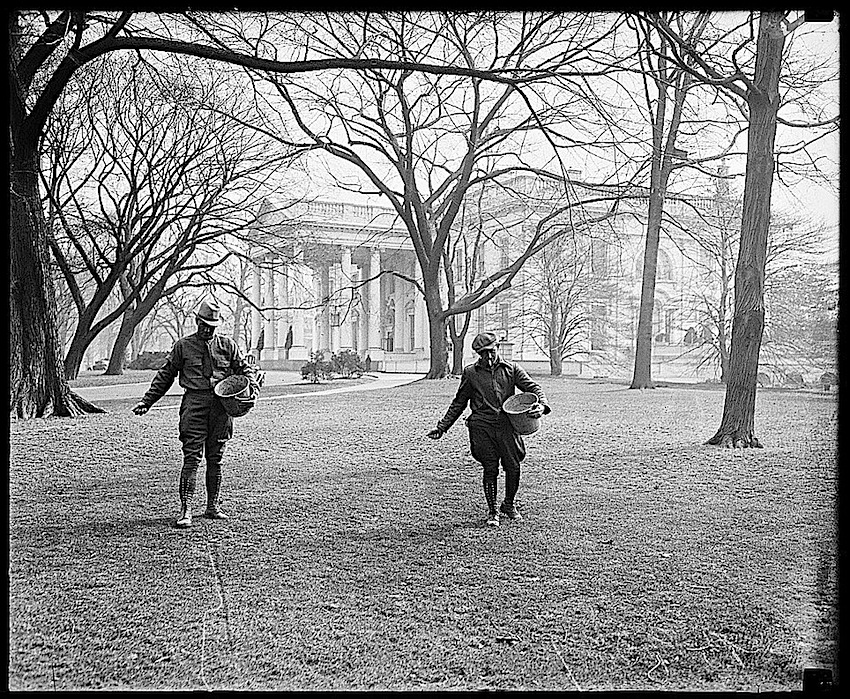
Life in gardens: sowing

Gardeners at the 1936 White Hse., Library of Congress“Grounds workers at White House, Washington, D.C.,” March 1936, by Harris & Ewing, via Library of Congress Prints and Photographs Division. (You can click on the photo to enlarge it.)

The National Park Service has maintained the White House gardens since 1933.

. . . [W]hile lawns are cultural (in the sense that they are meaning-laden), they are not the product of some pre-existing “culture,” and are instead the meaningful expression of political and economic forces. . . . Lawns are propelled into the landscape both by economic imperatives (e.g., real estate growth) and also by intentional and thoughtful efforts to produce certain kinds of subjects. Lawns are a strategy, therefore, both for capital accumulation and making docile and responsible citizens.

— Paul Robbins, from Lawn People: How Grasses, Weeds, and Chemicals Make Us Who We Are (p. 32)

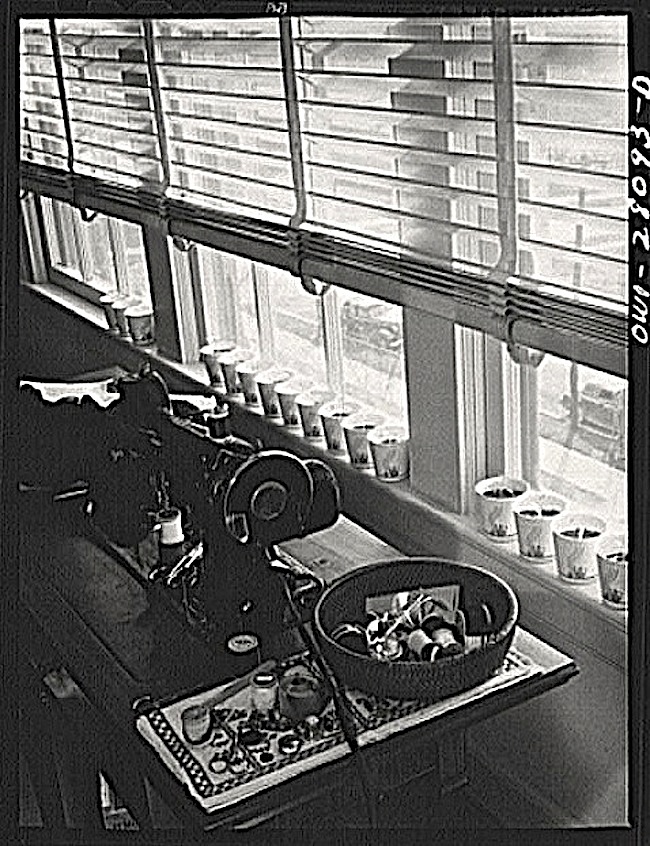
Vintage landscape: preparation

Starting seeds 2, 1943, L. Rosskam, Library of Congress“Washington, D.C. Victory gardening in the Northwest section. [Tomato s]eedlings in paper cups that will be transplanted in the victory garden,” 1943, by Louise Rosskam, via Library of Congress Prints and Photographs Division. (Another view here.)

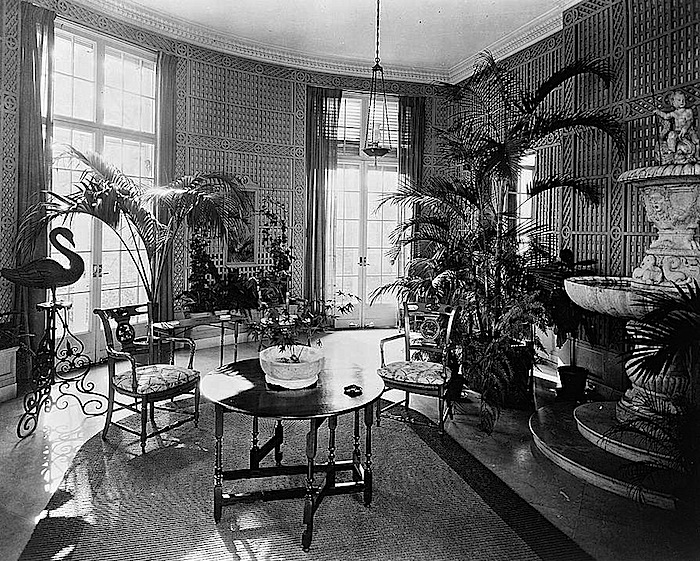
The winter garden: Parmelee house

Washington conservatory, Library of CongressThe conservatory of “The Causeway,”  or James Parmelee house, Northwest Washington, D.C., 1919, by Frances Benjamin Johnston, via Library of Congress Prints and Photographs Division.

The estate has also been called Twin Oaks and Tregaron.  Its 1912 house still stands, and some of the land is a campus for the Washington International School.

James Parmelee was a Cleveland financier and co-founder of the National Carbon Company.

More winter gardens are here.

The Downing Urn

Still looking through some photos that I took this fall, when we visited Washington, D.C. . .

This slideshow requires JavaScript.

I admired the Andrew Jackson Downing Urn in the Enid A. Haupt Garden behind the Smithsonian Institution Castle. It was designed by Downing’s architectural partner, Calvert Vaux, and sculpted from marble by Robert E. Launitz several years after Downing’s death.

In 1850, Andrew Jackson Downing transformed the Mall into the nation’s first landscaped public park using informal, romantic arrangements of circular carriage drives and plantings of rare American trees. Downing’s design endured until 1934, when the Mall was restored to Pierre L’Enfant’s 1791 plan. Downing (1815-1852), the father of American landscape architecture, also designed the White House and Capitol grounds.

The memorial urn stood on the Mall near the Smithsonian’s National Museum of Natural History for 109 years (1856-1965). In 1972, it was restored and placed on the lawn east of the Smithsonian Building (“Castle”) flag tower. In 1987, it was relocated to the Rose Garden at the Castle’s east door. The urn was moved to its location in the Enid A. Haupt Garden in 1989.”

– text of the plaque near the foot of the urn’s pedestal

I wonder where the urn will go in the new design plans for the area, recently released by the Smithsonian.

Continue reading “The Downing Urn”