In Rome

This slideshow requires JavaScript.

Everyone soon or late comes round by Rome.
— Robert Browning, from The Ring and The Book

As you might imagine, late May was a beautiful time to be in Rome.  Coming in from the airport — and later on the way to Naples — we saw swathes of red poppies blooming all along the train tracks.  In the city, there were jasmine flowers everywhere.  The temperatures were in the seventies, and the crowds of tourists weren’t yet (too) bad.

We continued our rather unfocused wanderings in this city as well. But I did spend about two hours in the Museo di Palazzo Doria Pamphilj* (or Pamphili), which was recommended in a 2013 New York Times article, “Three Quiet Museums in Rome.”  It’s a family art collection in what is still the family’s palace home.

Prince Camillo Pamphilj and his brother Pope Innocent X began buying the paintings and sculptures in the 17th century.  In the 18th, the palazzo became the dynasty’s principal residence, and it is now mostly presented as it was at that time.

It is quiet, and you can see masterworks by Bernini, Caravaggio, Memling, Titian, and Rubens, among others.  Admission is €11 and includes a good audio tour by a current Pamphilj prince.

The extended family lives in other parts of the building (you can get a peek at their private courtyard garden just as you enter the museum).  We think my husband, who met up with me later in the gift shop, may have been directed around the corner to the entrance by two of its members — older Italian ladies who told him he would “have a lovely time” in perfect British English.  The audio guide tells you that English is the first language of the family today (a legacy of a 19th century English peeress ancestress).

This slideshow requires JavaScript.

We were also able to visit the beautiful grounds of the American Academy of Rome on Janiculum Hill (photos above).

Miscellaneous tips for Rome

Reserve your hotel room as early as possible. I started looking about six weeks before our trip, and all of my first and second choices were booked up.

The two (casual) restaurants we particularly liked were:

  • the pizzeria Panattoni, Viale di Trastevere 53/57 (dinner only, cash only, closed Wednesdays) in Trastevere — for thin Roman-style pizza.
  • L’Antica Birreria Peroni, near Piazza Venezia — serving lunch and Peroni beer to local businesspeople. (The menu they gave us was only in Italian, but you can see a translation here.)

I liked the Kindle guidebook Revealed Rome by Amanda Ruggeri (and her blog of the same name) for culture, restaurant, and shopping tips.  I also consulted the blogs Parla Food Aglio, Olio e Peperoncino, and The Guardian’s city guide for Rome.

I also liked Italian Survival Guide (on Kindle and paper) by Elizabeth Bingham for a good explanation of Italian pronunciation, numbers, and basic phrases, as well as culture tips.

Not Built in a Day by George H. Sullivan is an interesting guide to Roman architecture, but don’t buy the Kindle version, as I did.  The maps are tiny and fuzzy, making it very difficult to follow his walking tours.  


*It is not part of the large park, Villa Doria Pamphili. The Palazzo is just northwest of the Piazza Venezia in the historic city center.  The entrance is on Via del Corso.
Continue reading “In Rome”

The Sunday porch: Pompeii atrium

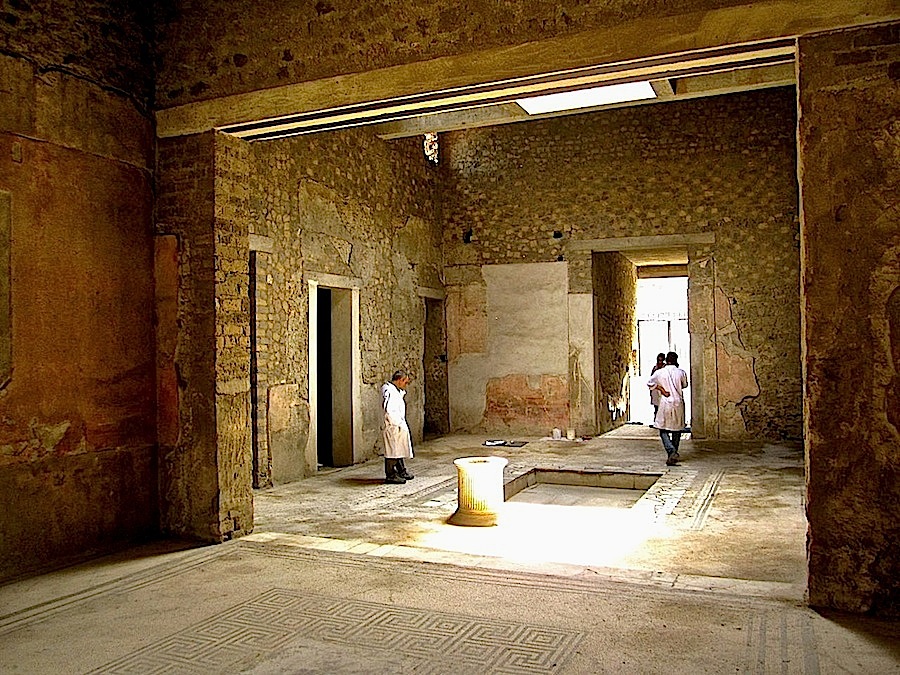
enclos*ure- Pompeii courtyard, Hse of the Tragic PoetThe atrium of the House of the Tragic Poet, Pompeii, Italy.  This house was built near the end of the 1st century B.C. and excavated in 1824.

Well-to-do Roman city houses had no openings to the streets other than the front and back doors.  After entering from the front directly from the sidewalk, one walked down an entrance corridor or fauces and into the atrium, which often had an ceiling opening to the sky, like the one shown above.

Underneath the opening was a shallow pool or impluvium to catch rainwater and channel it to a water tank below. The water could later be drawn up through the puteal — in the photo above: the short, round, hollow column beside the impluvium.

At the back of the atrium, opposite the entrance corridor, was the tablinum or central room of the house. The doors of family bedrooms also opened onto the atrium.

When I took the photo above about two weeks ago, I was standing behind the tablinum, looking across it and into the atrium.  On the other side was the fauces and then the front door of the house. Behind me was a very small enclosed garden surrounded by a colonnade and some other small bedrooms, a kitchen, and a latrine.

The walls of the atrium of this house used to be covered with six frescoes depicting scenes from the Iliad.  The three that survived can be seen today in the National Archeology Museum in Naples.

The house takes its name from one of the frescoes that was in the tablinum, which excavators mistakenly thought to be a picture of a poet reciting his verses.

Visiting Pompeii

To get to Pompeii from Naples, we again took the Circumvesuviana rail line from the Central Station (more information here).  We took the “Sorrento” train and, about an half hour later, got off at “Pompeii-Scavi.”   The entrance to the site is right there at the station.

Guides

For a 2 to 3 hour guided tour of the site with 8+ people, the cheapest options I found were:

  • Mondo Guide, a guide company loosely affiliated with travel writer Rick Steves.  Go to this link, and put your name/s on the list for the desired date.  If 8 people sign up, they will do the tour and everyone will be charged €12*.  If there aren’t at least 8 requests, there will be no tour that day (it didn’t work out for us).
  • Tempio Travel, a guide company with a ticket stand right where you get off the train (Infopoint).  They guide groups of 8+ as they collect enough people (we waited about 20 minutes).  For the price of €12* per person, our guide was OK, and since we have only a moderate interest in Roman history, we were satisfied.

Walks of Rome offers a group tour for a maximum of 12 people for €49 each, which includes the entrance fee.  They are recommended on the blog Revealed Rome.  (Its author also has a good, inexpensive Kindle guidebook by the same title.)  However, they were fully booked for our day.  For all these options, except Tempio Travel, book early.

If you have the budget, you can get a personal tour from Mondo Guides (see above) or Gaetano Manfredi (who is also recommended by Rick Steves).  There is also a Mr. Caporaso (yourguidetonaples@gmail.com), who was recommended to me in an e-mail from Mr. Manfredi. And, of course, if you do an internet search, you will find many others.  It seems that the per-person prices are €50 to €100+.

Of course, you can also rent an audioguide at the entrance.

Tickets and lunch, etc.

The entrance ticket to Pompeii is €11.  Contrary to what I read online, the site did seem to be accepting credit cards, but I would recommend having cash to be sure and for a faster line.  Mid-morning, near the end of May, it was not bad — about 5-10 minutes.

The ticket is for all day, but once you leave the site, you can’t re-enter.  So if you want to stay inside after your morning tour, you will have to go to the busy cafeteria near the forum to buy lunch (the restrooms are there too.)  However, there didn’t seem to be any restriction against bringing in a sandwich in a small backpack or bag.

Wear serious sunscreen; the site is almost completely open to the sun.

You will appreciate the ruins much more if you visit the National Archeology Museum in Naples and see the many frescoes and other artifacts that were removed from the site during the 19th and 20th century excavations.  (You may also want to check out this series of articles about Pompeii in The Telegraph.)


*Site entrance fee and transport not included.

In Amalfi


This slideshow requires JavaScript.

Two Saturdays ago, we were just beginning a brief vacation in Italy, in  Sorrento on the Bay of Naples.

On Sunday, as a day trip, we took a local bus along the winding, narrow, cliff-hanging road that edges the gorgeous Amalfi Coast.

We rode it all the way to Amalfi itself– an important city back around the first millennium A.D., but now just a very pretty coastal resort selling hand-painted ceramics and products made from lemons.

The little strip of grey pebbles and fist-sized rocks that is Amalfi’s “beach” did not impress us, but the sparkling blue, clear-to-the-bottom water was very inviting.

There is one main street, which runs straight back from the sea and up into the surrounding hills about a half mile. On either side above it, houses and small lemon groves cling to steep slopes, connected by an extensive web of covered and open alleyways and steps.

The duomo or cathedral is the town’s major site. It was constructed and re-constructed from the 9th to 19th centuries and displays a mix of Norman-Arab Romanesque, Gothic, Byzantine, and Baroque architecture styles.

The photos above are of its Cloister of Paradise, built in 1268 as a gravesite for local wealthy merchants. The Arab style of the beautiful simple arches is not surprising, given Amalfi’s close ties during the Middle Ages with Arab traders throughout the Mediterranean (not excluding traffickers in European slaves).

Pretty as the cloister was, however, I have to say that my favorite Amalfi garden was this tiny terrace (below). Its horizontally espaliered lemon trees were guarded by a Roman soldier and the seven dwarves.


This slideshow requires JavaScript.

Visiting Sorrento and the Amalfi Coast

Travel writer Rick Steves says this about Sorrento:

The Sorrentines have gone out of their way to create a completely safe and relaxed place for tourists to spend money. . . . Spritzed by lemon and olive groves, this gateway to the Amalfi Coast has an unspoiled old quarter, a lively main shopping street, [and] a spectacular cliffside setting.

That’s pretty much what we wanted for the first two nights of our vacation, and that’s what we got.   Like Amalfi, aside from tourism, the city is now mainly known for growing impressively large lemons.  Its limoncello is supposed to be the best.  (Although I think it tastes like an alcoholic lemon drop, much too sweet; Amaro is my Italian digestive of choice.)

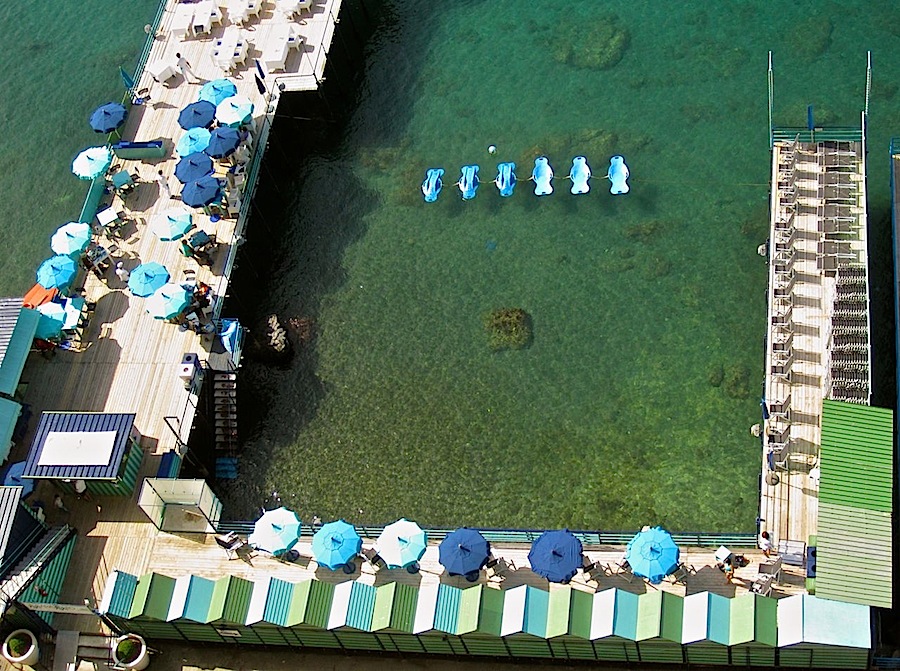
A swimming area along the Sorrento waterfront.
Getting around . . . train

To get to Sorrento from the Naples train station (Stazione Centrale), follow the signs leading downstairs to the platform for the Circumvesuviana commuter train.  Tickets are only €4.10 and can be purchased right at the turnstile.  Make sure you get on a train marked “Sorrento.”  They leave every half hour.

The Circumvesuviana was the only place where we had any problem with crime during our trip.  The platform was very crowded, and almost as soon as we entered the train, a pickpocket tried to take my husband’s wallet. After that, he kept his credit card and money in a small zippered bag with a loop attached to his belt — something like this.

We were each traveling with a rolling carry-on bag and a “personal item.”  This is the most I would ever try to keep track of on this train.

From the Sorrento train station, it’s an easy walk to the historic part of the city.

Boat

To return to Naples, we walked to the Sorrento piers and took one of the fast hydrofoil boats. The boats leave about every two hours, and you don’t need a reservation. (From the same place, there are also boats to Amalfi, Positano, and Capri.)

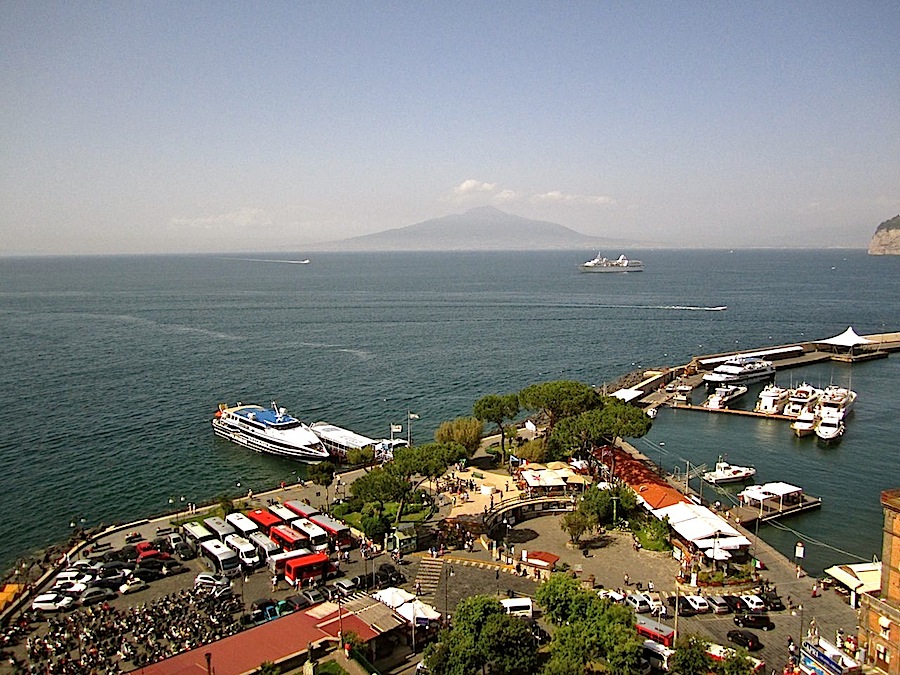
To buy the €15 ticket, go to the sunken semi-circle area in the photo below, consult the extensive, yet unrevealing signage to the find the correct line, and then ask for a one-way on the “Jet”  to Calata Beverello-Naples (a brief walk away from the Piazza Plebiscito).  The view of Naples as you arrive by water is lovely.

That's Mt. Vesuvius in the center.
That’s Mt. Vesuvius in the center.
Bus

The SITA bus that took us to Amalfi and back was a bargain thrill ride (the road is often only one and a half lanes wide) at €6.80 for all-day, on-and-off access. Buses leave Sorrento, Positano, and Amalfi about every hour (but not 24 hours, so check the schedule for the time of the last bus). The Sorrento-Amalfi trip takes one to two hours, depending on traffic.  In Sorrento, tickets are sold at the SITA bus stop in front of the train station.  The buses are blue, except when they’re red.

Hotel and restaurants

We stayed at the Hotel Rivoli in Sorrento, right in the center of the historic area.  The rooms were simple, clean, and comfortable.  The staff were very helpful with directions and advice.  The €5 breakfast offered croissants, cereal, and fruit, plus enough sweets to fill out a respectable Christmas buffet table.

We arrived in Sorrento after 24 hours of travel and by 6:15 p.m., we were exhausted.  At that very un-Italian dinner hour, L’Antica Trattoria served us their three-course “light lunch” very graciously.  Given the high quality of the food, it was a bargain at €20 each. We also had a very good meal the next night at the more unassuming Ristorante O’ Murzill’ at Via Dell’ Accademia, 17.

.   .   .  borne on
Beyond Sorrento and Amalfi, where
The Siren waits thee, singing song for song.

— Walter Savage Landor, from “To Robert Browning

In the ferns

the elegant script of ferns. . .*

Last February, we took our visiting oldest daughter to Nyungwe National Park and hiked the first half of the trail that includes a tree canopy walkway.  Last week, with second daughter and friend in tow, we completed the entire circuit.

Nyungwe National Park/enclos*ure

The hike started with us tucking our pants legs into our socks (against ants) and receiving walking sticks.

Although the paths are well-maintained, the sticks are necessary for the steeper, sometimes slippery sections.

The steps shown above are the first of many, many, many on a long descent to the canopy walkway. (The welcome center is at one of the highest points in the park.)

It was a hazy day, so I can’t show you the great mountain views that are otherwise visible along the way, but you can click here to see my photos from last February.

Photo by L. Koran
Photo by Laura Koran

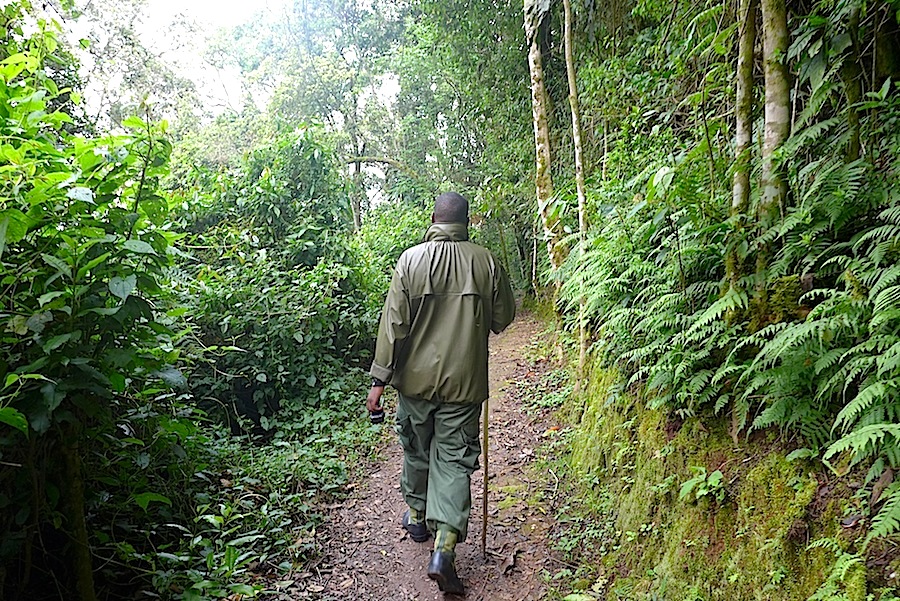
Above: Our guide led the way.  He spotted a number of blue monkeys and turaco birds for us.**

(The earth walls that were cut when the trail was created — to the right of the guide above — bring the smaller plants of the forest floor to almost eye level. I’ve put pictures and names of some of them in a photo gallery, which you can scroll through by clicking on ‘Continue reading’ at the end of this post.)

Photo by L. Koran
Photo by L. Koran

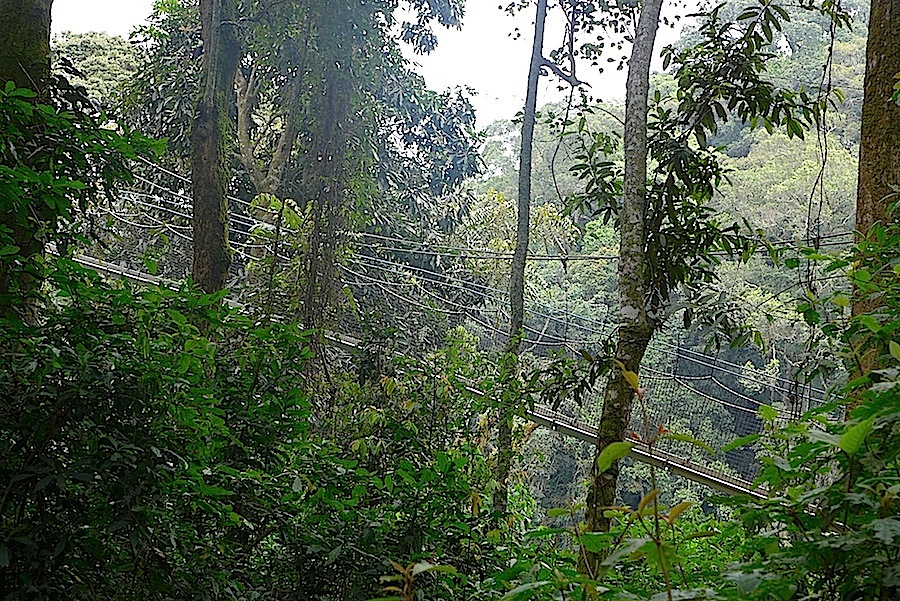
Above: We arrive at the beginning of the canopy walkway.

Photo by L. Koran
Photo by L. Koran

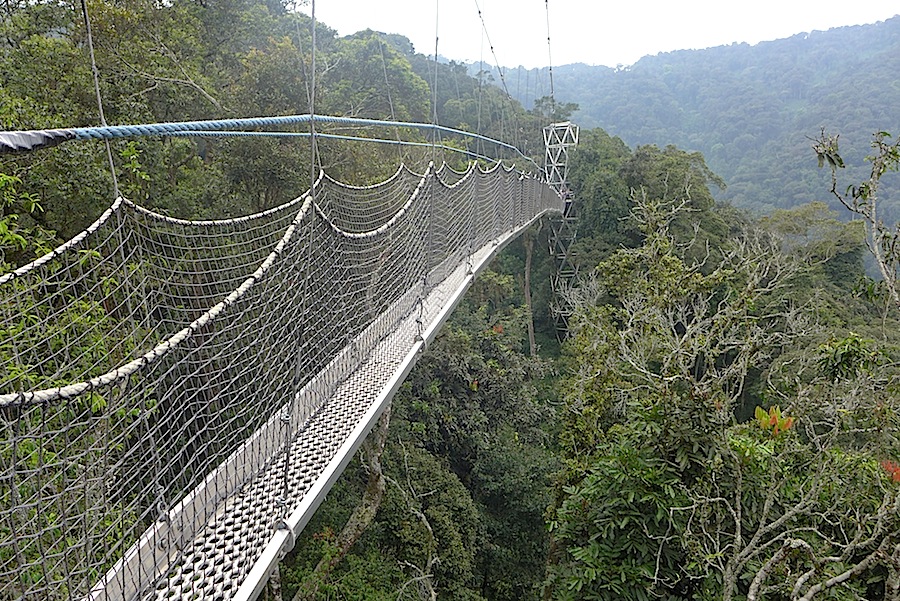
Above: The middle and highest section is 187′ (57 m.) above the ground.

During last year’s visit, with only the three of us and the guide, the walkway swung less, and I stopped a few times to look down and take pictures. (You can see them here.)

This time, in a group of about fifteen — with eight people crossing the walkway at a time — the shaking made me keep my eyes on the back of the person in front of me.

Photo by L. Koran
Photo by L. Koran

Above: Our guide starts across.

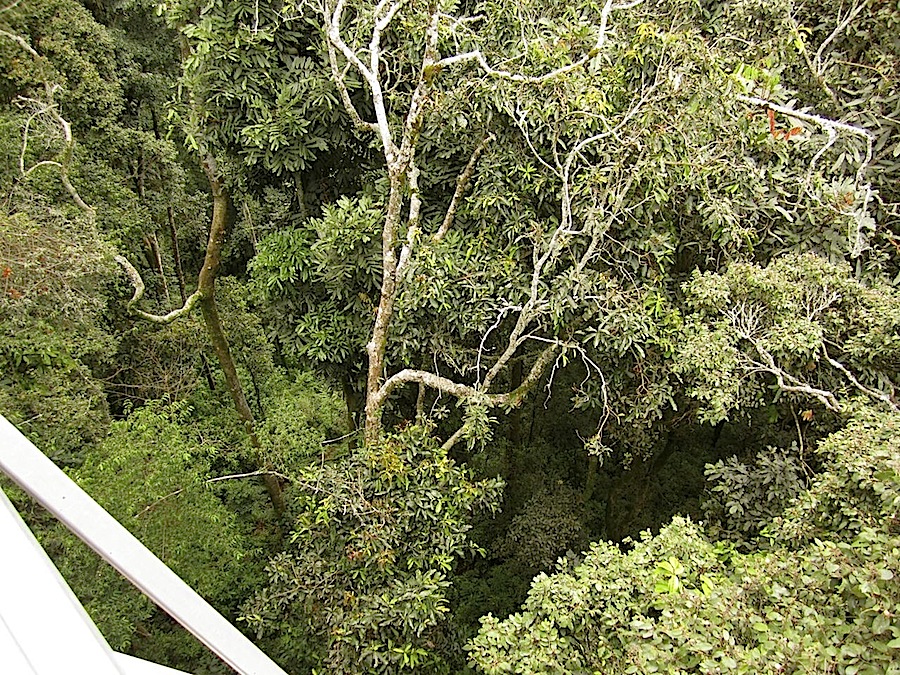
Nyungwe National Park/enclos*ureAbove: I did look down after I reached the top of the second tower.

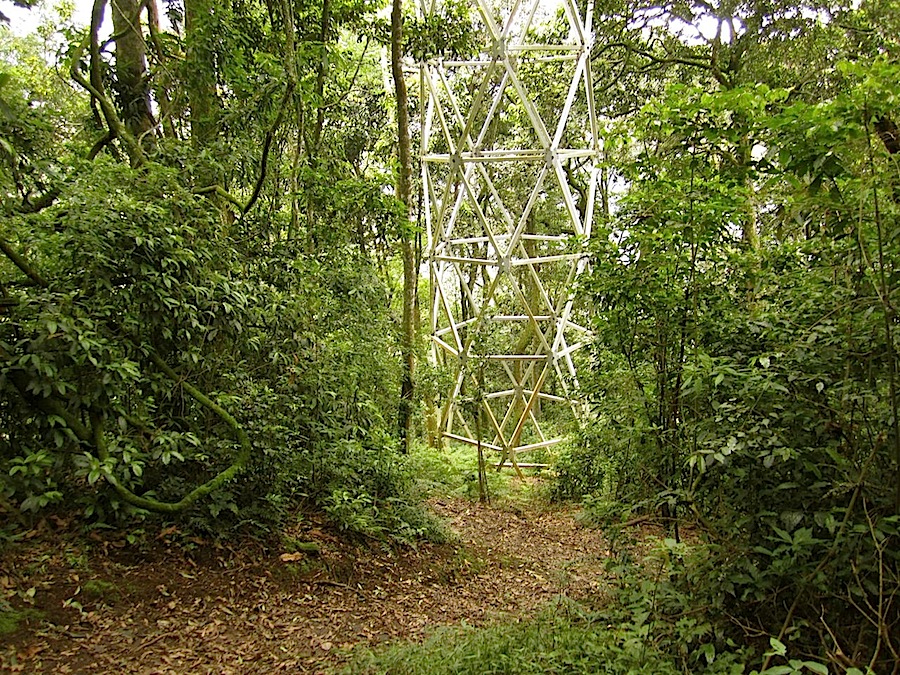
Nyungwe National Park/enclos*ureAbove: Back on the ground below the second tower.

Nyungwe National Park/enclos*ure

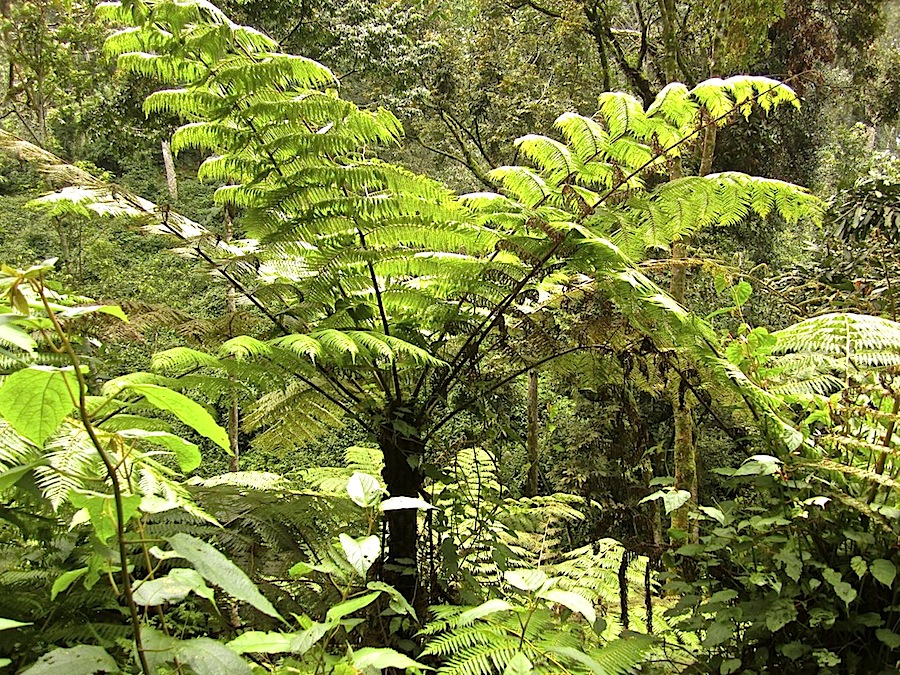
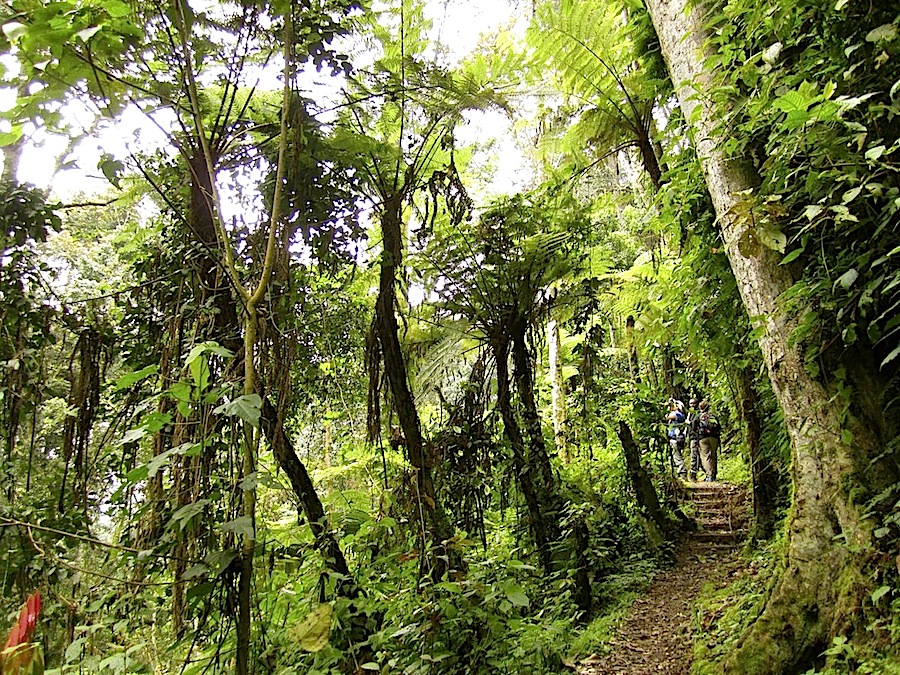
When you cross the middle section of the walkway and (dare to) look down, you see a narrow valley of tree ferns and hear the moving water of a stream.  The second half of the hike continues on to that valley.  There, we saw hundreds of the tall ferns.

Nyungwe National Park/enclos*ure

In fact, this trail is named — in Kinyarwanda — for the tree ferns: the Igishigishigi Trail.

Nyungwe National Park/enclos*ure

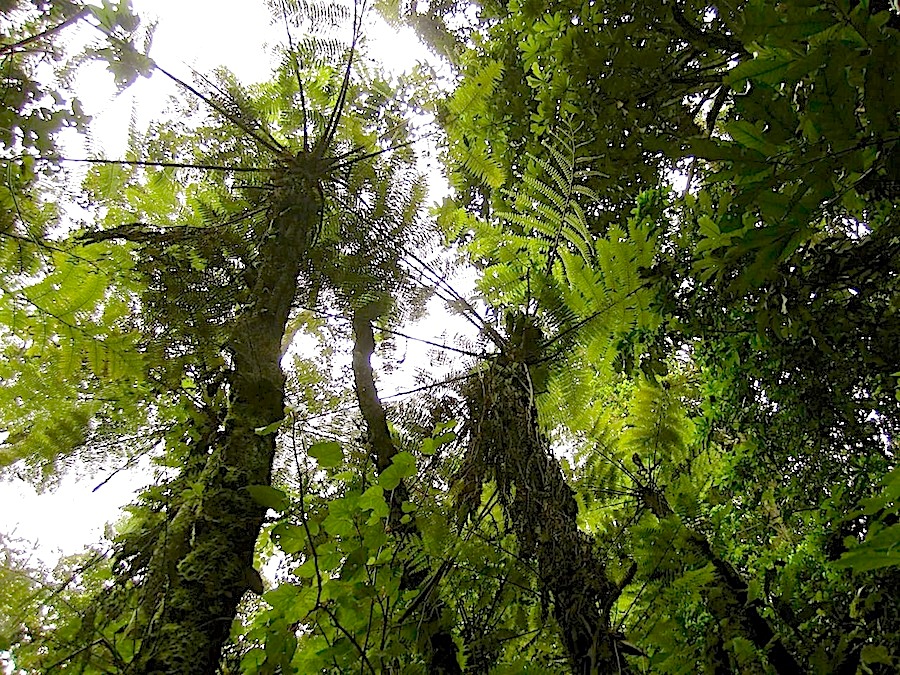
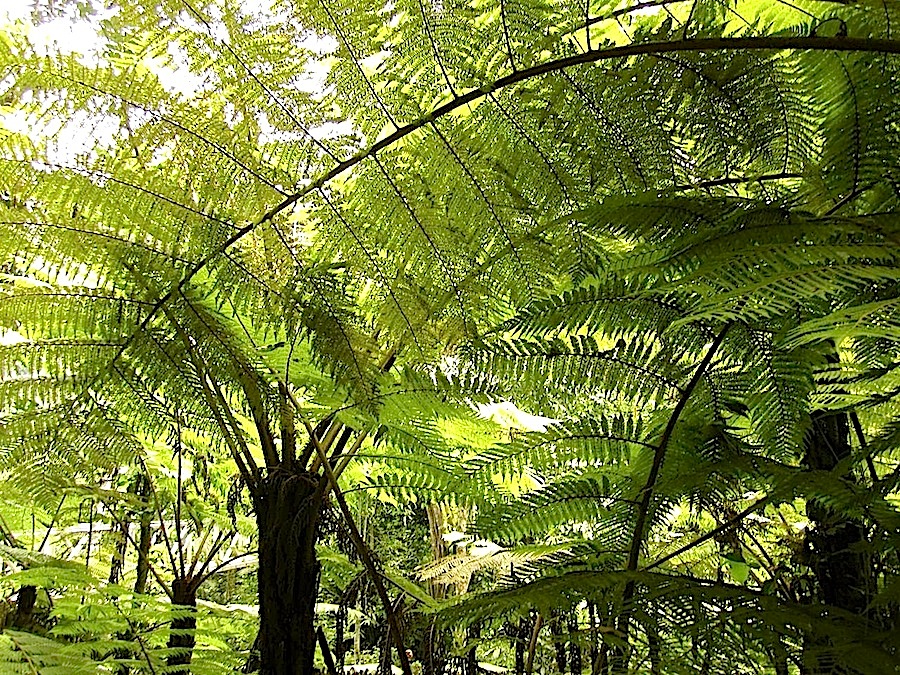
Cyathea manniana is one of two tree ferns in the park.  The other is C. dregei.  Manniana only grows in undisturbed forest, while dregei can be found along the sides of the road through the park (it also has persistent old leaves).

Nyungwe National Park/enclos*ureAbove: Looking up into the ferns. C. manniana can grow to almost 20′ (6 m.) tall.

Nyungwe National Park/enclos*ure

C. manniana is traditionally used as a medical plant to treat snake bites,” according to my field guide.*** There are nine kinds of snakes in the park, but only one is poisonous.

Nyungwe National Park/enclos*ure

Nyungwe National Park/enclos*ure

Photo by L. Koran
Photo by L. Koran

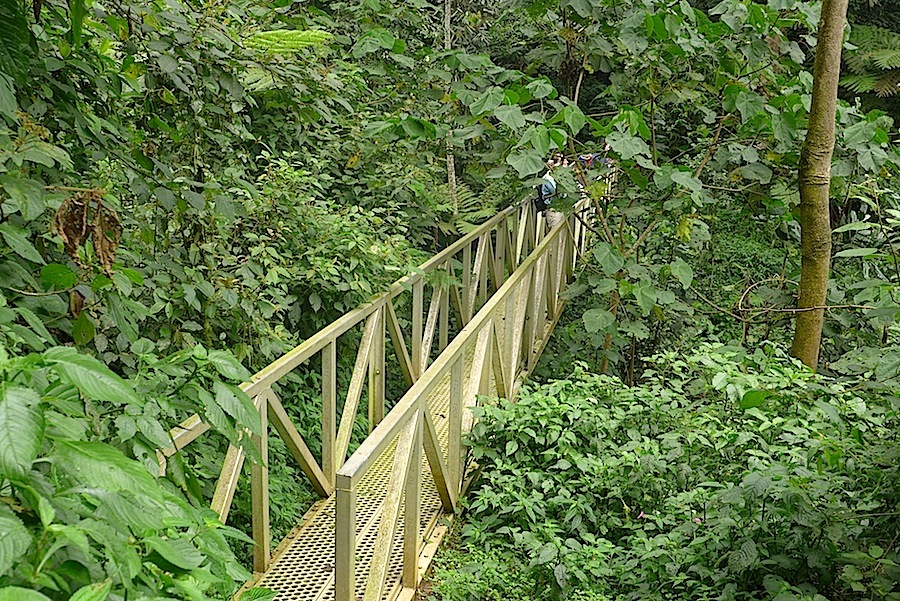
Above: A small bridge crosses the stream that we heard from the canopy walkway.  The guide meant to take us down to the water, but there were too many biting ants on the path.

Nyungwe National Park/enclos*ure

Tree ferns are one of my favorite plants, but unfortunately, they would not grow well in the cold or the heat of our Washington, D.C., garden.

Nyungwe National Park/enclos*ure

Nyungwe National Park/enclos*ureAbove: Leaving the ferns behind, we started back to the welcome center.

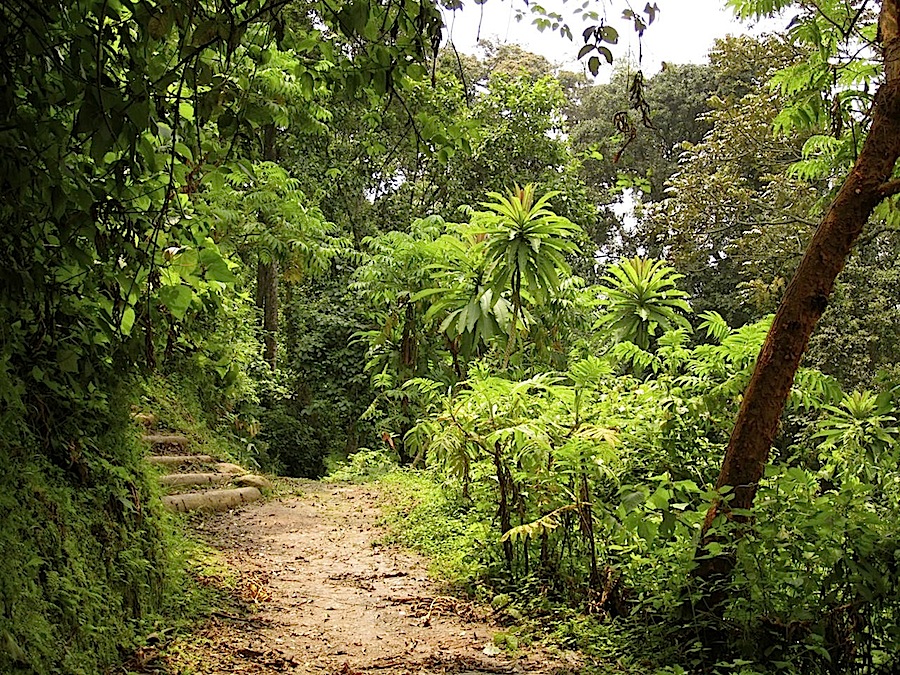
The Igishigishigi Trail is 1.3 miles (2.1 km.) long and takes 1 1/2 to 2 hours.  It is rated ‘easy,’ but a large part of it involves descending and ascending steps.  It’s a solid workout.

The trail begins at an elevation of 8,038′ (2450 m.) and descends to 7,530′ (2295 m.).

Nyungwe National Park/enclos*ureAbove (on the right): Nearing the final set of steps, we found a large group of Lobelia gibberoa or giant lobelias.

With their long candles of greenish white flowers, the plants can grow to 29′ (9 m.) in height.  Latex from the stems is traditionally used to treat irritation from stinging nettles.

Nyungwe National Park/enclos*ureAbove: After the hike, we went back to the Nyungwe Forest Lodge on the Huye-Rusizi Road.  The yellow flowers along the edge are a Senecio species.


*from “Ex Libris” by Eleanor Wilner.

** It’s also quite possible to see turacos flying from tree to tree from the pool at the Nyungwe Forest Lodge.

***An excellent book about the park is the Illustrated Field Guide to the Plants of Nyungwe National Park [of] Rwanda by Eberhard Fischer and Dorothee Killman.  It’s 770 pages long, with color photographs of 650 plants.  You can buy a copy here.  Unfortunately, it’s $71.  Some copies were printed for the Rwandan tourism office, and  I bought mine in a Kigali bookstore for about $25, but I haven’t seen any on sale here for about a year.