
 “Memie” (Mary Elizabeth Edwards) and her first post office in Lloyd, Florida, ca. 1910, via State Library and Archives of Florida (Florida Memory) Commons on flickr.
Shades of Eudora Welty. . . here’s her famous story.
 “Waiters at Day and Brothers Ice Cream Saloon,” 1880, Ocean Grove, New Jersey, by William H. Stauffer, via Robert Dennis Collection of Stereoscopic Views, The New York Public Library.

The image is not very clear, but it looks like a fun place. The same company still exists at the location shown above as Day’s Ice Cream. It is Ocean Grove‘s oldest continuously operating business.
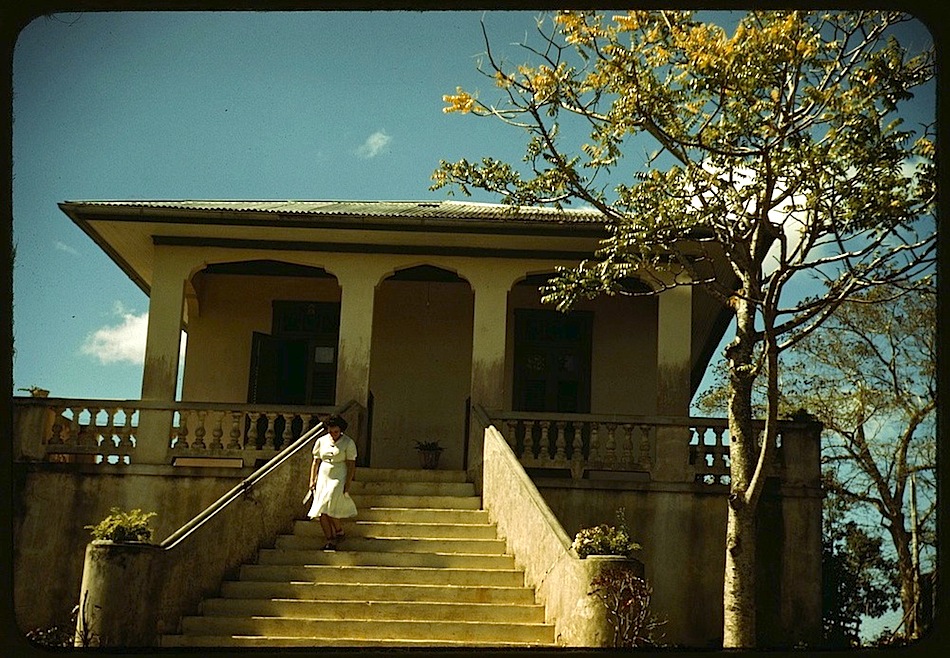 Puerto Rico or the Virgin Islands, winter 1941/42, by Jack Delano, via Library of Congress Prints and Photographs Division.
 “Calvert Richard Jones (on the right), with six women, a man, boy, girl and dog, standing and sitting in a colonnaded porch way,” probably Swansea, Wales, ca. 1860, via National Library of Wales Commons on flickr.
Jones was a member of Swansea’s wealthly, landowning elite. He studied mathematics at Oxford and was ordained as an Anglican priest, but spent much of his time traveling and painting. Like many men and women of his class in the Swansea area from the 1840s to the early 1860s, he was a photography enthusiast. In 1841, he took a daguerreotype that is now the earliest accurately dated photograph in Wales.
The photo may include Mrs. Jones (Portia Smith) and one or more of their three daughters.
 Farmhouse on Michaux Plantation, Danville area, Virginia, 1935, by Frances Benjamin Johnston, via Library of Congress Prints and Photographs Division. (There are two more views here.)
I could not find out when this simple house* was built or if it still exists. It is somewhat similar to this house in the same area, which Johnston’s notes say was built between 1776 and 1850.
Michaux was one of eleven plantations in southern Virginia owned by the Hairston family, one of the largest slaveholders in the South. Its name probably indicates that the land was also once owned by a member (this one?) of the local branch of the Michaux family.
This is the kingdom that you find
When the brave eye-holes stare
impartially against the air. . .— Joy Davidman, from “Stark Lines-Resurrection”
*It reminds me of the old house or schoolhouse quilt block pattern.
 enclos*ure