

A home in Raleigh County, West Virginia, May 1996, a 35 mm slide by Lyntha Scott Eiler for the Coal River Folklife Project and the American Folklife Center, via Library of Congress Prints and Photographs Division.
A home in Raleigh County, West Virginia, May 1996, a 35 mm slide by Lyntha Scott Eiler for the Coal River Folklife Project and the American Folklife Center, via Library of Congress Prints and Photographs Division.
 “Residents of an older home,* built in the 1850’s, take advantage of the summer weather to sit on their front porch off Route #800.” Barnesville, Ohio, July 1974. Below, the back porch.

Both photos above were taken by Erik Calonius for DOCUMERICA, an early photography program of the U.S. Environmental Protection Agency (EPA). They are shown, with the original caption, via The U.S. National Archives Commons on flickr.
From 1972 to 1977, the EPA hired over 100 photographers to “document subjects of environmental concern.” They created an archive of about 20,000 images.
In addition to recording damage to the nation’s landscapes, the project captured “the era’s trends, fashions, problems, and achievements,” according to the Archives, which held an exhibit of the photos, “Searching for the Seventies,” in 2013.
By 1974, the proliferation of porchless ranch-style houses, air-conditioning, and television had made sitting on a shady front porch in hot weather something of an anomaly for many Americans.
*A visitor to the first photo’s flickr page wrote, “This house stood on the north side of State Route 800, near Barnesville, at about 40.014772, -81.168533. The section pictured here may have been of log construction.”
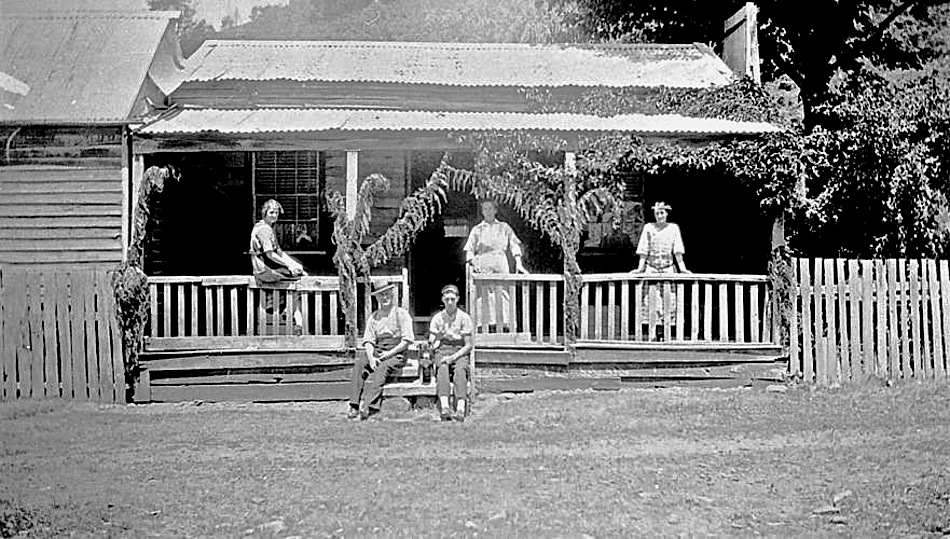 Rae family home with fern fronds as Christmas decorations, Jericho, Victoria, Australia, ca. 1918, via Museums Victoria Collection.
Jericho was a gold mining town, established in the 1860s. The local tree ferns resembling palm trees were said to remind early settlers of the biblical Jericho. By 1918, the old settlement was well into a decline, and its last buildings were destroyed by a bush fire in 1939.
 Back porch, possibly in Northwest Manville, New Jersey, February 1936, by Carl Mydans for the U.S. Resettlement Administration, via Library of Congress Prints and Photographs Division.
 Collins-Davis House, Main Street, Old Washington, Kentucky, 1982, by Jack Boucher for an Historic American Buildings Survey (HABS), via Library of Congress Prints and Photographs Division (all photos here).

This clapboard structure, built in 1875, is the most exuberant interpretation of Gothic Revival architecture in Washington. . . . A mid-western interpretation of Gothic Revival cottage architecture, . . . with three steep gables emphasizing verticality and the porch with stylized Tudor arches drawing attention from the Greek Revival doorway. Notably absent is any vestige of . . . the “gingerbread” often associated with post-Civil War architecture.
— HABS, written ca. late 1970s or early 1980s
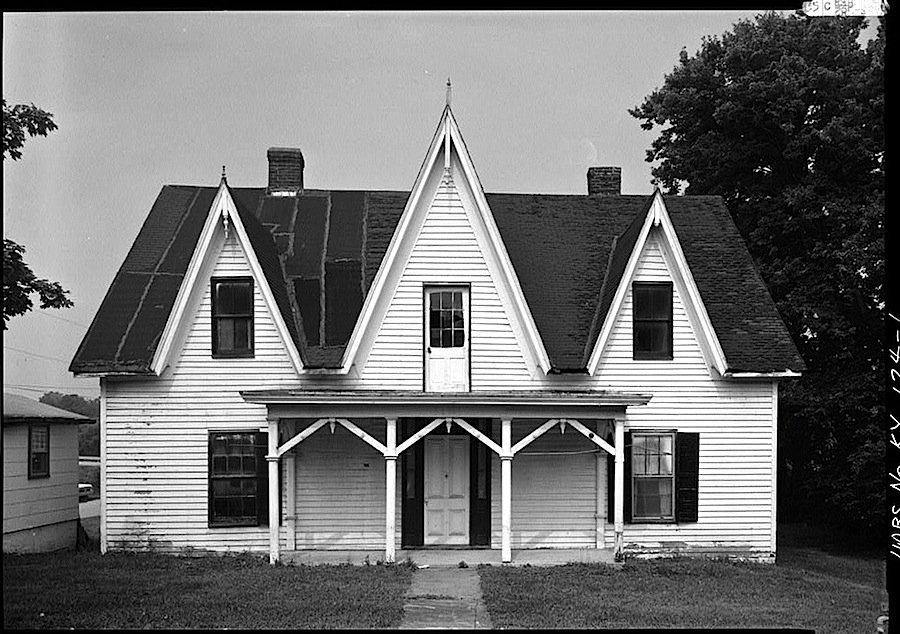
Looking at Google Maps street view for Old Washington, it appears that the house still exists in good condition.
 enclos*ure