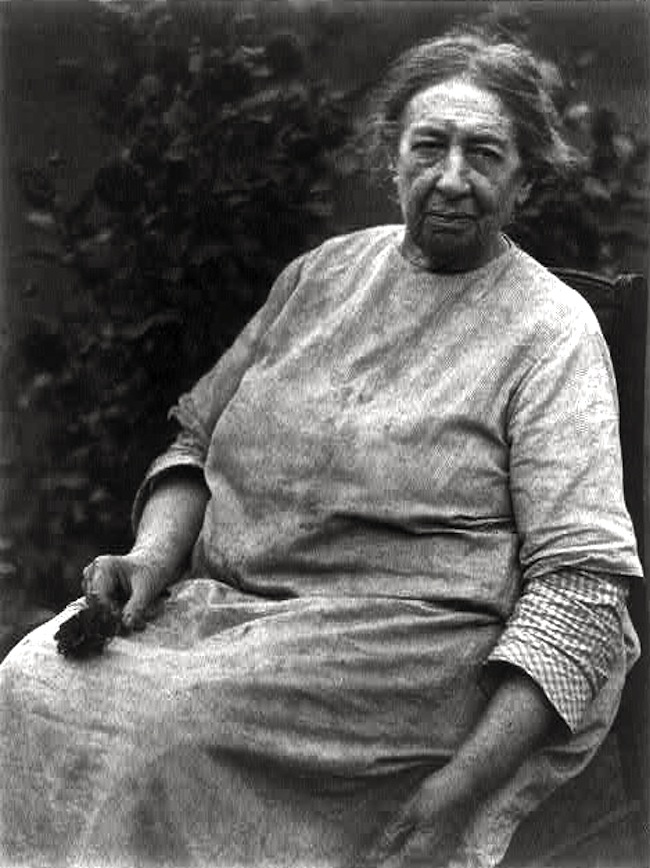
Vintage landscape: cabbage

Cabbage portrait, Mississippi Dept. of History and ArchivesCrystal Springs, Mississippi, between 1900 and 1950, via Luther Hamilton Photograph Collection, Mississippi Department of Archives and History Commons on flickr.

The almost 1,000 photos in this collection were taken or collected by the Luther Myles Hamiltons — Sr. and Jr. — during the first half of the 20th century.  They document life in and around the farm town of Crystal Springs.  

Luther Sr. was a portraitist, and his pictures of the babies, children, and women on this page are lovely.

Many of the farm fields in the suburbs of Stuttgart are blue with rows of cabbages right now.  I will try to get a photo before the harvest.

The stump of the newborn
dries in the crook of my arm.
I am the witch, cradling
the pale green head,
murmuring, “Little one,
you look good enough to eat.”

— Lisel Mueller, from “Found in the Cabbage Patch“

The Birkenkopf, Stuttgart

This mountain, piled up after World War II from the rubble of the city, stands as a memorial to the victims and a warning to the living.
— plaque at Birkenkopf

This slideshow requires JavaScript.

Allied bombing raids on Stuttgart during World War II  destroyed at least 45% of the city, including nearly all the city center.*

In the mid-1950s, 1.5 million cubic meters of the resulting rubble were moved to a hill in the southwest of the city — raising it by about 40 meters and making it the highest point in central Stuttgart.

This is the Birkenkopf or Rubble Hill, which we visited two weekends ago.  It is sometimes also called Monte Scherbelino or Mount Shards.

A wide spiraling asphalt path leads walkers, runners, and cyclists up through the woods that have grown over the debris. At the summit, a semi-circular berm of broken concrete and ornamental stonework forms a terrace or shallow amphitheater facing a spectacular view of the city.

There are many post-WWII rubble hills (aka Schuttberge or Trümmerberge) in Germany.  London has some as well, and there’s an interesting essay about this kind of ‘made ground’ (“a sort of spatial redistribution of violence”) here.

I have not been able to find the name of the company or person who directed the design of the Stuttgart hilltop area.

You can watch a beautiful short video of the Birkenkopf from the air here. If you visit Stuttgart, you can reach the site via the no. 92 bus from the Rotebühlplatz U-bahn stop.

To scroll through larger versions of the slides above, click on ‘Continue reading’ below and then on any thumbnail in the gallery.

Roofless walls
Rooks overlook
I told you so
Babbles the brook

— Samuel Menashe, from “Ruins“

ADDENDUM:  From the Facebook page Birkenkopf-Stuttgart, I learned that the Birkenkopf was designed by Manfred Pahl, a painter and architect working for the city’s Department of Landscape Planning and later with the Verschönerungsverein Stuttgart (beautification association).

There’s an interesting picture of the construction of the hill here.


*Over 4,500 people on the ground and 2,400 Allied aircrew (300 planes) are estimated to have died during the Stuttgart attacks, according to Wikipedia. The city had important industrial resources and several military bases and was a railway hub for the southwest.


Continue reading “The Birkenkopf, Stuttgart” →
Life in gardens: snake

Man with snake, Alabama, 1948, via Galt Museum“James Burness Senior holding a rattle snake outside the family’s home at Coste Station, six miles from Burdett, Alberta[, Canada]. ”

The photo, dated August 1948, is via the Galt Museum & Archives Commons on flickr.

I’m trying to figure out what plant is coming up in the narrow L-shaped — or does it go around to form a square with the sidewalk — bed behind him.  Sunflowers?

Life in gardens: dahlias

Woman with dahlia, Library of Congress“Woman with dahlias,” ca. 1930, by Doris Ulmann, via Library of Congress Prints and Photographs Division.

In this beautiful portrait of an older Appalachian women, you can just see her stand of dahlias behind her.

In the traditional language of flowers, the dahlia is usually said to represent dignity, sometimes elegance.

A well-to-do New Yorker, Doris Ulmann trained as an art photographer with Clarence H. White in the 1910s. In the 1920s, she began traveling to the southeast to photograph rural people, particularly in the hills of Kentucky and the Sea Islands of South Carolina — people “for whom life had not been a dance.” She also documented Appalachian folk arts and crafts, working with musician and folklorist John Jacob Niles.

Life in gardens: 1967

Tompkins Square Park, 1967, George Eastman HouseTompkins Square Park, East Village, New York City, 1967, by James Jowers, via George Eastman House Commons on flickr.

Tompkins Square Park . . .  was reconstructed [in the mid 1960s,] just in time for an era of sweeping changes. The surrounding neighborhood became the east coast version of ‘Haight-Ashbury.’ Rock musicians, poets, hippies, and political activists transformed downtown Manhattan into a center for counter-cultural activities and political protest. It was during the mid- to late-1960s that the area surrounding Tompkins Square Park came to be called ‘The East Village.’ . . .

Tompkins Square had once before been the site of powerful expressions of joy and rebellion. A century earlier, German-Americans had transformed the square with their volkefestes and mass demonstrations. Their spirit and command of the space were being revived— only now in 1960s terms. Young people demonstrated at the bandshell against American involvement in Vietnam and in favor of women’s and third world liberation movements. They gathered to hear bandshell concerts put on by the Fugs, the Grateful Dead and Charles Mingus. They were certainly ignoring signs that cautioned ‘keep off the grass.’ . . .

— Laurel Van Horn, from “A History of Tompkins Square Park“