Redistribution of produce

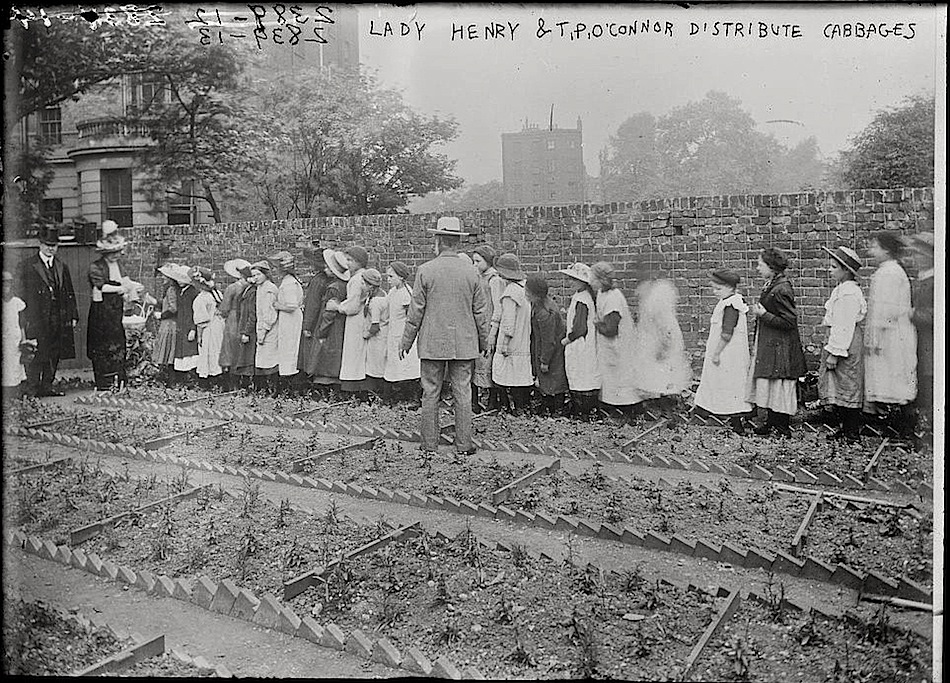
Cabbage distribution, Library of Congress
Lady Henry Somerset and T.P. O’Connor in a garden distributing cabbages to children, between ca. 1910 and ca. 1915, Bain News Service, via Library of Congress, Prints and Photographs Division.

Lady Henry  (born Lady Isabel Cocks) was an heiress who married the second son of the Duke of Beaufort.  After the couple separated, she turned to charity work on her various properties. She later became president of the British Women’s Temperance Association and a campaigner for birth control and women’s suffrage. In 1913, the readers of the London Evening News voted her their choice for first female prime minister of the United Kingdom.

Thomas Power O’Connor was an Irish journalist who founded and edited several newspapers in London. He was also a member of Parliament for the Irish Nationalist Party and later as an independent (representing Galway and then Liverpool).

I cannot tell what plants are growing in the flower (?) beds, but they are sectioned off — perhaps by bloom color?
The Sunday porch: Mothers’ Day


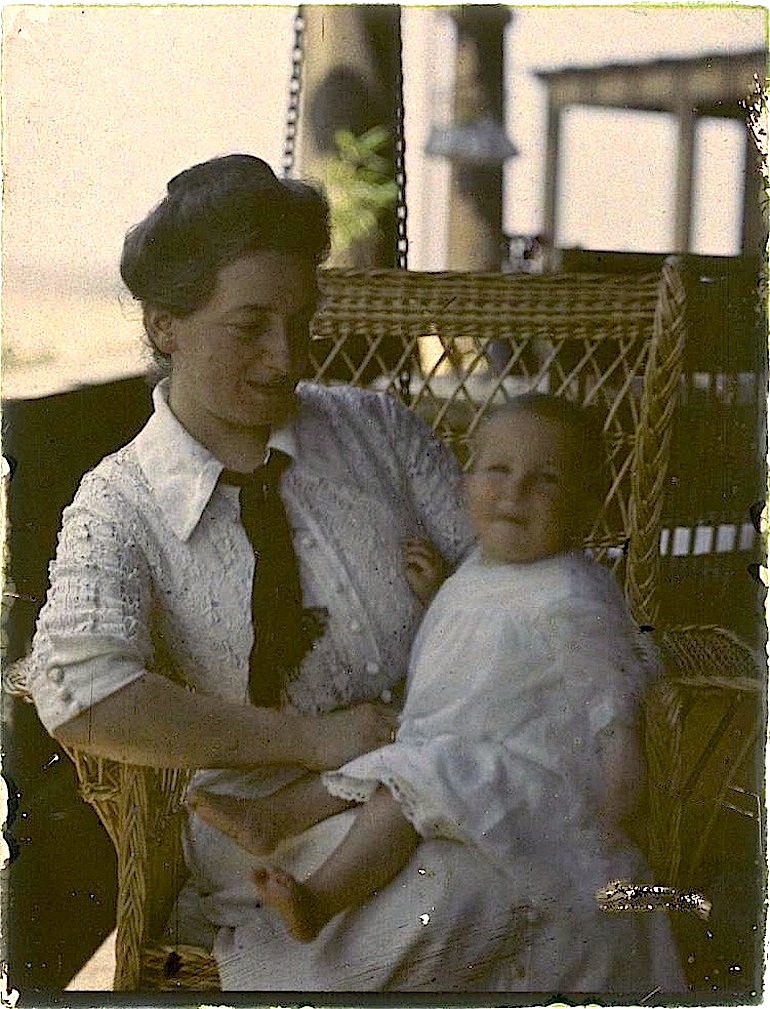
“Woman holding baby on outdoor porch,” ca. 1915, an autochrome by unknown photographer, via George Eastman Museum Commons on flickr.

The porches look as if they are facing out to a beach.

Boston, Massachusetts

“‘City farmer’ tends garden in the Fenway, administered by the 600-member Fenway Civic Association. Four hundred twenty-five personal gardens are tilled on these five acres in Metropolitan Boston, [Massachusetts],” May 1973, by Ernst Halberstadt, via U.S. National Archives Commons on flickr.

This photo was taken for DOCUMERICA, an early photography program of the U.S. Environmental Protection Agency (EPA). 

From 1972 to 1977, the EPA hired over 100 photographers to “document subjects of environmental concern.” They created an archive of about 20,000 images. In addition to recording damage to the nation’s landscapes, the project captured “the era’s trends, fashions, problems, and achievements,” according to the Archives, which held an exhibit of the photos, “Searching for the Seventies,” in 2013.

San Francisco, California

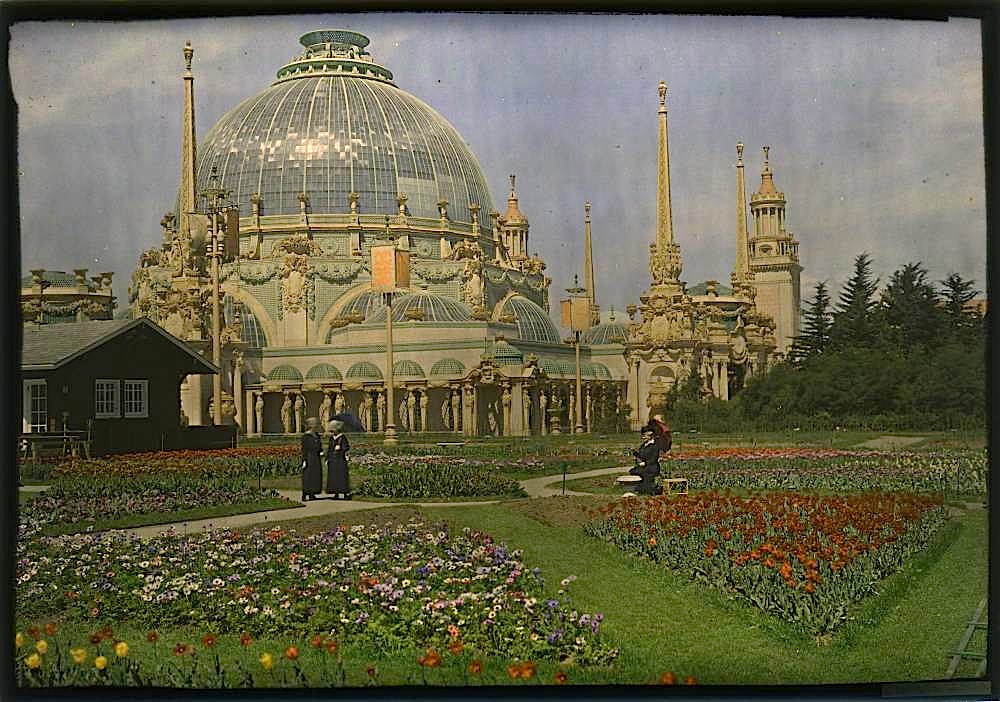
Palace of Horticulture, Panama-Pacific International Exhibition, San Francisco, California, 1915, an autochrome by an unknown photographer, via George Eastman Museum Commons on flickr.

The Exhibition was open from February to December 1915 and celebrated the completion of the Panama Canal in 1914. It also showcased the city’s recovery from the devastating 1906 earthquake. Its palaces and halls were built on a 635-acre site along the city’s northern shore, between the Presidio and Fort Mason.

“Constructed from temporary materials (primarily staff, a combination of plaster and burlap fiber), almost all the fair’s various buildings and attractions were pulled down in late 1915,” according to Wikipedia.

The flower sellers, Paris

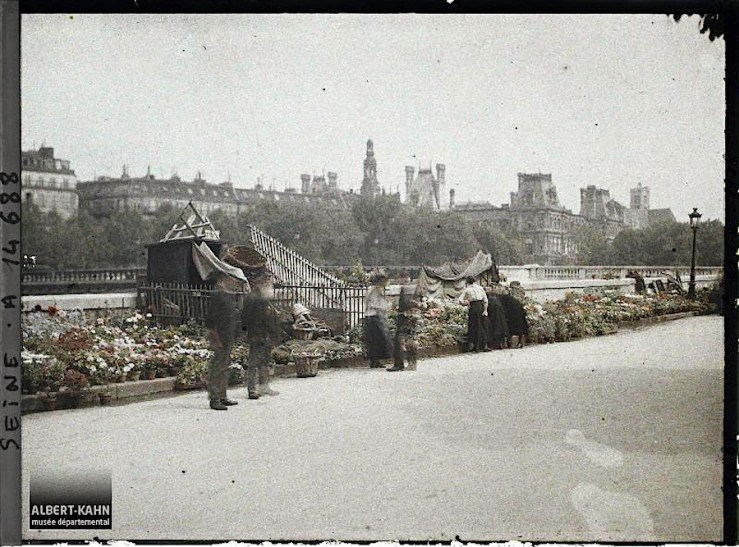
Flower sellers at Place Louis-Lépine on the l’île de la Cité, at Quai de la Corse, Paris, France, May 2, 1918, by Auguste Léon, via Archives of the Planet Collection – Albert Kahn Museum /Département des Hauts-de-Seine (both photos).

There has been a flower market on or near this spot since 1808. Since June 2014, it has been called Queen Elizabeth II Flower Market, to commemorate the visit of the British queen just prior to the 70th anniversary of D-Day.

Behind the sellers, on the other side of the river, is the Palmier Fountain and Châtelet Theater.

France, Paris, Marché aux fleurs
Looking the other directions, with the Hotel de Ville in the background across the river.

These autochromes are two of about seventy-two thousand that were commissioned and then archived by Albert Kahn, a wealthy French banker and pacifist, between 1909 and 1931. Kahn sent thirteen photographers and filmmakers to fifty countries “to fix, once and for all, aspects, practices, and modes of human activity whose fatal disappearance is no longer ‘a matter of time.'”* The resulting collection is called Archives de la Planète and now resides in its own museum at Kahn’s old suburban estate at Boulogne-Billancourt, just west of Paris. Since June 2016, the archive has also been available for viewing online here.


*words of Albert Kahn, 1912. Also, the above photos (A 13 994, A 14688) are © Collection Archives de la Planète – Musée Albert-Kahn and used under its terms, here.