
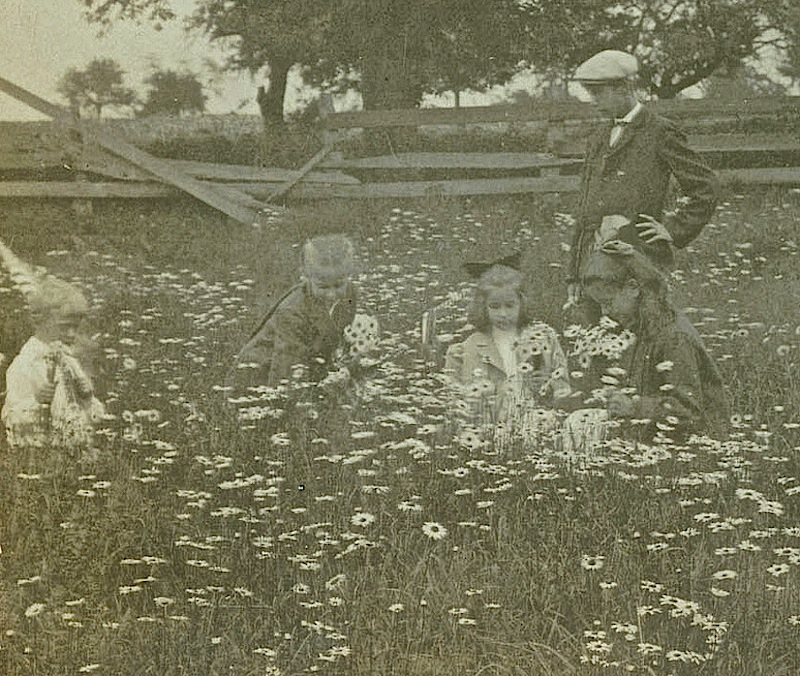
 Wallace and Dot Boyd, Fossie, and “Mother,” with “Uncle Phil” (standing) in a field of daisies. ca. 1900, one half of a stereographic portrait by an unknown photographer, via Library Company of Philadelphia Commons on flickr.
Category: life in gardens
Cheshire County, N.H.
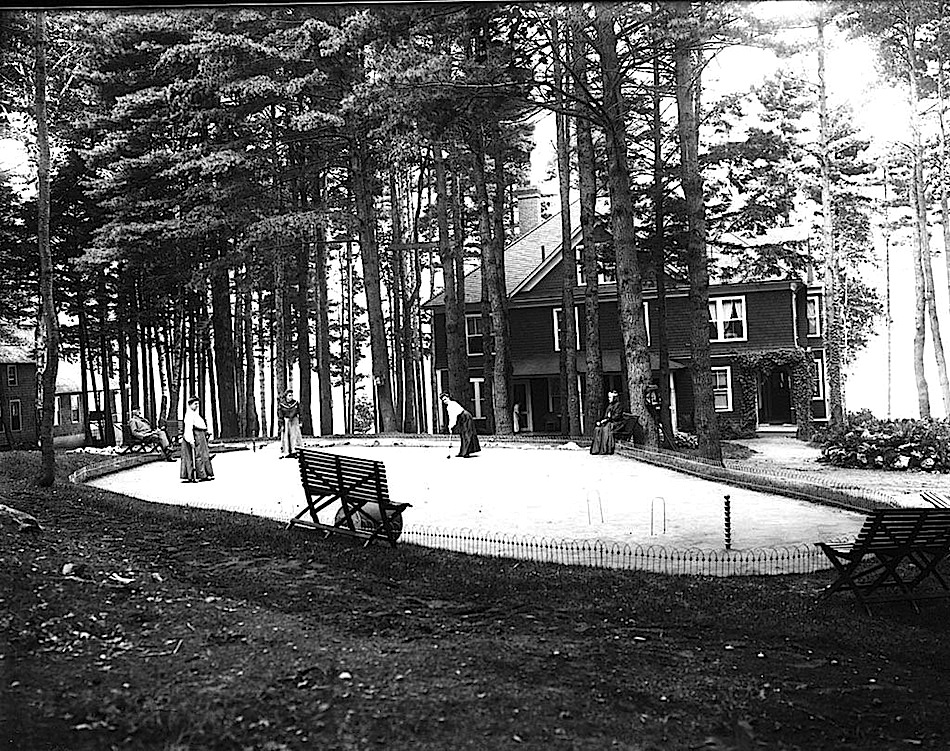
“Ladies playing croquet,” probably Cheshire County, New Hampshire, ca. 1900, by Bion Whitehouse, via Keene Public Library and the Historical Society of Cheshire County Commons on flickr.
Technically, they are playing roque, an American variant* of croquet, which is played on a hard sand or clay surface. Introduced in the late 1880s, it was extremely popular in the first few decades of the 20th century — and an Olympic sport in 1904 — and then almost entirely disappeared after the 1950s.
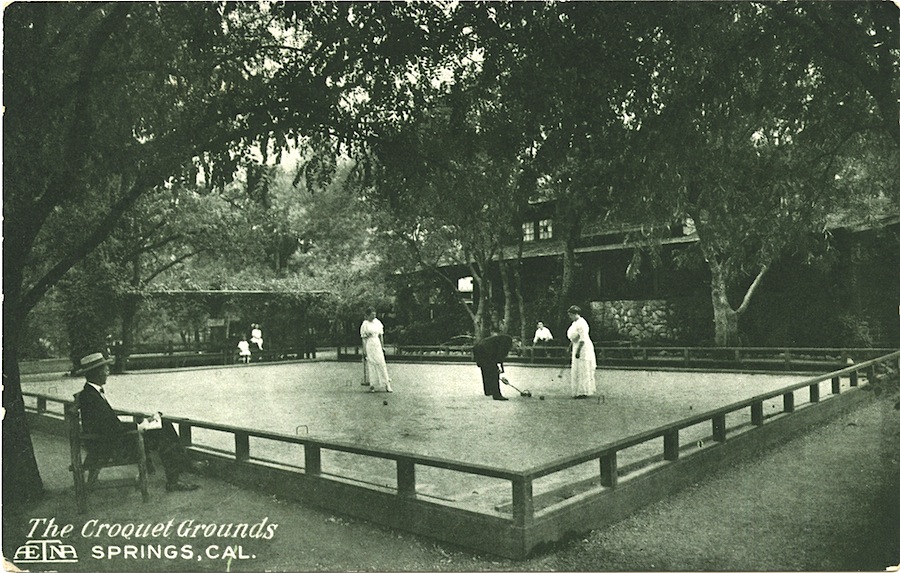
The photo above was published between 1900 and 1919, photographer unknown. It is part of the Termaine Arkley Croquet Collection and via UBC (University of British Columbia) Library Digitization Centre Commons on flickr.
There’s also a photo of 1918 roque grounds in Florida here.
*There is also a modern game of beach croquet.
New York City

The finishing touch. . .
Schoolchildren’s victory gardens on 1st Avenue between 35th and 36th Streets, New York City, June 1944, by Edward Meyer for U.S. Office of War Information, via Library of Congress Prints and Photographs Division (all photos here).
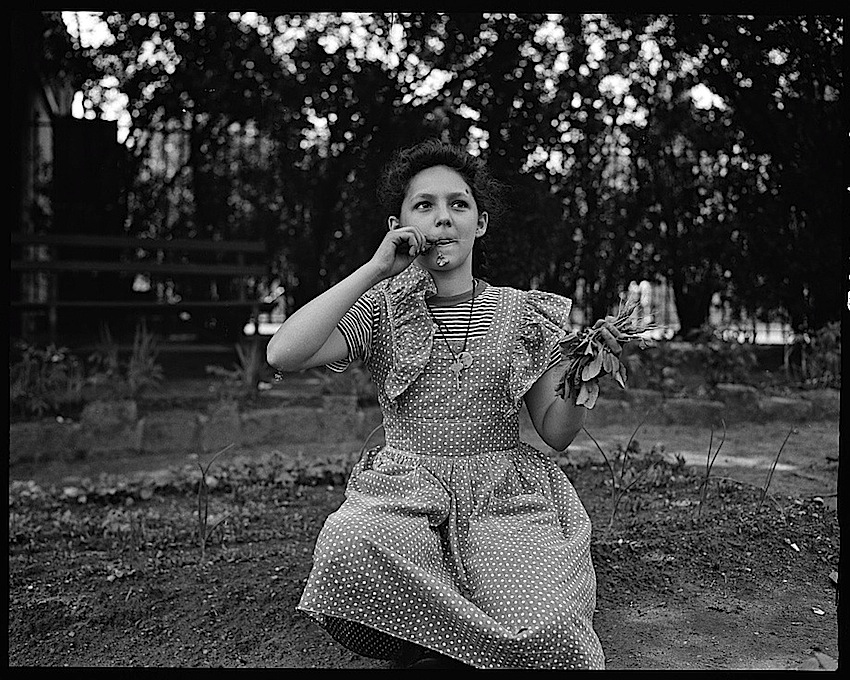
The first taste.

The location was St. Gabriel’s Park at the time of the photos. It is now called St. Vartan Park.
Please click on any of the thumbnails below to see a few more pictures of this garden.


The Sunday porch: Estero, Florida
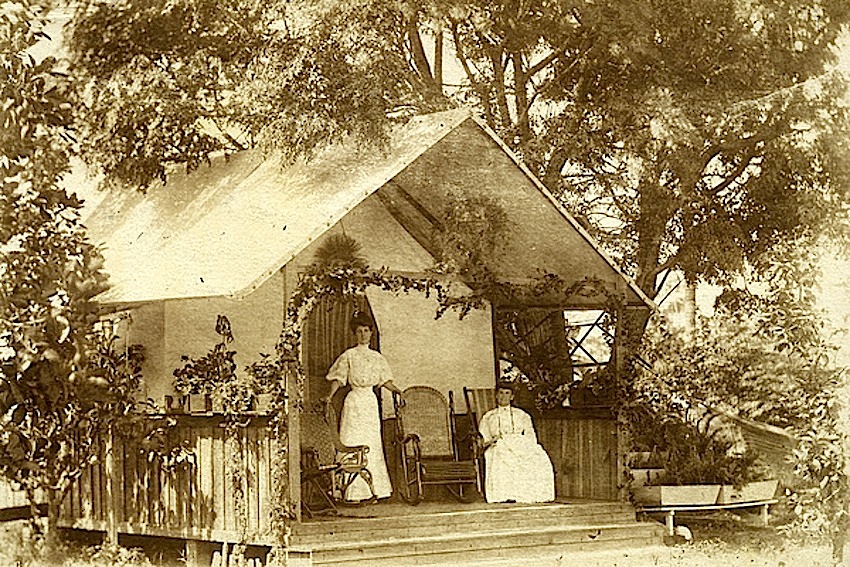
“Tent house on Koreshan property in Estero, Florida,” 1895, via Koreshan Unity Collection, Florida Memory Commons on flickr (State Library and Archives of Florida).
The Koreshan Unity was a late 19th and early 20th century utopian community whose members believed in a god that was both male and female, as well as in reincarnation, celibacy, collectivism, equality of the sexes, and cellular cosmogony.* It was founded by Cyrus Teed in upstate New York in the 1870s, and later there were also followers in Chicago and San Francisco. In 1894, the community began moving to a donated 320-acre property in Estero, Florida. During the next decade, it purchased over 5,000 additional acres and began building a settlement that “included a sawmill, cement works, bakery, machine shop, general store, art gallery, symphony, theater troupe, plant nursery and more,” according to USA Today. Its population peaked at 250 residents between 1903 and 1908; the majority were well-educated middle-class women, seven of whom managed the day-to-day affairs of the commune.
When Teed died in 1908 — and his body was not resurrected as he had promised — the commune began to decline; there were 10 members left in 1948. The last Koreshans deeded the site of its village to the state of Florida in 1961. It is now a state park.
*”Among the most interesting beliefs of Koreshan Unity was the cellular cosmogony, or the hollow earth,” according to Florida Memory. “According to the cellular cosmogony, the earth was not a convex sphere but instead a hollow, concave cell containing the entire universe with the sun at its center and Earth’s populace living on the inside surface of the hollow cell.”
Ronde kom
 Round enclosure on Eeuwigelaan (street) in Bergen, The Netherlands, 1926, by A. J. Bonda, via Archief Alkmaar Commons on flickr.
I have been wondering about the purpose of this really nice rustic fence in a wooded area (there’s another view here). In a much larger version of the photo, you can see barbed wire all around the top rails. The ground inside has either been dug out or worn away. There are two benches nearby, with more barbed wire fencing behind them. What appears to be a road in the background is actually a canal. (And you can also see that the man standing on the right is wearing wooden shoes.)
It could have been the site of a large tree of special local significance, which then died and was removed. Or the spot of some other removed shrine or monument. But why not take away the fence and fill the hole after dismantling what was inside? Then I thought it might have been the small crater itself that was important — perhaps the remains of a WWI shelling in the area.
Today, this street is lined with very large homes.
ADDENDUM: Nope, wrong all round. 🙂 Please see the very interesting comment below.
 enclos*ure