
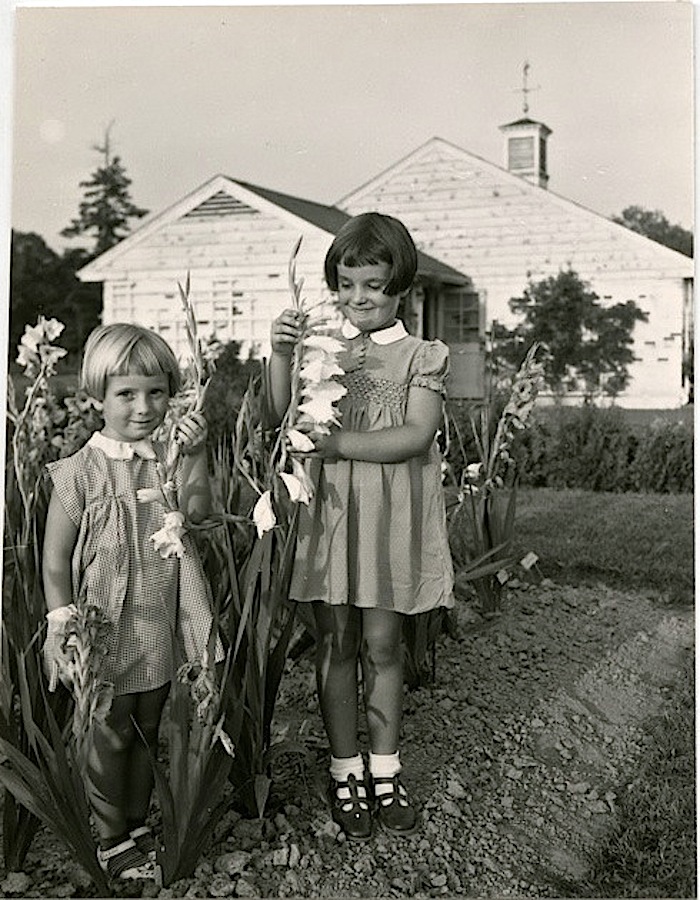
Gladiolus in the Children’s Garden, Royal Botanical Gardens, Ontario, 1955, via Local History & Archives, Hamilton Public Library (used with permission).
Gladiolus in the Children’s Garden, Royal Botanical Gardens, Ontario, 1955, via Local History & Archives, Hamilton Public Library (used with permission).
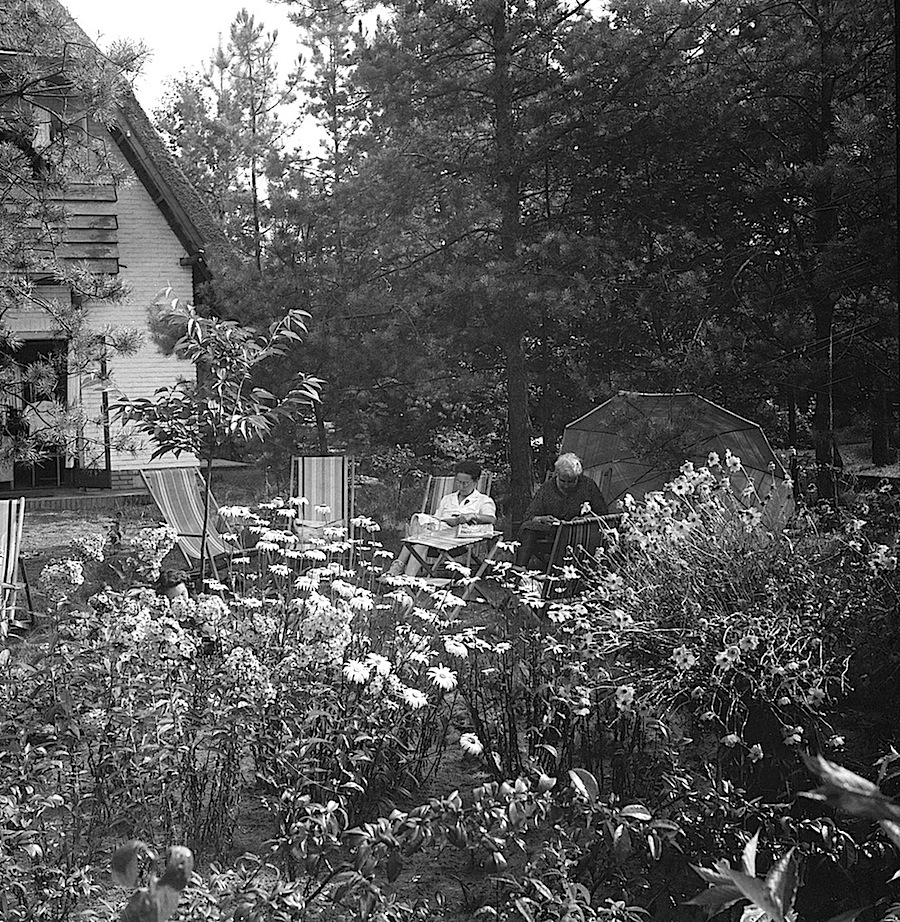
Three women in the garden; the one on the right is probably the mother of the photographer, Aalst, Gelderland, the Netherlands, undated, by Willem van de Poll, via Nationaal Archief (Netherlands).
 Sanders-Eckles wedding party, Lincolnville, Florida, ca. 1925, from the Richard Twine Collection, via Florida Memory (State Archives and Library of Florida) Commons on flickr.
Lincolnville is an historically African-American neighborhood of St. Augustine. It was established after the Civil War, in 1866, by several freedmen and women who leased the land for $1 a year. By the 1880s, it had begun to grow and “was characterized by narrow streets, small lots, and houses built close to the street line, similar to the colonial St. Augustine style and land-use pattern,” according to Wikipedia. By the 1930s, it was an important subdivision of the city in size and in political participation of its residents, and by the 1960s, it drew national attention for its role in the Civil Rights Movement.
In 1991, Lincolnville was listed on the National Register of Historic Places for its many late Victorian Era buildings and its place in African-American history. It is now known as the Lincolnville Historic District.
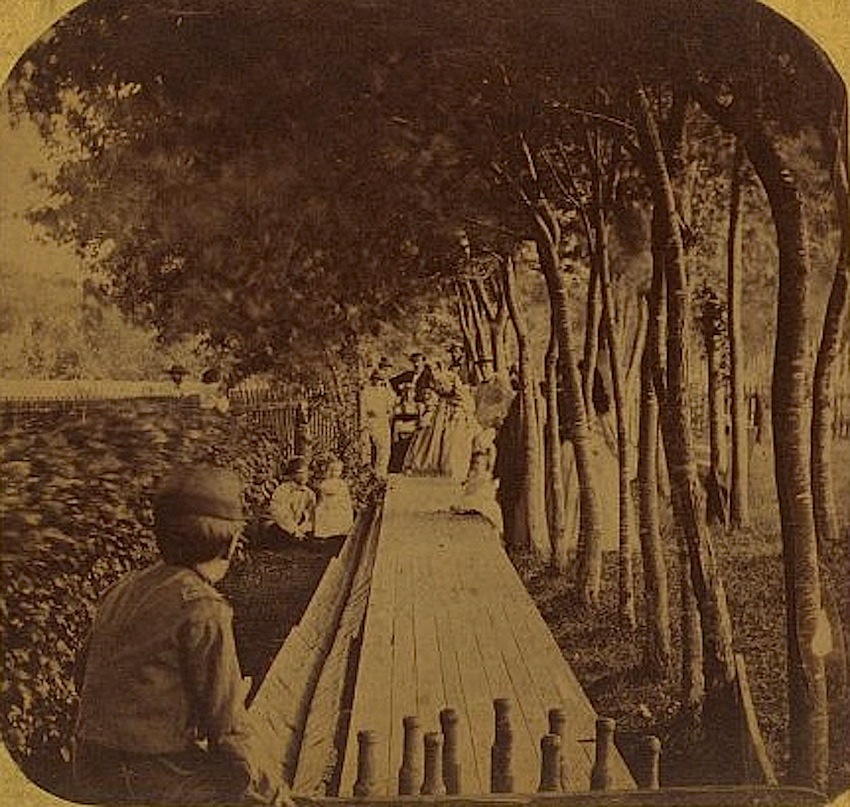
“Group of people bowling on a wooden lane erected in a yard,” July 4, 1861, via Library of Congress Prints and Photographs Division.
I just found this photo. It was taken exactly one year before yesterday’s picture, probably by James Hunter,* who would host the 1862 picnic.
The Library’s online catalogue says that “Mrs. H. Bowling and Coleman Sellers, Jr.,” have been identified in this image, although it doesn’t say where they are — probably the woman bowling (Mrs. H., bowling†) and perhaps the boy in charge of setting up the pins.
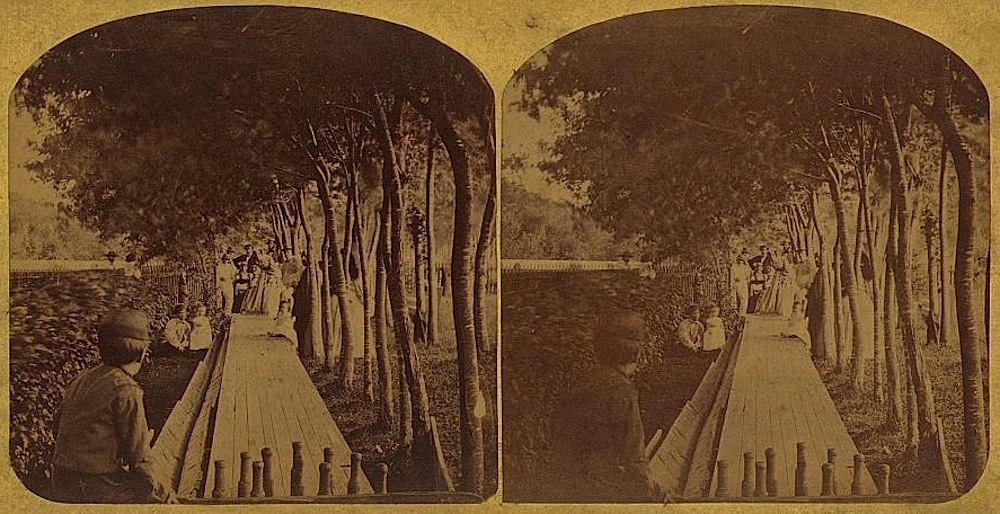
“By the mid-1800s, the game of ninepins was so popular that wealthy families installed bowling lanes at their estates. . . , ” according to American Profile. “When some states outlawed ninepins [in the 1830s and 40s] because it encouraged gambling, the modern game of tenpins evolved to skirt the laws.” I’m not sure if there are nine pins in this picture or ten. What looks like one middle pin may be two pins lined up.
The image is part of the Charles F. Himes collection of stereographs by amateur photographers, primarily members of the Pennsylvania Photographic Society (1860-61) and the Amateur Photographic Exchange Club (1861-63).
*James Hunter may have been co-owner of the Print and Dye Works in Hestonville, Pennsylvania.
†H. for Hunter? Coleman Junior’s father was Coleman Sellers II, a prominent engineer and inventor from Philadelphia. — as well as an amateur photographer.
 Fourth of July picnic at Mr. James Hunter‘s, Hestonville, Pennsylvania, 1862, a stereograph by Coleman Sellers, via Library of Congress Prints and Photographs Division.

Hestonville is now a neighborhood of Philadelphia.
 enclos*ure