Philadelphia

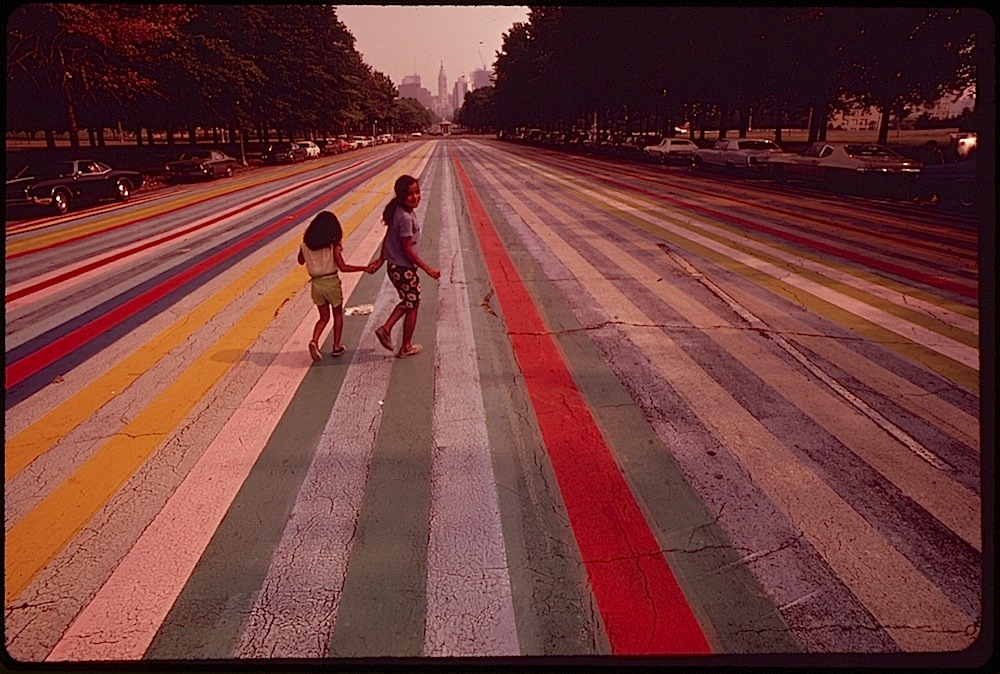
“Crossing the painted road which extends east from The Philadelphia Museum of Art, August 1973,” by Dick Swanson, via the U.S. National Archives Commons on flickr (all photos and captions in quotes here).
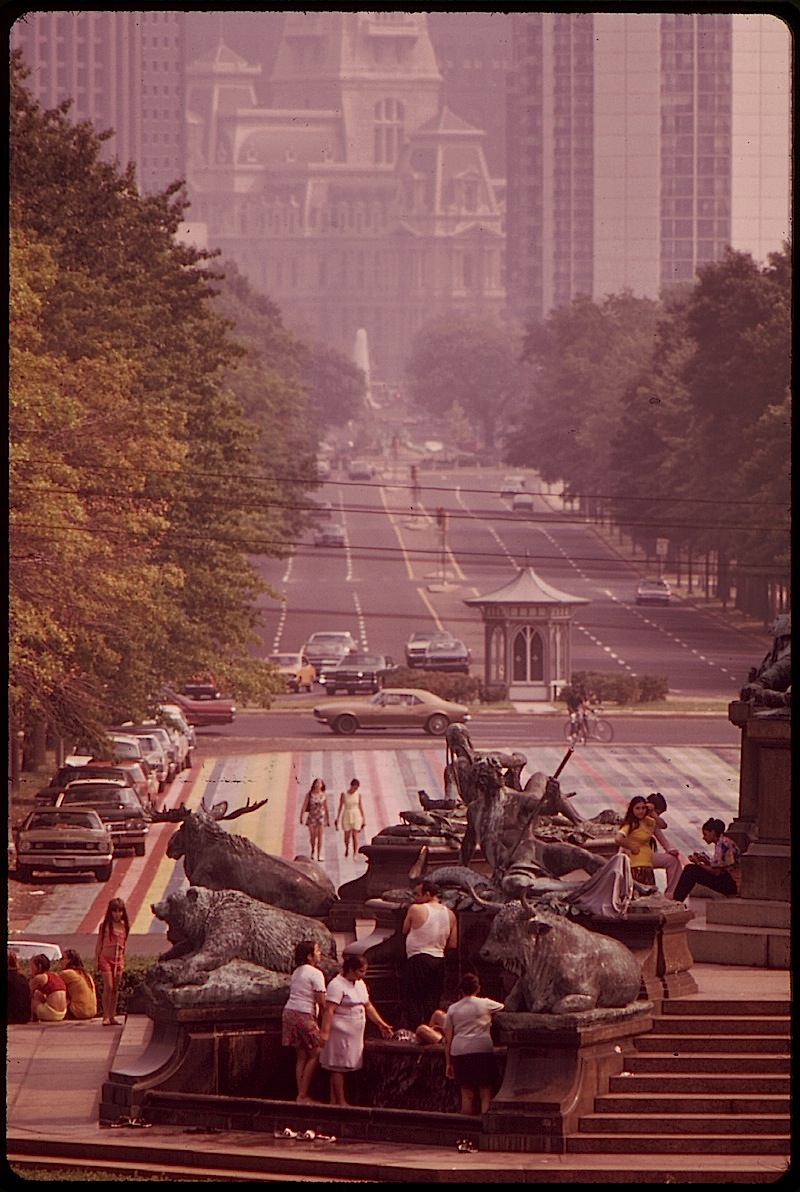
“From the steps of the Philadelphia Museum of Art — looking down Benjamin Franklin Parkway toward City Hall and Center City.”

The road painting, “Big Stripes,” was created by Gene Davis in 1972. At the time, it was the world’s largest painting.  Davis was a leader in the Washington [D.C.] Color School.
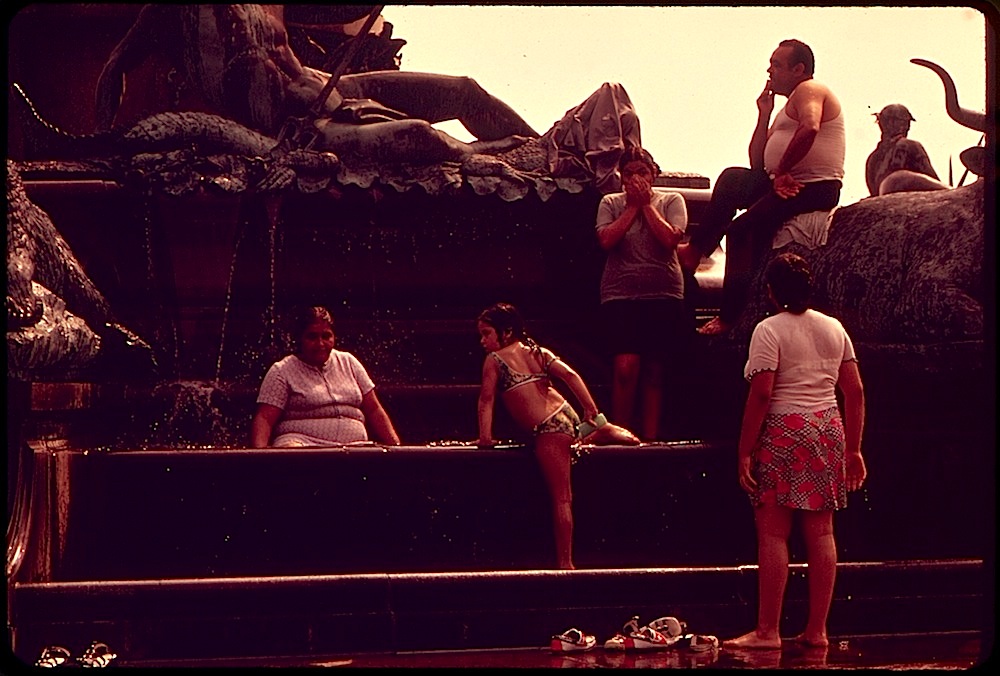
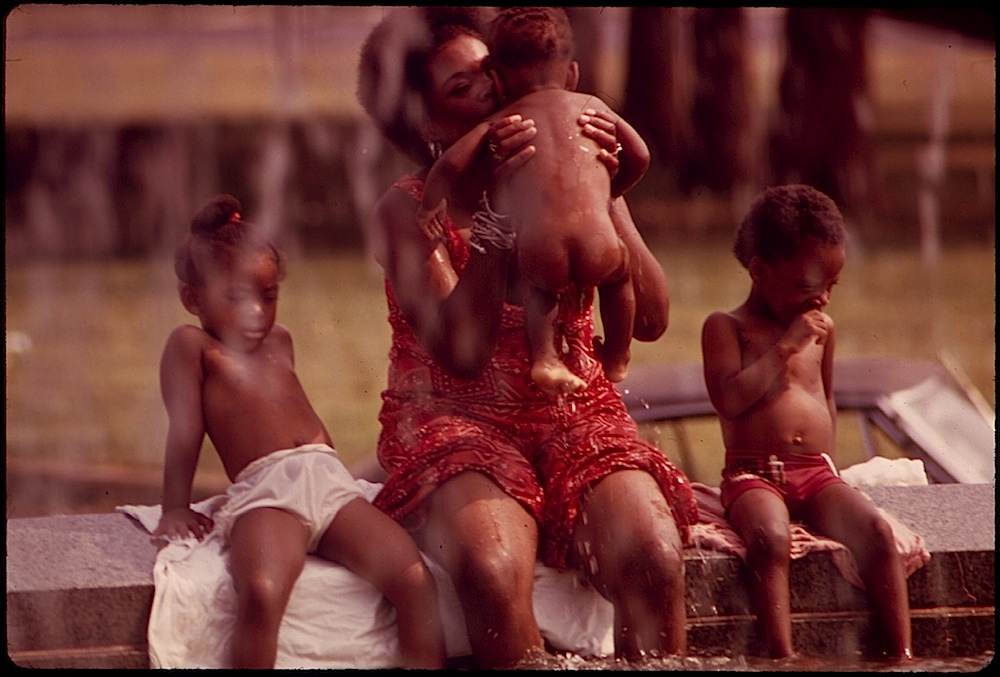
“Fountains surrounding Philadelphia Museum of Art are especially popular in a heat wave.”

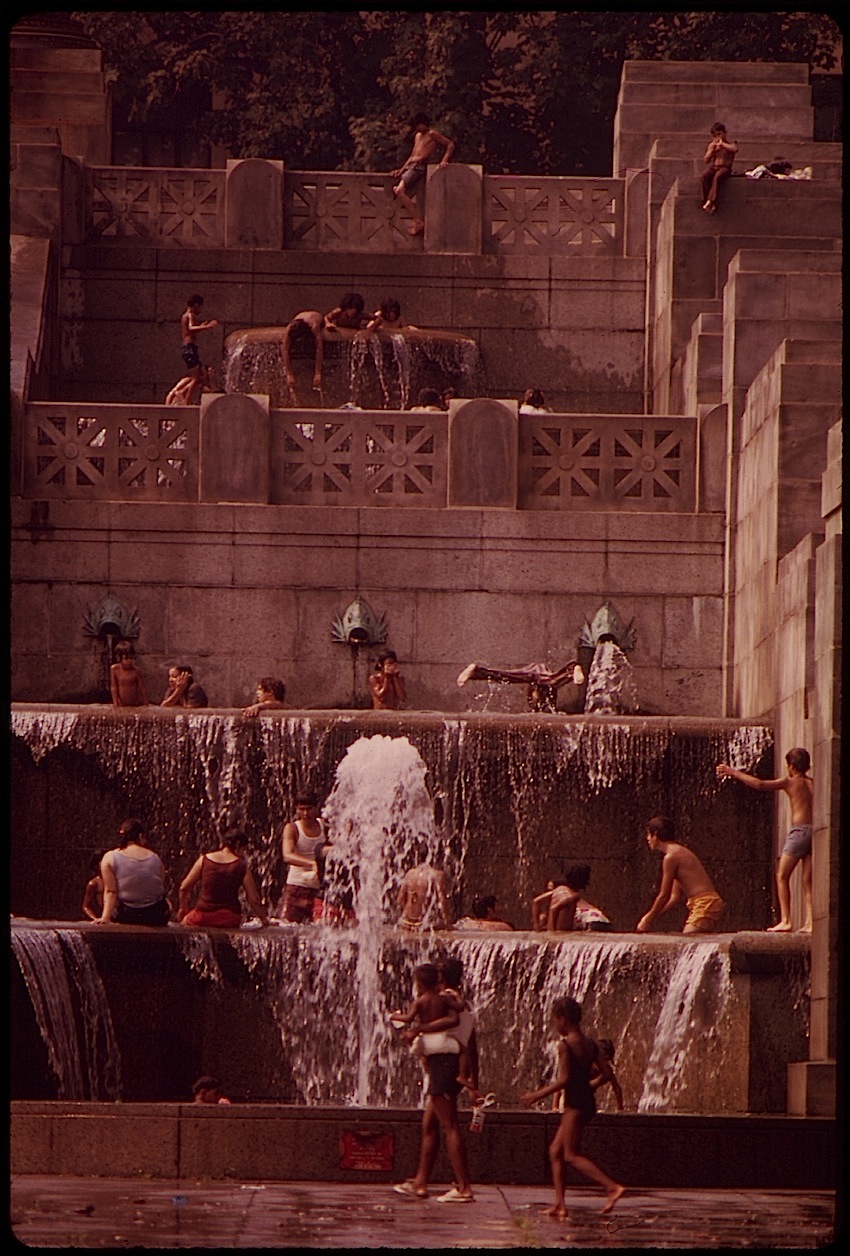
Swanson took these images for DOCUMERICA, a photography program of the U.S. Environmental Protection Agency (EPA). From 1972 to 1977, it hired over 100 photographers to “document subjects of environmental concern.” They created an archive of about 80,000 images. In addition to recording damage to the nation’s landscapes, the project captured “the era’s trends, fashions, problems, and achievements,” according to the Archives, which held an exhibit of the photos, “Searching for the Seventies,” in 2013.
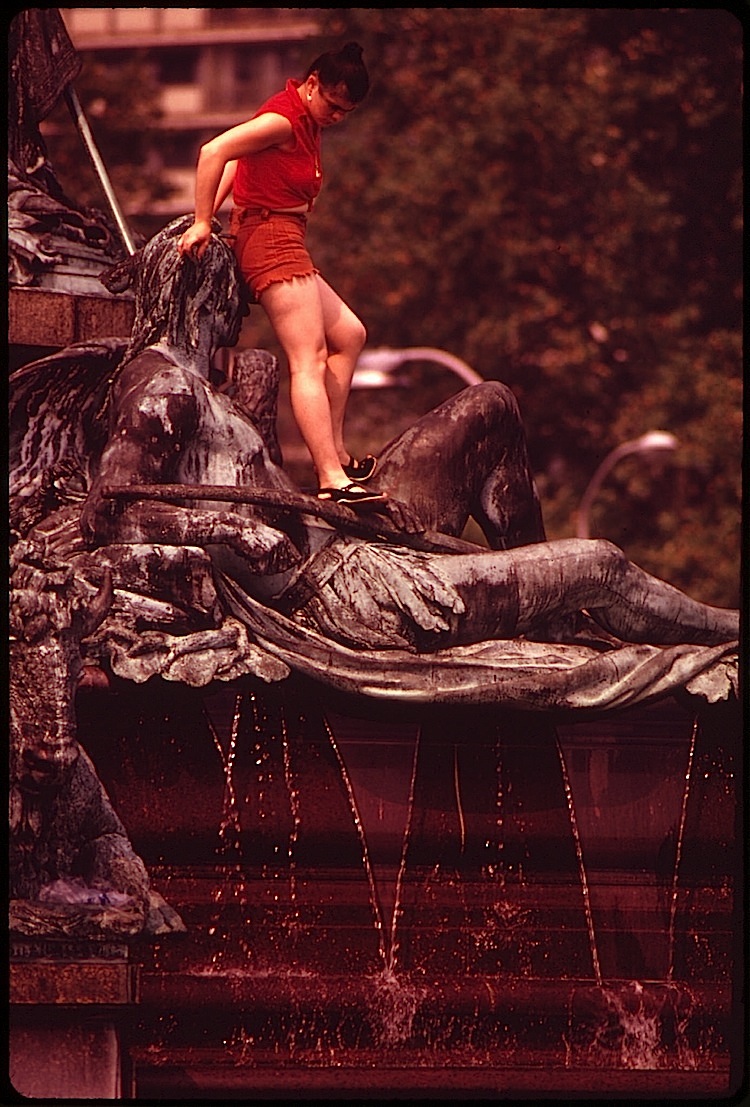
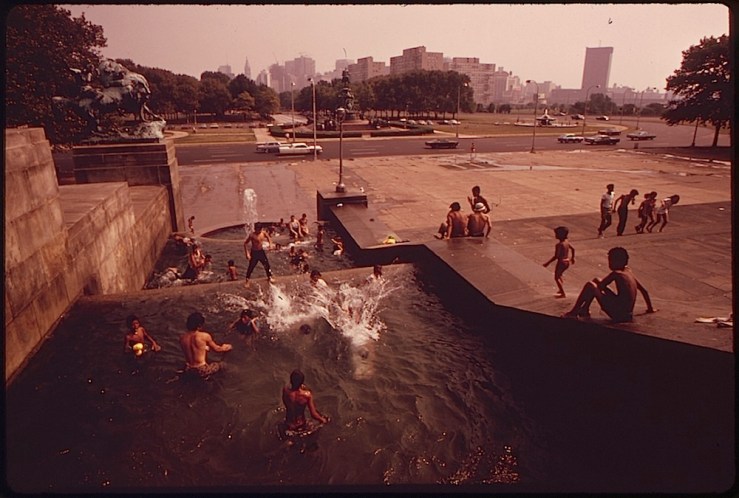
“The art of cooling off is enthusiastically pursued in the fountains of The Philadelphia Museum of Art.”
Ottawa, Ontario

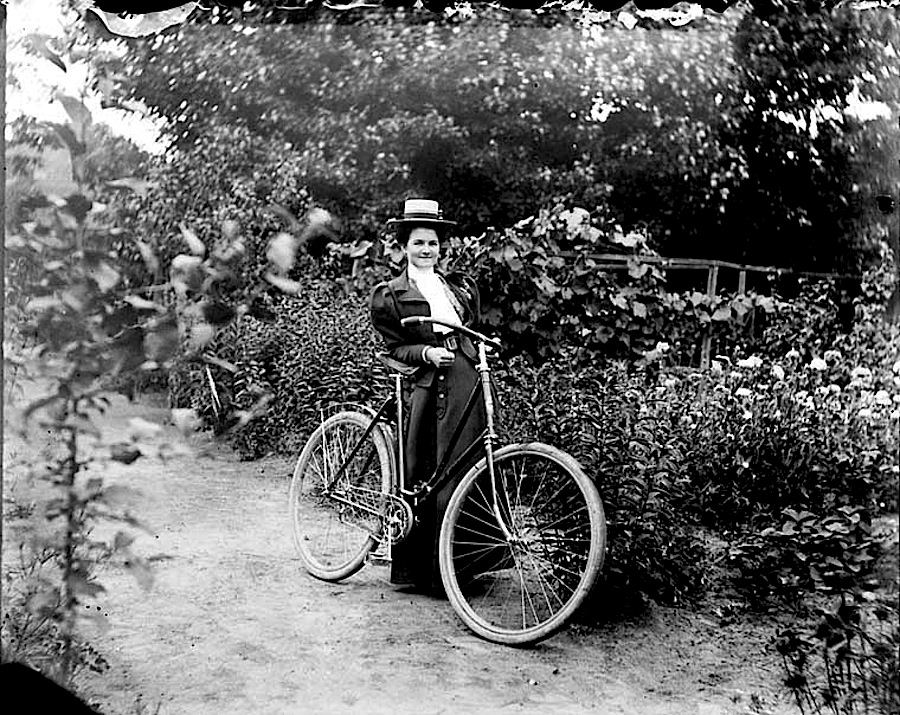
“Mabel Williams with her bicycle at 54 Main Street, residence of James Ballantyne, Ottawa, Ontario,” July 1898, by James Ballatyne, via Library and Archives Canada Commons on flickr (under CC License).

Memory of a summer

One of the terraces of Hotel Splendid (I believe), in the spa town of Châtel-Guyon, France, ca. 1900 – ca. 1910, via Vladimir Tkalčić on flickr (used under CC license).

The writing across the postcard says “Il y a une vingtaine d’années” — “Twenty years ago.” On the back is an undated note addressed to someone in Zagreb. The affixed stamp was issued in 1927.

Saint John, New Brunswick

King Edward VII Memorial Bandstand, King’s Square, Saint John, New Brunswick, date and photographer unknown, via Canadian National Railways at Library and Archives Canada on flickr (used under CC license).

I think this photo was taken in the 1930s.  The band climbed up a ladder to perform over the pool and fountain. The bandstand was built in 1908 and still exists today. It was refurbished in 2013.

Van Ness Park

A repeat post of 2013. . .
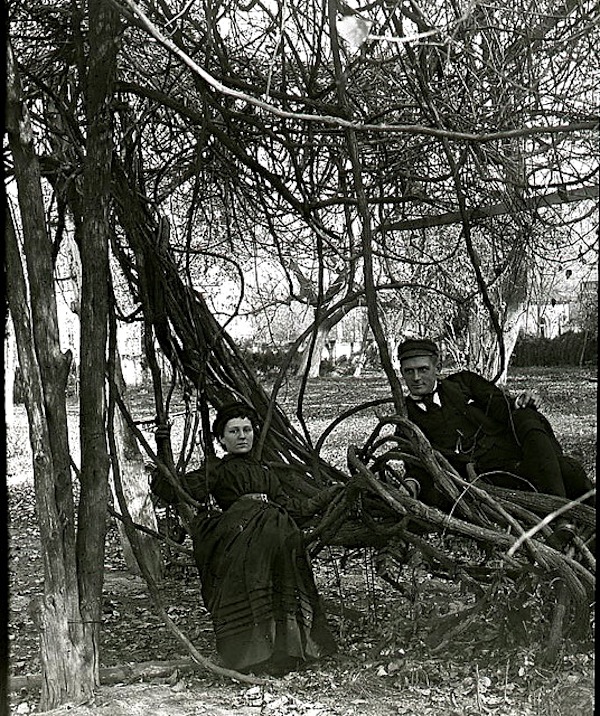
Van Ness Park, 1880, Washington, D.C.“Two people relaxing in Van Ness Park about 1880,” Washington, D.C.,  via D.C. Public Library Commons on flickr.

This park was not located in the present-day neighborhood known as Van Ness.  The photo was taken in an area southwest of the White House near the corner of C and 18th Sts., N.W. — which was then known informally as “Van Ness Park.”

According to the Library’s notation on the photo, the building that can be seen in the middle of the far right side (above the man’s legs) is a “dependency of Van Ness Mansion.”

Van Ness House (Mansion) and its grounds were located on the block bordered by 17th and 18th Sts. and  C St. and Constitution Ave.  Built about 1816, the Greek Revival house was one of the finest in the city until the Civil War.  But afterwards, it served as a “German beer garden, florist’s nursery, headquarters of the city streetcleaners, and in the end, for the Columbia Athletic Club,” according to the blog Lost Washington.

The college that became George Washington University bought the property in 1903 but later decided that its location was too unhealthy for campus facilities.  At that time, the Potomac River and its marshes came up to B St., now Constitution Ave.

The State Department bought it in 1907, tore down the house, and built the Pan American Union (today OAS) Building.

I think the dependency in the photo is the old stable of the estate, which still exists at C and 18th Sts.  If that’s so, the couple may be lounging in what is now Bolivar Park.

According to the blog DC Ghosts, the stables have a connection to a local ghost story in which six white horses “run wildly around the grounds” and then group together to walk to the P St. Bridge crossing to Georgetown and Oak Hill Cemetery.  The full story is here.

It is good to be alone in a garden at dawn or dark so that all its shy presences may haunt you and possess you in a reverie of suspended thought.

— James Douglas, Down Shoe Lane