
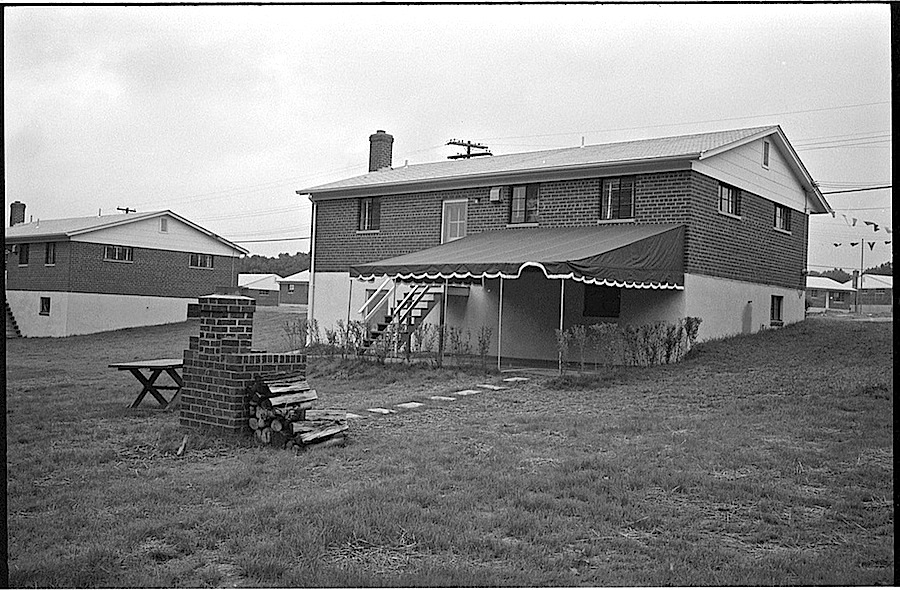
 “Backyard of a brick house in the suburbs with picnic table and barbecue,” location unknown, 1959, by Marion S. Trikosko, via U.S. News & World Report Magazine Photograph Collection, Library of Congress Prints and Photographs Division.
Category: landscape
Central Park
 Children climbing on monkey bars in Central Park playground, New York City, October 1942, by Marjory Collins, via Library of Congress Prints and Photographs Division.
During the early 1940s, Collins recorded American life on the home front for the U.S. Office of War Information. At the time of this photo, she was following the Wynn children, Janet and Marie, (lower left) for a project on Czech-American immigrants.
Pasadena, California
A repeat post from July 2013. . .
 Unidentified garden in Pasadena, California, 1930, by Diggers Garden Club, via Archives of American Gardens, Garden Club of America Collection, Smithsonian Institution Commons on flickr.
Simple, elegant, and a little mysterious. . .
The Diggers Garden Club was founded in 1924 and still exists today. It is a member of the Garden Club of America (which celebrated its centennial in 2013).
At its 75th anniversary, the GCA donated 3,000 glass lantern slides (of which this is one) and over 30,000 film slides to the Smithsonian Institution’s Archives of American Gardens. Its members continue to contribute to the collection, which now has over 60,000 images.
Many of the gardens pictured in the Archives’ slides are unidentified. The Smithsonian is asking the public’s help in finding names and locations. Click here to view its “Mystery Gardens Initiative.”
I do think a garden should be seductive. The strength of any garden is its ability to take you away.
— David L. Culp, in “3,000 Plants, and Then Some,” The New York Times.
Point Pleasant, W.Va.

“A [river] pilot’s wheel stuck in the backyard of a retired pilot’s home,” Point Pleasant, West Virginia, May 1943, by Arthur S. Siegel, via Library of Congress Prints and Photographs Division.
Point Pleasant lies at the confluence of the Ohio and Kanawha Rivers. Siegel was working along the rivers on assignment for the U.S. Office of War Information. He photographed the U.S. Coast Guard patrol, steam and tow boats, and industrial plants, particularly the Marietta Manufacturing Company, which was constructing LT boats for the army.
Comparing bouquets

Alfalfa crops, probably in Oregon, ca. 1955, via OSU Special Collections & Archives Commons on flickr.
Plants on the left show growth without Borax added to the soil and the plants on the right show what growth has occurred with borax. When soils have a borax deficiency, a “yellow top” condition develops, especially during the dry season. The plants are part of the Experiment Station soils program experiments.
— OSU photo caption
 enclos*ure