
 Little girl and grandmother (?) with hose, Detroit, Michigan, July 1942, by Arthur S. Siegel for U.S. Office of War Information, via Library of Congress Prints and Photographs Division (both photos).

Little girl and grandmother (?) with hose, Detroit, Michigan, July 1942, by Arthur S. Siegel for U.S. Office of War Information, via Library of Congress Prints and Photographs Division (both photos).
 Small front gardens and a sidewalk cafe on 17th Street, N.W., between H and I Streets, August 1973, by Dick Swanson for DOCUMERICA, via The U.S. National Archives Commons on flickr.
(Click on the image for a better view.)
None of these buildings remain today. The current view (from the ground) is here.
DOCUMERICA was an photography program of the U.S. Environmental Protection Agency (EPA). From 1972 to 1977, it hired over 100 photographers to “document subjects of environmental concern.” They created an archive of about 80,000 images.
In addition to recording damage to the nation’s landscapes, the project captured “the era’s trends, fashions, problems, and achievements,” according to the Archives, which held an exhibit of the photos, “Searching for the Seventies,” in 2013.

A young woman and two little girls in front of a row of double poppies, Gagnef, Sweden, August 1910, by Auguste Léon, via Archives of the Planet Collection – Albert Kahn Museum /Département des Hauts-de-Seine (both photos).

The autochromes above are two of about seventy-two thousand that were commissioned and then archived by Albert Kahn, a wealthy French banker, between 1909 and 1931. Kahn sent thirteen photographers and filmmakers to fifty countries “to fix, once and for all, aspects, practices, and modes of human activity whose fatal disappearance is no longer ‘a matter of time.'”* The resulting collection is called Archives de la Planète and now resides in its own museum at Kahn’s old suburban estate at Boulogne-Billancourt, just west of Paris. Since June 2016, the archive has also been available for viewing online here.
*words of Albert Kahn, 1912. Also, the above photos (A 436 and A 425) are © Collection Archives de la Planète – Musée Albert-Kahn and used under its terms, here.
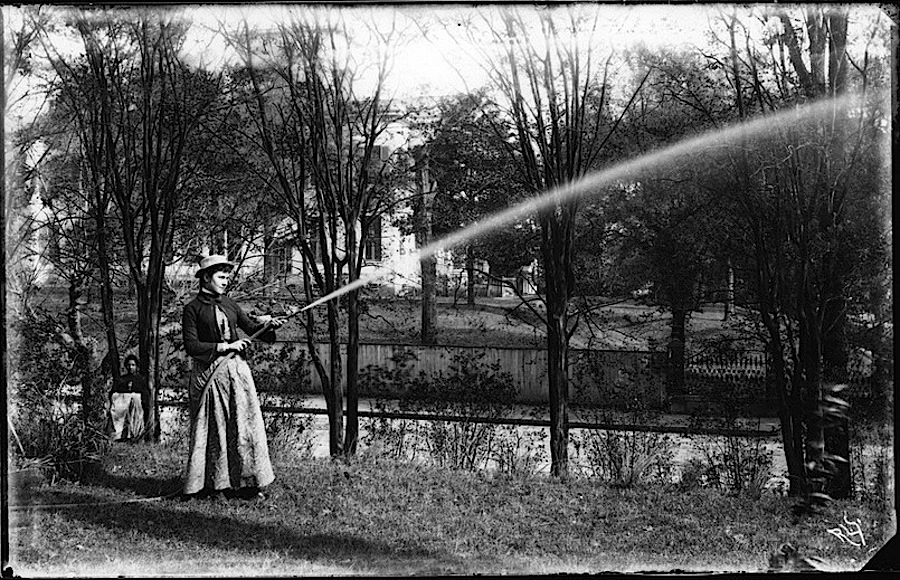 Myrtle Bank terrace, Natchez, Mississippi, ca. 1900, from the Stewart Photograph Collection,* via Mississippi Department of Archives and History Commons on flickr (both photos).
The two houses shown here are about two blocks from each other, both on N. Pearl Street.
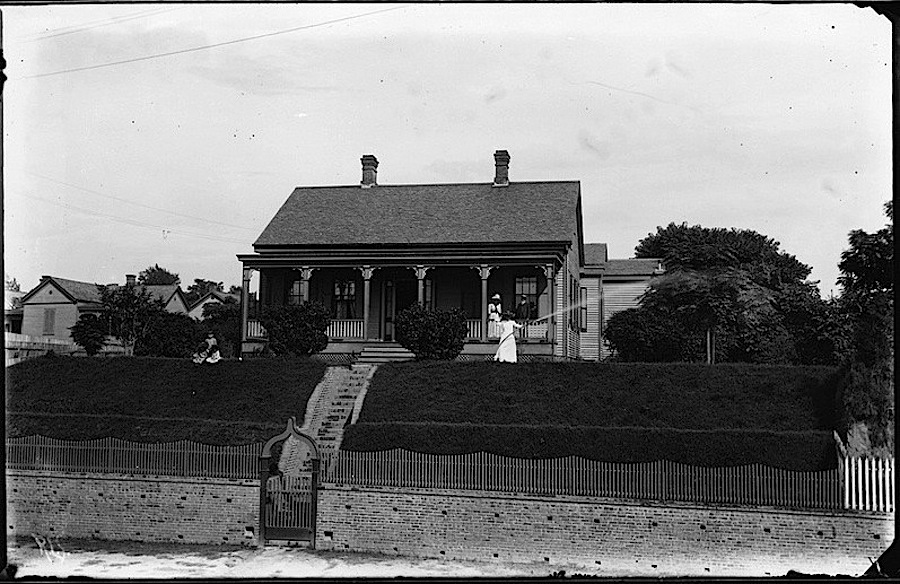
The neighborhood evidently had good water pressure. Both houses still stand.
In ancient Greece, the first hoses (for fire fighting) were made from ox intestines. In the late 17th century, Jan van der Heiden and his son sewed leather into long tubes for Amsterdam’s fire department. Then, in 1821 Boston, James Boyd invented a rubber-lined, cotton-webbed hose. By the 1870s, the first rubber and cotton fiber hoses for gardeners appeared on the market.
In 1895, a garden hose was the subject of what is believed to be the first comedy film, L’Arroseur Arrosé, by Louis Lumière. You can see it here.
*By brothers Robert Livingston Stewart and William Percy Stewart of Natchez, Mississippi, from ca. 1890 to ca. 1905.
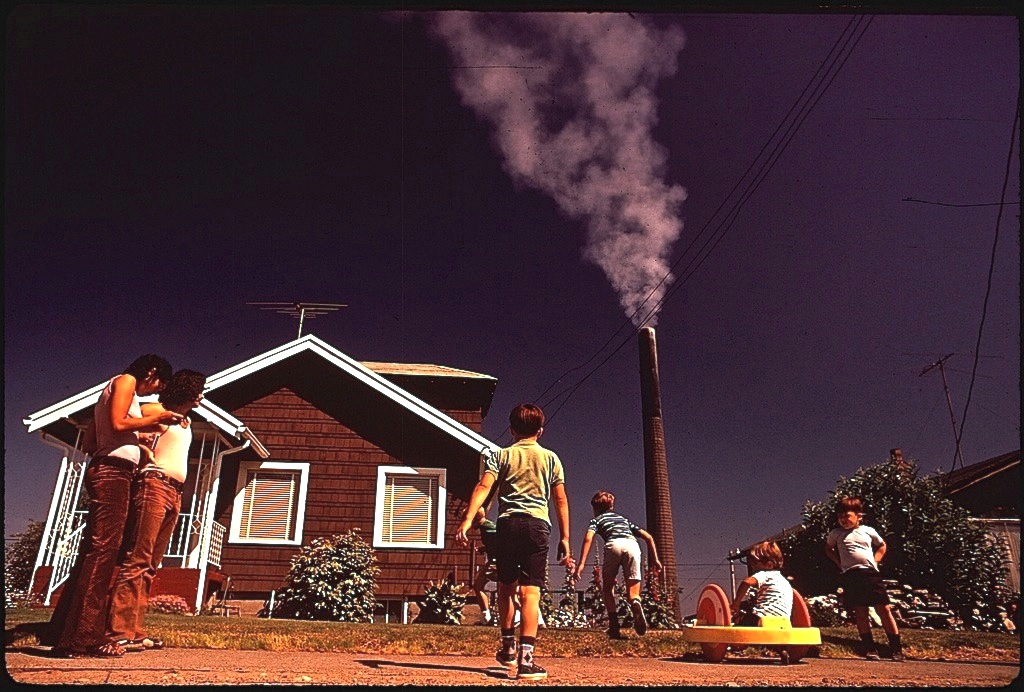 “Children play in yard of Ruston home, while Tacoma smelter stack showers area with arsenic and lead residue,” August 1972, via The U.S. National Archives Commons on flickr.
The photo was taken by Gene Daniels for DOCUMERICA, an early photography program of the U.S. Environmental Protection Agency (EPA). It is shown here with its original caption.
From 1972 to 1977, the EPA hired over 100 photographers to “document subjects of environmental concern.” They created an archive of about 20,000 images.
In addition to recording damage to the nation’s landscapes, the project captured “the era’s trends, fashions, problems, and achievements,” according to the Archives, which held an exhibit of the photos, “Searching for the Seventies,” in 2013.
 enclos*ure