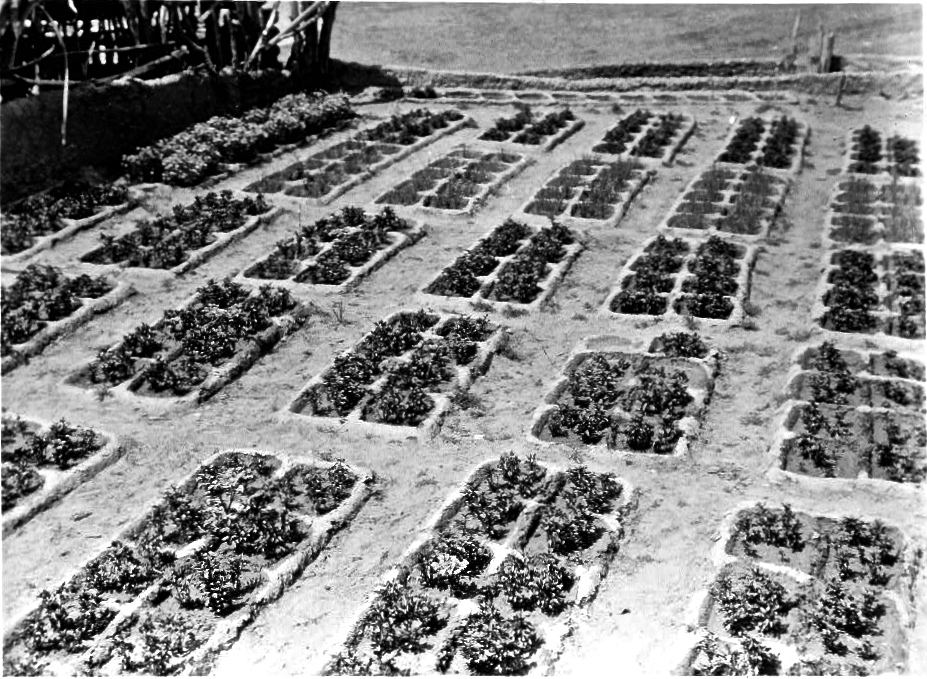
“Gardens surrounding the Indian Pueblo of Zuni, in which are raised a variety of vegetables, such as peppers, onions, garlic, etc.,” c. 1873, by Timothy H. O’Sullivan, via Library of Congress Prints and Photographs Division.
The Zuni people of western New Mexico have long built a form of kitchen garden (now) called “waffle gardens.”
Each square plot is about 2′ to 8′ wide with bermed sides of unamended soil. The design efficiently captures and holds rainwater and retards evaporation. The Zuni traditionally filled their gardens with corn, beans, and squash.
Timothy H. O’Sullivan, who took the picture above, photographed events of the Civil War as an employee of Alexander Gardner.
From 1871 to 1874, he traveled the southwestern United States as part of a survey of the land west of the 100th meridian. Later, he worked in Washington, D.C., as an official photographer for the U.S. Geological Survey. He died of tuberculosis at age 42.
 “Zuni gardens,” c. 1927, by Edward Curtis, via Library of Congress.
Edward Curtis, a Seattle photographer, took over 40,000 images of life in 80 native American tribes. The photo above was one of 2,000 he published, from 1907 to 1930, in the 20-volume The North American Indian.