A Sunday in the streets of Brussels

On the first day of our recent travels, we were lucky enough to arrive in Brussels on its annual “Car Free Sunday.” The streets of the city were closed to “all traffic with an engine”* from 9:00 a.m. to 7:00 p.m.

The streets were full of happy bikers, skaters, skateboarders, and walkers — in about that order. In addition, stands devoted to regional food and drink, organic farming, and ecology were set up from the Grand’Place to the Royal Palace and Brussels Park.

This slideshow requires JavaScript.

I like this garden (above slides) at the Mont des Arts. Like so many outdoor spaces in Brussels, its design successfully encompasses many centuries.

Under the rows of pleached trees, there were booths selling food and wine from France, so, bien sur, we had fois gras sandwiches for lunch.

This slideshow requires JavaScript.

A little farther east, on the street between the Royal Palace (above slides) and Brussels Park, sod had been put down over the stone block paving, and people were picnicking on every kind of organic cuisine.

I also really like Brussels Park (below slides).  It has very formal wide gravel walkways laid out in the shape of the Free Masonry symbol of an architect’s compass. Two rows of espaliered trees surround its perimeter.  But inside, there are forest-style groupings of very tall trees, long berms planted in a natural way with a variety of shrubs, and some well-used grass.

This slideshow requires JavaScript.

In the afternoon, we went back to our hotel for a rest and found that the street under our window had been blocked off for children’s activities. A local radio station had set up a stage, and, for the length of our planned nap, it featured a teenage punk rock band. I must admit they sang and played (what seemed like) their one song over and over again with some proficiency (I guess).

We ended our lovely day of walking in the neighborhood of Dansaert, along Rue de Flandre (or Vlaamsesteenweg), where the shops and residents were having a street-long yard sale/block party. At no. 17, we ate traditional Belgian food at the restaurant Viva M’Boma** (long live grandmother), which we highly recommend — as long as you eat meat.

To scroll through larger versions of all the photos above, click on ‘Continue reading’ below.


*Except for buses, taxis, some delivery vans, police, and ambulance.  The event is always in September, to coincide with the  European Week of Mobility.  I found one webpage indicating that it will be on September 16 in 2014.

**But they are normally closed on Sundays — and Wednesdays.  Main courses are between 11€ and 18€.
 

Vintage landscape: California living

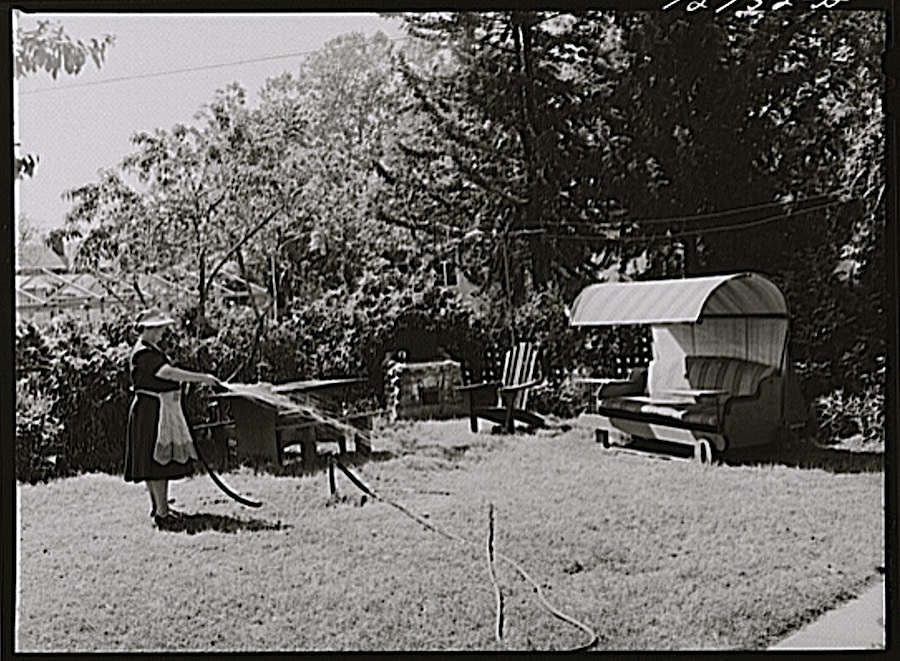
Back yard, Turlock, CA, 1943, by Russell Lee, Library of Congress

I just like this life-in-the-garden photo by Russell Lee, * of a (May) 1942 Turlock, California, backyard.  (Unfortunately, it’s not very sharply focused.)  The caption, possibly by the photographer, reads:

Housewife waters the lawn. All garden furniture and barbecue pit were made by her husband; about one out of every three houses in this town has such an arrangement in the backyard, and during the summer months people eat and spend many hours in their yards.

I particularly like the rolling sofa thing with the awning.  Turlock is located in central California between Modesto and Merced.

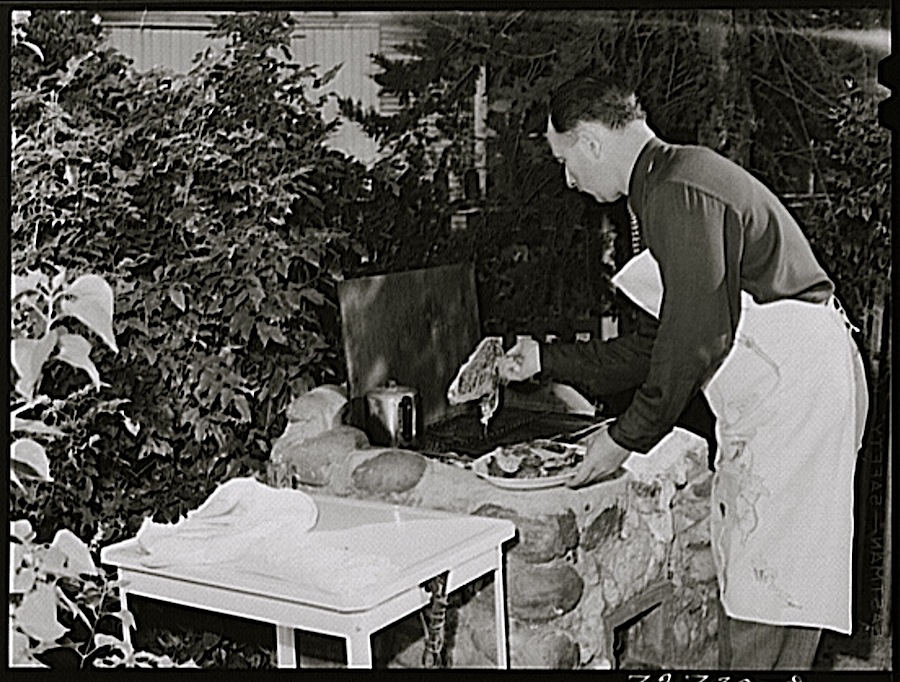
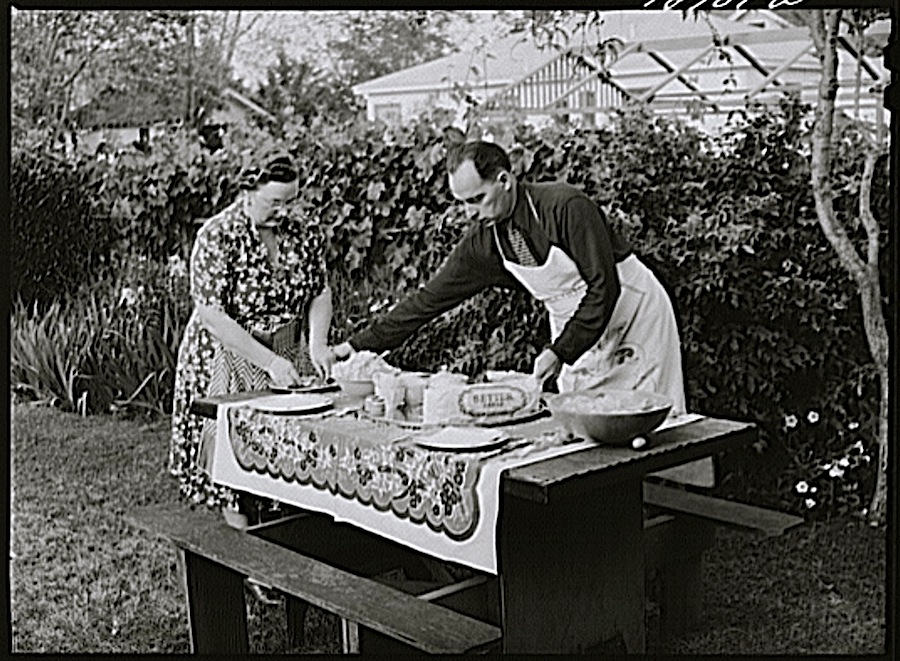
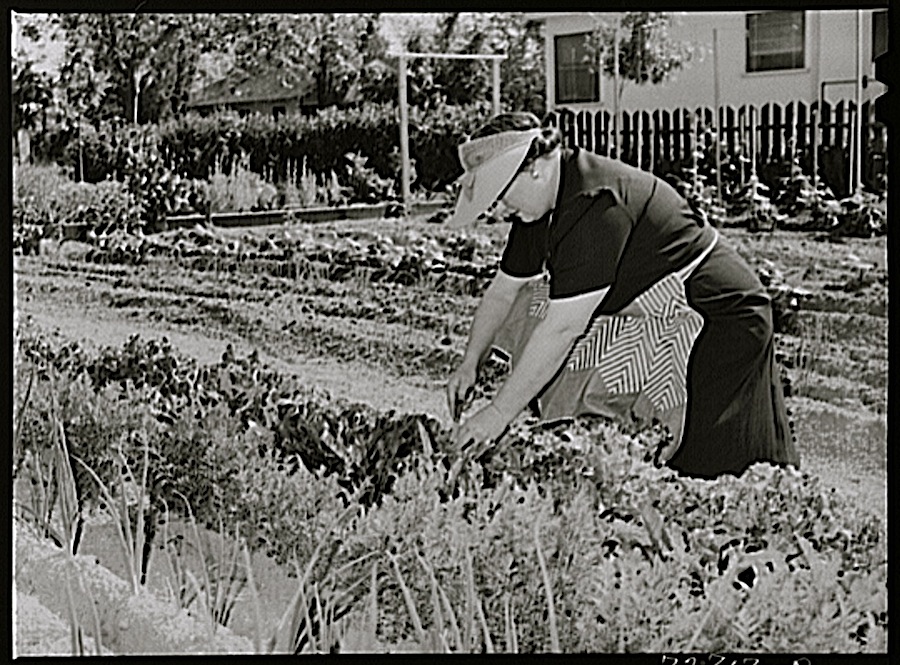
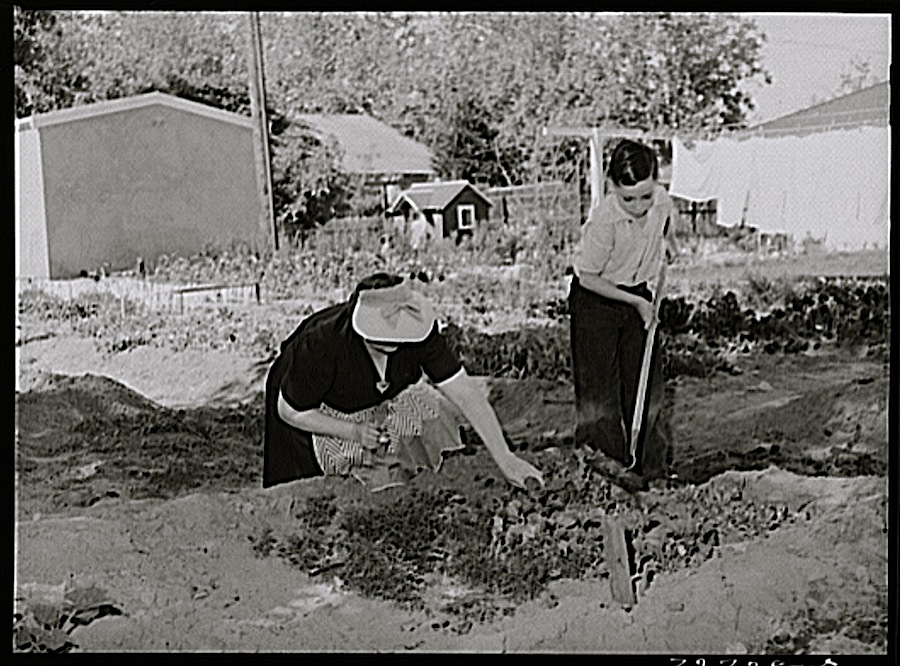
Lee was working for the Farm Security Administration/Office of War Information at the time.  He seems to have been sent to Turlock to photograph townfolks being resilient in the face of changes brought on by the war.  He took a number of photographs of this family, described in the Library of Congress online catalogue as from the “upper middle income group.”

Grillling steaks, Turlock, CA, 1943, by Russell Lee, Library of CongressAbove: “Man of the house barbecues steaks over open grill in his backyard. This family keeps vegetables, fruits and meats in frozen food lockers in town.”

Setting the table, Turlock, CA, 1943, by Russell Lee, Library of CongressAbove: “Husband and wife get ready for dinner in their backyard. Menu: barbecued steaks, fresh peas, potato salad, potato chips, celery and olives, strawberry shortcake, and coffee.”

The package around the loaf of bread says, “Better Bread.”  Over the hedge, the neighbors seem to be putting in a greenhouse.

Tending the garden, Turlock, CA, 1943, by Russell Lee, Library of CongressAbove: “Housewife works in her vegetable garden. She lives in small town where there is ample space for gardens; says she would move to country if she couldn’t have a garden in town.”

It’s quite impressive — and particularly that she works it in a dress.  Here’s another view, below:

Son's garden, Turlock, CA, 1943, by Russell Lee, Library of CongressAbove: “Housewife helps her son with his garden.”

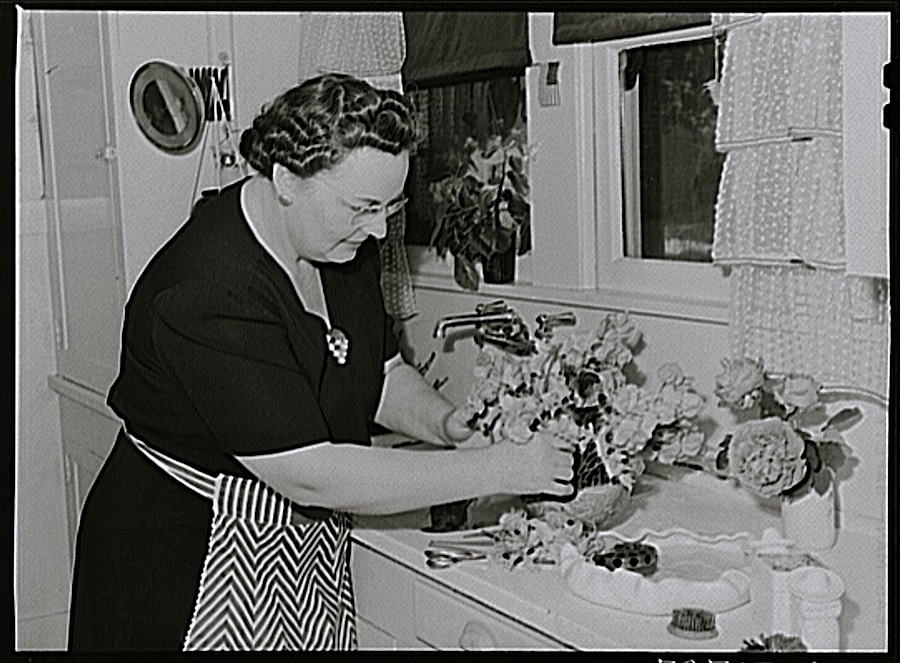
Arranging flowers, Turlock, CA, 1942, by Russell Lee, Library of CongressAbove: “Housewife arranging flowers in her kitchen.”

I like her dotted swiss curtains.

I’m going to take a break from blogging for a few weeks (except for “The Sunday porch”), but I’ll be back for GB Bloom Day in October.


* All photos here via Library of Congress Prints and Photographs Division.

A study in steps: coffee

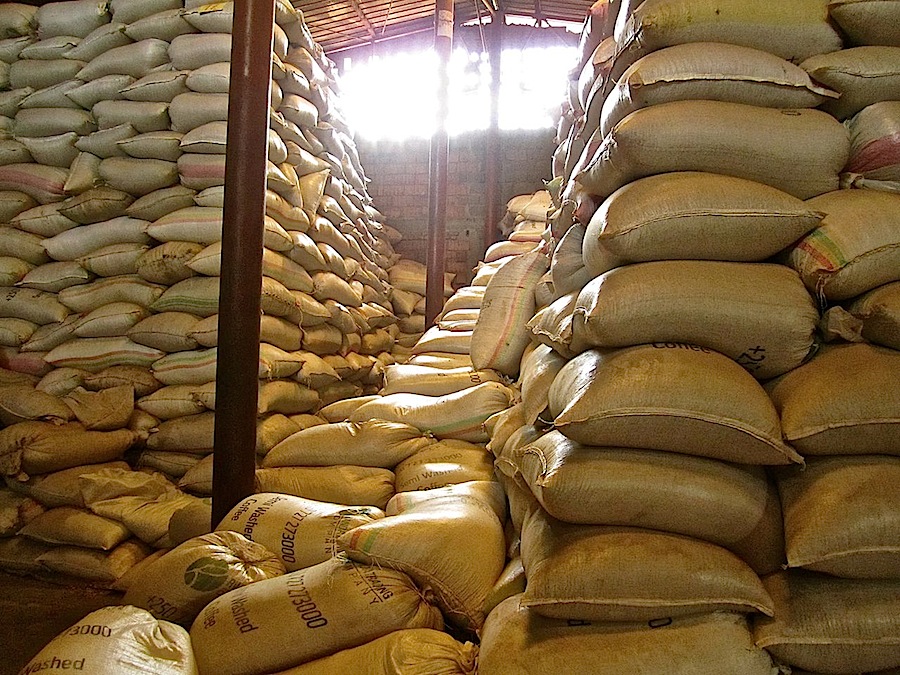
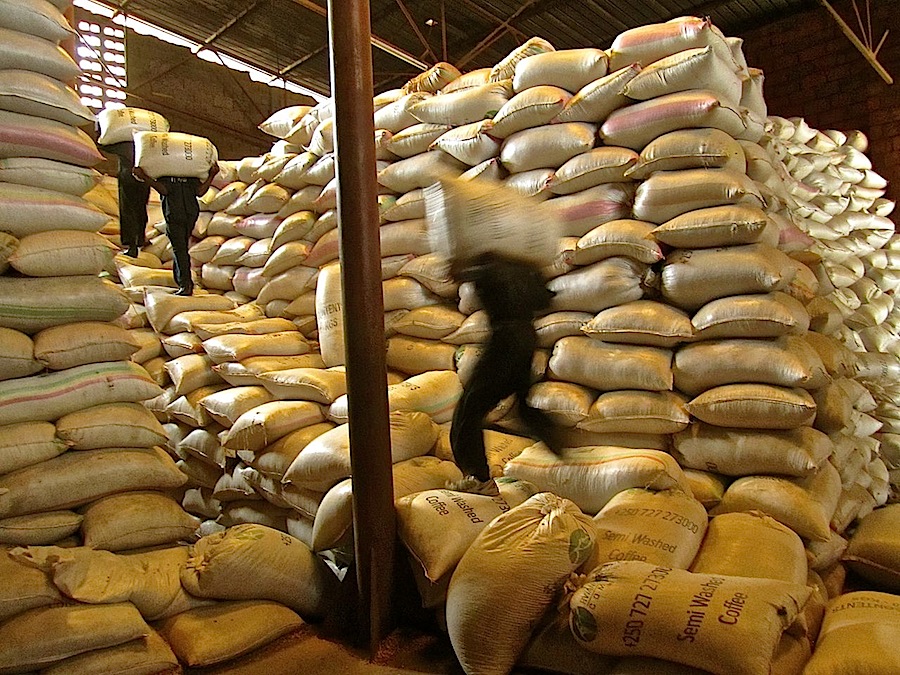
Coffee sacks stairs, Rwanda Trading Company:enclos*ureThis is a little stairway to heaven for me.

Coffee sacks stairs, Rwanda Trading Company:enclos*ureYesterday, I joined a group visiting the Kigali processing plant of the Rwanda Trading Company, an American-owned coffee exporter.

The company handles about 20% of Rwanda’s coffee.

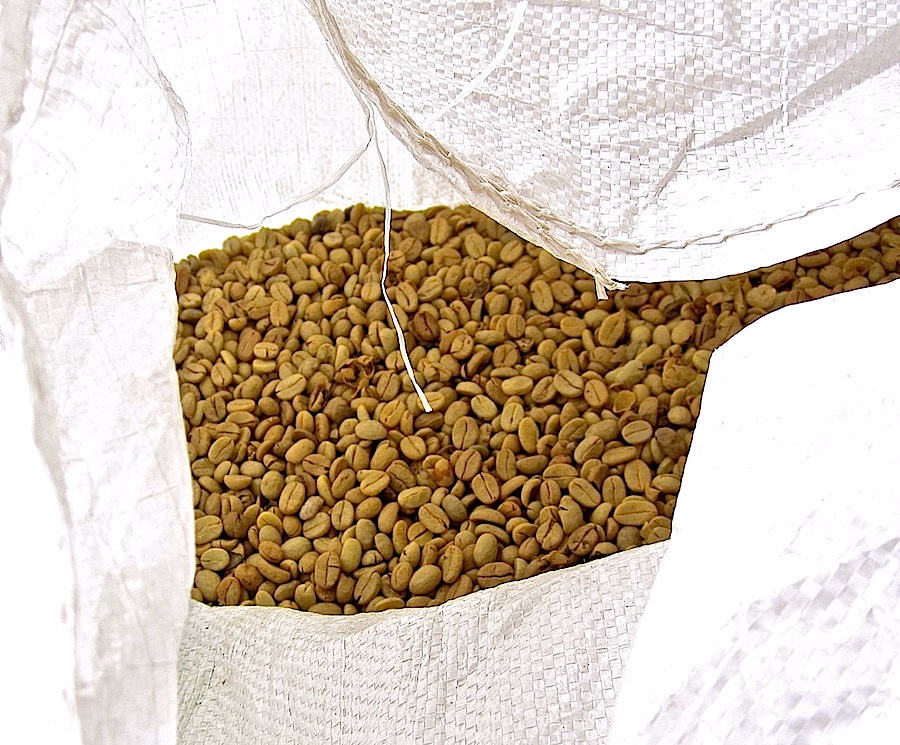
Parchment coffee, Rwanda Trading Company:enclos*ureThe sacks are full of “parchment” coffee — dried, but unhulled beans.

In the U.S., you can buy Rwanda Trading Company’s coffee at Wal-Mart or Sam’s Club or online here.

. . . Coffee steam rises in a stream, clouds the silver tea-service with mist, and twists up into the sunlight, revolved, involuted, suspiring higher and higher, fluting in a thin spiral up the high blue sky. A crow flies by and croaks at the coffee steam. The day is new and fair with good smells in the air.

— Amy Lowell, from “Spring Day

Garden Bloggers’ Bloom Day for August

Now is the winter of our discontent
Made glorious summer . . .

by our water hoses.

We are just below the equator here in Rwanda, so technically it is near the end of winter — and of the long dry season, which began in May and normally ends in September.

But last night there was a light rain for about seven hours, so today I don’t need to water anything in the garden, not even the new plants.

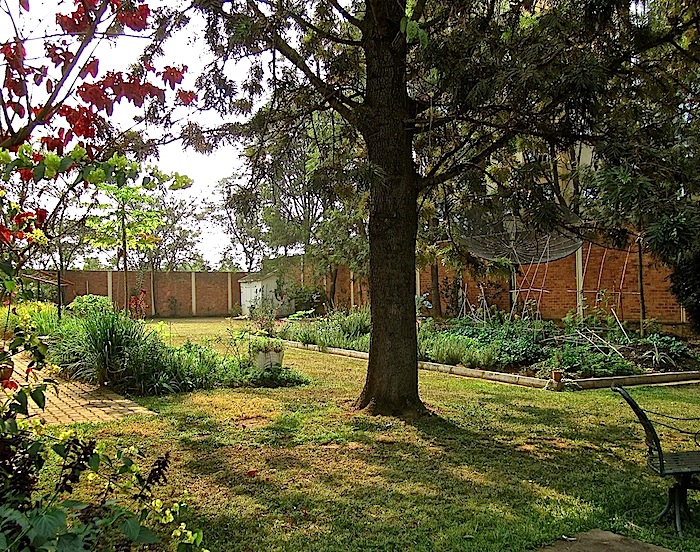
The cutting garden (left) and the vegetable garden (right).

We’ve really cut back on watering this year, anyway — none for the grass and a lot less for the planting beds. The grass is going brown, but we still have a lot of flowers, particularly my stalwarts, yellow daylilies and pink gerbera daisies.

The vegetable garden with kale, sunflowers, Missouri primroses, nasturtiums.

My biggest project in the last month has been to tackle our mess of a vegetable garden, which has consisted of several not very productive, but very wide and long raised beds.  Their dimensions just weren’t manageable, so we’ve dug new paths and now all the beds are about 4′ x 5′.

Orange nasturtium in our vegetable garden.
Orange nasturtium bloom in our vegetable garden.

Growing among the argula, lettuce, kale, strawberry, and tomato plants are also celosias, nasturtiums, Missouri primroses, and sunflowers.

Sunflower (one of the shorter varieties) in our vegetable garden.
The garden with celosia, feverfew, supports for tomatoes and beans, with lettuce gone to seed in the back.
Our still rather disorderly garden with celosia, feverfew, supports for tomatoes, with a row of lettuce going to seed along the back.

Recently, I tried to grow American hardy hibiscus from seed (in the vegetable garden, where the soil is best), and, despite the fact that I have always read that this is a very easy thing to do, only about ten seedlings appeared from two packets of seeds, and for weeks they have remained at 2″ tall.

Nothing at all came up from a packet of black-eyed Susan seeds; only one plant from a packet of Verbena bonariensis.  However, alpine strawberry seeds have produced about 15 plants.

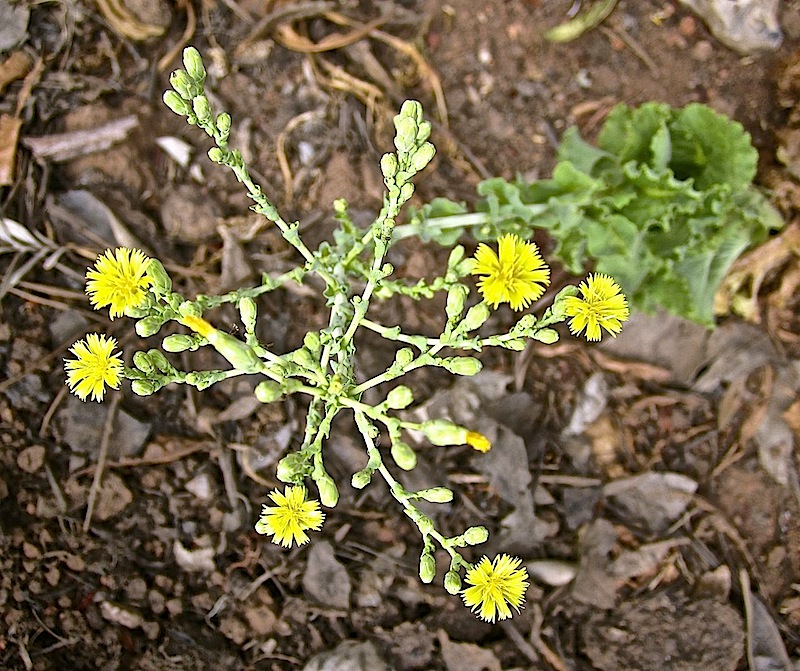
Lettuce flowers.
Lettuce flowers.

I have also done well with re-seeding lettuce, dill, basil, garlic chives, and coriander and with rooted rosemary cuttings. I have high hopes for my cherry tomato plants, many of which have clusters of tiny fruit.

Feverfew in the vegetable garden.
Celosia in the vegetable garden. The fading blooms are full of seeds.

In the long flower border along the lower lawn, I have one bloom from several purple coneflower plants that I have grown from seed.

The first coneflower bloom.
The first coneflower bloom from plants I grew from seed.

Garden Bloggers’ Bloom Day is the 15th day of every month.  Check out May Dreams Gardens to see what’s blooming in other garden bloggers’ gardens today.

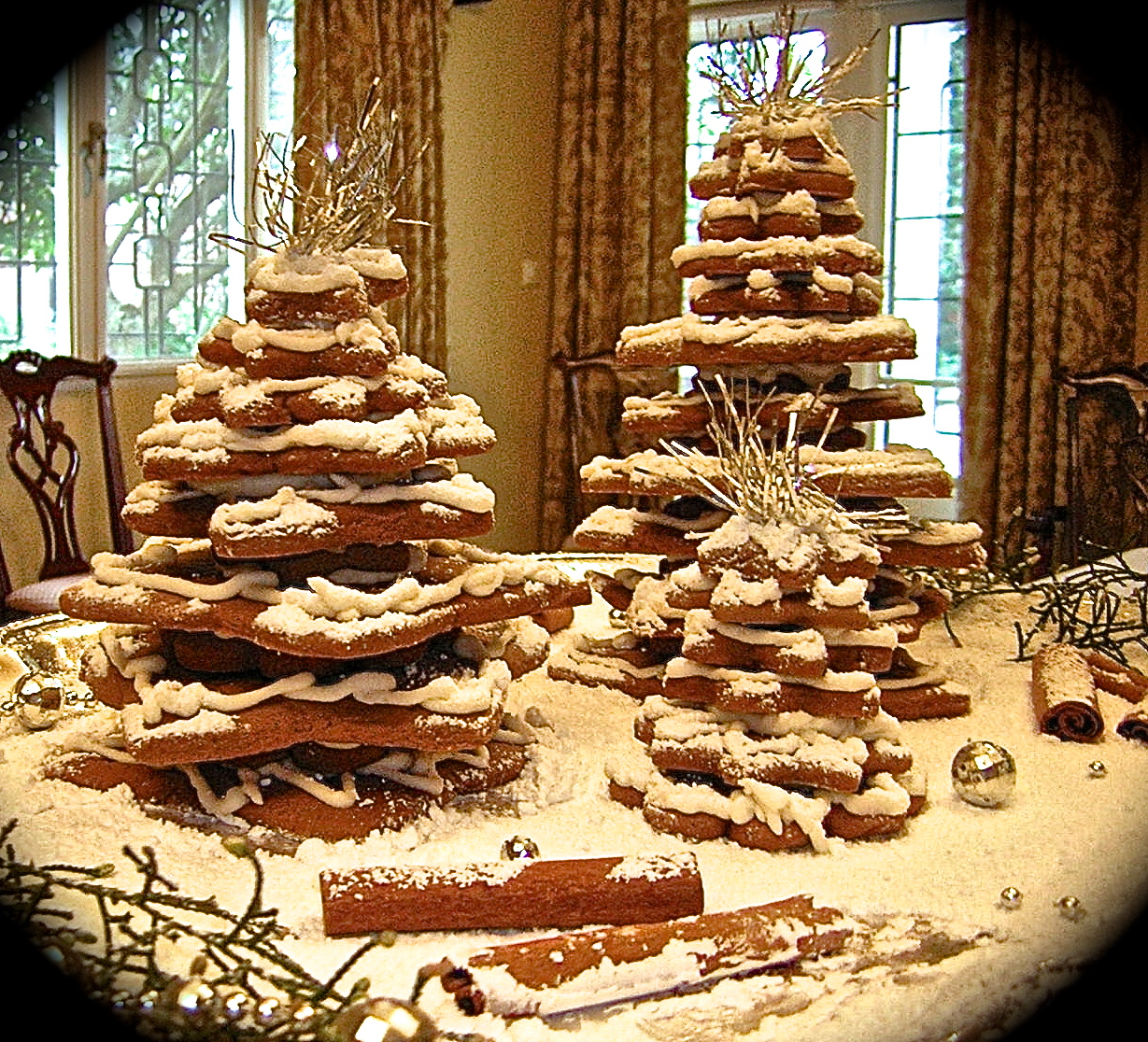
My Christmas trees

Whose woods are these I think I know. . . .

The Christmas Trees, enclos*ure

I just wanted to share this week’s planting project, a centerpiece for our holiday open house buffet table, before it crumbles — or actually turns green.

Pictures of many similar trees and links to recipes are here.