In Amalfi


This slideshow requires JavaScript.

Two Saturdays ago, we were just beginning a brief vacation in Italy, in  Sorrento on the Bay of Naples.

On Sunday, as a day trip, we took a local bus along the winding, narrow, cliff-hanging road that edges the gorgeous Amalfi Coast.

We rode it all the way to Amalfi itself– an important city back around the first millennium A.D., but now just a very pretty coastal resort selling hand-painted ceramics and products made from lemons.

The little strip of grey pebbles and fist-sized rocks that is Amalfi’s “beach” did not impress us, but the sparkling blue, clear-to-the-bottom water was very inviting.

There is one main street, which runs straight back from the sea and up into the surrounding hills about a half mile. On either side above it, houses and small lemon groves cling to steep slopes, connected by an extensive web of covered and open alleyways and steps.

The duomo or cathedral is the town’s major site. It was constructed and re-constructed from the 9th to 19th centuries and displays a mix of Norman-Arab Romanesque, Gothic, Byzantine, and Baroque architecture styles.

The photos above are of its Cloister of Paradise, built in 1268 as a gravesite for local wealthy merchants. The Arab style of the beautiful simple arches is not surprising, given Amalfi’s close ties during the Middle Ages with Arab traders throughout the Mediterranean (not excluding traffickers in European slaves).

Pretty as the cloister was, however, I have to say that my favorite Amalfi garden was this tiny terrace (below). Its horizontally espaliered lemon trees were guarded by a Roman soldier and the seven dwarves.


This slideshow requires JavaScript.

Visiting Sorrento and the Amalfi Coast

Travel writer Rick Steves says this about Sorrento:

The Sorrentines have gone out of their way to create a completely safe and relaxed place for tourists to spend money. . . . Spritzed by lemon and olive groves, this gateway to the Amalfi Coast has an unspoiled old quarter, a lively main shopping street, [and] a spectacular cliffside setting.

That’s pretty much what we wanted for the first two nights of our vacation, and that’s what we got.   Like Amalfi, aside from tourism, the city is now mainly known for growing impressively large lemons.  Its limoncello is supposed to be the best.  (Although I think it tastes like an alcoholic lemon drop, much too sweet; Amaro is my Italian digestive of choice.)
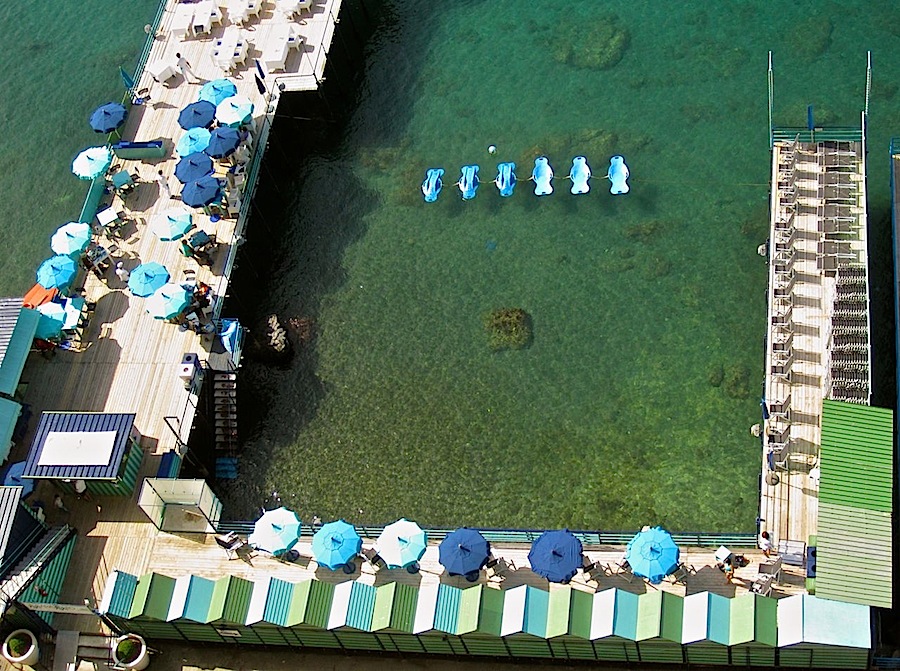
A swimming area along the Sorrento waterfront.
Getting around . . . train

To get to Sorrento from the Naples train station (Stazione Centrale), follow the signs leading downstairs to the platform for the Circumvesuviana commuter train.  Tickets are only €4.10 and can be purchased right at the turnstile.  Make sure you get on a train marked “Sorrento.”  They leave every half hour.

The Circumvesuviana was the only place where we had any problem with crime during our trip.  The platform was very crowded, and almost as soon as we entered the train, a pickpocket tried to take my husband’s wallet. After that, he kept his credit card and money in a small zippered bag with a loop attached to his belt — something like this.

We were each traveling with a rolling carry-on bag and a “personal item.”  This is the most I would ever try to keep track of on this train.

From the Sorrento train station, it’s an easy walk to the historic part of the city.

Boat

To return to Naples, we walked to the Sorrento piers and took one of the fast hydrofoil boats. The boats leave about every two hours, and you don’t need a reservation. (From the same place, there are also boats to Amalfi, Positano, and Capri.)

To buy the €15 ticket, go to the sunken semi-circle area in the photo below, consult the extensive, yet unrevealing signage to the find the correct line, and then ask for a one-way on the “Jet”  to Calata Beverello-Naples (a brief walk away from the Piazza Plebiscito).  The view of Naples as you arrive by water is lovely.
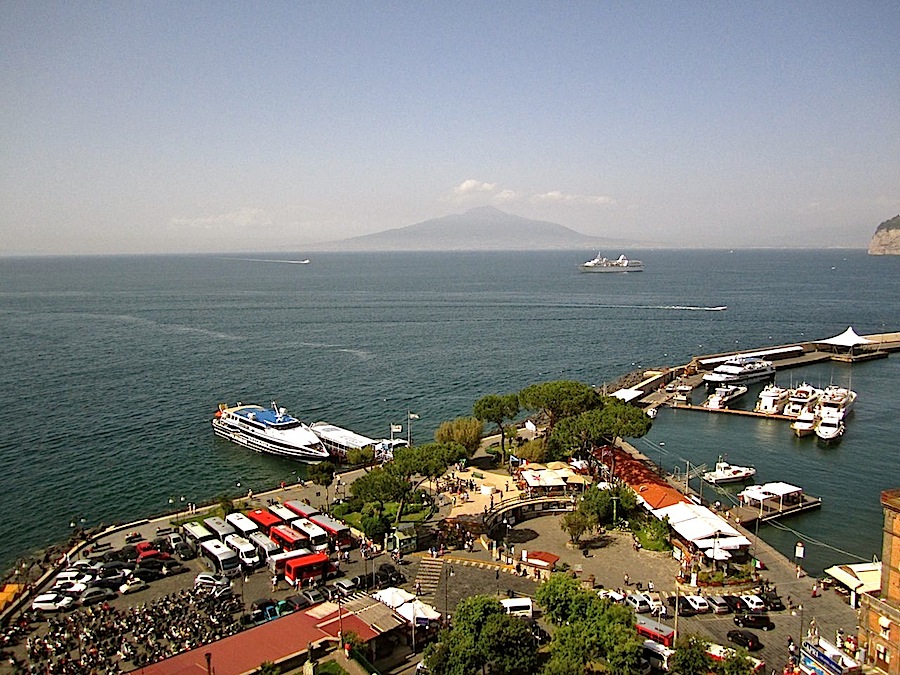
That's Mt. Vesuvius in the center.
That’s Mt. Vesuvius in the center.
Bus

The SITA bus that took us to Amalfi and back was a bargain thrill ride (the road is often only one and a half lanes wide) at €6.80 for all-day, on-and-off access. Buses leave Sorrento, Positano, and Amalfi about every hour (but not 24 hours, so check the schedule for the time of the last bus). The Sorrento-Amalfi trip takes one to two hours, depending on traffic.  In Sorrento, tickets are sold at the SITA bus stop in front of the train station.  The buses are blue, except when they’re red.

Hotel and restaurants

We stayed at the Hotel Rivoli in Sorrento, right in the center of the historic area.  The rooms were simple, clean, and comfortable.  The staff were very helpful with directions and advice.  The €5 breakfast offered croissants, cereal, and fruit, plus enough sweets to fill out a respectable Christmas buffet table.

We arrived in Sorrento after 24 hours of travel and by 6:15 p.m., we were exhausted.  At that very un-Italian dinner hour, L’Antica Trattoria served us their three-course “light lunch” very graciously.  Given the high quality of the food, it was a bargain at €20 each. We also had a very good meal the next night at the more unassuming Ristorante O’ Murzill’ at Via Dell’ Accademia, 17.

.   .   .  borne on
Beyond Sorrento and Amalfi, where
The Siren waits thee, singing song for song.

— Walter Savage Landor, from “To Robert Browning

A study in steps: Petraio in Naples


This slideshow requires JavaScript.

I believe L’ESSENZIALE, inscribed at the top, refers to a song written and sung by Marco Mengoni.  Translated into English, one verse says:

As the world falls into pieces
I craft new spaces and needs
That belong to you too
You, whom I believe to be the ESSENTIAL

L’essenziale” was Italy’s third best selling single of 2013. It came in seventh at the 2013 Eurovision Song Contest.

Visiting Naples

We were on vacation in Italy last week, spending two nights in Naples.

The city has a reputation and a reality that puts off many tourists, but I have to say, I loved it and wished that we could have stayed another night.

I liked the sense of theater in its architecture and that its narrow lively streets made me think of Morocco and Istanbul, as well as Caracas and Havana.  And everywhere we looked, there was something wonderful to eat.

Added to that, we saw relatively few other tourists and no American food franchises.

While we were there at least, it was no more littered than Rome (granted, not really high praise).  We saw many patrolling police officers and had no crime problems (except for a pickpocket attempt while getting on the Circumvesuviana commuter train).*

The sights

This living medieval city is its own best sight.
Rick Steves

We are very low-achieving tourists, taking the flâneur approach. We spent most of our time walking along the little streets of the Spagnoli and Spaccanapoli (centro storico) neighborhoods. We also took the funicular up to Petraio for panoramic views of the city and Mt. Vesuvius — particularly good from the entrance to Certosa di San Martino.


This slideshow requires JavaScript.

The only museum we visited was the National Archeology Museum, which houses many of the frescoes and other artifacts from nearby Pompeii.  This was essential preparation for a visit to the site, which took more than half a day of our stay in Naples.

If you arrive at the museum after lunch, don’t be disappointed if many of its galleries are closed off and dark.  They will open a little later.  The museum does not have the funds to keep all the rooms open during the lunch hours. (It’s closed entirely on Tuesdays.)

If we had stayed another day or two, I would have visited the Capodimonte, some churches in Spaccanapoli (particularly the Cappella Sansevero with its “veiled Christ”), and maybe the National Museum/Monastery of San Martino.  There are also a number of interesting underground sites, but I don’t do well with underground.

Hotel

We stayed at the Chiaja Hotel de Charme on Via Chiaia, a pedestrian shopping street on the edge of the well-to-do Chiaia (or Chiaja) neighborhood.

The hotel is 27 rooms on the second floor of a multi-story apartment building with a central courtyard.  Don’t panic if you come back from dinner and find the building shut up like a fortress.  Push the hotel’s doorbell (on the panel to the left), and the front desk will buzz you in through a tiny door set into the huge main doors.  The hotel is attractive, quiet, and comfortable in a traditional style.  The staff was very helpful, and the breakfast was good (sfogliatella, fruit, yogurt, cereal).

The hotel is an easy walk to the waterfront and to Via Toledo, a north-south (partly pedestrian) street, which runs from the Piazza del Plebiscito — between the historic neighborhoods of Spagnoli and Spaccanapoli — to the National Archeology Museum (a little over a mile-long walk).  It is also about a half mile to a subway stop on the line to the main train station.

(I got a better room rate on Expedia.com, by the way, than on the hotel’s own website, so check both.)

Restaurants

We wanted to eat our dinners fairly close to the hotel, so the staff directed us to Pizzeria Mattozzi (on Via G. Filangeri) and to Umberto (on Via Alabardieri).  Both were excellent, and both serve traditional Napoli dishes, including pizza.  We also enjoyed lunch one day at Hosteria Toledo on Vico Giardinetto in Spagnoli.


*We generally felt quite safe, but do carry a well-zipped crossbody bag. (Men might like one of these.) Avoid empty, dark side streets (well, they are all rather dark, but most are full of working or strolling people). I would only enter or leave the train station by the main Piazza Garibaldi entrance and only during daylight hours.

Continue reading “A study in steps: Petraio in Naples”

Here’s one little dream. . .

To have a pied-à-terre in Brussels and to have it be on Rue de la Cigogne.

Rue de la Cigogne is a ruelle or alleyway about 70 m. (230′) long between Rue Rempart des Moines and Rue de Flandre in the neighborhood of Dansaert.

Click any thumbnail in the gallery above to scroll through larger images.

All day all over the city every person
Wanders a different city, sealed intact
And haunted as the abandoned subway stations
Under the city. Where is my alley doorway?

— Robert Pinsky, from “City Elegies — I. The Day Dreamers