
One hundred and two years ago today. . .
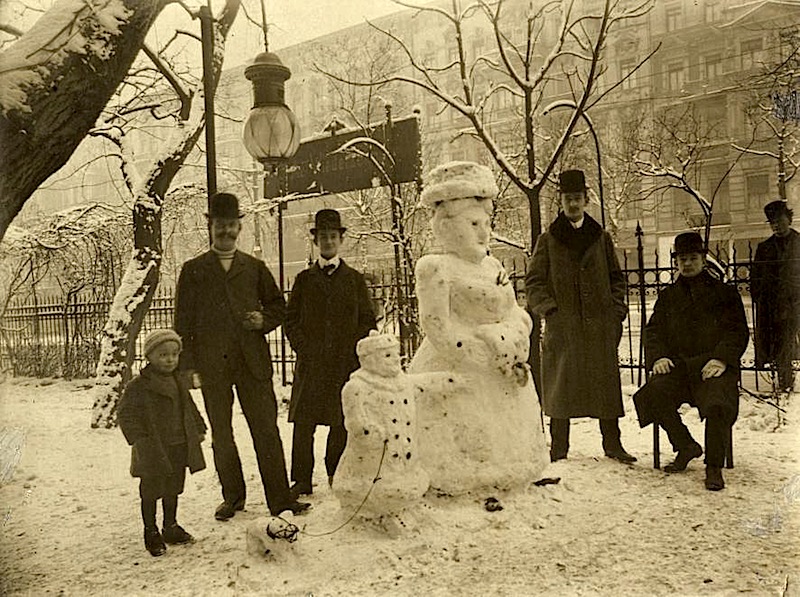 “The Dutch queen Wilhelmina and princess Juliana [and their little dog] as snowmen [or sneeuwpop],” January 21, 1913, The Netherlands, via Nationaal Archief Commons on flickr.
One hundred and two years ago today. . .
“The Dutch queen Wilhelmina and princess Juliana [and their little dog] as snowmen [or sneeuwpop],” January 21, 1913, The Netherlands, via Nationaal Archief Commons on flickr.
Late winter in Parc de Bruxelles, Brussels, Belgium, redux from 2012.
 Professional photographers Gertrude Käsebier and Frances Benjamin Johnston eating together on a hotel patio in Venice, Italy, 1905, via Library of Congress Prints and Photographs Division.
Johnston — from Washington, D.C. — and Käsebier — from New York City — had traveled across the Atlantic at the invitation of the Royal Photographic Society of Great Britain. On the same trip, they also visited France, Switzerland, and Italy.
The older and more successful Gertrude Käsebier had been born in a log cabin in Iowa in 1852. After marrying* a successful businessman of aristocratic German origins and having three children, she began to study photography at the Pratt Institute in Brooklyn. Within ten years, by the late 1890s, she had opened a studio on Fifth Avenue in Manhattan.
At the time of this photo, she was “one of the best known photographers in the United States,” according to her Library of Congress biography. Her portraits of women and children were shown in major exhibitions and won her critical acclaim and financial independence.
Käsebier’s ability to discern the complexities of situations helped her achieve conflicting goals. She aimed to be associated with fine art and the upper classes but she enjoyed the relatively déclassé technical art of photography. She also wanted to earn a living, a desire that brought criticism from [Alfred] Stieglitz for sacrificing art to commerce, while society frowned on women participating in any kind of business. At a time when a salesman challenged women’s right to purchase high quality photographic equipment, Käsebier encouraged women to enter the professional world. For example, she befriended and supported Frances Benjamin Johnston, whose ambition and need to earn an income may have surpassed her own.
Kasebier worked until the mid-1920s, when she turned her studio over to her daughter, Hermine.
Johnston had a long career as well, ultimately specializing in architectural and garden photography. She retired at age 81 in 1945.
*It was an unhappy marriage and inspired her to make this photo.
Everyone soon or late comes round by Rome.
— Robert Browning, from The Ring and The Book
As you might imagine, late May was a beautiful time to be in Rome. Coming in from the airport — and later on the way to Naples — we saw swathes of red poppies blooming all along the train tracks. In the city, there were jasmine flowers everywhere. The temperatures were in the seventies, and the crowds of tourists weren’t yet (too) bad.
We continued our rather unfocused wanderings in this city as well. But I did spend about two hours in the Museo di Palazzo Doria Pamphilj* (or Pamphili), which was recommended in a 2013 New York Times article, “Three Quiet Museums in Rome.” It’s a family art collection in what is still the family’s palace home.
Prince Camillo Pamphilj and his brother Pope Innocent X began buying the paintings and sculptures in the 17th century. In the 18th, the palazzo became the dynasty’s principal residence, and it is now mostly presented as it was at that time.
It is quiet, and you can see masterworks by Bernini, Caravaggio, Memling, Titian, and Rubens, among others. Admission is €11 and includes a good audio tour by a current Pamphilj prince.
The extended family lives in other parts of the building (you can get a peek at their private courtyard garden just as you enter the museum). We think my husband, who met up with me later in the gift shop, may have been directed around the corner to the entrance by two of its members — older Italian ladies who told him he would “have a lovely time” in perfect British English. The audio guide tells you that English is the first language of the family today (a legacy of a 19th century English peeress ancestress).
We were also able to visit the beautiful grounds of the American Academy of Rome on Janiculum Hill (photos above).
Reserve your hotel room as early as possible. I started looking about six weeks before our trip, and all of my first and second choices were booked up.
The two (casual) restaurants we particularly liked were:
I liked the Kindle guidebook Revealed Rome by Amanda Ruggeri (and her blog of the same name) for culture, restaurant, and shopping tips. I also consulted the blogs Parla Food, Aglio, Olio e Peperoncino, and The Guardian’s city guide for Rome.
I also liked Italian Survival Guide (on Kindle and paper) by Elizabeth Bingham for a good explanation of Italian pronunciation, numbers, and basic phrases, as well as culture tips.
Not Built in a Day by George H. Sullivan is an interesting guide to Roman architecture, but don’t buy the Kindle version, as I did. The maps are tiny and fuzzy, making it very difficult to follow his walking tours.
*It is not part of the large park, Villa Doria Pamphili. The Palazzo is just northwest of the Piazza Venezia in the historic city center. The entrance is on Via del Corso.
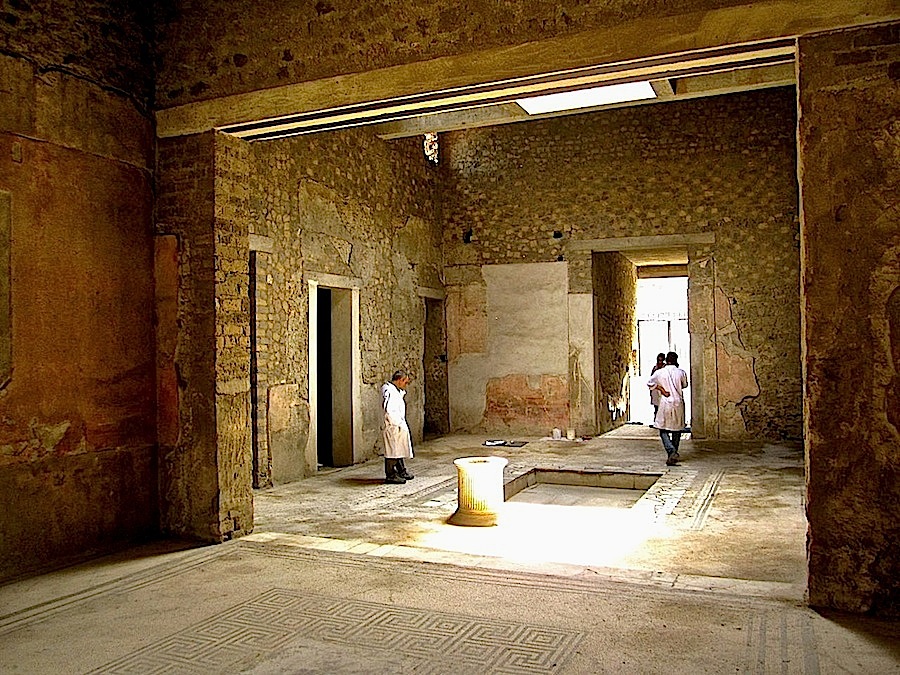 The atrium of the House of the Tragic Poet, Pompeii, Italy. This house was built near the end of the 1st century B.C. and excavated in 1824.
Well-to-do Roman city houses had no openings to the streets other than the front and back doors. After entering from the front directly from the sidewalk, one walked down an entrance corridor or fauces and into the atrium, which often had an ceiling opening to the sky, like the one shown above.
Underneath the opening was a shallow pool or impluvium to catch rainwater and channel it to a water tank below. The water could later be drawn up through the puteal — in the photo above: the short, round, hollow column beside the impluvium.
At the back of the atrium, opposite the entrance corridor, was the tablinum or central room of the house. The doors of family bedrooms also opened onto the atrium.
When I took the photo above about two weeks ago, I was standing behind the tablinum, looking across it and into the atrium. On the other side was the fauces and then the front door of the house. Behind me was a very small enclosed garden surrounded by a colonnade and some other small bedrooms, a kitchen, and a latrine.
The walls of the atrium of this house used to be covered with six frescoes depicting scenes from the Iliad. The three that survived can be seen today in the National Archeology Museum in Naples.
The house takes its name from one of the frescoes that was in the tablinum, which excavators mistakenly thought to be a picture of a poet reciting his verses.
To get to Pompeii from Naples, we again took the Circumvesuviana rail line from the Central Station (more information here). We took the “Sorrento” train and, about an half hour later, got off at “Pompeii-Scavi.” The entrance to the site is right there at the station.
For a 2 to 3 hour guided tour of the site with 8+ people, the cheapest options I found were:
Walks of Rome offers a group tour for a maximum of 12 people for €49 each, which includes the entrance fee. They are recommended on the blog Revealed Rome. (Its author also has a good, inexpensive Kindle guidebook by the same title.) However, they were fully booked for our day. For all these options, except Tempio Travel, book early.
If you have the budget, you can get a personal tour from Mondo Guides (see above) or Gaetano Manfredi (who is also recommended by Rick Steves). There is also a Mr. Caporaso (yourguidetonaples@gmail.com), who was recommended to me in an e-mail from Mr. Manfredi. And, of course, if you do an internet search, you will find many others. It seems that the per-person prices are €50 to €100+.
Of course, you can also rent an audioguide at the entrance.
The entrance ticket to Pompeii is €11. Contrary to what I read online, the site did seem to be accepting credit cards, but I would recommend having cash to be sure and for a faster line. Mid-morning, near the end of May, it was not bad — about 5-10 minutes.
The ticket is for all day, but once you leave the site, you can’t re-enter. So if you want to stay inside after your morning tour, you will have to go to the busy cafeteria near the forum to buy lunch (the restrooms are there too.) However, there didn’t seem to be any restriction against bringing in a sandwich in a small backpack or bag.
Wear serious sunscreen; the site is almost completely open to the sun.
You will appreciate the ruins much more if you visit the National Archeology Museum in Naples and see the many frescoes and other artifacts that were removed from the site during the 19th and 20th century excavations. (You may also want to check out this series of articles about Pompeii in The Telegraph.)
*Site entrance fee and transport not included.
 enclos*ure