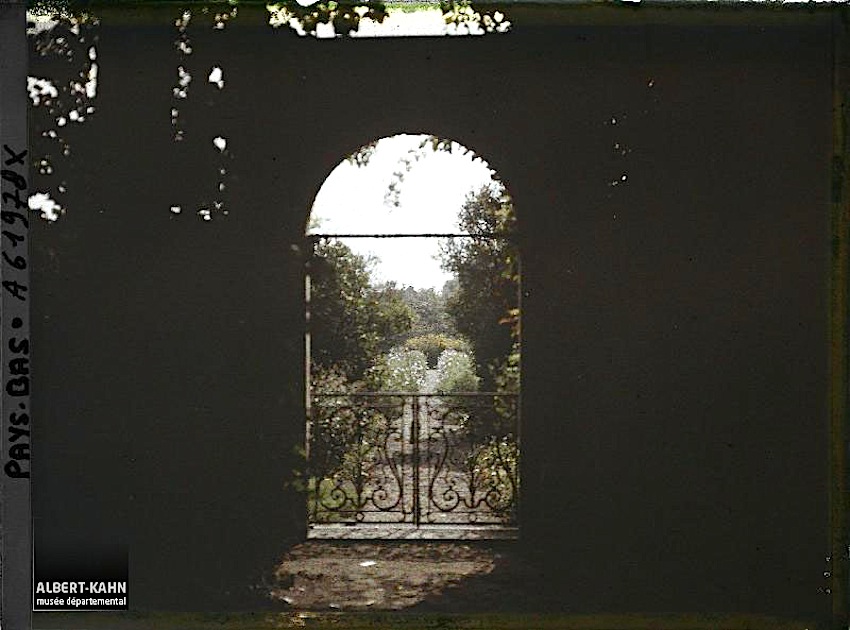
Palace Garden, The Hague, Netherlands, August 1929, by Stéphane Passet, via Archives of the Planet Collection – Albert Kahn Museum /Département des Hauts-de-Seine.
The autochrome above is one of about seventy-two thousand that were commissioned and then archived by Albert Kahn, a wealthy French banker, between 1909 and 1931. Kahn sent thirteen photographers and filmmakers to fifty countries “to fix, once and for all, aspects, practices, and modes of human activity whose fatal disappearance is no longer ‘a matter of time.'”* The resulting collection is called Archives de la Planète and now resides in its own museum at Kahn’s old suburban estate at Boulogne-Billancourt, just west of Paris. Since June 2016, the archive has also been available for viewing online here.
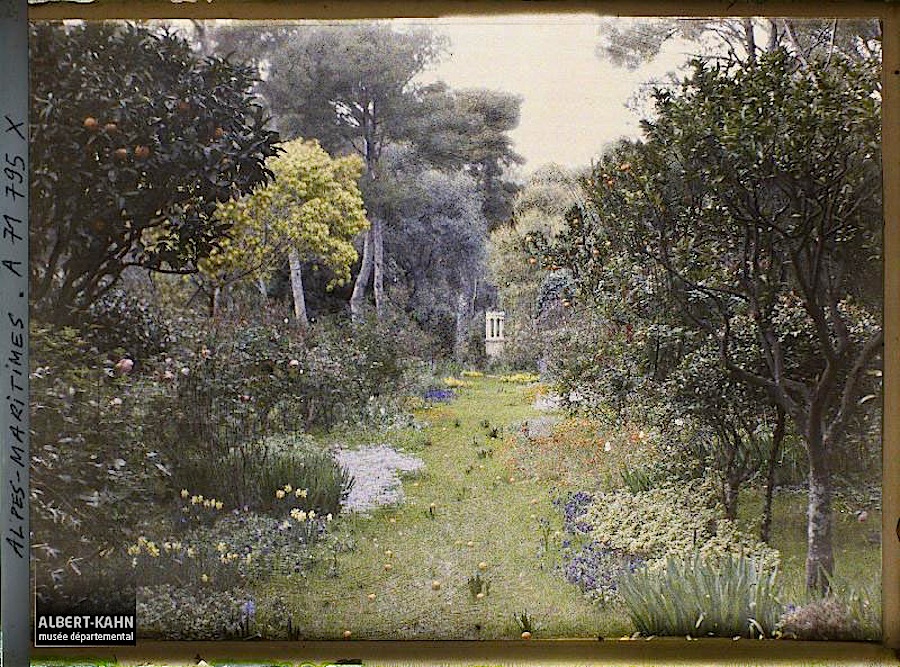
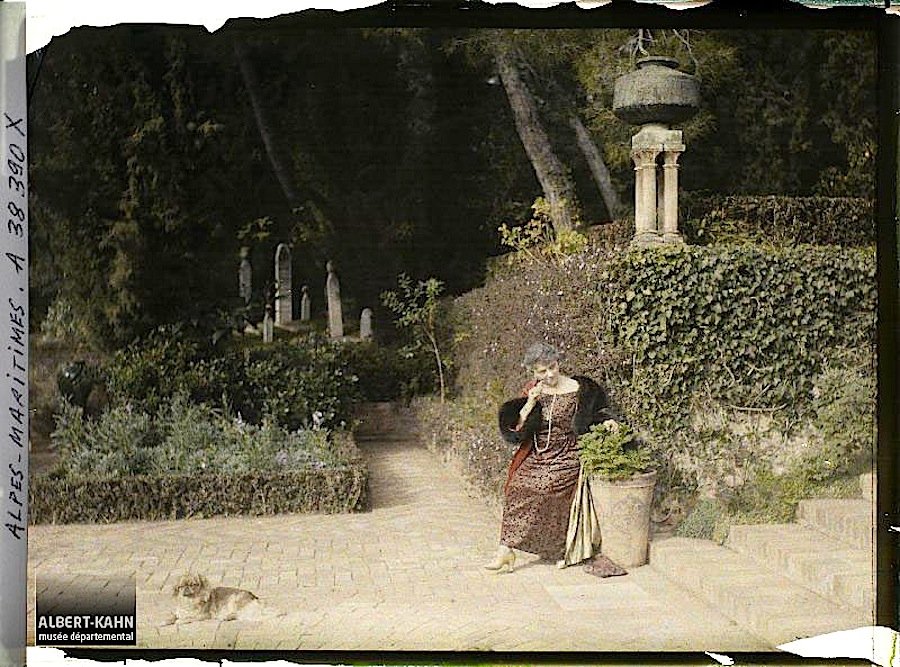
“The property of Madame Douine, Cap Martin, France,” January 1923, by Roger Dumas, via Archives of the Planet Collection – Albert Kahn Museum /Département des Hauts-de-Seine (both photos).
If you watched The Paradise (2013) on either BBC America or Masterpiece and wondered what happened to Denise after the series ended . . . well, perhaps it was this.
The series was based on Au Bonheur des Dames (The Ladies’ Paradise) by Émile Zola. It is novel about a saleswoman in one of the grand Paris department stores — Denise — who eventually marries the store’s owner. Her story mirrored the real life of Cyprienne Dubernet, a saleswoman at Grand Magazins du Louvre who married the owner, Olympe Hériot, in 1887.*
Cyprienne in her garden.
In 1909, Cyprienne — now widowed and re-married to Roger Douine — decided to build a villa in Cap Martin on the French Riviera. Her architect designed a Neo-Byzantine house inspired by her travels to Naples, Smyrna, Cairo, Jerusalem, and Constantinople. She named it “Villa Cypris” in tribute to the Greek goddess of love and her own name. Italian painter Raffael Mainella designed the interiors and the garden, which included a stone bridge along the seafront, a cloister, a “Venetian Sanctuary,” a Mauritanian pergola, and sunken Dutch-style parterres with a canal/swimming pool.
You can see more pictures of the estate here, on its website (it seems to be for sale). There’s a video here.
The autochromes above are two of about seventy-two thousand that were commissioned and then archived by Albert Kahn, a wealthy French banker, between 1909 and 1931. Kahn sent thirteen photographers and filmmakers to fifty countries “to fix, once and for all, aspects, practices, and modes of human activity whose fatal disappearance is no longer ‘a matter of time.'”† The resulting collection is called Archives de la Planète and now resides in its own museum at Kahn’s old suburban estate at Boulogne-Billancourt, just west of Paris. Since June 2016, the archive has also been available for viewing online here (search “Madame Douine” to see more of Villa Cypris).
*It seems doubtful that Cyprienne (born just plain Anne Marie) was the direct inspiration for Denise, as the novel was published in 1883. She and Olympe had at least one (maybe two) of their four children before their marriage. Their oldest son, Auguste, was an inspiration for the main character of Colette’s novel Cheri. Cyprienne died in 1945.
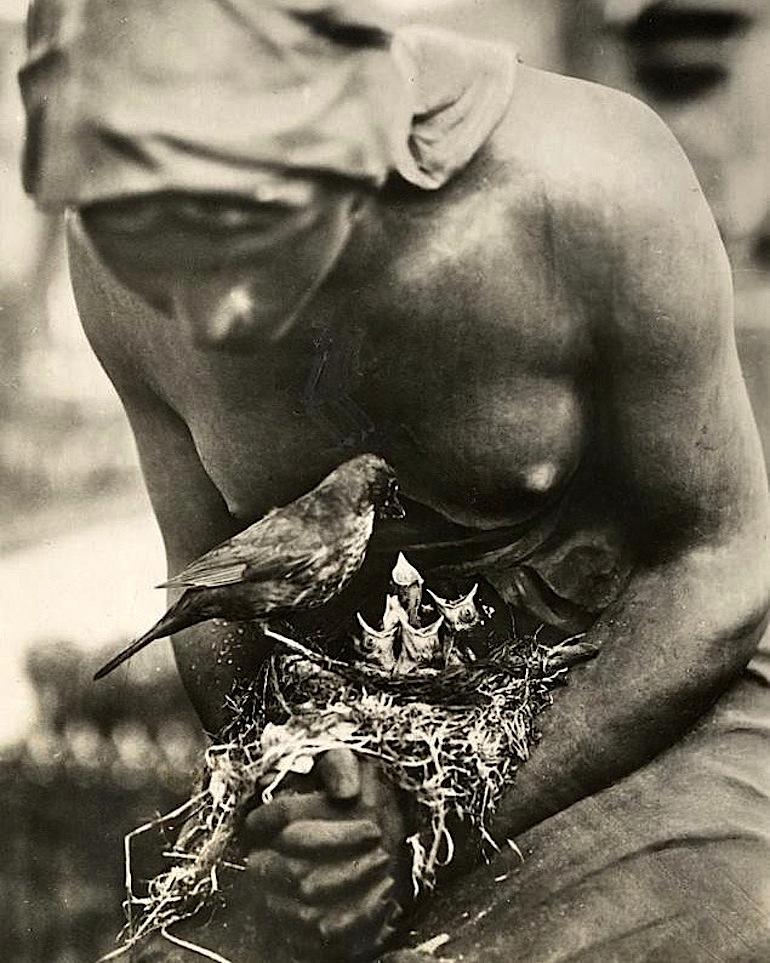
“Blackbird’s nest in the folded hands of a statue on a graveyard in Berlin, Germany,” 1932, Het Leven photographer, via Nationaal Archief (Netherlands) Commons on flickr.
“Castle, possibly in Italy,” ca. 1900, by Queen Victoria of Sweden, via Tekniska Museet (Sweden) Commons on flickr under CC license.
Click on the image to enlarge it. There are three more enormous urns on the right and some very tall agave blooms/stalks to the left of the little gate just in front of the castle.
Victoria (or Viktoria) of Baden — Queen of Sweden after 1907 — was the daughter of the Grand Duke of Baden (south-west Germany). She married Crown Prince Gustaf in 1881, and they had three children, but it was not a happy marriage. From 1882, she spent almost every winter in Egypt and Italy, mostly in Capri. She was a good amateur photographer, as well as a painter and sculptor.
I have a new old salt-glazed pottery crock from the Stuttgart Saturday flea market — just the right size for a supermarket bouquet of tulips.
The market always has a lot of these pretty blue and grey pots, which were made in the Westerwald* region of Germany and range in size from egg cup to several liters. They are very affordable: normally about €5 to €12 for those big enough to hold kitchen utensils. I haven’t found anything particularly useful online about how to assess their age. The woman who sold me this one pointed out the circular ridges on its bottom as an indication that it was “very old.” But I’ve seen other pots labeled “antique” (late 19th century) on websites that have smooth bottoms. I think you just have to look for a pleasing pattern and patina combination.
To see what other garden bloggers have put in vases today, please visit Cathy at Rambling in the Garden.


 enclos*ure