A walk around a Kigali nursery

This slideshow requires JavaScript.

Green Passion plant nursery — which I visited yesterday — has beautiful, healthy plants and knowledgable owners who speak French and English.

It’s located on Avenue du Lac Kivu in Kigali, Rwanda.

You can scroll through larger images by clicking on ‘Continue reading’ below.

Continue reading “A walk around a Kigali nursery”

Vintage landscape: spring rain

Showers, White House, early 1920s, via Library of Congress“Sidewalk in front of White House, Washington, D.C.,” early 1920s, by Harris & Ewing, via Library of Congress Prints and Photographs Division.

Whan that Aprill with his shoures sote
The droghte of Marche hath perced to the rote,
And bathed every veyne in swich licour,
Of which vertu engendred is the flour. . .

— Geoffrey Chaucer, from “The General Prologue” of The Canterbury Tales

Translation: April showers bring May flowers.

Today is Whan that Aprille Day — a day to enjoy “alle langages that are yclept ‘old,’ or ‘middel,’ or ‘auncient,’ or ‘archaic,’ or, alas, even ‘dead.’” This is the idea of @LeVostreGC (or Chaucer Doth Tweet), who blogs at Geoffrey Chaucer Hath a Blog.

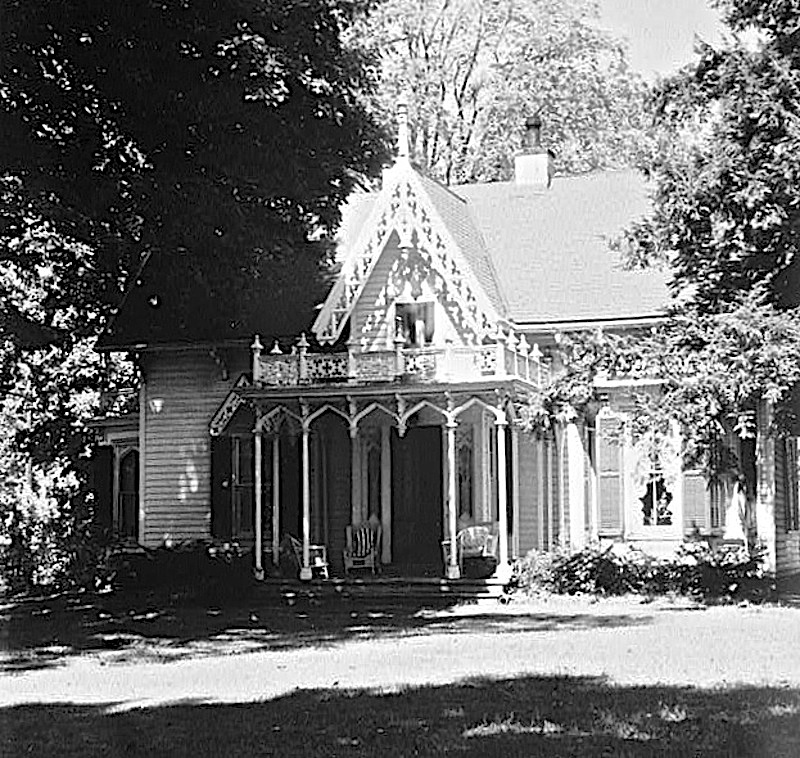
The Sunday porch: Gothic Revival anyone?

Peter Neff Cottage in Ohio, via Library of CongressEntrance porch of the Peter Neff Cottage, Kenyon College, Gambier, Ohio. Photo taken 1951 by Perry E. Borchers for an Historic American Buildings Survey (HABS), via Library of Congress Prints and Photographs Division.

Gothic Revival hse. in Ohio, via Library of CongressAnother 1951 photo of the porch, also by Perry E. Borchers for the HABS (cropped by me).

The HABS report for this house said it “may be the finest example of Gothic Revival cottage style and wood detail in Ohio.”  It was built about 1860 for Peter Neff, a co-inventor of the tintype and an alumnus and benefactor of Kenyon College.

All was not happy in this charming abode, however. Neff quarreled with nearby Kenyon over the bells of the campus’s Church of the Holy Spirit, “which he claimed had driven him to the brink of nervous collapse,” according to the Historic Campus Architecture Project.

“Place yourself and family in my location, about seven hundred feet distant,” he wrote in a 19-page open letter. “How would you like this ding dong every fifteen minutes? . . . [It is] machinery wearing out flesh and blood to those who have any nerves. It is too much bell-ringing . . . it is a sickening nuisance.”

Neff finally moved away from the campus and its bells in 1888.

The house is now named Clifford* Place and is the residence of the Dean of Students.


*The name of one of Neff’s daughters.

Life in gardens: Ivy Cottage

E. von Seutter photo, 1869, Jackson, MS, via MS Department of Archives and HistoryThe garden of Ivy Cottage, residence of Elisaeus von Seutter, in Jackson, Mississippi,  via the E. von Seutter Photograph Collection of the Mississippi Department of Archives and History (MDAH) Commons on flickr.

Elisaeus, the youngest son of German aristocrats, emigrated to  New Orleans in 1848, hoping to explore the American west.  However, after a series of false starts, he ended up in Raymond, Mississippi, where he trained as a jeweler and later opened a successful jewelry shop.  He then travelled to Austria to marry and bring back an old love, Julia Hoch.

The von Seutters lost most of their business and property in Raymond after the Civil War.  They moved to Jackson for a fresh start, and Elisaeus built a two-story building for his new jewelry/watchmaking shop and photography studio.

He also built Ivy Cottage on North State Street, and the couple created an impressive garden there.

The above photo is dated c. 1869 by the MDAH, but that seems unlikely, as the house was only just completed at that time.  It may have been taken in the late 1870s or early 1880s.  From eight births, the von Seutters had only three children who lived past age eleven: Armine, b. 1854; Edward, b. 1860; and Carl, b. 1866.  The photo may show Julia standing with the youngest son and one of the older boys in the background.

MDAH’s E. von Seutter collection has 35 stereocards and 48 photographs of post-Civil War Jackson assembled by the von Seutter family. Most were taken by Elisaeus and his son, Armine.

There are more Ivy Cottage photos here.

Life in gardens: many pretty devises

Embroidering in the garden, via British Library“Ladies seated at their embroidery, including one engaged in lace-making, and another at the virginal, with a man beside her singing. Behind, a formal garden, with clipped hedges, parterres, and fountain.”  

The image  is from the Album Amicorum of Gervasius Fabricius, 1603-1637, (Würzburg and Salzburg) via The British Library Commons on flickr.

It’s hard to see how any of them could work over their ruffs.

Now for women instead of laborious studies, they have curious Needle-workes, Cut-workes, spinning, bone-lace, and many pretty devises of their own making, to adorne their houses, Cushions, Carpets, Chairs, Stooles, confections, conserves, distillations, etc. which they shew to strangers. . . . This they have to busie themselves about, household offices, etc. neate gardens full of exotick, versicoloure, diversely varied, sweet smelling flowers, and plants, in all kindes, which they are most ambitious to get, curious to preserve and keepe, proud to possesse, and much many times to bragge of.

Robert Burton, Anatomy of Melancholy, 1621