A little more. . .

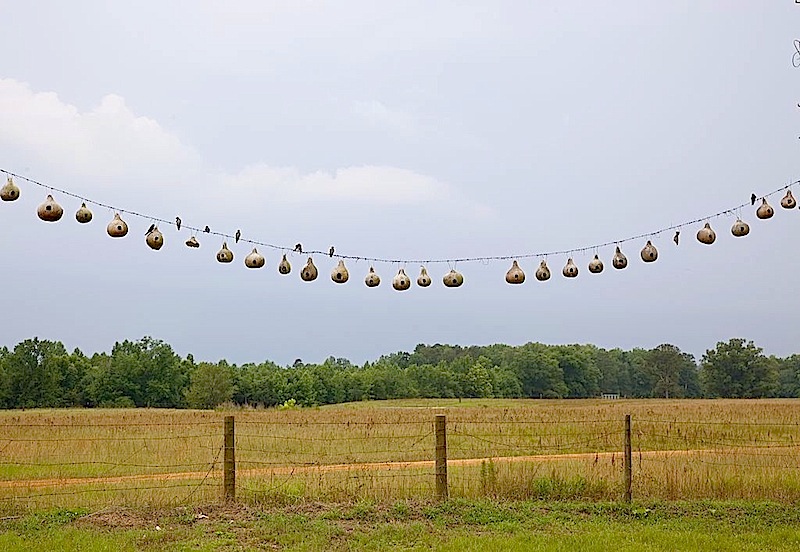
"Purple Martin gourd bird nests in rural Alabama," 2010, by Carol Highsmith via Library of Congress Prints and Photographs Division.
Purple martin gourd nests in Alabama, 2010, by Carol Highsmith, via Library of Congress.

About purple martins (see Tuesday’s post, “gourds and cans”): they have become entirely dependent on humans for nests in which to breed along the North American east coast.

Susie at pbmGarden sent me the link to a short (about 8 mins.) NPR documentary about the songbirds and the threats they face in the modern world (the fault is partly in Shakespeare).

Check it out here: “The Mystery of the Missing Martins” by Adam Cole

Vintage landscape: First Birds

Wh.House birdhouse, Harding Admin., via Library of Congress“One of the many bird houses which Mrs. [Warren G.] Harding has installed in the White House grounds,” between 1921 and 1923, by National Photo Company, via Library of Congress Prints and Photographs Division.

First Lady Florence Harding was a great advocate for better animal care and protection. In addition to the birdhouses, she also had squirrel huts placed around the gardens  — and had the animal trophy heads removed from the State Dining Room, according to her biographer Carl Anthony.

Early changes to the residence’s outdoor space were part of the Harding  Administration’s determination to banish the “gloom” of the war years under President Wilson,  wrote John A. Morello in Selling the President, 1920. “More bulbs and flowers would be planted, and birdhouses were installed in trees.”

At least some of the official birdhouses came from Evans Brothers, “Manufacturers of Bird House and Lawn Accessories,” on Main Street in Evanston, Illinois.

A tiny article in the August 18, 1921, Chicago Tribune says, “Sparrows, robins, and other birds who are flat hunting at present may be interested to know that Conroy Evans. . . has just received an order from Mrs. Warren G. Harding for several bird houses to grace the White House grounds. . . and that Mrs. Harding will supervise the placing of the houses in trees.”

Conroy Evans contributed brief reports on the movements of Evanston birds to Bird Life magazine.  In its fall issue of 1919, Evans Brothers also placed a small ad:  “Who’s the ‘Mr. Hoover’ for the Birds? Why Evans Bros. of course.”

From 1917 to 1919, Herbert Hoover (later President Hoover) became well-known for his work on food relief for Europe as head of the U.S. Food Administration and then of the American Relief Association.

Life in gardens: for the birds

birdhouse-competition-winners-washington-dc-library-of-congress
“Birdhouse Group,” 1922, by National Photo Company, via Library of Congress Prints and Photographs Division (all pictures here).

I’m not certain, but I believe this happy group of young designers/builders were Washington, D.C., schoolchildren taking part in an annual “American Forestry Association National Bird House Contest.”

The Library of Congress  has a set of 1921 photos  labeled as such (and also as “bird house story”). You can scroll through them by clicking on any thumbnail in the gallery below.

Unfortunately, I could find almost no other information about the competition. Today, the American Forestry Association is known as American Forests. Their website does not mention the event.

The event must have continued until at least April 15, 1924, when Senator George W. Pepper made the presentation on the Capitol grounds.

Sen. Pepper, Birdhouse Contest, 1924, Library of Congress

Vintage landscape: gourds and cans

Gourd and Can birdhouses, via Library of Congress“Typical birdhouses, gourds and tin cans in Coffee County, Alabama,” April 1939, by Marion Post Wolcott, via Library of Congress Prints and Photographs Division.

Hanging clusters of gourd birdhouses for the purpose of attracting purple martins is an Alabama folk tradition, according to the blog Appalachian History.

Choctaw and Chickasaw gardeners began the practice.  The purple* martins would eat damaging insects and mosquitoes and drive away crows and blackbirds from the corn.  

Farmers of European and African origins later adopted the custom, particularly as the birds also protect chickens by scaring away hawks.

The gourds should be hung in groups of 10 or more, according to the National Wildlife Federation’s blog.  They should also swing from crossbars and wires on poles at least two-stories high.


*They are actually dark blue and black, or pale grey.

Vintage landscape: birds’ house view

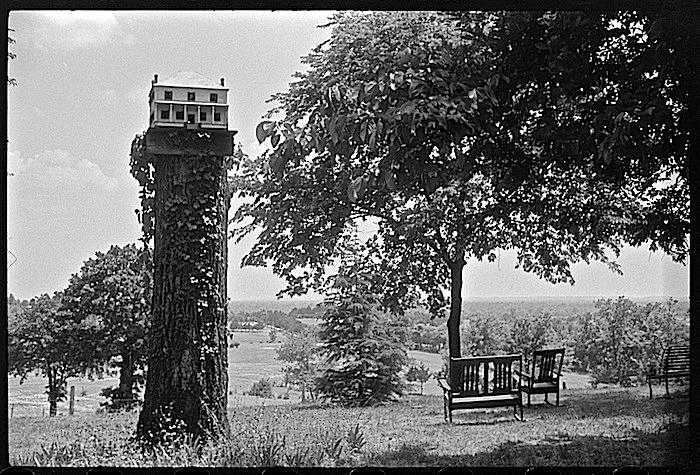
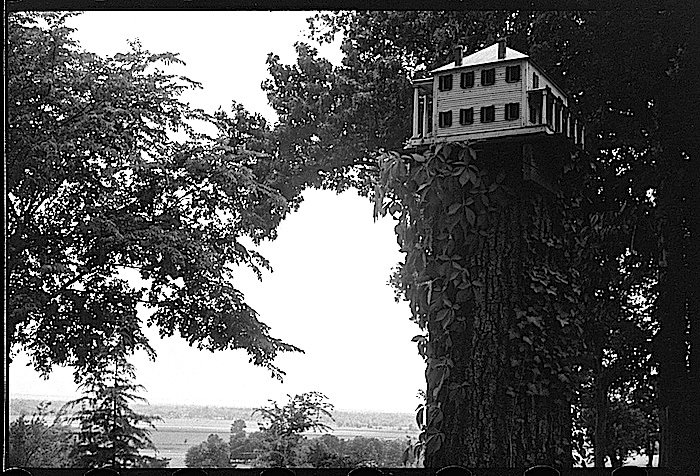
Farmhouse birdhouse, via Library of Congress“Birdhouse and landscape at an old plantation home [probably this one] near Eutaw, Alabama,” May 1941, by Jack Delano, via Library of Congress Prints and Photographs Division.
Farmhouse birdhouse 2, via Library of Congress

As I was reading about the history of birdhouses, I learned that shelters like the one above, which mirror a builder’s own house or other nearby architecture, were common in Turkey from the 15th century (and probably earlier).

Their compassionate purpose was to provide winter protection to non-migratory birds.  Many were quite ornate and built right onto the sides of “mosques, madrasas, libraries, houses, inns, baths, tombs, bridges, churches, synagogues, and even palaces,” according to the Turkish Cultural Foundation website.*

In Europe, during the same period, birdhouses were built from baskets, wood, and clay as traps for collecting eggs or for capturing the birds themselves.

In colonial-era North America, both Native Americans and European settlers used birdhouses to attract and increase the local bird population for hunting and insect control.

Pines in the distance begin to brighten,
deep blue to something like green.

Everything winged must be dreaming.

Susan Ludvigson, from “Grace


*There is also a nice photo here of the very large birdhouses that were placed in Istanbul parks in the 1960s. Last December, I saw many small birdhouses in the trees along the Hippodrome, put there by the local government.